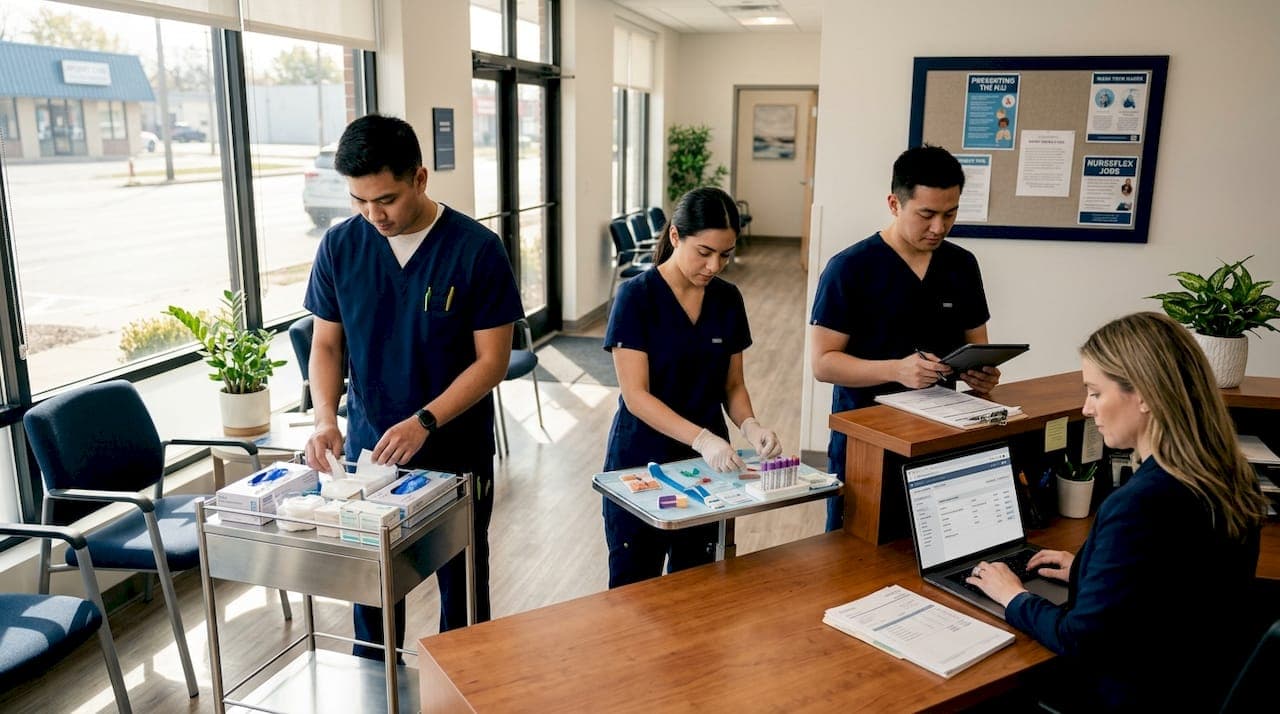
You want to start working in healthcare fast. You have the drive, maybe a credential or two, and zero interest in waiting two years to land your first shift. The good news: examples of quick-hire medical roles are more plentiful than most job seekers realize. Healthcare is one of the few industries where a six-to-twelve month training program can translate directly into a full-time job with real growth potential. This guide breaks down the specific roles, what each one actually requires, and how to choose the right fit for your schedule, goals, and starting point.
Table of Contents
- Key takeaways
- What makes a good example of a quick-hire medical role
- 1. Medical assistant
- 2. Phlebotomy technician
- 3. Urgent care technician
- 4. Limited-scope radiology technician
- 5. Medical billing and coding specialist
- 6. Pharmacy technician
- 7. Remote healthcare educator
- 8. Telehealth triage nurse
- Role comparison at a glance
- How to choose the right quick-hire role for you
- My take on choosing quick-hire roles strategically
- Find your next role on Flexiblenursingcareers
- FAQ
Key takeaways
| Point | Details |
|---|---|
| Short training opens doors | Many quick-hire roles require under one year of certification training before you can start working. |
| Clinical and non-clinical options exist | You can enter healthcare fast through patient-facing roles or behind-the-scenes positions like billing and coding. |
| Remote roles are growing fast | Telehealth triage and remote educator positions offer flexible scheduling with rapid onboarding timelines. |
| Comparison shopping roles matters | Training length, salary, and work setting vary significantly, so comparing options before committing saves time. |
| Certifications drive advancement | Starting in a quick-hire role with a clear certification path sets you up for long-term career growth. |
What makes a good example of a quick-hire medical role
Before you commit to any specific path, you need a consistent framework for evaluating your options. Not all fast medical job examples are created equal. Some look quick on paper but require state licensing that adds months to your timeline. Others have short training but limited room to grow.
Here are the factors worth measuring for any role you consider:
- Training length: How many months until you are job-ready? Programs under twelve months signal true quick medical employment.
- Credential or licensing requirements: Does the role need a state license, a national certification, or just on-the-job training?
- Clinical vs. non-clinical duties: Are you directly touching patients, or working in documentation and support functions?
- Work setting: Is the role in-person, remote, or a mix? Does it offer day shifts, evenings, or variable hours?
- Salary and growth potential: Does the starting wage match your financial needs? Is there a defined path to higher-paying roles?
Pro Tip: Before enrolling in any certification program, verify that the credential is nationally recognized. A local certificate that only satisfies one employer's requirements limits your ability to pursue rapid hire healthcare jobs across multiple facilities.
Use this framework as a filter throughout this article. Every role below gets evaluated against these same criteria.
1. Medical assistant
Medical assisting is one of the most widely available rapid hire healthcare jobs in the country. You can complete a medical assisting diploma in about ten months, which makes it one of the fastest training-to-employment pipelines in clinical healthcare.
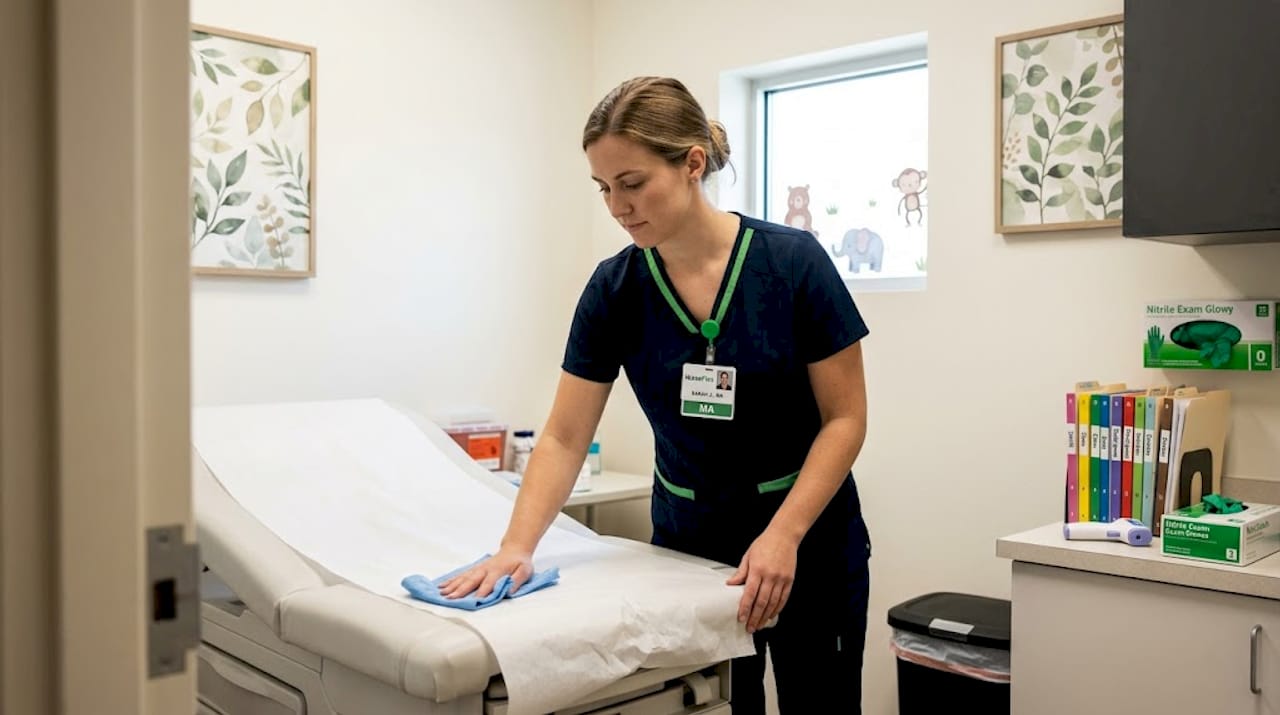
The day-to-day work covers both clinical and administrative duties. You take vital signs, prepare exam rooms, assist physicians during procedures, and handle patient intake. On the administrative side, you schedule appointments, update records, and process referrals. That combination makes you genuinely useful across specialties including primary care, pediatrics, and orthopedics.
Pay typically starts between $36,000 and $42,000 annually depending on your region and the practice type. Certification through the American Association of Medical Assistants adds credibility and improves your chances of getting hired quickly.
2. Phlebotomy technician
Phlebotomy is the most concentrated form of quick medical employment available. Training programs run as short as eight weeks, with some hospital systems offering in-house programs that hire candidates directly upon completion.
Your core job is drawing blood for lab work, transfusions, donations, or research. You work in hospitals, outpatient labs, blood banks, and mobile collection units. The work requires precision and calm under pressure since patients are often anxious. Some technicians move into broader lab roles over time, using phlebotomy as their entry credential.
Immediate medical job openings for phlebotomists are reliably consistent. Hospitals run high specimen volumes daily, and turnover in the role creates steady demand. If you want to be working within sixty to ninety days of starting a program, phlebotomy is a realistic target.
3. Urgent care technician
This is one of the more underrated examples of quick-hire medical roles because the title varies by employer and the role blends clinical and operational responsibilities in ways most people do not expect.
Urgent care technician duties include wound care, specimen collection, room turnover, patient communication, and assisting with clinical procedures. A real listing from Beth Israel Lahey Health shows a thirty-hour urgent care technician role covering exactly this kind of mixed responsibility. The operational awareness required here is substantial. Candidates who document accurately and support clinical workflow align far better with the staffing needs of high-volume urgent care centers.
These positions often offer variable shifts, which suits people who want flexibility without giving up a clinical environment. The operational efficiency demanded in urgent care settings also teaches you skills that transfer to virtually every other fast-paced medical environment.
Pro Tip: When applying for urgent care technician roles, highlight any experience with electronic health records and specimen processing. These specific skills appear repeatedly in job postings and signal readiness for fast-paced clinical settings.
4. Limited-scope radiology technician
Not every X-ray tech job requires a full two-year radiologic technology degree. Limited-scope radiology technicians operate under state-specific certifications that allow them to perform designated imaging procedures, typically plain X-rays of specific body regions.
Training programs vary by state but commonly run three to twelve months. Some states like California and Florida have structured limited-permit pathways that lead to quick employment in urgent care clinics, orthopedic offices, and rural health centers. The salary range typically sits between $38,000 and $55,000 depending on your state and the scope of your permit.
This role offers a real specialization without the two-year associate degree commitment. If you are drawn to imaging but want a shorter path into the field, this is one of the most specific and practical fast medical job examples available.
5. Medical billing and coding specialist
This is one of the clearest examples of a non-clinical quick-hire path in healthcare. Medical billing and coding specialists handle insurance documentation, claims submission, and reimbursement accuracy. The field is projected to grow 7% from 2024 to 2034 with an average salary around $50,250 per year.
Certification programs run roughly twelve months. The Certified Professional Coder (CPC) credential from the American Academy of Professional Coders is the gold standard and is recognized by employers nationwide. Many roles allow remote work, which means your job search is not limited by geography.
If you have no clinical background and want to enter healthcare quickly, this is one of the most accessible and financially stable on-ramps available.
6. Pharmacy technician
Pharmacy technicians support licensed pharmacists with medication dispensing, inventory management, customer service, and insurance processing. The field expects around 49,000 annual job openings with an average salary of approximately $43,460 per year. Training is typically a certificate program completed in under two years, with many programs finishing in twelve months or less.
You can work in retail pharmacies, hospital inpatient pharmacies, mail-order operations, or specialty infusion centers. Each setting has its own pace and patient interaction level, so you have real options when it comes to matching the role to your preferences. Licensure requirements vary by state, but national certification through the Pharmacy Technician Certification Board is widely accepted and improves hiring speed.
7. Remote healthcare educator
Remote healthcare roles are becoming a major entry point for flexible quick medical employment, especially at health plan companies. Remote educator positions in companies like Molina Healthcare span health literacy coaching, care management support, and patient outreach. A search of their career portal shows over 400 results for remote healthcare educator roles at any given time.
These positions often require a background in nursing, health education, or a related field, but the onboarding is faster than most clinical hiring processes. You work from home, follow structured scripts and protocols, and support members in understanding their diagnoses and treatment plans.
For an RN or a health educator looking for short-term healthcare positions with genuine flexibility, this category is worth prioritizing in your search.
8. Telehealth triage nurse
If you hold a registered nurse license and want to step away from the bedside without leaving clinical practice entirely, telehealth triage is one of the best rapid hire healthcare jobs available right now. Telehealth triage nurse roles like those offered through Fonemed include part-time, variable-shift arrangements and prefer candidates with recent clinical experience.
Your job is to assess patient symptoms by phone or video, provide clinical guidance, and route callers to the appropriate level of care. The work demands solid clinical judgment and communication skills. In return, you get geographic freedom, schedule control, and the ability to keep your clinical skills sharp without hospital shift demands.
If you are looking for remote work options alongside your flexible schedule, understanding your health coverage options as a remote worker is worth thinking through early.
Role comparison at a glance
| Role | Training length | Setting | Avg. salary | Remote option |
|---|---|---|---|---|
| Medical assistant | ~10 months | In-person | $36,000–$42,000 | Limited |
| Phlebotomy technician | 8–12 weeks | In-person | $34,000–$40,000 | No |
| Urgent care technician | Varies | In-person | $33,000–$45,000 | No |
| Limited-scope rad tech | 3–12 months | In-person | $38,000–$55,000 | No |
| Medical billing and coding | ~12 months | Office/Remote | ~$50,250 | Yes |
| Pharmacy technician | 6–12 months | In-person | ~$43,460 | Limited |
| Remote healthcare educator | Varies | Remote | $40,000–$60,000 | Yes |
| Telehealth triage nurse (RN required) | RN license | Remote | $55,000–$75,000 | Yes |
How to choose the right quick-hire role for you
Once you have a list of high-demand healthcare careers that interest you, the real work is matching them to your actual situation. Here is a practical framework for narrowing down your choice.
- Define your timeline. If you need income within ninety days, phlebotomy and urgent care technician roles are your fastest options. If you can invest twelve months in training, medical billing, coding, or medical assisting opens more doors.
- Decide on clinical vs. non-clinical. Some people thrive in direct patient interaction. Others prefer the precision work of documentation and insurance. Be honest with yourself about which environment energizes you.
- Match the schedule to your life. Remote roles like telehealth triage and healthcare educator positions give you control. In-person urgent care shifts offer variety. Hospital float pool positions give you the most scheduling flexibility within clinical work.
- Weigh your salary needs against training cost. A medical billing certification costs less to complete than most medical assistant programs, but both lead to stable salaries above $40,000.
- Use staffing platforms for immediate medical job openings. General job boards work, but healthcare-specific platforms connect you directly to urgent medical job vacancies and shift-based roles that match your certifications.
Pro Tip: If you already hold a certification in one area, check whether it partially satisfies requirements in adjacent roles. A phlebotomy certificate, for example, can support entry into broader lab technician training programs without starting from scratch.
My take on choosing quick-hire roles strategically
I've seen a lot of healthcare professionals approach the job search backwards. They pick a role because it's the fastest one available, then spend the next two years feeling stuck. Speed of entry matters. But what matters more is whether the role teaches you something transferable.
In my experience, the roles with the best long-term value are the ones that build operational awareness. Urgent care technicians who learn clinical workflow and documentation are not just filling a shift. They are building a resume that reads well to any fast-paced employer. That carries weight.
What I've learned watching people move through quick-hire positions is that the remote healthcare space is still underutilized by candidates. Most people think "remote" means non-clinical. But telehealth triage nursing is fully clinical, and it pays well. The talent pool applying for those roles is smaller than it should be, which means your odds of landing them quickly are better than you might expect.
My honest advice: pick a role with a defined certification path attached to it. Quick employment is the goal right now. Career mobility is the goal two years from now. The best quick-hire positions serve both.
— Flexible
Find your next role on Flexiblenursingcareers
If you are ready to act on what you have read, Flexiblenursingcareers makes the next step simple.

The platform connects healthcare professionals and recent graduates with flexible job openings across urgent care, allied health, telehealth, and remote healthcare roles. Real-time job matching means your skills, availability, and credentials are matched to current openings without sorting through irrelevant listings. Whether you are chasing immediate medical job openings or exploring short-term healthcare positions to build experience, the platform is built to get you placed fast. Sign up, set your preferences, and start seeing matches that actually fit your situation.
FAQ
What are the fastest medical roles to get hired into?
Phlebotomy technician and urgent care technician roles typically have the shortest path from training to employment, with some programs completing in eight to twelve weeks before you can apply for immediate openings.
Can you get a medical job without a four-year degree?
Yes. Many quick-hire roles including medical assistant, pharmacy technician, and medical billing and coding specialist require only a certificate program, often completed in under twelve months.
Are there remote quick-hire jobs in healthcare?
Remote telehealth triage nursing and healthcare educator roles offer rapid hire options for qualified candidates, with telehealth positions specifically suited for RNs seeking flexible, work-from-home arrangements.
How much can you earn in a quick-hire medical role?
Salaries range from approximately $34,000 for entry-level phlebotomy positions to over $75,000 for experienced telehealth triage nurses, with most mid-level quick-hire positions falling between $40,000 and $55,000 annually.
Do temporary medical roles lead to permanent positions?
Short-term healthcare positions frequently convert to permanent roles when you demonstrate reliability and clinical competence. Many facilities use temporary staffing as a direct pipeline to fill full-time urgent medical job vacancies.