
The healthcare job market is full of opportunity, but getting hired quickly is harder than most people expect. Traditional recruiting timelines run 90 or more days for clinical roles, which means waiting months just to get started. If you are a nurse, a new graduate, or a healthcare professional who needs to get hired healthcare job fast, you need a smarter approach than simply submitting applications and hoping for callbacks. This guide gives you the exact steps to cut through the process, avoid the mistakes that slow most candidates down, and start working sooner.
Table of Contents
- Key Takeaways
- How to get hired in a healthcare job fast: your starting point
- Applying and interviewing to get a healthcare job quickly
- Common mistakes that delay healthcare job placement
- Maximizing success after you land the offer
- My honest take on fast-track healthcare hiring
- Start working faster with Flexiblenursingcareers
- FAQ
Key Takeaways
| Point | Details |
|---|---|
| Prepare before you apply | Gather your licenses, references, and a tailored resume before sending a single application. |
| Target specialized channels | Use healthcare-specific job boards and recruiters to speed up fast healthcare job placement. |
| Communicate quickly | Responding within 48 hours keeps you competitive and signals professionalism to hiring teams. |
| Avoid generic applications | Resumes with specific clinical skills get callbacks faster than general ones. |
| Start strong after the offer | Expedite your background check and onboarding paperwork to shorten your time to first shift. |
How to get hired in a healthcare job fast: your starting point
Before you send a single application, your preparation determines how fast the whole process moves. Most candidates skip this phase and pay for it with weeks of delays.
Licenses and certifications come first. If your license is expired, pending renewal, or not yet issued, no employer can move forward with you. Check your state licensing board today. For new graduates, short-term certificate programs in fields like medical assisting, pharmacy tech, and radiology tech can be completed in under a year and open doors immediately. Know exactly what credentials are required for the roles you want before you apply.
Your resume needs to be specific, not general. Hiring managers and applicant tracking systems both filter for clinical keywords. A resume that lists "chemotherapy safety protocols" will outperform one that says "oncology experience." Research shows that specific clinical skills on a resume produce measurably better results than vague descriptions. Pull the exact language from job postings and mirror it in your resume.
Here is what your application toolkit should include before you start:
- A current, role-specific resume with clinical keywords matched to each job posting
- Three professional references who are ready to respond quickly
- Copies of all active licenses, certifications, and immunization records
- A signed authorization for background checks to avoid delays later
- A list of 10 to 20 target employers with their HR contacts identified
Pro Tip: Set up a dedicated email folder for your job search and check it twice daily. Slow email response is one of the top reasons candidates lose offers in healthcare hiring.
Employers also increasingly evaluate candidates on technology familiarity. Knowing your way around cloud-based EMR systems is now a real differentiator. Flexible scheduling and EMR fluency rank among the top factors employers use to attract and select candidates quickly.
Applying and interviewing to get a healthcare job quickly
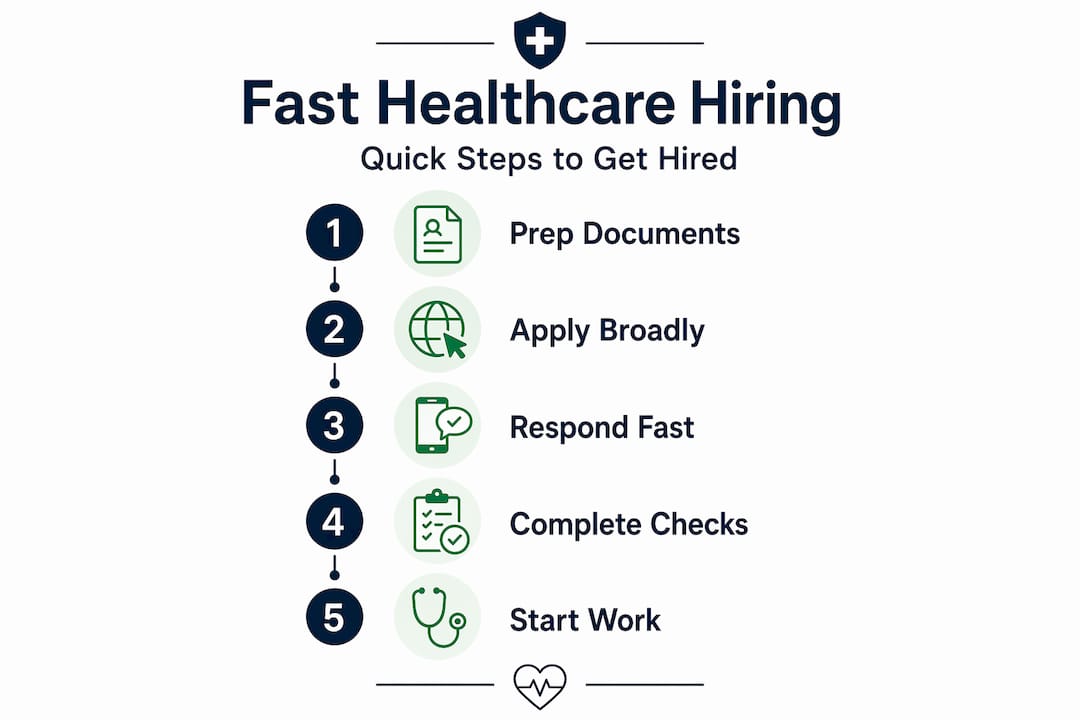
Once your toolkit is ready, execution speed matters. Here is a step-by-step approach that prioritizes fast-track healthcare employment without cutting corners.
-
Start with specialized job boards and staffing agencies. General job boards are slower and more competitive. Healthcare-specific platforms and staffing agencies have direct relationships with employers and can often place candidates in days rather than weeks. The healthcare sector generates roughly 1.9 million job openings annually, and agencies with access to urgent healthcare job openings can connect you to roles that never get publicly posted.
-
Reach out directly to recruiters. Do not wait for recruiters to find you. Send a short, professional message on LinkedIn or by email. State your role, your credentials, and your availability. Personalized recruiter outreach consistently produces faster placements than applying through job boards alone.
-
Prepare for common healthcare interview questions. Most clinical interviews cover situational judgment, patient safety scenarios, and team communication. Practice your answers to questions like "Tell me about a time you handled a difficult patient" and "How do you prioritize tasks during a high-volume shift." Rehearse out loud, not just in your head.
-
Follow up within 24 hours of every interview. Send a brief thank-you email that references something specific from the conversation. This keeps you top of mind and signals that you are serious. Most candidates skip this step entirely.
-
Respond to offers and requests within 48 hours. Responding within 48 hours is the threshold that keeps candidates competitive. If you need time to evaluate an offer, say so clearly and give a specific date when you will respond. Silence reads as disinterest.
-
Negotiate without stalling. If the offer is close but not quite right, ask for what you need in one clear message. Salary, shift preference, and start date are all negotiable. Avoid going back and forth multiple times, as that signals indecision and can cost you the offer.
Pro Tip: Apply to five to ten roles at a time rather than one at a time. Healthcare hiring moves unpredictably, and having multiple active conversations protects you from putting all your effort into a single opportunity that falls through.
Top healthcare organizations now favor transparent, on-demand recruitment partnerships that prioritize speed and quality over volume. Knowing this helps you choose which agencies and platforms are worth your time.

Common mistakes that delay healthcare job placement
Getting hired fast requires avoiding the traps that slow most candidates down. These are not obvious errors. They are the kind of small missteps that add weeks to your timeline without you realizing it.
-
Sending a generic resume. A resume that is not tailored to the specific role and facility will almost always be filtered out before a human reads it. Customize every application, even if it takes an extra 20 minutes.
-
Applying to roles you are not qualified for. Applying broadly might feel productive, but it wastes time and can flag your profile as unfocused to recruiters who see your activity. Target roles where you meet at least 80 percent of the listed requirements.
-
Letting credentialing and licensing delays go unaddressed. If your license is in process, say so upfront and provide an expected date. Hiding it or leaving it vague causes employers to move on. Proactive communication keeps you in the running.
-
Slow follow-up and poor communication. Not replying to recruiter messages within a day or two is one of the fastest ways to lose momentum. Healthcare hiring teams are often managing multiple candidates simultaneously, and the one who responds first often gets the call.
-
Underestimating the competition. The healthcare sector is growing fast, but so is the pool of candidates. Medical assistant roles alone are projected to grow 12 percent through 2034. Growth does not mean easy. Prepare as if every interview is competitive, because it usually is.
Maximizing success after you land the offer
Getting the offer is not the finish line. What you do in the days between acceptance and your first shift determines how quickly you actually start and how well you perform early on.
The table below shows the difference between a candidate who moves quickly after an offer and one who waits.
| Action | Slow candidate | Fast candidate |
|---|---|---|
| Background check submission | Waits for employer to initiate | Submits authorization within 24 hours |
| Onboarding paperwork | Completes on first day | Completes digitally before start date |
| Licensing verification | Provides documents when asked | Sends copies proactively at offer stage |
| First-day readiness | Asks about parking and schedule on day one | Confirms all logistics one week in advance |
| Early relationship building | Waits to be introduced | Emails manager to introduce themselves before starting |
Expediting your background check is one of the highest-leverage moves you can make. Most delays in start dates come from incomplete documentation on the candidate's side, not the employer's. Submit everything the moment it is requested.
Set a clear expectation about your start date during the offer conversation. If you can start within two weeks, say so. Employers with urgent healthcare job openings will prioritize candidates who can begin quickly. If you need more time, be honest and specific.
Once you are in the role, your first 30 days shape how you are perceived for months. Ask questions, show up early, and learn the team's workflow before suggesting changes. Continuing education also signals commitment. Short online certifications in areas like BLS renewal, IV therapy, or wound care can be completed in days and make you more useful immediately.
My honest take on fast-track healthcare hiring
I have spent years working alongside healthcare recruiters and clinicians, and the single biggest thing I have seen separate candidates who get hired fast from those who wait months is this: they treat the job search like a clinical shift. They show up prepared, they communicate clearly, and they do not leave tasks half-finished.
What hiring managers actually want is not the most credentialed candidate. They want the candidate who makes their job easier. That means responding quickly, having your documents ready, and being honest about your availability and timeline. I have watched highly qualified nurses lose offers to less experienced candidates simply because they were slow to reply or vague about their start date.
Healthcare fast hiring also varies significantly by role and geography. Rural facilities and long-term care settings often move faster than large urban hospital systems. If you need to get hired immediately, those settings are worth prioritizing even if they are not your long-term goal. They build your resume and your confidence.
The candidates I have seen succeed fastest are the ones who do not wait for the perfect opportunity. They take the right opportunity and make it work.
— David
Start working faster with Flexiblenursingcareers
You have the strategy. Now you need the right platform to put it into action.

Flexiblenursingcareers connects healthcare professionals with real-time job matches based on your skills, availability, and preferences. There is no lengthy application process and no waiting weeks to hear back. The platform is built specifically to address the staffing gaps that leave facilities scrambling and qualified candidates sitting idle. Whether you are a registered nurse, a new graduate, or a healthcare worker looking for flexible shifts that fit your schedule, sign up at Flexiblenursingcareers and get matched to open roles today. Fast placement is not a promise here. It is how the system is designed to work.
FAQ
How long does it take to get hired in healthcare?
Traditional clinical hiring takes 90 or more days, but candidates who use specialized staffing platforms and prepare their documents in advance can start working in a matter of days or weeks.
What is the fastest way to get a healthcare job?
Use a healthcare-specific staffing platform, reach out directly to recruiters, and have your license, resume, and background check authorization ready before you apply.
Do new graduates get hired quickly in healthcare?
Yes, especially in high-demand roles like medical assisting and home health. The healthcare sector projects 1.9 million annual openings, and many facilities actively recruit new graduates to fill entry-level gaps.
What slows down healthcare job placement the most?
Missing or outdated credentials, slow communication with recruiters, and generic resumes are the top causes of delayed placement. Fixing all three before you apply removes the most common bottlenecks.
Should I use a staffing agency to get hired faster?
Yes. Staffing agencies with healthcare specializations have direct access to urgent openings and can place candidates faster than applying independently, especially for nurses and allied health professionals.