OSHA requirements for nurses cover most people working in U.S. hospitals, clinics, and long-term care facilities. The standards that matter most are the Bloodborne Pathogens rule (29 CFR 1910.1030), Respiratory Protection (29 CFR 1910.134), PPE requirements (29 CFR 1910 Subpart I), recordkeeping rules (29 CFR 1904), and the General Duty Clause. In practice, this means your employer must supply protective equipment, train you on hazards, keep a written Exposure Control Plan, and report serious incidents on time.
TL;DR:
- Employers are required to offer hepatitis B vaccination within 10 days of a nurse’s assignment to at-risk duties, and maintain a sharps injury log with frontline input.
- Respirator fit testing must be repeated regularly, and nurses should keep personal records of their fit test results to ensure proper protection during aerosol procedures.
- A comprehensive safe patient handling program involves hazard assessments, staff participation, and documented training, not just providing equipment without sufficient staffing.
- Workplace violence prevention relies on management commitment, hazard analysis, safety measures, and incident documentation, with extra protections in some states beyond federal requirements.
- Nurses should request and retain copies of safety documentation, log incidents, and consider flexible staffing options to improve safety conditions and advocate for necessary workplace adjustments.
Table of Contents
- Bloodborne pathogens: exposure plans, sharps, and vaccination
- PPE and respirators: when a mask is not enough
- Safe patient handling and preventing injuries from lifting
- Workplace violence prevention and what employers owe you
- Recordkeeping and reporting: what your employer must track
- Training requirements and shared duties when agencies staff your shift
- State plans and how to file a complaint when employers fall short
- What you can do now, and how flexible staffing fits in
- OSHA, CDC, and NIOSH pages worth bookmarking
- Nurses drive safety programs, not just follow them
- Sources
- FAQ
Bloodborne pathogens: exposure plans, sharps, and vaccination
If your job involves contact with blood or other body fluids, the Bloodborne Pathogens Standard applies to you. Your employer must keep a written Exposure Control Plan that names job classifications like "nurse" and spells out how exposure risk gets handled. Engineering controls, such as safer needle devices, come first; PPE fills the gaps those controls do not close.
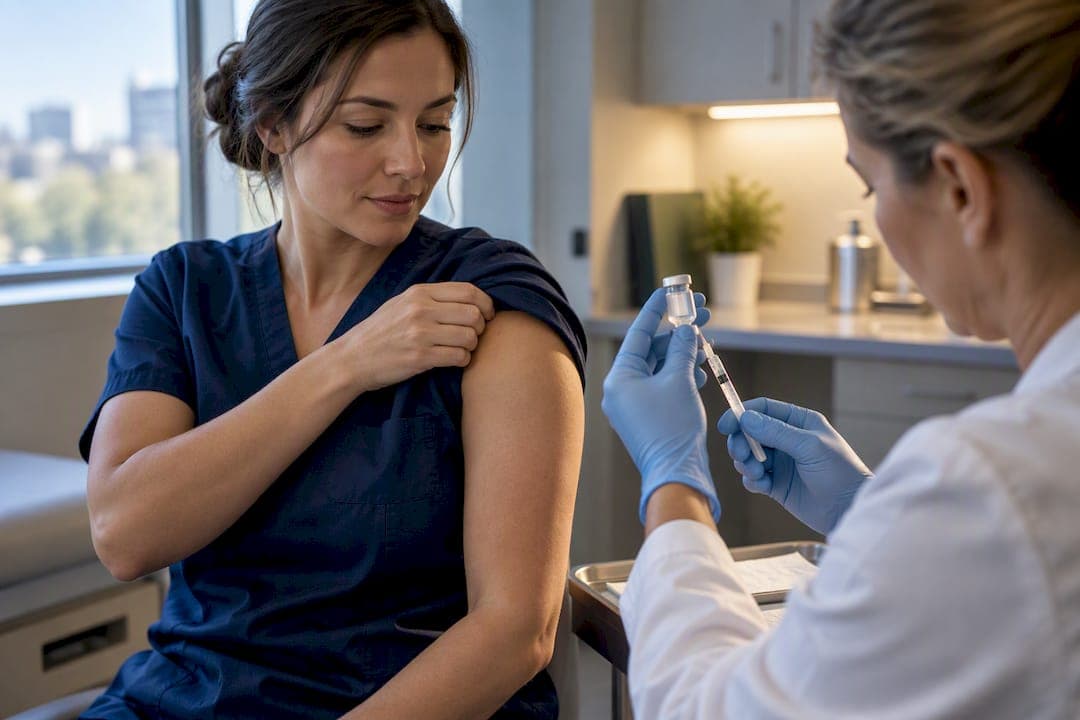
- Employers must offer the hepatitis B vaccine within 10 working days of your start date, at no cost.
- A sharps injury log must be maintained, and staff input on device safety is required, not optional.
- Training happens at initial assignment and at least once a year, during paid time.
Employers must offer hepatitis B vaccination within 10 working days of assignment to at-risk duties. That single deadline is worth remembering because it is one of the few hard numbers in the standard.
Ask to see the written ECP. Request documentation showing safer devices were evaluated with frontline input, and keep your own copies of training records and any post-exposure paperwork.
PPE and respirators: when a mask is not enough
A surgical facemask blocks droplets. It does not protect you during aerosol-generating procedures like intubation or bronchoscopy. For those situations, OSHA's hospital eTool guidance calls for a fit-tested N95 or a higher-level respirator, not a standard mask.
- Employers must provide appropriate respirators at no cost and run a full respiratory protection program under 29 CFR 1910.134, covering medical evaluation, fit testing, and training.
- Whether a registered nurse can serve as the licensed health care professional who signs off on those medical evaluations depends on your state's scope-of-practice law, according to an OSHA interpretation letter on the subject.
- Fit testing is not a one-time formality; it should be repeated periodically and whenever your respirator model changes.
Pro Tip: Keep a personal copy of your fit test date and result. If a manager can't produce one when you ask, that's your cue to escalate.
Safe patient handling and preventing injuries from lifting
Musculoskeletal injuries remain one of the most common ways nurses get hurt on the job. In one measured year, nursing assistants recorded 18,090 days-away-from-work cases with an incidence rate significantly higher than the all-industry average. OSHA's safe patient handling guidance, developed alongside NIOSH, points to mechanical lifts and transfer devices as the primary fix, not manual technique alone.
- A real program includes hazard assessment, worker participation in choosing equipment, and training on how to use it correctly.
- Equipment without staffing to match does not solve the problem. Ceiling lifts sit unused when there is no time to use them.
- Employers should be able to show a written program, training logs, and documented hazard reviews.
If your unit lacks lift equipment or the staffing to use it safely, say so in writing and ask to be part of the equipment evaluation process.
Workplace violence prevention and what employers owe you
Workplace violence has no single OSHA standard, but the General Duty Clause requires employers to address hazards they know about, and OSHA's Guidelines for Preventing Workplace Violence for healthcare and social service workers spells out what a program should include.
- Management commitment paired with real employee participation, not a policy nobody reads.
- Worksite analysis to identify where and when violence happens.
- Hazard prevention and control measures, from panic buttons to staffing adjustments.
- Training that covers de-escalation and reporting procedures.
- Recordkeeping and evaluation so the program improves over time.
Several states, including California, Washington, New York, New Jersey, Oregon, and Illinois, have gone further and passed mandatory workplace violence prevention laws for certain healthcare settings, beyond what federal guidance requires. Document every incident, no matter how minor it seems, and push for a joint safety committee that includes frontline nurses.
Recordkeeping and reporting: what your employer must track
OSHA's recordkeeping rule, 29 CFR 1904, requires covered employers to log work-related injuries and illnesses on OSHA Forms 300, 300A, and 301. Some employers get a partial exemption based on size or a low-hazard NAICS code, but that exemption never covers the duty to report the most serious events.
- A fatality must be reported within 8 hours of the employer learning about it.
- An inpatient hospitalization, amputation, or loss of an eye must be reported within 24 hours.
- Even partially exempt facilities must report these events; there is no size-based exception for that requirement.
You have a right to see the injury and illness log for your workplace. If the entries look incomplete or don't match what you witnessed, raise it with your safety officer or human resources.
Training requirements and shared duties when agencies staff your shift
Training under these standards is not a one-time orientation video. It has to cover site-specific hazards, correct PPE use, and how exposure actually happens on your unit, delivered at initial assignment and refreshed at least annually.
- Your employer must document an exposure determination that lists job classifications and tasks with exposure risk.
- Non-managerial staff, meaning nurses actually doing the work, must be asked for input on safer devices and procedures.
- When a staffing agency places you, training duties split between two parties: the agency typically covers general bloodborne pathogens training, while the facility where you work must provide site-specific hazard orientation, according to OSHA guidance on shared responsibilities.
Pro Tip: If you work through an agency, ask both the agency and the facility, in writing, who is responsible for which training before your first shift.
State plans and how to file a complaint when employers fall short
Federal OSHA covers most private-sector workplaces, but 22 states run their own OSHA-approved state plans, and some set tougher rules than the federal minimum, particularly around workplace violence.
- Start by documenting the issue with dates, witnesses, and any photos or messages.
- Request corrective action from your employer in writing and keep a copy.
- If nothing changes, file a complaint with your state plan or with federal OSHA; retaliation complaints go through whistleblower.gov.
- Preserve your evidence separately from workplace systems you might lose access to.
Checking your state's specific rules matters because a facility in a state-plan state may owe you protections that federal guidance alone does not require.
What you can do now, and how flexible staffing fits in
Ask for the written Exposure Control Plan, request your fit test records, join or start a safety committee, log every incident, and keep copies of your training documentation. These steps cost little time and give you a paper trail if things go wrong.

Chronic understaffing is part of why manual handling injuries and rushed, unsafe shortcuts happen in the first place. Flexible staffing options, including remote nursing job postings and travel nursing placements, can give you more control over the conditions you work in.
OSHA, CDC, and NIOSH pages worth bookmarking
For the full legal text, keep the Bloodborne Pathogens Standard and respiratory protection guidance handy. OSHA's workplace violence guidelines and safe patient handling resources cover the two biggest physical risks nurses face, with practical program details you won't find in a summary article.
Nurses drive safety programs, not just follow them

The standards on paper only work when nurses treat them as leverage, not background noise. A written Exposure Control Plan or a workplace violence policy means little if nobody documents when it fails in practice. Filing a complaint or raising an issue in a safety committee meeting is not disloyalty. It is how equipment gets replaced and staffing gets adjusted.
Use the resources and steps above the next time something on your unit feels unsafe. A paper trail today is what makes a case for change tomorrow.
— Flexible
FAQ
Does OSHA apply to nurses?
Yes, OSHA requirements apply to most nurses working for private employers and many public employers, depending on state plan coverage. Standards including Bloodborne Pathogens, Respiratory Protection, and general PPE rules apply directly to nursing roles in hospitals, clinics, and long-term care.
What are the requirements for nurses to work in the USA?
Working as a nurse in the U.S. requires a state nursing license, which is separate from OSHA rules. OSHA requirements govern workplace safety conditions, such as PPE, training, and exposure protections, once you are employed, not licensure itself.
What are 5 safety measures that nurses must follow?
Nurses are generally expected to use PPE correctly, follow sharps disposal procedures, participate in required bloodborne pathogens and respiratory protection training, use safe patient handling equipment rather than manual lifting, and report hazards or incidents promptly. These measures align with OSHA's Bloodborne Pathogens Standard and safe patient handling guidance.
Who is exempt from OSHA requirements?
Self-employed individuals and some public-sector employees in states without an OSHA-approved state plan may fall outside direct federal OSHA coverage. Most hospital and healthcare facility employees, including nurses, are covered, though certain recordkeeping duties carry partial exemptions based on employer size or industry classification.
How do I file an OSHA complaint as a nurse?
You can file a complaint with federal OSHA or your state's OSHA-approved plan after documenting the hazard and requesting corrective action from your employer. Retaliation for raising safety concerns can be reported through whistleblower.gov, which handles complaints tied to protected workplace safety reporting.