
Most hospital administrators view staffing agencies as a last resort. Something you call at midnight when three nurses call out sick and you have no other options. That framing costs you money and flexibility. The role of staffing agencies in hospitals is far more strategic than emergency coverage, and if you are managing workforce decisions without fully understanding that, you are leaving both money and operational efficiency on the table. This article breaks down how healthcare staffing agencies actually work, what they really cost, and how to use them as a deliberate part of your workforce strategy rather than a reactive patch.
Table of Contents
- Key takeaways
- How staffing agencies work in hospitals
- Understanding the real cost of agency staffing
- Strategic benefits of partnering with staffing agencies
- Building a hybrid staffing model that actually works
- Challenges to manage when working with staffing agencies
- My honest take on staffing agencies in healthcare
- Find nurses faster with Flexiblenursingcareers
- FAQ
Key takeaways
| Point | Details |
|---|---|
| Agencies do more than fill gaps | Healthcare staffing agencies handle recruiting, credentialing, compliance, and rapid deployment for multiple placement types. |
| Markups reflect real costs | Agency bill rates cover taxes, insurance, housing, and overhead. Net margins are often only 3-8% on travel contracts. |
| Vacancies are expensive too | An unfilled skilled position costs roughly $500 per day, making rapid agency placement financially competitive. |
| Hybrid models outperform either extreme | Combining in-house recruiting with preferred agency agreements reduces cost and improves continuity. |
| Transparency is negotiable | Hospitals can and should request bill rate breakdowns and negotiate rate caps with agency partners. |
How staffing agencies work in hospitals
Healthcare staffing agencies act as intermediaries. They recruit, screen, credential, and deploy clinical professionals to hospitals and health systems that need them. The relationship is simpler than most administrators assume, but the value it delivers goes well beyond simply sending bodies through the door.
Agencies typically offer several types of placements:
- Temporary or per diem staffing. Nurses and allied health workers fill short-term needs, often with 24 to 48 hours of notice for general roles.
- Travel nursing. Clinicians take 8 to 13 week contracts, usually at higher bill rates, covering predictable gaps from census spikes, seasonal demand, or extended leaves.
- Contract-to-hire. Hospitals trial a candidate through a temporary engagement before converting to a permanent position.
- Direct permanent placement. The agency sources and screens candidates for full-time roles, charging a placement fee rather than an ongoing bill rate.
Beyond placement, agencies manage the administrative weight that in-house HR teams often struggle to handle at scale. Credentialing verification, background checks, license validation, malpractice insurance, and compliance with state and federal employment law all fall on the agency for their placed workers. That transfer of administrative burden is one of the most undervalued staffing agency benefits for hospital teams already stretched thin.
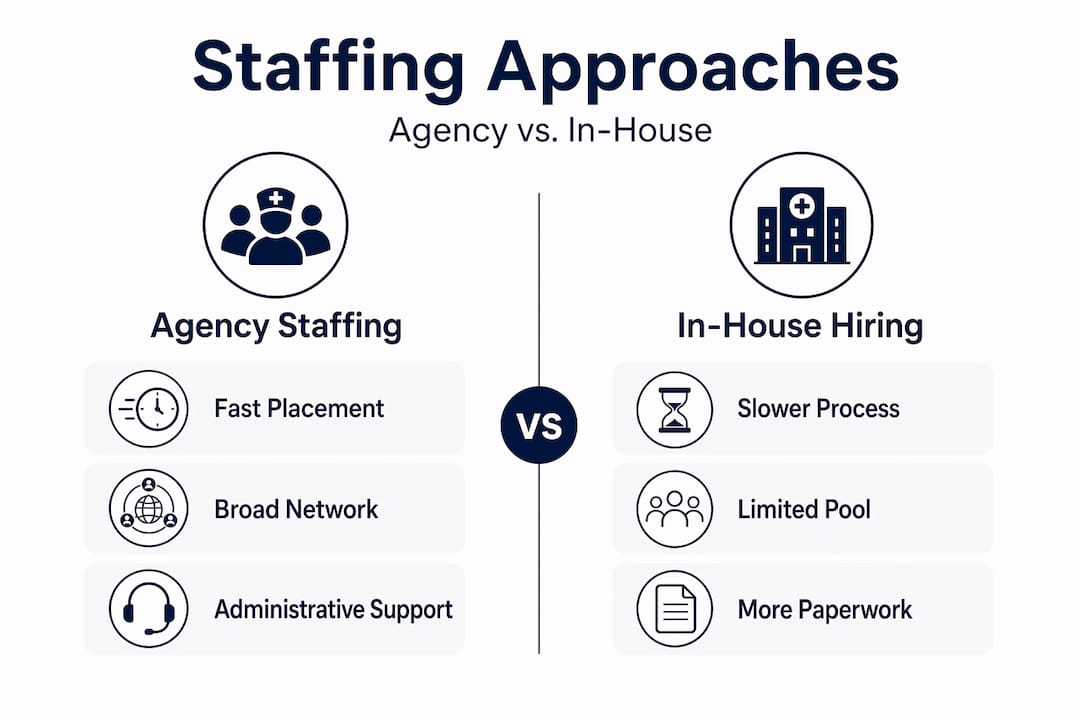
The difference between agency staffing and in-house recruitment comes down to speed and capacity. Your HR team is built for consistent hiring volume. Agencies are built for surge capacity and specialized access. They maintain active pipelines of pre-credentialed candidates, which is why top agencies can deploy qualified workers within 24 to 48 hours for general roles and 3 to 7 business days for specialized positions.
Understanding the real cost of agency staffing
This is where most conversations about staffing agencies break down. Administrators see a high bill rate and assume the agency is profiting excessively. The reality is more nuanced, and understanding it gives you better leverage.
Healthcare staffing agencies charge markups of 40% to 65% for temporary and travel placements, and 15% to 25% of first-year salary for permanent placement fees. That range sounds wide until you see what is inside it.
| Cost component | What it covers |
|---|---|
| Employer payroll taxes | FICA, FUTA, SUTA contributions for each worker |
| Workers' compensation insurance | Clinical settings carry elevated rates |
| Health and benefits | Many agencies provide benefits to attract candidates |
| Housing and travel stipends | Required for travel nursing contracts |
| Recruiter and administrative overhead | Sourcing, credentialing, compliance, account management |
| Agency net profit margin | Typically only 3-8% on travel nursing contracts |
When you see that breakdown, the markup starts to make sense. The agency is essentially functioning as a full employer of record for that clinician. You are outsourcing a significant portion of HR, benefits, and compliance administration along with the placement itself.

The comparison to permanent staff costs also deserves honest scrutiny. Hospital administrators often overlook the fully loaded cost of permanent employees, which includes benefits, recruiting fees, onboarding time, and turnover costs. Agency nurses can cost 36% more annually than permanent hires, but a single nurse turnover event, including recruiting, onboarding, and productivity ramp, can easily cost $30,000 to $50,000. That changes the math considerably.
Consider the vacancy cost angle as well. An unfilled skilled hospital position in an urban setting costs roughly $500 per day in lost productivity and coverage costs. A 30-day vacancy costs $15,000 before you factor in patient safety risk. Agency placement looks quite different against that benchmark.
Pro Tip: Request a full bill rate breakdown from any agency before signing a contract. According to industry standards, clinician pay should represent 70-80% of the total bill rate. If an agency cannot or will not provide this transparency, that is a signal worth paying attention to.
Strategic benefits of partnering with staffing agencies
The operational value of healthcare staffing agencies extends well beyond plugging a hole on the schedule. When used deliberately, they deliver advantages across multiple dimensions of hospital workforce management.
Speed and access. Urgent and specialized roles get filled faster through agency pipelines than through traditional recruiting. This matters acutely for ICU, OR, and emergency specialties where unfilled positions directly affect patient throughput and safety.
Flexibility for fluctuating demand. Hospital census is not constant. Seasonal flu surges, post-holiday admissions, and elective procedure cycles all create predictable but hard-to-staff peaks. Temporary staff in hospitals allow you to scale up during those windows without permanently expanding your payroll.
Access to niche specialties. Finding a CVOR nurse or a pediatric interventional radiology tech through standard job postings takes months. Specialty-focused healthcare staffing agencies maintain pre-credentialed rosters of these professionals and can place them in days.
Compliance and accreditation support. The Joint Commission's 2026 standards mandate adequate RN staffing levels 24/7 as a patient safety requirement enforceable through accreditation. Agencies help hospitals maintain those thresholds during gaps that could otherwise trigger compliance risk. Outsourcing credentialing verification also reduces the hospital's exposure to licensing or background check failures.
Risk mitigation at scale. When you use an agency worker and the placement is not a fit, you end the engagement and request a replacement. That process is far less complicated, legally and administratively, than managing a permanent employee performance issue.
Building a hybrid staffing model that actually works
The hospitals that get the most value from staffing agencies are not those that use them constantly or those that avoid them. They are the ones that have built a deliberate hybrid model. That means clear criteria for when to use agencies versus internal recruiting, preferred vendor agreements, and performance tracking that keeps agencies accountable.
Hospitals using a hybrid model see measurably better outcomes when they define explicit agency use rules, negotiate rate caps, and measure fill rates and quality metrics by vendor. Here is a framework for structuring that model:
Use in-house recruiting for permanent positions, predictable volume roles, and candidates sourced through your own employer brand. Use agency staffing for urgent coverage needs, specialized or hard-to-find roles, geographic markets where your brand is weak, and any position that needs to be filled in less than two weeks.
For your preferred agency relationships, negotiate the following:
- Volume commitments in exchange for rate reductions
- Conversion clauses that define the fee structure if you hire an agency worker permanently
- Rate caps that set a ceiling on bill rates regardless of market conditions
- Performance scorecards tracking fill rate, time-to-fill, and retention through the contract period
Pro Tip: Negotiate preferred vendor agreements with two or three agencies rather than spreading volume across ten. Concentrated relationships give you more leverage on rates, priority access during high-demand periods, and better service continuity.
Avoiding overreliance is equally important. If agency spend consistently exceeds 15% to 20% of your total labor budget, that is a sign to invest more aggressively in direct sourcing, employee retention, and internal float pool development. Agencies should supplement your workforce strategy, not substitute for one.
Challenges to manage when working with staffing agencies
Using agencies effectively requires managing real operational challenges. Ignoring them does not make them go away.
- Cultural fit and team cohesion. Agency workers rotate through. They may not know your EMR workflow, your unit culture, or your informal communication norms. A structured onboarding process for agency staff, separate from your standard employee orientation, significantly reduces friction.
- Patient care consistency. Continuity of care is harder to maintain when clinical staff change frequently. Where possible, request the same agency workers for repeat assignments. Many agencies will honor this if you establish the relationship early.
- Communication gaps. Agency nurses report to their agency for employment matters but to your charge nurses for clinical direction. That dual-reporting structure creates ambiguity. Define clinical authority clearly in your agency agreements and in your onboarding materials.
- Legal and compliance risk. Workers placed by agencies are generally not your employees, but co-employment liability is a real concern if you direct their work too closely. Work with legal counsel to define appropriate boundaries in your agency contracts.
- Transparency issues. Some agencies are not forthcoming about bill rate breakdowns or their clinicians' actual compensation. Request this data upfront. Transparency protects both your budget and the workers placed in your facility.
My honest take on staffing agencies in healthcare
I have watched hospital systems treat agency partnerships as a necessary embarrassment for years. Leadership approves the spend under duress, then resents the cost without ever analyzing it against the full alternative. That cycle is expensive and preventable.
In my experience, the administrators who get the most from staffing agencies are the ones who treat them like any other vendor relationship. They negotiate clearly, set performance standards, and hold agencies accountable for outcomes. They also do their own math. They calculate total agency spend per FTE and compare it against the fully loaded cost of a permanent hire, including turnover risk, before making workforce decisions.
The future of hospital workforce management is not about choosing between agencies and direct hiring. It is about building the infrastructure to use both well. Technology platforms are accelerating this shift. Real-time job matching, automated credentialing, and digital fill rate dashboards are making hybrid models easier to manage than they were five years ago.
My recommendation is direct: stop thinking of agencies as a cost center and start thinking of them as a flexible labor supply mechanism. The importance of staffing agencies becomes obvious the moment you calculate what a 30-day vacancy actually costs you compared to a 48-hour agency fill.
— David
Find nurses faster with Flexiblenursingcareers
If you are ready to move beyond reactive staffing and build a workforce model that works, Flexiblenursingcareers is worth a serious look.

Flexiblenursingcareers connects hospitals with pre-screened nurses and healthcare professionals available for temporary, travel, and permanent placements. The platform uses real-time job matching based on skills, availability, and location. That means shorter time-to-fill, less administrative back-and-forth, and better fit on both sides. Hiring managers can post needs and find qualified nurses without the delays typical of traditional agency processes. You get the speed you need for urgent coverage without sacrificing credential quality. Sign in and start building your staffing roster today.
FAQ
What is the role of staffing agencies in hospitals?
Staffing agencies connect hospitals with credentialed clinical professionals for temporary, travel, contract, and permanent placements. They also manage recruiting, compliance, and credentialing, reducing the administrative burden on hospital HR teams.
How much do healthcare staffing agencies charge hospitals?
Agencies typically charge a markup of 40% to 65% on temporary and travel placements. That markup covers employer taxes, insurance, benefits, housing stipends, and overhead, not just agency profit.
Are staffing agencies cost-effective for hospitals?
Yes, when compared against the full cost of a vacancy. An unfilled skilled position costs roughly $500 per day. Agencies can fill most general roles within 24 to 48 hours, making the placement cost far more competitive than it first appears.
How do hospitals negotiate better rates with staffing agencies?
Consolidate volume with two or three preferred vendors, set rate caps in your contracts, and request full bill rate transparency. Clinician pay should account for 70% to 80% of the total bill rate as a general benchmark.
What is a hybrid staffing model for hospitals?
A hybrid model combines in-house recruiting for permanent and predictable roles with agency staffing for urgent needs and hard-to-fill specialties. Hospitals that define clear criteria for each channel and track performance by vendor consistently see better workforce outcomes.