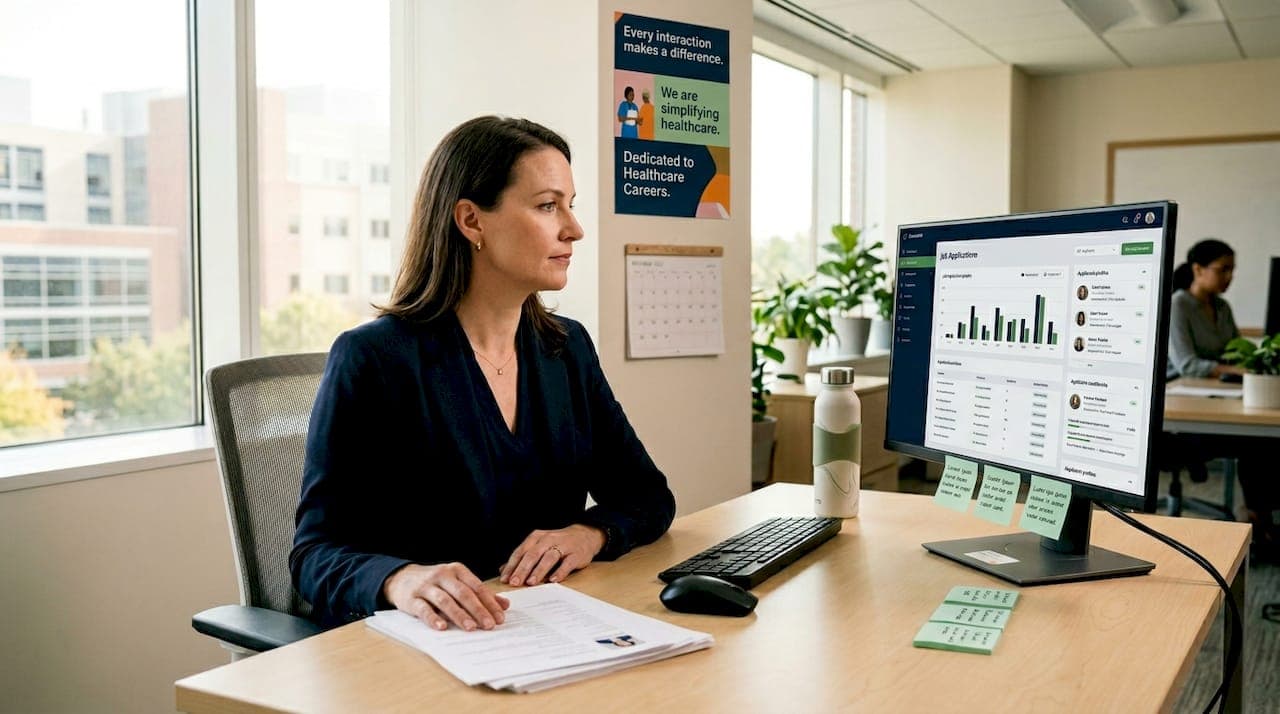
Automation is reshaping job placement in ways most healthcare professionals did not expect. The role of automation in job placement goes far beyond cutting administrative hours. It changes who gets found, who gets hired, and how fast any of it happens. If you work in healthcare recruitment or you're actively searching for your next clinical role, the tools now filtering resumes and scheduling interviews are working either for you or against you. Understanding exactly how they work puts you in a much stronger position.
Table of Contents
- Key takeaways
- The role of automation in job placement today
- How automation affects candidates and recruiters
- Weighing efficiency against fairness
- Practical strategies for healthcare job placement
- My honest take on automation in healthcare hiring
- Find your next role faster with Flexiblenursingcareers
- FAQ
Key takeaways
| Point | Details |
|---|---|
| Automation speeds up hiring | Over half of recruiting teams report reduced time-to-hire after adopting AI tools. |
| Bias is a real legal risk | Automated tools can disadvantage protected classes and neurodiverse candidates, raising compliance concerns. |
| Candidates must adapt now | Tailoring resumes for ATS systems directly improves your chances of making it past the first filter. |
| Human judgment stays critical | Automation works best when it frees up recruiters for relationship-building and complex assessments. |
| Healthcare is uniquely affected | High hiring volumes and credentialing requirements make automation both more useful and more risky in this sector. |
The role of automation in job placement today
Healthcare recruitment runs on volume. A single hospital system may post hundreds of nursing and allied health positions in any given month. Without automation, filling those roles fast enough to maintain safe staffing ratios is nearly impossible.
Here is where automation in the hiring process has become standard practice across health systems:
- Resume screening: Applicant tracking systems scan resumes for keywords tied to certifications, specialties, and experience before a human recruiter ever opens the file.
- Candidate sourcing: AI tools scan professional databases and job boards to identify passive candidates who match specific clinical criteria.
- Interview scheduling: Automated calendar tools eliminate the back-and-forth that typically adds days to the hiring timeline.
- Initial outreach: AI agents send personalized messages to qualified candidates at scale, handling early-stage engagement without recruiter involvement.
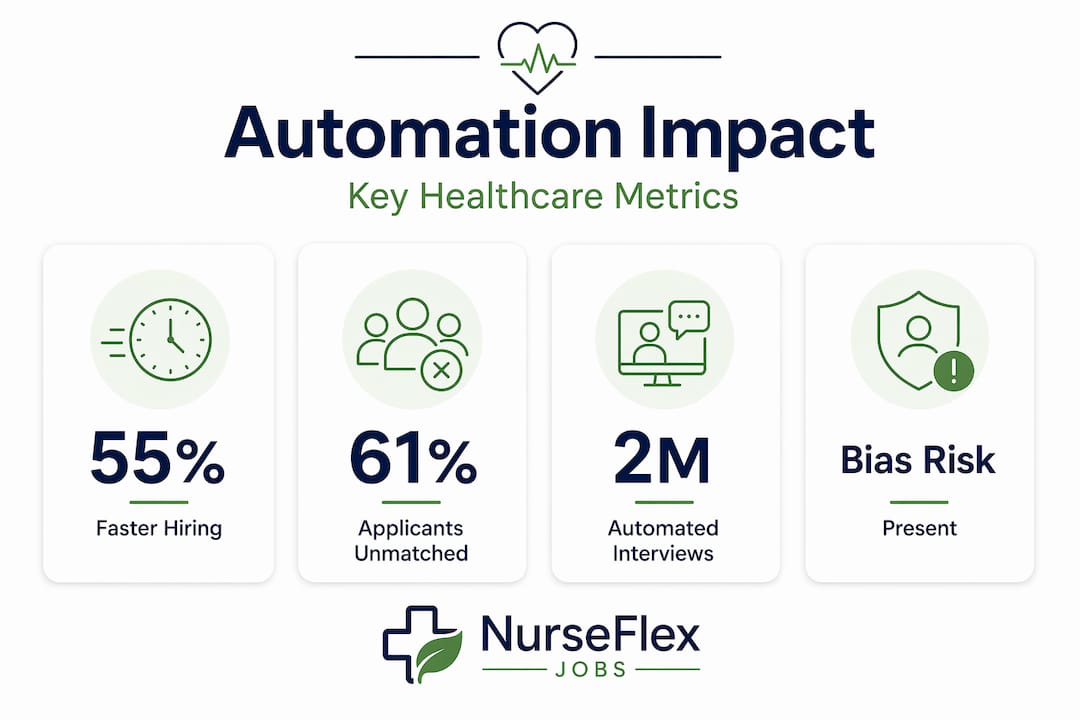
The scale of this shift is significant. Autonomous AI agents like Paradox's Olivia now conduct millions of automated interviews annually, handling sourcing, screening, and scheduling with minimal human involvement. That is not a future projection. It is already happening in large health systems.
The benefits of automated job placement show up clearly in the data. 55% of recruiting teams report that AI and automation reduced time-to-hire, and 49% cite increased productivity from automating repetitive tasks. For healthcare, where an unfilled ICU nursing position can affect patient outcomes within days, that speed matters enormously.
Pro Tip: If you are a healthcare recruiter, audit your ATS keyword library at least quarterly. Clinical terminology evolves, and outdated keyword filters may be screening out qualified candidates who use current terminology.
Job placement technology trends in healthcare are also moving toward specialty-specific matching. Platforms built for clinical roles factor in license status, shift availability, and specialty certifications rather than relying on generic resume parsing. That level of specificity produces far better fit from the first pass.
How automation affects candidates and recruiters
The impact of automation on recruitment is not felt equally. Candidates and recruiters experience it in very different ways, and both groups face real tradeoffs.
For candidates, the biggest shift is invisible. 61% of candidates fail to tailor resumes for each application, and on average, job seekers spend over 10 hours per week on manual job search tasks. When an ATS filters out a resume before a human reads it, that effort disappears without feedback. The system does not explain what it rejected or why.
Asynchronous video interviews add another layer of friction. Research shows a greater than 50% drop in application continuation rates when employers use asynchronous interviews, with the sharpest declines among highly qualified candidates and women. That is not a small rounding error. It represents a meaningful loss of talent from the pipeline.
For recruiters, automation removes the repetitive work but adds a new responsibility: oversight. You are no longer just screening candidates. You are now auditing the decisions your AI tools make.
"The value of recruitment automation lies in freeing recruiter time from routine tasks to focus on strategic evaluations and personalized human interactions that machines cannot replicate." — Lever
The challenge is that many organizations stop there. They automate the front end and assume the quality follows. It does not always. Automated hiring tools have documented patterns of bias against protected classes and neurodiverse candidates, creating legal exposure alongside the efficiency gains. Facial and voice analytics tools used in video interviews can flag non-standard communication patterns as red flags, which puts candidates with neurological differences at an unfair disadvantage.
The roles that automation affects most in healthcare recruitment are not the clinical jobs themselves. Automation changes how candidates are evaluated before any clinical skill is ever tested.

Weighing efficiency against fairness
The case for automated recruitment in healthcare is strong on paper. The practical picture is more complicated.
| Factor | Benefit | Risk | Mitigation |
|---|---|---|---|
| Resume screening | Faster filtering at scale | Misses qualified candidates with non-standard formatting | Supplement with keyword-agnostic review stages |
| AI-driven outreach | Reaches passive candidates efficiently | Impersonal tone erodes candidate trust | Personalize message templates with role-specific details |
| Asynchronous interviews | Eliminates scheduling delays | Reduces application continuation by over 50% | Offer a live interview option at every stage |
| AI scoring algorithms | Can predict job success accurately | Scores genders and minorities differently from human assessors | Run regular demographic audits on scoring outcomes |
| Automated ATS filtering | Consistent, repeatable process | Perpetuates bias embedded in training data | Use bias audits before deployment and after updates |
The data on fairness is harder to ignore than most organizations admit. Nearly all Fortune 500 companies now use AI in hiring, yet documented bias has not decreased. It has simply become harder to detect because it is embedded in algorithms rather than individual decisions.
For healthcare specifically, this matters on two levels. First, the regulatory environment around equal employment opportunity is strict, and AI-related discrimination claims carry real legal consequences. Second, workforce diversity in healthcare has a direct connection to patient outcomes. A less diverse nursing workforce affects care quality for underserved populations.
Pro Tip: Before adopting any new AI screening tool, request a bias audit report from the vendor. If they cannot produce one, that is your answer.
The challenges of automation in hiring do not negate the benefits. They require that you build governance around automation rather than letting it run without review. Consistent human checkpoints, clear candidate communication, and documented AI decision logic protect both your organization and the candidates moving through your pipeline.
Practical strategies for healthcare job placement
Whether you are a recruiter managing a large clinical pipeline or a nurse searching for your next position, using automation well is a skill in itself. Here are specific steps that produce better outcomes for both sides.
For recruiters:
- Audit your ATS settings twice per year. Check which keywords are filtering candidates out and whether those filters reflect actual job requirements or outdated preferences.
- Build a human touchpoint early. A brief live phone screen after the AI filtering stage significantly improves candidate trust and reduces dropout rates.
- Set demographic checkpoints. Compare the demographic profile of candidates who pass AI screening against those who applied. Unexplained gaps signal bias in the system.
- Use automation to focus on relationships, not to replace them. Let the tools handle scheduling and initial outreach so your time goes to complex assessments and candidate conversations that matter.
For job seekers in healthcare:
- Mirror the job posting language in your resume. If the posting says "critical care RN," use that exact phrase rather than a synonym.
- Do not skip asynchronous interview invitations just because they feel impersonal. Completing them keeps you in the pipeline where a human recruiter will eventually make the final call.
- Optimize your license and certification details. ATS systems in healthcare often filter specifically on credential status and expiration dates. List these prominently and keep them current.
- Treat the AI screening as a minimum bar, not the finish line. Crafting an ATS-friendly resume gets you in the door. Your actual value gets demonstrated in the human stages that follow.
Pro Tip: When applying to healthcare roles through any job platform, read the job description twice. The second time, highlight every skill and credential mentioned. Each one is a potential ATS keyword that belongs in your resume.
One practical example worth noting: some health systems have deliberately reintroduced friction at certain stages after discovering that highly automated pipelines were filling roles quickly but with poor long-term retention. Structured hiring processes that include human evaluation alongside AI scoring produce better candidate-to-role fit, even if they take slightly longer.
My honest take on automation in healthcare hiring
I have watched healthcare recruiters navigate this shift for years, and the clearest lesson I have drawn is this: automation's greatest value is not efficiency. It is focus.
When I look at recruiters who use AI tools well, they are not the ones who automate the most. They are the ones who use automation to protect their time for the conversations no machine can have. The call with a travel nurse who is weighing two competing offers. The debrief with a hiring manager about why candidates keep dropping out mid-process. The honest conversation with a candidate about whether a role actually fits their career goals.
What worries me is the organizations that treat automation as a solution rather than a tool. I have seen health systems implement AI screening, watch their time-to-hire drop, and call it a success, without noticing that 90-day turnover climbed at the same rate. Speed and quality are not the same metric.
I also think candidates undersell themselves by trying to "beat" the ATS rather than focusing on fit. Gaming keyword filters might get you through the first screen. It does not help you in the job. The nurses and allied health professionals I see thriving use automation to find roles faster, then show up as themselves in every human interaction that follows.
The future of job placement automation in healthcare will involve more AI agents, more autonomous screening, and more pressure to move quickly. The professionals who come out ahead will be the ones who stay clear on what automation cannot do: it cannot evaluate judgment, compassion, or clinical instinct. Those stay human, and they still decide who gets the job.
— Flexible
Find your next role faster with Flexiblenursingcareers
Healthcare job placement is changing fast. You should not have to figure out how to work with automation on your own.

Flexiblenursingcareers was built specifically for nurses and healthcare professionals who want to move quickly without sacrificing fit. The platform matches your skills, credentials, and availability to real open positions in real time, so you spend less time filling out applications and more time evaluating actual opportunities. No lengthy back-and-forth. No guessing whether your resume made it through a filter.
Sign up or log in to NurseFlex today to see roles matched to your profile. The right position might already be waiting for you.
FAQ
What is the role of automation in job placement?
Automation handles repetitive tasks like resume screening, interview scheduling, and candidate outreach, making hiring faster and more consistent. In healthcare, it allows recruiters to manage high-volume pipelines while spending more time on strategic candidate evaluation.
How does automation in the hiring process affect nurses and healthcare workers?
Automation filters candidates before a human recruiter sees them, so nurses who do not tailor their resumes for ATS systems may never get a callback. Using job-posting language in your resume and keeping certifications current significantly improves your chances of passing automated screening.
What are the biggest challenges of automation in hiring?
AI tools can perpetuate bias against protected classes, neurodiverse candidates, and women, particularly in asynchronous interview formats where continuation rates drop by over 50%. Regular bias audits and human checkpoints are necessary to manage these risks.
Can automated hiring tools actually predict job success?
AI assessment scores in asynchronous interviews sometimes predict employment success more accurately than human recruiters, but they also score genders and minorities differently. That means accuracy and fairness are separate questions that both need monitoring.
What is the future of job placement automation in healthcare?
Autonomous AI agents will take on more sourcing and screening tasks, but human recruiters will remain central to relationship-building, culture assessment, and complex role evaluation. The most effective healthcare recruitment combines both.