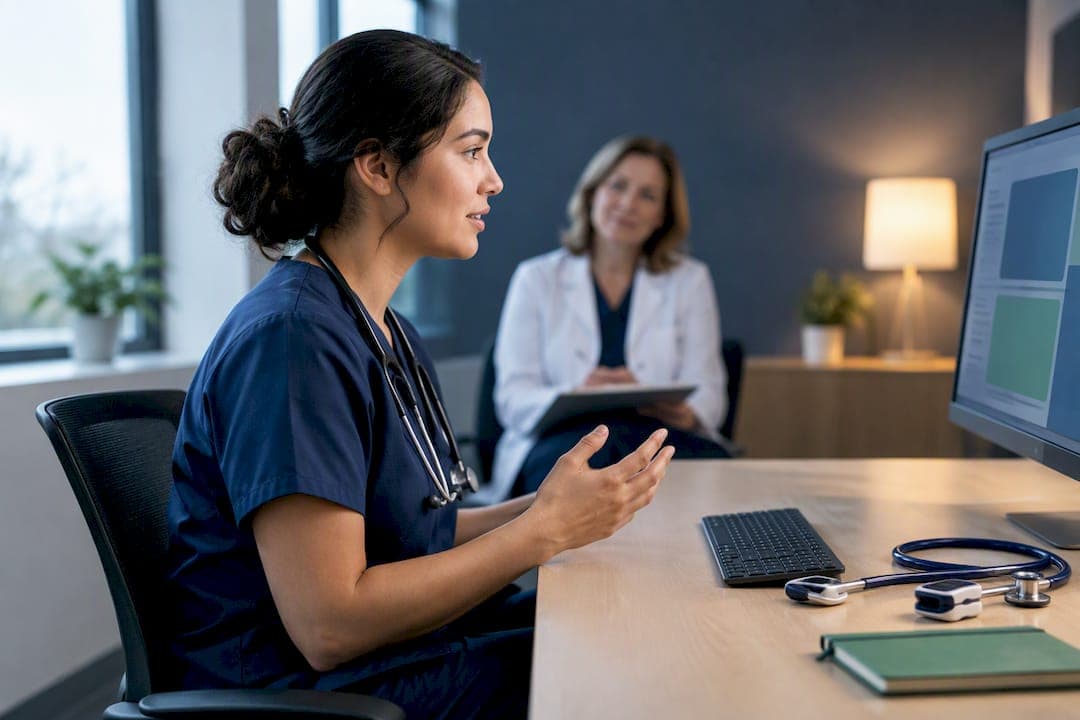
If you want to upskill, pick a target role or competency, confirm licensure and employer requirements, and enroll in accredited training that includes supervised practice and a real competency check, not just a certificate of completion. High-value targets right now include critical-care procedures, telehealth and informatics, and case management. Whatever you choose, verify your state's licensure rules before you assume a new skill is usable at the bedside.
TL;DR:
- Nurses should verify their state's scope-of-practice and licensure rules before applying new skills in clinical settings to avoid legal issues.
- Accredited training programs with hands-on assessments, such as simulation or competency check-offs, are essential for valid upskilling rather than just completing online modules.
- Employers that provide protected learning time, tuition assistance, and formal competency validation significantly increase nurse retention and skill application.
- Telehealth and critical-care skills are highly in demand, with long-term service projections indicating growth of 39% to 41% through 2038.
- Nurses seeking new roles should update their profiles and set job alerts on platforms that match skills in real-time, especially for telehealth, travel, or specialty positions.
Table of Contents
- Why Upskilling for Nurses Pays Off for Patients, Careers, and Employers
- How Do You Build an Upskilling Plan Step by Step?
- What Types of Training Actually Count as Upskilling?
- Does Your License Cover the New Skill Everywhere You Work?
- How Can Employers Make Upskilling Stick (and What Should You Ask For)?
- How NurseFlex Jobs Fits Into Your Next Career Move
- Sources
- FAQ
Why Upskilling for Nurses Pays Off for Patients, Careers, and Employers
Upskilling is not a resume exercise. The ANA Code of Ethics treats competence as a career-long duty, not a box checked at graduation, and that framing matters because it ties learning directly to patient safety rather than professional optics.
The career math backs it up too. The Bureau of Labor Statistics projects 5% employment growth for registered nurses through 2034, with median RN pay at $93,600 a year. Specialty skills, such as telehealth competency or case management certification, are often what separates a nurse who qualifies for that growth from one who doesn't.
Employers benefit just as much. Nurses who feel supported in learning tend to stay longer, and turnover is expensive to replace. A metasynthesis on continuing professional development found that organizational culture largely determines whether nurses actually participate, and time and funding remain the most common barriers.
What this means in practice:
- Competence isn't optional under professional ethics standards; it's expected throughout a nursing career.
- Specialty training tends to open doors to roles tied to projected workforce demand.
- Retention improves when employers fund and protect time for learning.
- Time and money remain the two biggest obstacles nurses report, regardless of specialty.
Quick fact: RN employment is projected to grow 5% from 2024 to 2034, with roughly 189,100 openings expected each year, according to BLS data.
How Do You Build an Upskilling Plan Step by Step?
Skipping steps is how nurses end up with a certificate that doesn't translate into a new role. Follow this sequence instead:
- Define the target skill or role. Look at where the demand actually is. HRSA projects long-term services and supports could see demand grow by roughly 39% to 41% through 2038, driven by an aging population, so gerontology and home-health competencies are a smart bet for many nurses.
- Check your state board and employer scope-of-practice rules first. A skill you learn online may not be usable until your employer signs off on it.
- Choose accredited education with a real assessment component, not a video series with a quiz at the end.
- Practice through simulation or precepting, and get your competency documented in writing.
- Apply the skill on the floor, then track outcomes so you can show it's making a difference.
Rapid-training research from the COVID-19 era backs up step four especially. An integrative review found that fast-tracked education worked only when paired with simulation and formal competency validation, not when speed replaced practice.
Pro Tip: Ask your manager for a competency check-off sheet before you start a course, not after. Knowing exactly what "proficient" looks like on paper keeps you from wasting hours on the wrong module.

What Types of Training Actually Count as Upskilling?
Not every course builds a usable skill. Continuing education for nurses generally falls into a few categories, and knowing the difference saves you money and time.
- ANCC contact-hour CE courses through professional societies, often free or discounted for members.
- Specialty certification programs (critical care, oncology, informatics) that combine coursework with an exam.
- Certificate programs through community colleges or universities for a defined skill set.
- Academic bridge programs (RN to BSN, BSN to MSN) for nurses aiming at leadership or advanced practice.
- Employer-run competency programs, often the fastest path since they're tied directly to your current job.
The American Association of Critical-Care Nurses offers free evidence-based CE activities on topics like end-tidal CO2 monitoring, and ANA's continuing education listings include ANCC contact-hour courses at member rates. Before enrolling in anything free, check whether it includes an assessment and any hands-on component. A course without either is background reading, not a credential you can point to during a performance review.
Does Your License Cover the New Skill Everywhere You Work?
Practice happens where the patient is, not where you got trained. That single fact trips up more nurses than any other part of the upskilling process.
- The Nurse Licensure Compact allows nurses who qualify for a multistate license to practice across compact states, but it doesn't override every state-specific rule.
- Continuing-education requirements, both hours and acceptable activity types, vary widely from state to state.
- Telehealth nursing adds another wrinkle: you generally need to be licensed in the state where the patient is physically located, even if you never leave your own state.
Quick fact: NCSBN confirms licensure and CE rules differ by state, and the compact applies only to nurses who qualify for a multistate license in a compact member state. Always verify with your board before assuming a new skill or credential travels with you.
How Can Employers Make Upskilling Stick (and What Should You Ask For)?
Upskilling fails most often when nurses are expected to absorb it on their own time with no support. Research on CPD participation is consistent on this: relevance, access, and a supportive culture drive uptake far more than motivation alone.
Employers who get this right typically offer:
- Tuition assistance or reimbursement for accredited programs.
- Protected CE days that don't eat into PTO.
- Simulation lab or precepting access for hands-on validation.
- Documented competency check-offs tied to career ladders, not just annual reviews.
If your workplace doesn't offer these yet, ask directly. Request tuition assistance for a specific certification, propose a competency validation process for a skill you're already using informally, or ask about an internal pathway into a specialty unit.
Pro Tip: Bring data to the ask. Track your own competency progress, patient outcomes tied to the new skill, and any retention risk if you leave for a role that offers better support. Managers respond to numbers faster than requests alone.
How NurseFlex Jobs Fits Into Your Next Career Move
New competencies only pay off when they connect to the right opening, and that's where matching speed matters. Some job platforms use real-time matching to help nurses present their skills to employers actively hiring, aiming to reduce the usual application backlog after gaining new credentials.

Once you've validated a skill, update your profile and set alerts through Flexiblenursingcareers's job alert service so new postings that match your competencies land in your inbox instead of getting buried in a general job board. Nurses moving into telehealth can browse telehealth nursing roles directly, while those pursuing travel or specialty work can explore Flexiblenursingcareers's travel nursing matching service. Employers looking to fill roles with upskilled candidates can post openings directly.
Sources
- ANA Code of Ethics for Nurses (2025 provisions)
- Registered Nurses — Occupational Outlook Handbook (BLS)
- Rapidly Upskilling Nurses During a Pandemic: An Integrative Review — PubMed
- Lifelong learning and nurses’ continuing professional development — metasynthesis (PMC)
FAQ
How Can a Nurse Make $200,000 a Year?
Very few staff RN roles reach that figure on salary alone; the median RN pay is $93,600 a year. Nurses who approach that range usually combine advanced practice credentials (like nurse anesthetist training), leadership roles, or high-demand travel and per diem contracts with significant overtime.
What Are the Top Skills Nurses Need Today?
Clinical judgment, communication, and adaptability consistently top the list, alongside growing demand for technology fluency in telehealth and informatics. The ANA Code of Ethics frames all of these as part of an ongoing professional duty rather than a one-time skill set.
Is Nursing Considered a Professional Degree?
Nursing is a licensed profession with defined educational and clinical requirements set by state boards, and the NCSBN governs licensure standards nationwide. Debates about how nursing degrees are classified don't change the legal licensure and competency requirements nurses must meet to practice.
At What Age Do Most RNs Retire?
There's no single published retirement age for RNs, and it varies by specialty, physical demands, and financial readiness. Many nurses shift into less physically demanding roles, such as case management, informatics, or education, in their later career years rather than retiring outright.
Do I Need a New License to Use a New Skill in Another State?
It depends on the skill and the state. The Nurse Licensure Compact allows multistate practice only for nurses who qualify for a multistate license in a compact state, and even then, some scope-of-practice rules remain state-specific. Always confirm with the destination state's board before practicing a new skill across state lines.