
The term "urgent healthcare vacancy" appears in dozens of job postings every day, but most professionals misread what it actually signals. Understanding the urgent healthcare vacancy explained correctly can mean the difference between landing a role fast and wasting weeks on applications that stall. Right now, the U.S. healthcare system is operating under sustained workforce pressure that makes these postings more common and more complex than they look. This guide breaks down what urgency really means in healthcare hiring, what drives it, and how you can position yourself to move quickly when the right opportunity appears.
Table of Contents
- Key Takeaways
- Why urgent healthcare vacancies are rising fast
- What "urgent" actually means in a job posting
- The real cost of an unfilled healthcare role
- How to secure urgent healthcare jobs effectively
- My take on urgent vacancies and what they really offer
- Find your next role with Flexiblenursingcareers
- FAQ
Key Takeaways
| Point | Details |
|---|---|
| Urgency reflects systemic shortages | Most urgent postings stem from long-term workforce gaps, not a single sudden opening. |
| "Urgent" does not always mean immediate start | Visa processing and credential checks can delay start dates by months even in urgent roles. |
| Specific experience matters most | Recruiters filling urgent roles prioritize candidates with EMR proficiency and direct urgent care experience. |
| Prolonged vacancies cost organizations heavily | A single unfilled physician role can create a revenue gap of up to $500,000 in three months. |
| Flexible platforms accelerate placement | Technology-driven staffing platforms match skills to openings faster than traditional recruitment methods. |
Why urgent healthcare vacancies are rising fast
The U.S. healthcare workforce is under pressure that has been building for years. The numbers tell a stark story. The country faces a projected physician shortage of up to 86,000 by 2036, with specialists consistently ranked as the hardest roles to fill. That shortage does not sit quietly in the background. It shows up directly in job boards as postings marked urgent, critical, or immediate need.
Beyond physicians, the broader healthcare job market trends point to relentless demand across every category. The U.S. Bureau of Labor Statistics projects 1.9 million annual openings through 2034, with healthcare support roles growing at 15.2% and technical roles at 8.6%. These are not temporary spikes. They represent structural growth that outpaces the pipeline of trained workers entering the field.
Some sectors are expanding faster than others. Consider the following areas driving urgent medical staffing demand right now:
- Ambulatory care is adding approximately 120,000 jobs per year, creating constant pressure on outpatient facilities to hire quickly.
- Mental health offices are expanding at 28.8%, one of the fastest growth rates in the entire healthcare sector.
- Rural and underserved regions face the steepest shortages, where a single departure can leave an entire community without access to care.
Understanding healthcare vacancies starts with recognizing that these numbers are not abstract. They translate directly into the postings you see labeled urgent every time you open a job board.
What specialty gaps look like in practice
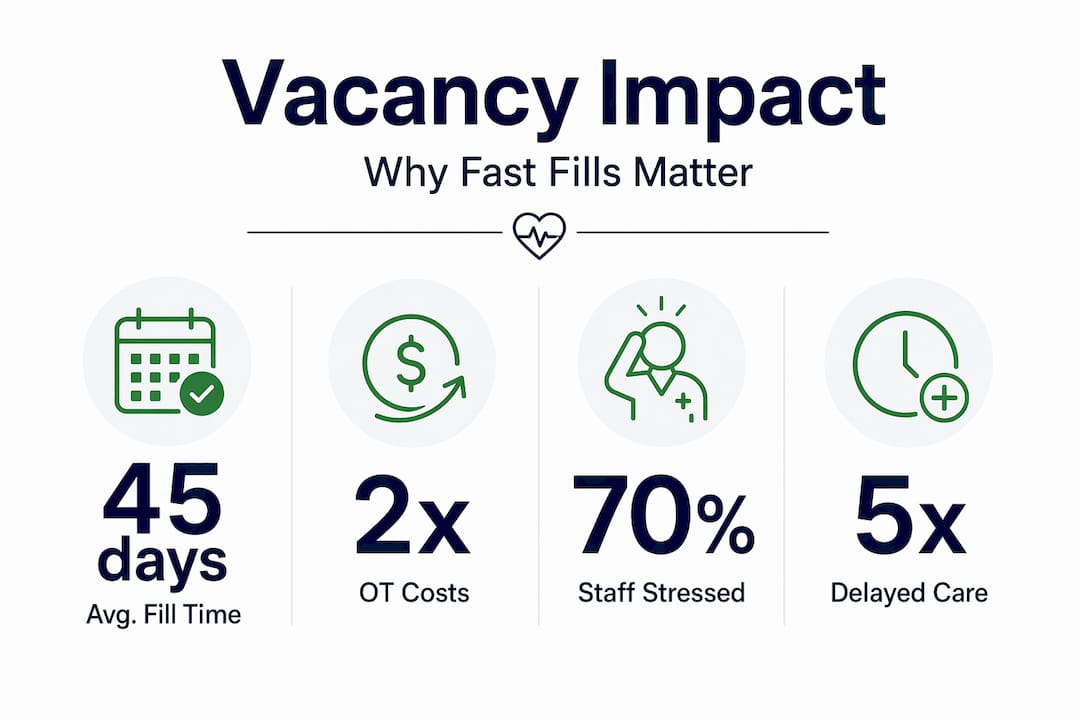
A hospital system losing a cardiologist does not just have one open seat. It has a backlog of referrals, overloaded remaining staff, and a revenue line that starts shrinking immediately. The average time to fill a physician role runs 45 to 90 days, and in rural or high-demand specialties, it can stretch past six months. That is why the word "urgent" gets attached to postings. The organization is not exaggerating. It is genuinely in trouble.

What "urgent" actually means in a job posting
Here is where most healthcare professionals get tripped up. Seeing the word urgent in a posting triggers an assumption that you need to apply today and start next week. That is not always how it works.
Urgency in a job ad reflects the organization's need, not necessarily a fast hiring timeline. Visa sponsorship bottlenecks, for example, can delay a start date by months even when the posting screams immediate opening. Visa processing delays are common in rural and remote postings where facilities have already exhausted their local candidate pools. The facility is desperate. The paperwork is not.
There are also credential verification requirements, background checks, and onboarding prerequisites that add weeks to the process regardless of how urgent the need is. When you see an urgent care employment posting, read it carefully for these signals:
- Immediate start preferred usually means they want someone credentialed and ready, not that they will skip verification steps.
- Visa sponsorship available often signals a longer timeline, not a shorter one.
- Experience required in urgent postings means they cannot afford to train you on the job. You need to hit the ground running.
- Specific EMR system listed (Epic, Cerner, Meditech) means proficiency is non-negotiable, not a nice-to-have.
Pro Tip: When applying to urgent roles, address the urgency directly in your cover letter. State your availability date, your relevant certifications, and your EMR proficiency in the first paragraph. Recruiters filling urgent roles scan for readiness, not potential.
The distinction between organizational urgency and candidate urgency matters. You can apply quickly and still wait. What you can control is how prepared and how visible you are when the hiring manager makes their decision.
The real cost of an unfilled healthcare role
Healthcare organizations do not post urgent vacancies because they enjoy the paperwork. They do it because leaving a role open is expensive in ways that compound quickly.
Start with the direct revenue impact. A physician vacancy with $2 million in annual billings can create a $500,000 revenue gap in just three months. That math gets the attention of every administrator in the building. But the financial damage does not stop there.
The operational costs of an unfilled role cascade in a predictable sequence:
- Remaining staff absorb extra patient load, driving overtime costs up immediately.
- The facility turns to agency or locum staffing to cover gaps, paying significant premiums over standard salaries.
- Burnout accelerates among existing staff, increasing the risk of secondary departures.
- RN turnover rates exceed 18% in understaffed environments, with each departure costing over $61,000 to replace.
"Every unfilled role in a healthcare facility is not just an open seat. It is a pressure point that pushes the people around it closer to their breaking point."
The table below shows how the cost profile shifts depending on how long a vacancy stays open.
| Vacancy duration | Primary cost driver | Secondary impact |
|---|---|---|
| 0 to 30 days | Overtime for existing staff | Mild increase in workload |
| 30 to 90 days | Agency and locum staffing premiums | Reduced patient throughput |
| 90 to 180 days | Revenue loss and staff burnout | Risk of secondary departures |
| 180+ days | Systemic operational disruption | Potential patient safety concerns |
This is the context behind every urgent healthcare job posting you encounter. The organization is not being dramatic. The cost clock is running.
How to secure urgent healthcare jobs effectively
Knowing why urgent vacancies exist is useful. Knowing how to position yourself for them is what actually moves your career forward. Here is what works.
First, understand what recruiters are actually looking for in urgent care employment situations. Recruiters filling urgent roles consistently prioritize candidates with direct emergency department or urgent care experience because they cannot afford a slow ramp-up. If your background includes fast-paced, high-acuity settings, lead with that. Make it the first thing a recruiter sees.
Second, your technical qualifications need to be specific and current. Facilities listing EMR proficiency requirements are not being picky for the sake of it. They need someone who can open a chart, document accurately, and move to the next patient without a training period. List your systems by name: Epic, Cerner, Meditech, or whichever platforms you have used.
Third, consider how you are searching. The healthcare job market trends in 2026 favor professionals who use multiple channels simultaneously. Staffing agencies that specialize in healthcare can surface postings that never appear on public job boards. Flexible career platforms that match you based on skills and availability can cut weeks off your search.
Key steps to take right now:
- Update your resume to highlight urgent care or high-acuity experience at the top.
- List all EMR systems you have used with specific versions if possible.
- Obtain or renew certifications relevant to your specialty (BLS, ACLS, PALS as applicable).
- Register with staffing platforms that offer real-time matching to reduce your time to placement.
- Set job alerts using specific terms like "urgent care employment" and "immediate start" to catch postings early.
Pro Tip: Contact the recruiter directly within 24 hours of applying to an urgent posting. A brief, professional message confirming your application and availability signals exactly the kind of responsiveness the facility is looking for.
My take on urgent vacancies and what they really offer
I have spent years watching healthcare professionals either chase urgent postings without a strategy or avoid them out of concern that urgency signals a troubled workplace. Both responses miss the point.
In my experience, urgent vacancies fall into two categories. The first is a facility with a genuine, temporary gap caused by a departure or expansion. These are often excellent opportunities. The organization is motivated, the hiring process moves faster than normal, and you can negotiate from a position of strength because they need you. The second category is a facility with chronic staffing problems that cycles through urgent postings repeatedly. That pattern is visible if you look for it. Check how long a facility has been posting the same role. Ask the recruiter directly what happened to the previous person in the position.
What I have learned is that urgency can work in your favor if you approach it strategically. Facilities filling urgent roles are more willing to discuss scheduling flexibility, sign-on incentives, and rapid onboarding support. They want to close the gap. You have leverage. Use it.
The mistake I see most often is professionals treating urgent postings as a race to submit an application. Speed matters, but fit matters more. A role you leave in four months because the environment was not sustainable costs you more than it costs the facility. Take the extra hour to research the organization before you apply.
— David
Find your next role with Flexiblenursingcareers
If you are actively looking at urgent healthcare jobs, you already know how fast the right opportunity can disappear. Flexiblenursingcareers connects nurses and healthcare professionals with facilities that need qualified staff right now, without the delays of traditional recruitment.

The platform matches your skills, certifications, and availability to real openings in real time. You set your schedule preferences. The system surfaces roles that fit. No lengthy application queues. No waiting weeks for a callback. Flexiblenursingcareers works with a broad network of healthcare facilities across the country, including urgent care centers, hospitals, and ambulatory care settings where demand is highest. If you are ready to move quickly, sign in and get matched to urgent healthcare vacancies that fit your profile today.
FAQ
What does an urgent healthcare vacancy mean?
An urgent healthcare vacancy signals that an organization has a critical staffing gap requiring fast action. It reflects the facility's need rather than a guaranteed immediate start date, since credential checks and onboarding steps still apply.
How long does it take to fill an urgent healthcare role?
Healthcare staffing time-to-fill averages 45 to 90 days for most roles, and can exceed six months for specialized or rural positions even when posted as urgent.
What qualifications do urgent care jobs typically require?
Urgent care employment roles prioritize candidates with direct high-acuity experience, current certifications such as BLS or ACLS, and proficiency with specific EMR systems. Facilities filling urgent roles cannot afford extended onboarding periods.
Are urgent healthcare vacancies good opportunities for career growth?
Yes. Facilities with urgent needs are often more flexible on scheduling, compensation, and advancement opportunities. Approaching these roles with clear qualifications and fast responsiveness puts you in a strong negotiating position.
Why are there so many urgent healthcare job openings right now?
The U.S. faces a projected shortage of physicians exceeding 86,000 by 2036, combined with 1.9 million annual healthcare job openings projected through 2034. These structural gaps keep urgent postings at high volume across specialties and settings.