
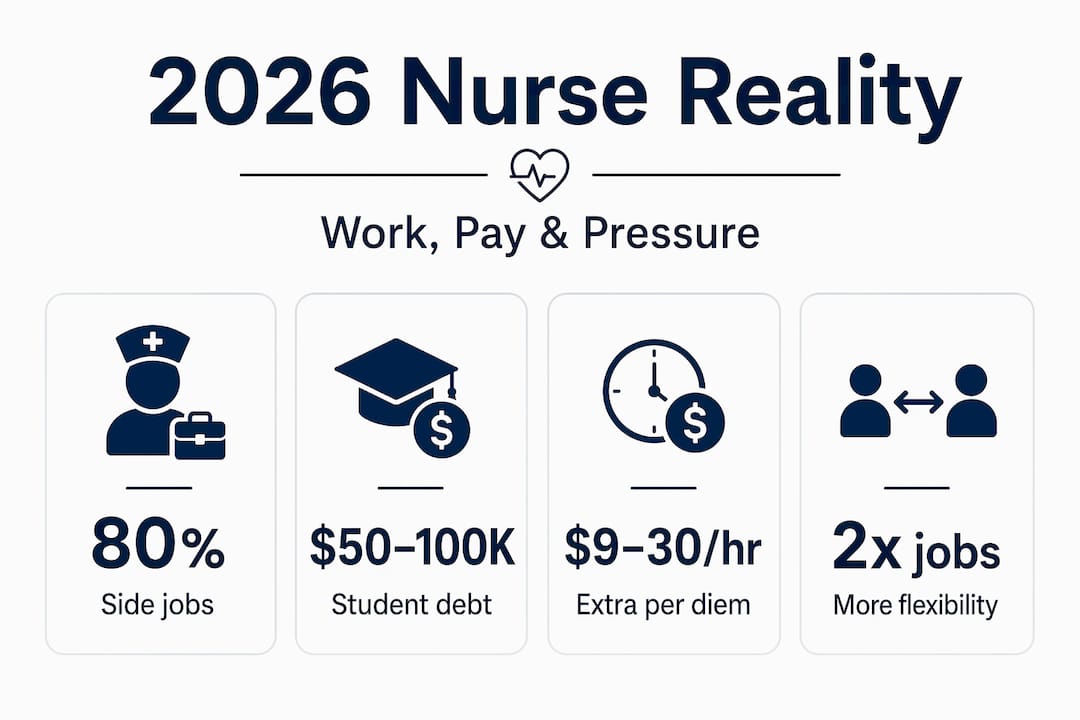
The assumption that nurses work multiple jobs simply because they love variety is wrong. For most, the answer is far less glamorous. Why nurses work multiple employers comes down to financial pressure, schedule control, and the need to build a career that one employer cannot fully support. 4 in 5 nurses now report having a side hustle outside of nursing. That number should stop you in your tracks. This article breaks down the real drivers behind multi-employer nursing, including money, flexibility, burnout, and career strategy.
Table of Contents
- Key takeaways
- Why nurses work multiple employers: the financial reality
- Scheduling flexibility and the multi-employer advantage
- Career advancement through multiple nursing roles
- Real challenges of working multiple nursing employers
- Practical steps for managing multiple nursing jobs
- My take on why nurses really juggle multiple jobs
- Find flexible nursing jobs that work for you
- FAQ
Key takeaways
| Point | Details |
|---|---|
| Financial pressure dominates | Most nurses take extra jobs to cover bills and debt, not for lifestyle reasons. |
| PRN roles unlock flexibility | Per diem shifts let nurses stack hours across employers without full-time commitments. |
| Career growth is a real driver | Multiple roles expose nurses to specialties and environments that one job rarely offers. |
| Contracts carry real risk | Moonlighting policies and non-compete clauses can affect your ability to work multiple jobs legally. |
| Burnout is the hidden cost | Working multiple employers without boundaries accelerates fatigue and reduces care quality. |
Why nurses work multiple employers: the financial reality
Money is the most honest answer. Multi-employer nursing is driven by financial survival, not lifestyle choices. Wages have not kept up with inflation, and the cost of living in many metro areas has outpaced what a single full-time nursing salary can cover.
Here is what the data shows:
- 71% of nurses started side hustles because of inflation, and 34% specifically to cover student loan debt.
- More than a third of nurses say financial pressure pushed them toward extra shifts or overtime, and 15% hold a second job outright.
- Side hustles contribute an average of 17% of total income for nurses who have them.
Student loans are a particular burden. Many nurses graduate with $50,000 to $100,000 in debt, and a single hospital salary in a mid-cost city often leaves less than $500 per month after housing, childcare, and loan payments. Adding even one per diem shift per week can change that math completely.
The pandemic made this worse. Many hospitals cut pandemic pay premiums after 2022, and some nurses saw their take-home pay drop while their workloads stayed the same. Per diem and PRN work became a fast fix to offset that income loss.
Pro Tip: If you are picking up per diem shifts for extra income, track whether the loss of benefits like health insurance or paid leave from a part-time status change actually costs you more than the added hourly pay brings in. Run the math before you commit.
Per diem rates support the financial case. Per diem nurses earn $9 to $30 more per hour than staff nurses working the same shifts, with the national average per diem RN rate sitting around $48 per hour in 2026. That premium is hard to ignore when your bills are due.
Scheduling flexibility and the multi-employer advantage
Flexibility is the second major reason nurses juggle multiple employers. A fixed full-time schedule means you work when your employer needs you. PRN and per diem roles flip that arrangement.
Here is how nurses commonly use flexible structures to work across employers:
- Pick up per diem shifts at a second facility on days off from a primary full-time job, selecting only the shifts that fit personal schedules.
- Work part-time at two facilities instead of full-time at one, giving more control over total hours without being locked into any single employer's rotation.
- Add a remote telehealth role to the mix, which requires no commute and can often be scheduled around other shifts.
- Use internal per diem pools at your primary employer. Many hospitals offer internal float pool or per diem options that allow nurses to earn the higher hourly rate without formally changing employers.
Scheduling flexibility via PRN roles is the biggest enabler for stacking multiple nursing jobs. For nurses with children, elder care responsibilities, or school commitments, this control over their calendar is not a perk. It is a necessity.
That said, irregular hours come with real costs. Nurses working across multiple facilities often face inconsistent shift patterns, longer commutes, and less predictable recovery time between demanding shifts. Fatigue compounds when you work a 12-hour night shift at one hospital and then pick up a day shift at another facility two days later.

Pro Tip: Before adding a second employer, map out your sleep and recovery windows for a full two-week period. If you cannot find at least two full days of genuine rest per week, the extra income will cost you more in health and performance than it provides.
Contractual limits matter here too. Some employers require disclosure or prior approval before nurses take secondary jobs. Moonlighting feasibility depends on state rules and employer policies, and contracts often include fatigue and patient safety safeguards. Read your employment contract before accepting any additional role.
Career advancement through multiple nursing roles
Some nurses are not working multiple employers out of financial desperation. They are doing it strategically, to build skills, test specialties, and increase their long-term marketability.
The benefits of multiple nursing roles from a career standpoint are real:
- Specialty exposure: Working a primary position in med-surg while picking up shifts in an outpatient oncology clinic gives you cross-specialty skills no single employer would typically offer.
- Testing a career pivot: Nurses considering a move into ICU, pediatrics, or telehealth can use per diem shifts to test those environments before committing to a full-time switch.
- Reducing burnout through variety: Nurses leaving bedside roles often move into telehealth, case management, or nursing education. Adding one of those roles alongside bedside work reduces physical strain while keeping skills current.
- Building entrepreneurial income: Some nurses use multiple employer experience to develop consulting work, legal nurse consulting, or health coaching as parallel income streams.
Here is a direct comparison of two approaches:
| Approach | Career benefit | Risk |
|---|---|---|
| Single full-time employer | Stability, benefits, PTO | Limited skill exposure, slower advancement |
| Multiple employers or PRN roles | Broader skills, higher hourly pay, specialty testing | Less job security, fewer benefits, fatigue risk |
The nurses who benefit most from multiple roles are the ones who treat each job as a deliberate career move rather than just a paycheck. If you are picking up random per diem shifts with no connection to your long-term goals, you are spending your energy without much return beyond the hourly rate.
Real challenges of working multiple nursing employers
The risks of working across multiple employers are concrete and worth taking seriously.
Physical and mental toll
Normalized overtime is linked to burnout and has measurable impacts on patient care quality. When you work 60 or more hours per week across two facilities, the quality of your clinical judgment declines. Your patients feel that, even if you do not.
Common risks include:
- Chronic fatigue and sleep disruption from mismatched shift rotations across employers
- Increased risk of medication errors and clinical oversights during peak exhaustion
- Reduced time for family, relationships, and personal recovery
- Mental health strain from constant shift transitions and different team environments
Contractual and legal considerations
"Contract and employer moonlighting policies significantly shape nurses' ability to work multiple jobs safely and legally." Sermo
Some hospitals include non-compete or non-solicitation clauses in nursing contracts. Others require written approval before a nurse accepts any secondary employment. Violating those terms can put your primary job at risk. Malpractice coverage is another issue. Your primary employer's malpractice insurance does not automatically cover you at a second facility. Verify your coverage before you start any new role.
Pro Tip: Ask any new employer directly: "What malpractice coverage applies to my role here?" Do not assume it is included. If you are working per diem without coverage, consider purchasing individual liability insurance.
Practical steps for managing multiple nursing jobs
If you are considering adding a second employer or already working across multiple jobs, these steps help you manage it without burning out.
- Review your current contract first. Check for moonlighting restrictions, disclosure requirements, and non-compete clauses before accepting any additional role. Managing contracts before taking additional roles prevents legal and professional conflicts.
- Calculate your actual take-home math. Per diem pay is higher hourly, but you may lose benefits at your primary job if your hours drop. Factor in health insurance, retirement contributions, and PTO value before making changes.
- Set hard limits on weekly hours. Most nursing boards and professional organizations recommend no more than 60 hours per week for patient safety reasons. Build your schedule around that ceiling, not under pressure to fill every available shift.
- Prioritize roles that match your career direction. If your goal is to move into leadership, pick up shifts in charge nurse roles or case management rather than just any available shift. Use your time purposefully.
- Schedule rest like you schedule shifts. Recovery time is not optional. Block it in your calendar the same way you would confirm a shift.
Pro Tip: Nurses who use flexible job platforms to manage their availability in real time report better schedule control than those negotiating shifts manually with multiple employers. Centralized scheduling reduces the mental load significantly.
My take on why nurses really juggle multiple jobs
I have seen the pattern clearly. When nurses tell me they are working two jobs, the first thing people assume is ambition. The reality is almost always something more grounded. Rent went up. Loans are due. One employer cut the pandemic differential and never brought it back.
What I have learned is this: the financial survival piece is real, but it is often compounded by the fact that nurses feel trapped by it. They take the second job to close a gap, and then the second job becomes normalized, and suddenly working 55 hours per week feels like the baseline. That is the part that concerns me most.
The other thing I have noticed is how few nurses actually read their employment contracts before accepting a second role. Contract awareness is self-protection. Employers are not your advocates in this. You have to be your own.
The bigger issue here is structural. Healthcare employers need to reckon with the fact that their nurses are working at competing facilities on their days off because a single salary is no longer sufficient. Until compensation catches up, multi-employer nursing is not going away. But nurses can protect themselves by treating their time and their health as the non-negotiable variables in that equation.
— Flexible
Find flexible nursing jobs that work for you
If you are managing multiple employers right now or considering adding a second role, the right platform makes a real difference in how manageable your schedule becomes.

Flexiblenursingcareers connects nurses with per diem, PRN, travel, and telehealth roles matched to your skills, location, and availability in real time. You do not have to chase shifts manually or negotiate across multiple HR departments. You set your preferences, and the platform surfaces the roles that fit. Whether you are exploring nursing employment options for the first time or looking to replace a less flexible arrangement, sign up and start finding shifts that work around your life, not against it.
FAQ
Why do nurses work multiple jobs?
Most nurses work multiple jobs because a single salary no longer covers their financial needs, including student debt, inflation, and rising living costs. A third of nurses cite direct financial pressure as the reason they take on extra shifts or secondary employment.
Is it legal for nurses to work for multiple employers?
Yes, in most cases, but employer contracts may require disclosure or approval before you accept a second role. Moonlighting policies vary by state and employer, and some contracts include non-compete clauses that limit where you can work.
Do per diem nurses earn more than full-time staff nurses?
Yes. Per diem nurses earn $9 to $30 more per hour than staff nurses on the same shifts, with average per diem RN pay around $48 per hour nationally in 2026.
How many nurses currently have a second job or side hustle?
According to recent data, 4 in 5 nurses report having a side hustle outside of nursing, with roughly a quarter reporting some form of secondary income as of 2026.
What are the biggest risks of working multiple nursing employers?
The most common risks include burnout from excessive hours, lapses in malpractice coverage at secondary employers, and potential contract violations if moonlighting is not properly disclosed. Scheduling fatigue across different shift rotations is also a significant factor in clinical performance.