
Filtering nurse practitioner jobs by specialty area is the most effective way to identify roles that match your certification, patient population preference, and career goals. The NP job market spans 16 distinct specialty tracks, each governed by separate certification bodies including AANP, ANCC, PNCB, and NCC. Applying the right filters from the start prevents wasted applications and protects you from automated rejection systems that screen out mismatched credentials. Platforms like Flexiblenursingcareers let you filter NP career options by specialty, setting, and location so you reach only the roles you are actually qualified to fill.
How to filter NP jobs by specialty area effectively
Specialty filtering in NP job searching means narrowing listings by your specific certification track, not just your general nursing background. The distinction matters because employers often automate their screening. An AANP-certified Family Nurse Practitioner may be automatically excluded from roles requiring ANCC acute care credentials, even when clinical experience overlaps significantly. That rejection happens before a human ever reads your resume.
The core insight is simple: your certification body and specialty designation are the primary filters, not your years of experience. Matching those two data points to a job posting's requirements is the first step in any targeted NP job search. Everything else, including location, salary, and practice setting, comes after.

Flexiblenursingcareers applies real-time matching based on your credentials and availability, which means the platform does part of this filtering work for you. That said, understanding the underlying specialty structure makes you a sharper, faster searcher regardless of which platform you use.
What are the major NP specialty categories?
There are 16 recognized NP specialty tracks, and each one carries its own certification requirements. The most common tracks include Family (FNP), Adult-Gerontology Primary Care (AGPCNP), Adult-Gerontology Acute Care (AGACNP), Pediatric Primary Care (PPCNP), Pediatric Acute Care (CPNP-AC), Psychiatric-Mental Health (PMHNP), Women's Health (WHNP), and Neonatal (NNP).
The sharpest divide in NP specialties is between primary care and acute care. Primary care NPs, such as FNPs and AGPCNPs, typically work in outpatient clinics, community health centers, and private practices. Acute care NPs, such as AGACNPs and CPNP-ACs, work in hospitals, ICUs, and emergency departments. Applying for an acute care role with a primary care certification is one of the most common and costly mistakes NPs make during their job search.
Certification bodies also differ by specialty. AANP and ANCC both certify FNPs, but PNCB certifies pediatric NPs and NCC certifies neonatal and women's health NPs. Knowing which body issued your credential tells you exactly which job postings to target.
Pro Tip: Before applying, pull up the job posting's credentialing section and match the certification code listed there to your own certificate. If the employer lists "AGACNP-BC" and you hold "FNP-C," that role is not a match, regardless of how well the rest of the description fits.
What platforms let you filter NP jobs by specialty?
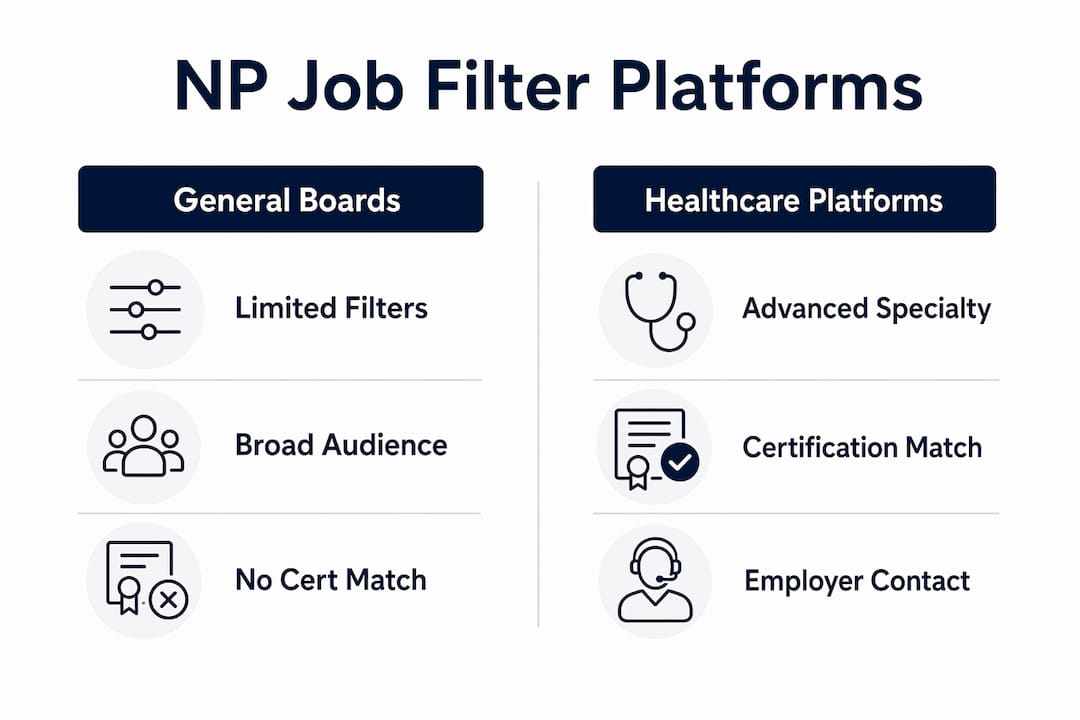
Modern job platforms vary widely in how well they support specialty filtering. The table below compares key filter features across platform types.
| Platform type | Specialty filter | Setting filter | Direct employer contact | Certification matching |
|---|---|---|---|---|
| General job boards | Limited | Rarely | No | No |
| Healthcare-specific boards | Moderate | Sometimes | Sometimes | Rarely |
| NP-focused platforms | Strong | Yes | Sometimes | Sometimes |
| Flexiblenursingcareers | Yes | Yes | Yes | Yes |
General job boards like broad employment sites rarely offer specialty-level filters for NPs. Healthcare-specific platforms improve on that, but many still rely on keyword searches rather than structured specialty categories. NP-focused platforms, including Flexiblenursingcareers, go further by letting you filter by specialty area and practice setting simultaneously.
PracticeMatch lists over 50 unique clinical and surgical specialties with advanced filters, which demonstrates what a well-built filtering system looks like in practice. Flexiblenursingcareers applies a similar approach while also connecting you directly to employers, cutting out third-party recruiters entirely. Direct employer platforms reduce time to hire and give you faster access to decision-makers.
Pro Tip: Use Boolean operators when searching on platforms that support keyword input. Searching "PMHNP AND outpatient AND (telepsychiatry OR telehealth)" surfaces niche roles that a basic specialty dropdown might miss. Set up saved searches with email alerts so new postings reach you within hours of going live.
Step-by-step approach to filtering and prioritizing NP jobs
A structured approach produces better results than browsing open listings. Follow these steps in order.
-
Confirm your specialty and certification first. Write down your exact certification title, the issuing body, and your expiration date. This is your baseline filter. Every search you run should start here.
-
Define your patient population and practice environment. Clarifying these priorities before you open a job board prevents you from getting distracted by listings that look appealing but do not fit your clinical identity. Decide whether you prefer pediatric or adult patients, inpatient or outpatient settings, and urban or rural locations.
-
Apply specialty filters before location filters. Specialty narrows the field most aggressively. Apply it first, then layer in location, setting, and schedule preferences. Reversing this order often produces a large list of geographically convenient but professionally incompatible roles.
-
Cross-check filtered results against state licensing requirements. NP scope of practice varies by state. A role in a full-practice-authority state gives you more clinical independence than the same role in a restricted state. Verify your license is active or transferable before investing time in an application.
-
Evaluate salary by specialty alongside job fit. Median NP salaries range from approximately $129,000 to over $170,000 depending on specialty and geography. Psychiatric-Mental Health NPs and Acute Care NPs tend to command higher compensation. Use this data to set realistic expectations and prioritize roles that reward your specific training.
-
Avoid applying to roles where the certification is listed as "preferred" rather than "required." Preferred language often means the employer will hire a different specialty if a better-matched candidate applies. Your time is better spent on roles where your certification is explicitly required.
-
Track your applications by specialty category. A simple spreadsheet with columns for specialty, setting, location, certification required, and application status shows you where your search is concentrated and where gaps exist.
How do you troubleshoot a stalled NP specialty job search?
A stalled search usually traces back to one of three problems: overly broad job titles, certification mismatches, or geography.
Job titles are the first culprit. Employers often post roles under generic titles like "Advanced Practice Provider" or "Mid-Level Clinician" that do not reflect the actual specialty depth of the position. Boolean search operators solve this problem. Searching for your specific certification abbreviation alongside the clinical setting surfaces these hidden roles more reliably than browsing by title alone.
- Check whether the posting uses "NP" generically or specifies a certification type. Generic postings often accept multiple specialties.
- Filter by inpatient versus outpatient setting separately. A search for "AGACNP" in outpatient settings will return very few results because that certification is primarily inpatient. Adjusting the setting filter fixes the mismatch.
- Specialty demand is highly localized. A PMHNP may find abundant openings in urban markets and almost none in rural areas. Cross-referencing your specialty with regional healthcare infrastructure data helps you decide whether to expand your geographic range or pursue telehealth options.
- Professional networks surface roles that never reach public job boards. Colleagues, clinical preceptors, and specialty-specific professional associations often know about openings before they are posted.
Pro Tip: Update your profile on every platform you use at least once a month. Many platforms surface recently active profiles higher in employer searches. A stale profile can cost you visibility even when your credentials are a perfect match.
Why specialty filtering changed how I search for NP roles
Before I started filtering by specialty, I treated the NP job market like a general nursing job board. I applied broadly, hoping that experience would compensate for credential mismatches. It did not. I received automated rejections from roles I was genuinely qualified for because I had not matched my PMHNP certification to postings that specifically required it.
The shift happened when I stopped browsing and started filtering. I defined my specialty, my preferred patient population, and my setting before I opened a single job board. That pre-work cut my search time significantly and produced a much shorter list of roles that were actually worth pursuing.
The lesson I keep sharing with colleagues is this: the filtering step is not a shortcut. It is the actual work. Browsing open listings without filters is the shortcut, and it produces poor results. Specialty filtering requires you to know yourself as a clinician first, and that self-knowledge is what makes every subsequent step faster and more accurate.
— Flexible
Flexiblenursingcareers and your specialty NP job search
Flexiblenursingcareers connects NPs directly with employers who post roles by specialty, setting, and schedule. No third-party recruiters stand between you and the hiring manager.

The platform's specialty filters let you narrow your search to the exact certification type and practice environment you want. Whether you are a PMHNP looking for outpatient telepsychiatry or an AGACNP targeting a hospital system, you can browse nursing jobs by specialty and apply directly. Flexiblenursingcareers also supports telehealth roles, which are increasingly common in specialized NP practice. Sign in or create an account to set up saved searches and receive alerts when new specialty positions go live.
FAQ
What does it mean to filter NP jobs by specialty area?
Filtering NP jobs by specialty area means narrowing job listings to roles that match your specific certification track, such as FNP, PMHNP, or AGACNP, rather than searching all nursing or advanced practice roles at once. This approach prevents credential mismatches and reduces wasted applications.
Why does my certification body matter when filtering NP jobs?
Employers use automated screening systems that check for exact certification matches. An AANP-certified FNP can be rejected automatically from a role requiring ANCC acute care credentials, even when clinical experience is comparable.
How do I find NP jobs in a specific specialty if postings use generic titles?
Use Boolean search operators to combine your certification abbreviation with setting or population terms. Searching "PMHNP AND outpatient" or "AGACNP AND ICU" uncovers relevant roles that generic titles would otherwise hide.
Do NP salaries differ significantly by specialty?
NP salaries range from approximately $129,000 to over $170,000 depending on specialty, geography, and setting. Psychiatric-Mental Health and Acute Care NPs generally earn at the higher end of that range.
Can I filter NP jobs by telehealth or remote setting?
Yes. Platforms that support setting-level filters, including Flexiblenursingcareers, allow you to narrow results to telehealth NP roles specifically. Telehealth positions are growing across multiple NP specialties, particularly in psychiatric-mental health and primary care.
Key takeaways
Filtering NP jobs by specialty area requires matching your exact certification to employer requirements before applying any other search criteria.
| Point | Details |
|---|---|
| Certification match is non-negotiable | Automated employer systems reject mismatched credentials before a human reviews your application. |
| Primary vs. acute care is the sharpest divide | Applying across this line wastes time and produces automatic rejections regardless of experience. |
| Specialty filters before location filters | Narrowing by specialty first produces a shorter, more relevant list than starting with geography. |
| Boolean operators surface hidden roles | Generic job titles hide specialty depth; combining certification codes with setting terms finds them. |
| Salary varies meaningfully by specialty | NP compensation ranges from $129,000 to over $170,000, making specialty choice a financial decision too. |