
Nurse practitioners spend years building specialized clinical skills, yet many turn to general job boards and end up wading through pages of RN listings, medical assistant postings, and roles that bear no resemblance to their credentials. That mismatch is exactly why NPs seek specialized job platforms in growing numbers. A targeted platform does what a broad board cannot: it filters by NP specialty, certifies employer listings, and surfaces salary ranges that reflect the true value of advanced practice. This article explains what sets these platforms apart, where they deliver real advantages, and how to build a search strategy that actually works.
Table of Contents
- Key takeaways
- Why NPs seek specialized job platforms
- Direct benefits you get from niche platforms
- Misconceptions that keep NPs stuck on general boards
- How to use specialized platforms effectively
- Choosing between platforms: a practical comparison
- My take on the specialized platform question
- Find your next NP role on Flexiblenursingcareers
- FAQ
Key takeaways
| Point | Details |
|---|---|
| Specialized platforms pay off | NP-focused boards connect you with roles that offer 15-25% higher salaries than those found on general sites. |
| Vetted listings reduce wasted time | Specialty platforms verify employers, cutting through spam and misleading remote job postings. |
| ATS readiness matters everywhere | Tailoring your resume with exact keywords from the job description improves your chances on any platform. |
| Multi-channel search wins | Combining two or three specialized boards with direct outreach and one universal board produces the best results. |
| Platform quality over quantity | Focusing on one or two NP-specific platforms beats spreading thin across ten generic job sites. |
Why NPs seek specialized job platforms
Not all job boards are built the same. General platforms index millions of listings across every industry and every credential level. When you search "nurse practitioner" on one of those sites, you might get relevant hits, but you will also scroll past travel nurse contracts, CNA openings, and administrative roles that were tagged with healthcare keywords just to capture clicks.
Specialized job platforms solve that problem at the structural level. They are built specifically for a professional community, meaning the filters, the employer network, and the listing criteria all reflect that community's needs.
For NPs, the most trusted specialized resource is the AANP JobCenter, which serves over 290,000 NPs and offers filtering by specialty, practice setting, and certification type. You can narrow a search to psychiatric mental health NPs in outpatient settings or family practice NPs seeking telehealth roles. That level of granularity simply does not exist on general boards.
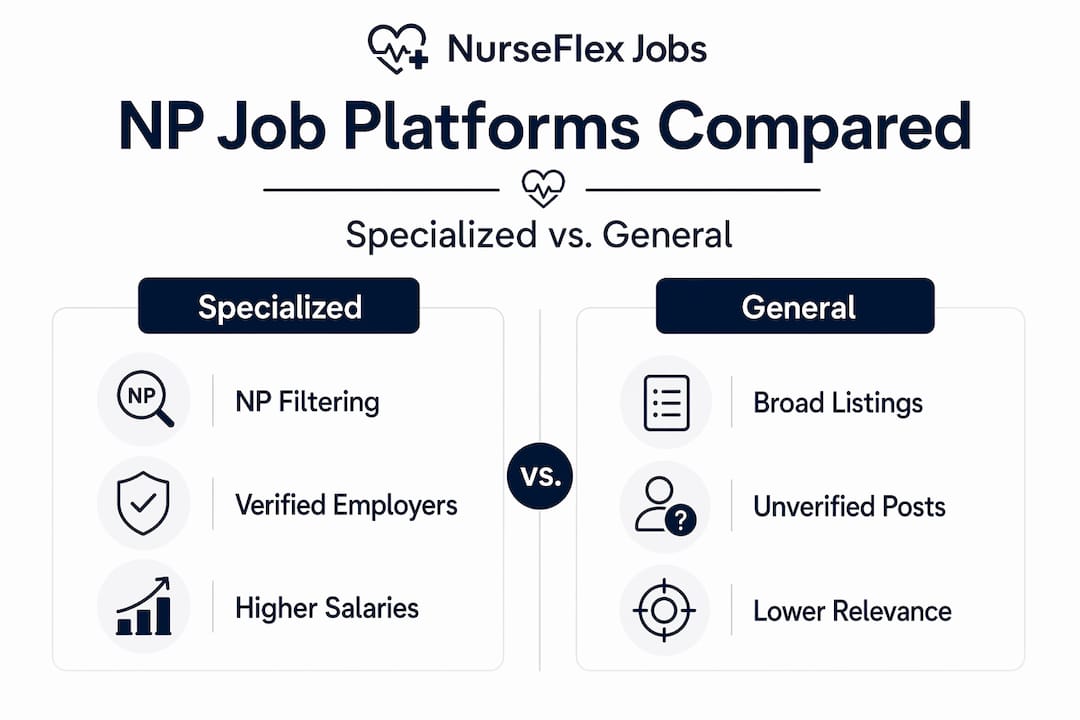
Here is how specialized NP platforms differ from general ones at a glance:
| Feature | Specialized NP platforms | General job boards |
|---|---|---|
| Specialty filtering | Yes, by NP certification and clinical focus | No or very limited |
| Employer vetting | Required verification process | Self-serve, minimal checks |
| Salary transparency | Common, reflects NP market rates | Inconsistent |
| Remote job accuracy | Screened for genuine remote roles | Frequent misleading listings |
| Community networking | Built in for NP professionals | Generic or absent |
| Listing relevance | 90%+ NP or advanced practice | Often below 30% |
The difference is not subtle. When specialized healthcare platforms require employer verification, they dramatically reduce scams and irrelevant postings that flood general boards. Your time per relevant listing drops, and your confidence in what you find goes up.
Direct benefits you get from niche platforms
The advantages of specialized job platforms for NPs go well beyond convenience. They translate into measurable career outcomes.
Higher salary access. Employers posting on niche NP boards are specifically recruiting advanced practice clinicians. They understand the credential, respect the scope of practice, and pay accordingly. Specialized roles on niche boards tend to offer salaries that run 15-25% higher compared to equivalent listings on general platforms. Employers also invest more in each posting, spending $300 to $600 per listing, which signals serious hiring intent.
Better signal-to-noise ratio. On a verified specialty platform, the listings you see were placed by someone who had to prove their organization was legitimate. That filter removes the noise that makes general boards so frustrating.

Protection from remote-washing. Remote-washing is when employers label a position as remote when it is actually hybrid or fully on-site. It is common on general boards. Specialty platforms vet listings, and genuine remote NP roles typically require two to three years of prior in-person clinical experience. A platform that states those standards upfront saves you from wasting time on applications that go nowhere.
Access to unadvertised positions. Some specialized platforms include networking directories, job alerts tied to specific specialties, and premium listings from employers who post exclusively with NP-focused organizations. Those roles never appear on general boards.
Here are the core benefits that make niche boards worth prioritizing:
- Listings aligned with your NP specialty and certifications
- Networking tools that connect you directly with hiring managers
- Job alert systems tailored to clinical focus and location preferences
- Employer profiles that include culture, scope of practice details, and compensation ranges
- Community forums and continuing education resources that build your professional presence
Pro Tip: Set up job alerts on your primary specialized platform using your most specific NP certification (for example, PMHNP or AGACNP) rather than just "nurse practitioner." You will receive fewer alerts, but nearly every one will be worth reading.
Candidates found through sourced channels on specialized platforms are five times more likely to be hired than inbound applicants on general boards. That is not a small edge. That is a fundamentally different hiring dynamic working in your favor.
Misconceptions that keep NPs stuck on general boards
Many NPs assume that bigger means better when it comes to job boards. The logic sounds reasonable: more listings equals more opportunities. In practice, it rarely works that way for advanced practice clinicians.
Here are the most common myths worth letting go of:
-
"General boards have the most jobs." They have the most listings. That is not the same thing. A board with 500,000 listings and 200 relevant to your specialty is less useful than a platform with 8,000 listings where 6,500 match your credential.
-
"My resume will stand out on a big platform." The opposite is usually true. High-volume boards attract high-volume applications. AI-generated spam applications flood employer inboxes, and generic resumes rarely clear the applicant tracking systems (ATS) that filter them.
-
"I can just use one job board." Exclusivity limits you. Combining platforms strategically across two to three specialty sites and one universal board produces the best results without overextending your effort.
-
"Online applications are enough." They are a starting point, not a complete strategy. Cold calling clinics and direct outreach to hiring managers consistently uncover leads that never get posted online. For NPs targeting specific practice settings or geographic areas, direct contact often outperforms mass applying.
"The NPs I see landing their best roles are not the ones with the most applications sent. They are the ones who picked the right two platforms, built a strong profile, and made a few well-targeted phone calls." — Pri-Med NP Career Guidance
Relying solely on general boards also means missing roles that employers post exclusively through professional organizations. If an employer wants a psychiatric mental health NP and they know the AANP JobCenter reaches that audience directly, they will post there and nowhere else. You will not find that role on a general board because it was never listed there.
How to use specialized platforms effectively
Knowing why these platforms matter is one thing. Using them well is another.
Start by picking the right one or two platforms. For most NPs, the AANP JobCenter is a primary resource. It is the largest NP-specific platform in the nation, widely recommended by career experts, and covers the broadest range of specialties. Depending on your focus area, psychiatric NPs may also benefit from platforms that specialize in behavioral health hiring. Check whether NPs practice psychiatry in your target setting before narrowing your platform selection by specialty.
Optimize your profile and resume before applying. ATS software scans for specific keywords before a human ever reads your resume. Tailoring with exact keywords from the job description and quantifying your clinical outputs (patient volume, quality metrics, procedures performed) significantly improves your pass rate. Generic resumes fail ATS on specialized NP roles at a higher rate than most candidates realize.
Use the networking tools the platform provides. Platforms tied to professional organizations often have directory features, member forums, and event listings. Attending a virtual conference through AANP or engaging in a specialty forum puts your name in front of hiring managers before a job ever gets posted.
Balance your search across channels. Use your specialized board as your primary resource. Supplement it with one universal board for broader visibility. Then add passive job search methods like keeping your LinkedIn updated and registering on healthcare-specific staffing platforms that reach out to you with matches.
Pro Tip: Track every application in a simple spreadsheet: platform used, date sent, follow-up date, and outcome. After 30 days, you will have clear data on which platforms are generating callbacks and which ones are wasting your time.
Getting hired quickly in healthcare correlates directly with how targeted your search is. Broad searches produce slow results. Focused searches on the right platforms produce faster calls and better offers.
Choosing between platforms: a practical comparison
With over 75% of job sites globally now classified as niche sites, the field has expanded considerably. That means you have real choices, but also real decisions to make.
| Criteria | Best platform type | What to look for |
|---|---|---|
| NP specialty alignment | Specialized | Filters by certification, not just job title |
| Remote job accuracy | Specialized | Verification of genuine remote roles |
| Volume of listings | General | Broader reach for early-career searches |
| Salary transparency | Specialized | Ranges tied to NP market, not general nursing |
| Employer credibility | Specialized | Required employer verification process |
| Networking features | Specialized (org-based) | Member directories, forums, event access |
When evaluating a platform, ask yourself three questions. Does it filter by your specific NP certification? Does it verify employer listings? And does it have active postings in your geographic area or for remote roles within the last 30 days? If the answer to all three is yes, it belongs on your short list.
Avoid the temptation to register on ten platforms at once. Managing profiles, keeping resumes current, and tracking applications across too many boards creates real overhead. Two to three well-chosen platforms used consistently will outperform ten that you check irregularly.
My take on the specialized platform question
I've watched a lot of NPs go through the job search process, and the ones who struggle longest share one habit: they start on the big boards, send a pile of applications, and then wait. Weeks pass. A few rejections arrive. Confidence drops.
What I've learned is that the platform you start on shapes your entire search psychology. When you open a board that actually speaks your credential, shows salary ranges you recognize, and filters by your specialty, the search feels different. You are not hunting for needles in haystacks. You are working a focused list.
My honest experience is that combining two specialized platforms with active outreach beats any single-channel approach. I've seen NPs land telehealth roles within three weeks by doing two things: setting up precise alerts on a specialty board and making five direct calls per week to practices in their area. The calls feel uncomfortable at first. They work anyway.
One more thing: flexible and part-time NP roles are genuinely available, but you will find far more accurate listings for them on platforms that were built for healthcare professionals. General boards are full of flexible job listings that collapse under scrutiny. Specialty boards hold up.
Be patient with the process, but be precise with your tools.
— Flexible
Find your next NP role on Flexiblenursingcareers
If you are ready to stop sorting through irrelevant listings and start applying to roles that actually match your credentials, Flexiblenursingcareers was built for exactly that.

Flexiblenursingcareers connects NPs with flexible, remote, part-time, and specialty positions through real-time matching based on your skills, certifications, and availability. There is no lengthy screening process. You sign up, set your preferences, and the platform surfaces opportunities that fit. Employers on the platform are vetted, listings are current, and the focus stays where it belongs: on advanced practice clinicians who want work that fits their life. Sign in or create your account today and see which roles are available in your specialty right now.
FAQ
Why do NPs prefer specialized job boards over general sites?
Specialized job boards filter by NP certification, practice setting, and salary range, saving significant time and connecting NPs with roles that match their credentials. General boards mix NP listings with unrelated healthcare postings, reducing search efficiency.
What is remote-washing and how do specialized platforms help?
Remote-washing is when a job is labeled remote but requires on-site or hybrid work. Specialized NP platforms vet listings for accuracy, and most genuine remote NP roles require two to three years of prior clinical experience, which reputable platforms disclose upfront.
How many specialized platforms should an NP use at once?
Two to three specialized platforms combined with one universal board and direct outreach gives you broad coverage without overloading your search. Using more than three platforms at once typically reduces the quality of each application you send.
Do specialized platforms offer better salary opportunities for NPs?
Yes. Specialized roles on niche boards offer salaries that run 15-25% higher on average compared to similar listings on general job boards, and employers investing in niche board postings typically have serious hiring intent.
How should NPs optimize their profiles on specialized platforms?
Use your exact NP certification title in your profile headline, include keywords from target job descriptions throughout your resume, and quantify clinical outputs like patient volume or quality metrics to improve your pass rate through applicant tracking systems.