
"Reciprocity" is not an official licensing term, and treating it like one leads nurses toward the wrong application. What actually exists is a multistate license under the Nurse Licensure Compact, licensure by endorsement, or a temporary permit. Your first move is running Nursys QuickConfirm and checking your state board of nursing's site to see which path applies to you.
TL;DR:
- A multistate license in the Nurse Licensure Compact allows nurses to practice across member states without separate applications, but advanced practice nurses are excluded.
- Licensing by endorsement is necessary for non-compact states or when moving between non-participating states, often taking several weeks to process depending on background checks and documentation.
- Confirm your license type and practice privileges through Nursys before accepting work, as disciplinary actions or pending investigations can restrict practice even in states where you hold a multistate license.
- Applying for a multistate license requires proof of residence, passing NCLEX, and completing background checks, with processing timelines and fees varying by state.
- Transitioning between states with a compact license usually involves verifying eligibility beforehand and may include a temporary permit to start working promptly.
Table of Contents
- Nursing License Reciprocity Isn't a Real Category. Here's What Is
- How the Nurse Licensure Compact Actually Works
- Do You Qualify? Uniform Licensure Requirements and Proving Residency
- How to Apply for a Multistate License
- Licensure by Endorsement: When the Compact Doesn't Cover You
- What to Expect: Timelines and Fees
- Verifying Your License Status Before You Accept Work
- Where NurseFlex Jobs Fits Into Your Licensure Timeline
- Our Take: Stop Calling It Reciprocity
- Sources
- FAQ
Nursing License Reciprocity Isn't a Real Category. Here's What Is
Nurses ask about "reciprocity" because it sounds like the obvious word for moving a license across state lines. No board of nursing issues something called a reciprocity license. Three mechanisms actually govern this:
- Multistate (compact) license: issued by your primary state of residence if that state is in the Nurse Licensure Compact, letting you practice in any other compact state without a separate application.
- Licensure by endorsement: the standard path when either your home state or the destination state isn't in the compact. You apply directly to the new state's board.
- Temporary permit: a short-term, conditional authorization that lets you work while your endorsement or compact application is still processing.
A travel nurse based in a compact state generally just needs her multistate license verified before accepting an assignment in another compact state. A nurse relocating permanently from a noncompact state to a noncompact state has to apply by endorsement, full stop. Matching your situation to the right mechanism saves weeks of confusion later.
How the Nurse Licensure Compact Actually Works
The compact covers RNs and LPN/VNs. It does not cover advanced practice registered nurses, who need separate state licensure or a different compact arrangement, according to CompactStates. If your primary state of residence is a compact state, that state issues your multistate license, and you gain practice privileges in every other compact state, including telehealth encounters with patients physically located there.
Many states participate in the compact in some form, though "enacted" and "live" status differ, and some states have never joined. Confirm current status through the 40 Nurse Compact States list rather than assuming your state qualifies.
Disciplinary accountability stays with your home state, but party states retain the right to restrict your practice privileges within their borders, according to the American Nurses Association. That split matters more than most nurses realize. An open investigation in your home state can freeze your multistate privileges everywhere, even in states where you've never had a complaint filed.
Do You Qualify? Uniform Licensure Requirements and Proving Residency
Eligibility for a multistate license runs through the Uniform Licensure Requirements the compact set. You need:
- An active, unencumbered nursing license with no pending discipline
- Graduation from a board-approved nursing education program
- A passing score on the NCLEX-RN or NCLEX-PN
- Completion of a fingerprint-based state and federal criminal background check
Beyond meeting the ULRs, you have to document your primary state of residence. States typically accept a driver's license, a federal tax return, a W-2, voter registration, or military form 2058 as proof, according to the compact's own public FAQ. No single document is universally required. Check your specific state's list before submitting anything.
A few situations trip people up regularly. Military spouses often keep a legal residence in one state while stationed in another, which can complicate PSOR claims. Nurses licensed before their state joined the compact sometimes had their single-state license automatically converted, so it's worth confirming your current status rather than assuming. Recent graduates should apply for their initial license in their state of residence, not wherever they happen to attend school.
Pro Tip: If you change your primary state of residence, most states expect you to apply for licensure in the new state, and some apply roughly a 60-day window for that transition. Check your destination board's page before you move, not after.
How to Apply for a Multistate License
If your state participates in the compact, converting to or applying for a multistate license follows a fairly consistent sequence:
- Confirm your state has implemented the compact and check whether your existing license is single-state or multistate through Nursys.
- Gather your PSOR documentation (driver's license, tax return, or equivalent).
- Complete your board of nursing's application for a multistate license.
- Submit fingerprints and consent to the state and federal background check.
- Pay the application fee listed on your state BON's site.
- Track your application status through your board's online portal.
If you need to start work before your license converts, ask your board whether a temporary permit is available and confirm the exact timeline directly on the BON website, since ranges vary widely by state.
Licensure by Endorsement: When the Compact Doesn't Cover You
Endorsement is the correct path when either your home state or your destination state sits outside the compact, or when you're moving between two noncompact states. It's a direct application to the new state's board rather than an automatic extension of privileges.
A typical endorsement checklist looks like this:
- Verify your current license status through Nursys before applying.
- Request transcripts from your nursing program if the new state requires them.
- Document completed continuing education hours if the state mandates them for endorsement.
- Complete fingerprinting and the criminal background check.
- Pay the state's application fee and submit any state-specific forms.
- Ask about temporary or provisional permits if you need to start working before the full license is issued.
Pro Tip: Every state varies on what it asks for beyond the basics. Some want an employer verification letter, others don't. Call the board directly if the online checklist feels incomplete. It's faster than guessing wrong and resubmitting.
What to Expect: Timelines and Fees
Processing time depends heavily on the state and the path you're taking, and delays usually trace back to missing fingerprints, incomplete transcripts, or unverified prior licenses.
- Endorsement applications commonly take several weeks, sometimes stretching to a few months when background checks or verification requests stall, according to NurseJournal.
- Some states issue temporary permits, occasionally valid for around 120 days and nonrenewable, to bridge the gap while endorsement processes.
- Multistate conversions for existing license holders often move faster than a first-time endorsement application, since much of the verification already exists in Nursys.
Fee amounts and exact timelines live on your specific board's application page, not in a national table, because states set these independently.
Verifying Your License Status Before You Accept Work
Never assume your privileges. Confirm them.
- Run a Nursys QuickConfirm search and check whether your license reads "multistate" or "single state," then review the "Where can the nurse practice?" field for the exact list of states.
- For endorsement licenses or temporary permits, use your state board's own license lookup tool, since Nursys doesn't always reflect permit-level detail immediately.
- If your record shows an encumbrance, a pending investigation, or a mismatch between what you expect and what's listed, contact the issuing board directly before accepting an assignment. A reinstatement process may need to run its course first.
Where NurseFlex Jobs Fits Into Your Licensure Timeline
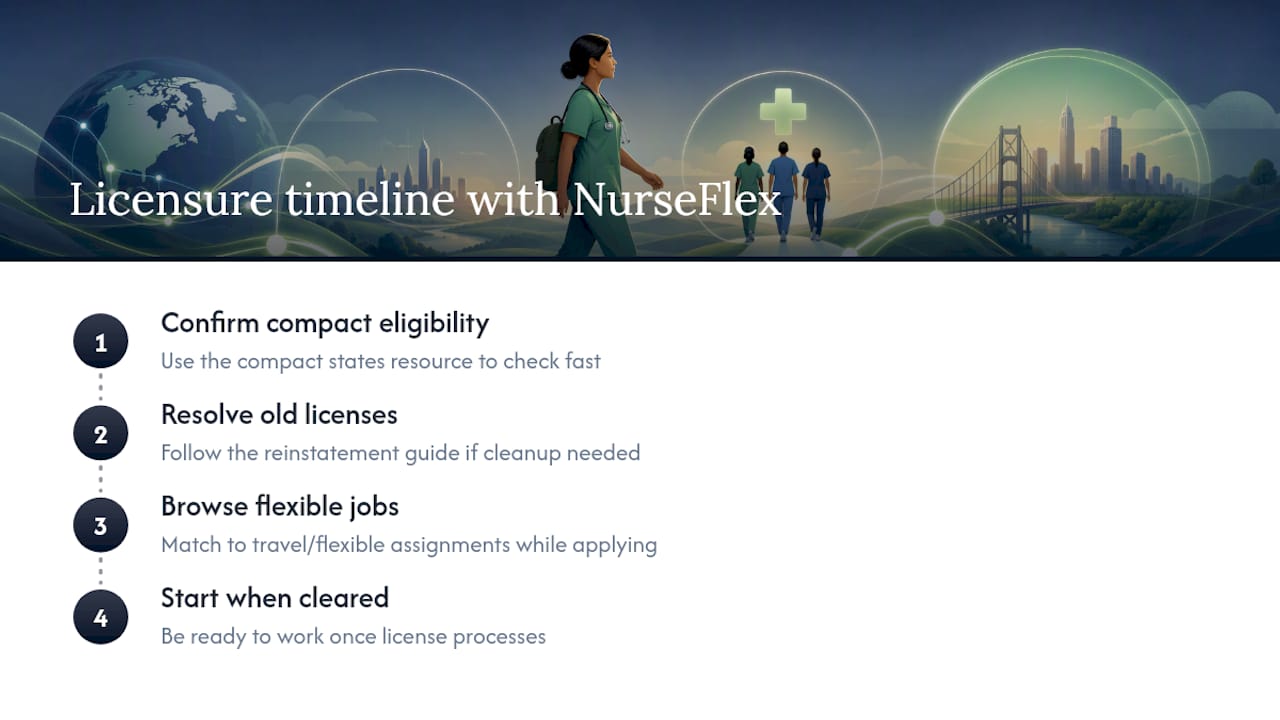
A job platform matches nurses to flexible and travel assignments across the U.S. while you sort out compact eligibility or endorsement paperwork. Our nurse compact states resource helps you confirm eligibility fast, and our reinstatement guide covers what to do if an old license needs cleanup first. Browse flexible nursing jobs while your application processes, so you're ready to work the moment your license clears.
Our Take: Stop Calling It Reciprocity
The word "reciprocity" survives because it's intuitive, not because it's accurate. That gap between vocabulary and mechanism costs nurses real time. Someone who searches "nursing reciprocity" expecting a simple transfer form ends up filling out an endorsement application meant for someone with zero prior licensing history, missing steps that a multistate conversion would have skipped entirely.
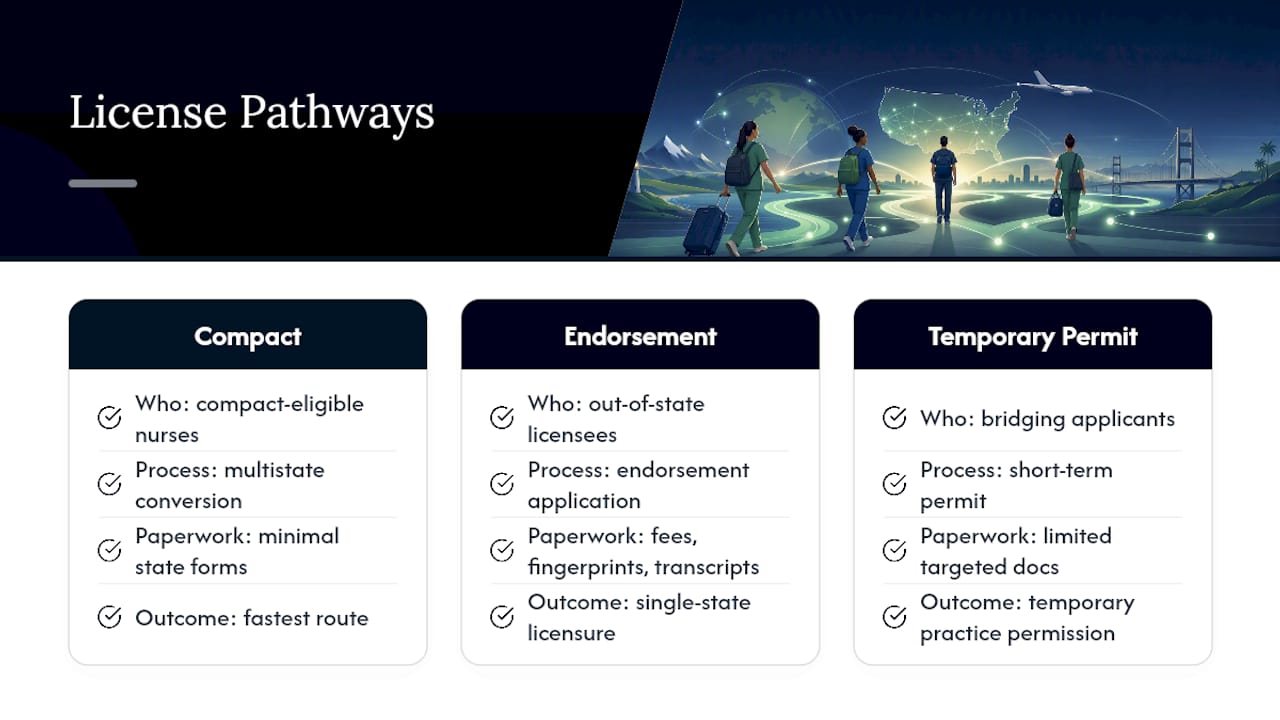
The nurses who navigate this fastest are the ones who identify their actual mechanism first: compact eligibility, endorsement, or a bridging temporary permit. Everything else, the fees, the fingerprinting, the transcript requests, follows from that one decision. Get it wrong and you're not just delayed. You may be submitting paperwork to the wrong process altogether.
Telehealth has made this messier, not simpler; see how teleradiology for rural and critical access hospitals organizes cross-state telehealth practice and accountability. A nurse can be physically in one state while treating a patient in another, and compact status determines whether that's even legal. If you're building a career around remote or cross-state work, understanding your telehealth practice privileges matters as much as understanding your license type. The paperwork isn't going away. But knowing which paperwork you actually need cuts the timeline in half for most nurses we talk to.
— Flexible
This article is general information, not a substitute for advice from a qualified lawyer. Consult a qualified legal professional about your own circumstances before acting on anything here.
Sources
- CompactStates — Compact nursing states (2026)
- NCSBN nurse licensure guidance / Nursys QuickConfirm
- American Nurses Association — Interstate Nurse Compact overview
- NurseJournal — RN licensing requirements by state (2026)
FAQ
What States Have Nursing License Reciprocity?
No state technically offers "reciprocity." Instead, states either participate in the Nurse Licensure Compact, which allows a multistate license to work across member states, or they require licensure by endorsement for nurses moving in from elsewhere.
What Countries Accept a U.S. RN License?
License recognition outside the U.S. depends entirely on that country's own nursing regulatory body and typically requires separate credential evaluation, exams, or supervised practice periods, since U.S. licenses don't automatically transfer internationally.
Can I Work in the U.S. With a Foreign Nursing License?
Generally no, not without going through a U.S. state board of nursing's endorsement process, which usually requires credential evaluation, passing the NCLEX, and meeting that state's specific requirements for internationally educated nurses.
What States Do Not Honor a Compact Nursing License?
States that haven't enacted the Nurse Licensure Compact don't recognize multistate privileges from another compact state, meaning a nurse working there needs to apply by endorsement instead. Check the current compact state list before assuming your multistate license applies, since membership changes as more states join.