
Several dozen jurisdictions have fully implemented the Nurse Licensure Compact as of mid-2026, giving nurses in those states a multistate license that works across every other fully implemented member. A few more jurisdictions have adopted the compact in total, but some of those have not activated it yet, which means a resident of those still cannot hold a multistate license today. That gap between "adopted" and "operational" trips up more nurses than any other part of the NLC, so check it before you assume your license travels.
This guide is current as of a June 2026 review of the National Council of State Boards of Nursing (NCSBN) and the NurseCompact map. If you need your specific state's live status right now, jump to the verification steps below and confirm it through Nursys before you accept an assignment.
Key Takeaways
A multistate license under the NLC only works in the 40 jurisdictions that have fully implemented the compact, not the 43 that have simply adopted it into law.
| Point | Details |
|---|---|
| Confirm live status first | Verify your state shows "fully implemented," not just "enacted," on the NurseCompact map. |
| Watch the 60-day clock | Apply for a multistate license in your new PSOR within 60 days of relocating, not a single-state license. |
| Practice follows the patient | Telehealth and travel nurses must follow the practice laws of the state where the patient is physically located. |
| Recheck border states often | Implementation status changes regularly, so recheck seams near noncompact or enacted-only jurisdictions each quarter. |
| Match roles to your license | NurseFlex Jobs connects nurses to flexible and telehealth roles that align with current multistate license status. |
Table of Contents
- Which States Are Fully Implemented Nurse Compact States in 2026?
- What Happens in States That Enacted the NLC but Aren't Live Yet?
- How Does the NLC Work and Who Qualifies for a Multistate License?
- What Are the Party-State, Telehealth, and 60-Day Rules?
- How Do You Verify Compact Status and Apply for a Multistate License?
- Sources
Which States Are Fully Implemented Nurse Compact States in 2026?
"Fully implemented" means a state's board of nursing has finished the legal and administrative work to actually issue and honor multistate licenses. Enacted-but-not-implemented status means lawmakers passed the compact into state law, but the board hasn't turned on the licensing mechanics yet. For a working nurse, that distinction is the difference between practicing legally in a new state tomorrow and waiting months for paperwork nobody controls.
Two of the more recent additions illustrate how fast this list moves. Pennsylvania went live on July 7, 2025, and Connecticut followed on October 1, 2025, according to a compact-state tracking guide from NurseZee. Both had been enacted for years before implementation actually landed.

Here's a representative snapshot of jurisdictions that were fully operational heading into 2026:
Always confirm current dates on the NurseCompact map before relying on any published table, including this one, since boards update status on a rolling basis.
The regional pattern matters as much as the raw count. Coverage across the South is dense enough that a nurse can often work state to state without hitting a gap, while the West remains more fragmented, with pockets of noncompact and enacted-but-not-live states breaking up the map. A few things to keep in mind about that coverage pattern:
- Multistate license reach ends abruptly at a noncompact border, even if the neighboring state feels like a natural commuting zone.
- Telehealth practice depends on where the patient sits, not where you're licensed, so a fully implemented home state doesn't guarantee coverage for every remote patient.
- Newer implementations can shift a "seam" overnight, so a border that was a hard stop last year may not be this year.
What Happens in States That Enacted the NLC but Aren't Live Yet?
Three jurisdictions have passed the compact into law but haven't finished the operational rollout, according to the same 2026 coverage analysis. Enacted-but-not-implemented is a real legal status, not a technicality you can work around.
If you live in one of these jurisdictions, you cannot get a multistate license there yet, no matter how long it's been since the law passed. Visiting nurses from other compact states might still be permitted to practice under transitional provisions, but that depends entirely on the individual board's rules, so verify directly rather than assuming.
A short checklist keeps you from getting caught off guard:
- Check the jurisdiction's board of nursing website directly, not a summary article, for its current implementation timeline.
- Search the NurseCompact map for the jurisdiction's exact status label ("enacted" versus "implemented").
- If you're relocating there, ask the board in writing whether a multistate license from your current state will be honored during the transition.
- Set a calendar reminder to recheck status every quarter if your assignment depends on that jurisdiction going live.
How Does the NLC Work and Who Qualifies for a Multistate License?
The compact runs on a concept called the Primary State of Residence, or PSOR: the one state where you legally live, and the only state that can issue your multistate license. Uniform Licensure Requirements (ULRs) are the shared eligibility standards every member state agrees to enforce, so a license issued in one compact state means something consistent in every other one.
To qualify, you generally need to meet a handful of ULR checks: a state and federal criminal background check, passage of an NCLEX exam or equivalent, no active discipline on your license, and no felony convictions related to practice. Boards also check for pending investigations, so a nurse mid-discipline in one state won't get a clean pass in another simply by applying somewhere else.
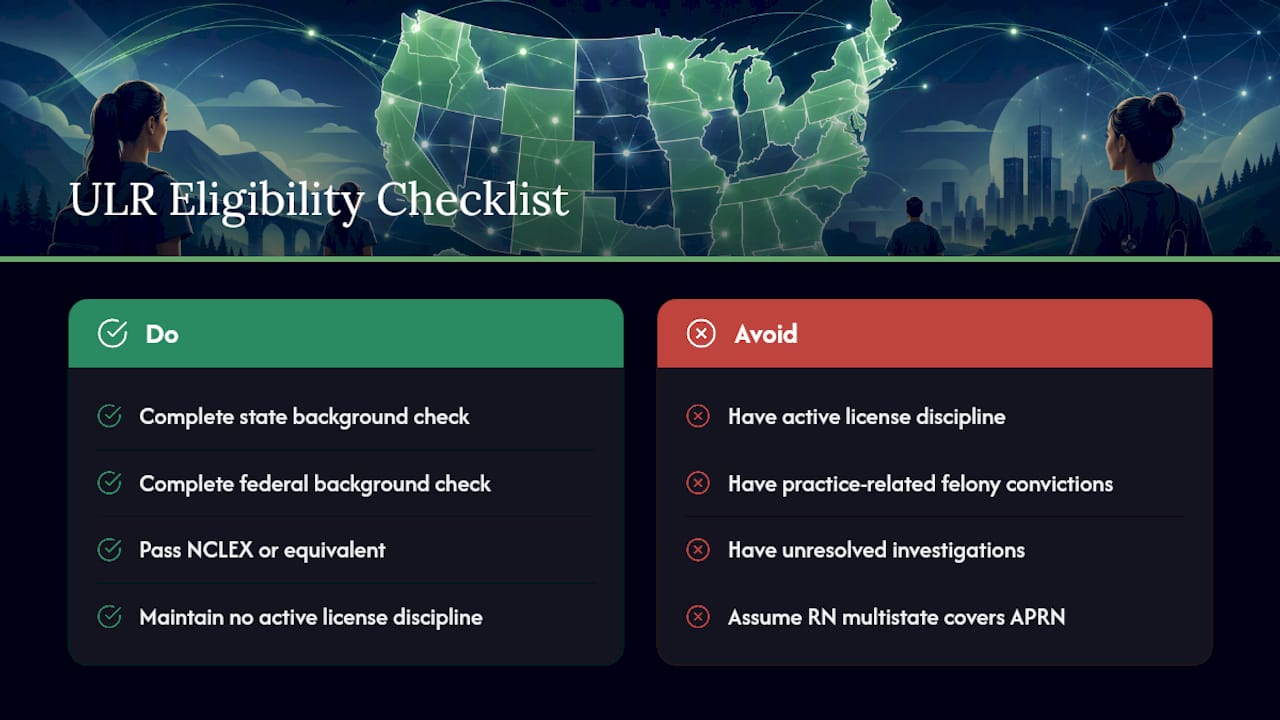
One distinction trips up a lot of APRNs specifically: the NLC covers RNs and LPN/LVNs. Advanced practice registered nurses operate under a separate agreement, the APRN Compact, which has a much smaller list of member states and a slower rollout. If you're a nurse practitioner or clinical nurse specialist assuming your RN-level multistate license extends to your advanced scope, it doesn't. Check APRN Compact status separately before you plan a move around it.
What Are the Party-State, Telehealth, and 60-Day Rules?
Three operational rules cause more compliance headaches than everything else in the compact combined, and all three come down to timing and geography.
- The party-state rule. You practice under the nursing laws of the state where the patient physically is, not the state that issued your license. A telehealth nurse licensed in Ohio treating a patient in Georgia follows Georgia's practice laws, full stop, even though the visit never crosses a physical state line.
- The 60-day rule. Move your primary residence to a new compact state, and you have 60 days to apply for that state's multistate license. Your existing license typically remains valid for practice continuity until the new one is issued, at which point your old license deactivates automatically.
- Military spouse provisions. Spouses stationed away from their PSOR state can often keep practicing under that state's multistate license without triggering the 60-day clock, depending on the specific state's military licensing pathway.
One mistake shows up constantly during a PSOR change: nurses apply for a brand-new single-state license in their new home state instead of a multistate license, which can complicate their eligibility down the line. The correct move is always a multistate application within the 60-day window, not a single-state fallback.
Pro Tip: Credentialing teams should never take a nurse's word on multistate status. Pull the license directly from Nursys during onboarding, confirm the PSOR matches the nurse's actual current address, and flag any recent moves for a 60-day compliance check before scheduling their first shift.
How Do You Verify Compact Status and Apply for a Multistate License?
Verification takes about five minutes if you know where to look, and skipping it is how nurses end up practicing on an invalid license without realizing it.
- Go to Nursys and run a license verification search using your name and license number. It shows your current multistate or single-state status in real time.
- Cross-check your state's compact status on the NurseCompact map, since implementation dates change and a state that was enacted-only last quarter may be live now.
- If you're applying fresh, gather your background check results, exam scores, and proof of PSOR (typically a driver's license or voter registration in the new state).
- Submit your multistate application through your board's licensing portal, and budget several weeks for turnaround since processing times vary by state.
- If Nursys and your state board show conflicting statuses, call the board directly. Nursys pulls from board data, so a lag usually means the board hasn't updated its feed yet, not that something's wrong with your license.
A credential checklist built for placement can help you keep every document organized before you start this process.
A note for nurse leaders planning 2026 staffing
If you manage scheduling or onboarding, build NLC verification into your intake process, not as an afterthought after a nurse is already on the floor. Keep a running "seam checklist" for any assignment near a noncompact border or an enacted-but-not-live jurisdiction. Staffing decisions built on assumed license reach are the ones that create compliance exposure nobody notices until an audit.
— Flexible
Finding flexible roles that fit your license status
Knowing your compact status only matters if it leads to work that actually fits your life. NurseFlex Jobs matches nurses to flexible and travel roles in real time based on your skills, availability, and current licensure, so you're not stuck sorting through postings that don't match where your multistate license actually applies.

For nurses eyeing remote patient care, our telehealth roles page factors in party-state rules so you can see which positions fit your PSOR before you apply. Nurse leaders managing staffing across compact seams can also explore how our employer resources support credential verification during onboarding. For operational planning beyond staffing, guides like this skilled nursing admissions resource cover workflow considerations that pair well with multistate mobility. Browse current openings on our nursing jobs page and see which roles are already matched to your compact status.
Sources
Check the NCSBN compacts page for the master member list, Nursys for individual license lookup, and your specific state board for implementation notices. Always verify dates directly rather than trusting a static summary.
- Nursing Compact States Report 2026: Coverage & Border Analysis | CompactStates
- Licensure Compacts | NCSBN
- Interstate Nurse Licensure Compact | ANA Enterprise