
A nursing residency program opening is a structured, paid position that gives new graduates a supported transition from nursing school into full clinical practice. These programs typically run for 12 months and combine precepted clinical hours with classroom instruction. The industry term for this category is "transition-to-practice program," and the terms are used interchangeably across hospital career portals. Knowing how to find nursing residency program openings before application windows close is the single most important step you can take in your first year out of school. Programs accredited by ANCC PTAP or recognized by Vizient meet national curriculum standards, making accreditation a reliable quality filter when you compare options.
How to find nursing residency program openings in 2026
The most direct source for nursing residency opportunities is the career portal of the hospital or health system itself. Large academic medical centers and regional health systems post cohort openings directly on their own websites, often months before the start date. Searching those portals first gives you the most accurate and up-to-date listing of available positions.
Beyond hospital portals, several channels help you cast a wider net:
- Hospital and health system career pages. Search for "nurse residency" or "new graduate RN" on the careers section of any hospital you want to work at. Set up job alerts so you get notified the moment a cohort opens.
- Healthcare-focused job boards. General and specialty nursing job boards aggregate listings from multiple systems. Use filters for "new graduate," "residency," or "transition-to-practice" to narrow results.
- Professional nursing associations. Organizations like the American Association of Critical-Care Nurses (AACN) and the American Nurses Association (ANA) post residency listings and maintain member job boards.
- Nursing forums and social media groups. Facebook groups and Reddit communities dedicated to new graduate nurses share real-time tips on which programs are accepting applications, including units that rarely advertise publicly.
- Networking and informational interviews. Talking directly to a nurse manager or a recent residency graduate at your target hospital can reveal openings before they are posted. Networking in nursing careers consistently surfaces positions that never reach public job boards.
Pro Tip: Set up Google Alerts for "[Hospital Name] nurse residency 2026" to catch announcements the moment they go live, without checking each portal manually.
What are the eligibility requirements for nursing residency programs?

Most programs share a core set of prerequisites, though specifics vary by institution. Meeting every requirement before you apply saves you from disqualification late in the process.
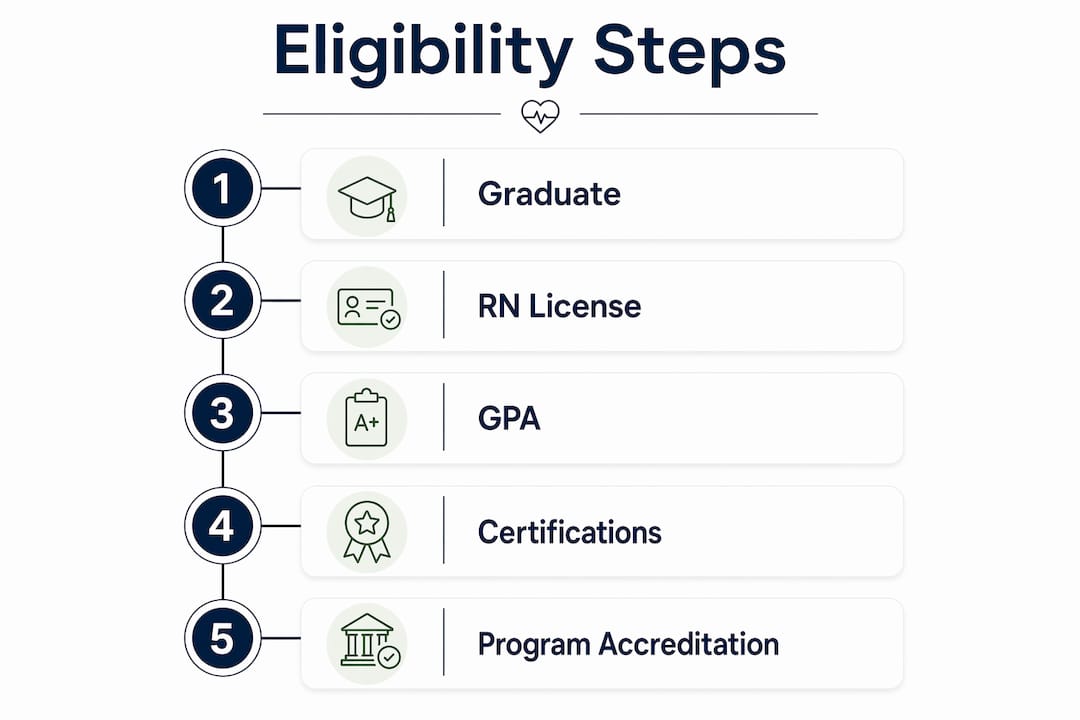
Common eligibility criteria include graduation from an accredited nursing program (ADN, BSN, or MSN), a minimum GPA of 3.0, and a current BLS/CPR certification. The experience cap is equally firm: most programs accept candidates with less than 12 months of RN experience. That window closes faster than most new graduates expect.
| Requirement | Standard |
|---|---|
| Nursing program accreditation | ACEN or CCNE accredited ADN, BSN, or MSN |
| RN experience limit | Fewer than 12 months post-licensure |
| Minimum GPA | 3.0 or higher (program-specific) |
| Certifications | Current BLS/CPR required; ACLS may be preferred |
| Licensure | Active RN license required before start date |
Permanent RN license deadlines are non-negotiable. Missing the licensure deadline by even a few days can result in automatic rejection, regardless of how strong the rest of your application is. Plan your NCLEX timeline backward from your target cohort start date.
Program accreditation also matters on your end. ANCC PTAP accreditation or Vizient recognition signals that a program meets national standards for transition-to-practice education. Prioritize accredited programs when you have a choice.
Step-by-step process to search and apply for residency positions
A structured approach prevents missed deadlines and duplicate effort. Follow these steps in order.
- Map your target hospitals. List every hospital within your acceptable commute or relocation range. Note whether each system uses a competitive cohort application or auto-enrolls new hires into residency. Some systems skip the separate application entirely, which changes your strategy.
- Identify cohort cycles and application windows. Application windows open 3–6 months before a cohort starts. Map those windows against your graduation and NCLEX dates to know exactly when to apply.
- Build a tracking spreadsheet. Record each hospital, the unit or specialty, the application open date, the deadline, and the cohort start date. Update it weekly.
- Tailor each application. Adjust your cover letter and resume for the specific unit and patient population. A pediatric ICU application should read differently from a medical-surgical application. Review nursing career advancement resources to align your language with what hiring managers look for.
- Apply to multiple units and specialties. Do not limit yourself to one preferred unit. Flexibility in unit preference directly increases your chances of securing a position, especially in competitive specialties like ICU and Emergency.
- Follow up after submission. Send a brief, professional email to the recruiter one to two weeks after submitting. Confirm receipt and express continued interest. This step separates attentive candidates from the rest.
- Prepare for phone screens and panel interviews. Most programs move quickly once applications close. Have your documents ready before you submit so you are not scrambling when an interview invitation arrives.
Pro Tip: Apply to at least three to five programs simultaneously. Residency seats are limited, and even strong candidates face rejection from their first choice. A parallel application strategy protects your timeline.
How should you prepare for a nursing residency interview?
Residency interviews focus on clinical judgment and cultural fit rather than technical skills. Interviewers assume you do not yet know how to start an IV perfectly. They want to know how you think and whether you will thrive on their unit.
Most programs use one of three formats: a panel interview with the nurse manager and staff nurses, a unit-specific interview with a charge nurse, or a behavioral interview conducted by HR. Behavioral questions follow the STAR format (Situation, Task, Action, Result). Prepare three to five clinical scenarios from your clinical rotations that demonstrate critical thinking, teamwork, and patient advocacy.
Bring printed copies of your resume, unofficial transcripts, and letters of recommendation to every in-person interview. Digital copies on your phone are a backup, not a substitute. Dress professionally, arrive ten minutes early, and address each panel member by name.
Common pitfalls to avoid:
- Vague answers. "I work well under pressure" means nothing without a specific example.
- Criticizing past clinical instructors or preceptors. This signals poor professionalism immediately.
- Failing to ask questions. Prepare two or three thoughtful questions about the unit's orientation structure or preceptor model. It shows genuine interest.
- Overlooking the cultural fit question. When asked why you want this unit at this hospital, give a specific answer tied to the hospital's mission or the unit's patient population.
Interview prep that emphasizes scenario-based reasoning and cultural alignment consistently outperforms candidates who focus only on clinical knowledge review.
What challenges should you expect when searching for residency programs?
Competition is the defining challenge. Specialty units like ICU, Emergency, and Labor and Delivery receive far more applications than they have seats. A broad application strategy is not a fallback. It is the standard approach for any serious candidate.
Timing creates its own complications. Programs run on staggered cohort cycles, meaning a hospital may accept applications in january for a march start and again in june for a september start. Missing one window does not mean waiting a full year. It means waiting three to six months for the next cycle.
Rotational and direct unit placement programs work differently, and understanding which model a program uses matters before you apply. Rotational programs move you through two or three units before permanent assignment. Direct placement puts you on one unit from day one. Neither is better universally. Choose based on how certain you are about your specialty preference.
Licensing delays are the most common reason qualified candidates miss their target cohort. If your NCLEX results are delayed or you need to retest, contact the program coordinator immediately. Many programs will hold a seat briefly for candidates who communicate proactively, but silence is always interpreted as withdrawal.
If your preferred units are closed or full, apply to general medical-surgical or telemetry units. These placements build foundational skills and often allow internal transfers to specialty units after your first year. Staying motivated through rejection requires reframing: every application cycle teaches you something about your search strategy.
Key Takeaways
The most effective way to secure a nursing residency position is to apply early, apply broadly, and meet every eligibility requirement before the application window opens.
| Point | Details |
|---|---|
| Start your search early | Application windows open 3–6 months before cohort starts; missing them means waiting for the next cycle. |
| Verify accreditation first | Prioritize programs with ANCC PTAP accreditation or Vizient recognition as a quality standard. |
| Meet all prerequisites | Active RN license, BLS/CPR, and under 12 months of experience are non-negotiable entry requirements. |
| Apply broadly | Flexibility in unit and specialty preference significantly increases your chances of placement. |
| Prepare for behavioral interviews | Focus on clinical judgment scenarios and cultural fit, not technical skill demonstrations. |
What I have learned from watching nurses search for residency programs
Most new graduates treat the residency search like a single job application. They pick one hospital, one unit, and wait. That approach fails more often than it succeeds, and the reason is structural: residency seats are allocated by department staffing needs, not by how qualified you are. A brilliant candidate applying to a fully staffed ICU will lose to a good candidate applying to a unit with three open seats.
The graduates who land strong programs early share two habits. They start researching cohort cycles before they graduate, and they treat accreditation as a filter, not a bonus. An ANCC PTAP-accredited program is not just a credential on your resume. It means your preceptor training, didactic curriculum, and competency evaluations meet a verified national standard. That matters for your clinical development in year one, when the habits you build become the nurse you become.
Geographic flexibility is the variable most candidates underestimate. Nurses who are willing to relocate even one state over consistently report shorter search timelines and more program choices. If you are anchored to one city, you need to compensate with a wider specialty range and a faster application pace.
Networking still surprises people. A five-minute conversation with a staff nurse at a hospital open house has led to more residency placements than any job board. Use clinical specialty pages to identify units that match your interests, then find a way to talk to someone who works there. The information you get from that conversation is worth more than any job listing.
— Flexible
Flexiblenursingcareers makes your residency search faster
Finding the right nursing residency position requires access to current, accurate listings across multiple health systems and specialties. Flexiblenursingcareers connects new graduate nurses with real-time nursing residency job listings updated as positions open.

You can browse nursing residency openings filtered by specialty, location, and experience level, all in one place. The platform is built for nurses who want to apply quickly without navigating dozens of separate hospital portals. Sign up, set your preferences, and get matched to positions that fit your graduation timeline and clinical interests. Your next step toward a structured, supported start to your nursing career is one search away.
FAQ
What is a nursing residency program?
A nursing residency program is a structured transition-to-practice program that supports new graduate RNs through their first year of clinical practice. Programs typically run for 12 months and include precepted clinical hours and didactic training.
How competitive are nursing residency programs?
Nursing residency programs are highly competitive, especially for specialty units like ICU and Emergency. Application windows open 3–6 months before cohort start dates, and seats fill quickly.
What GPA do I need for a nursing residency program?
Most programs require a minimum GPA of 3.0, along with current BLS/CPR certification and graduation from an ACEN or CCNE-accredited nursing program.
How do I know if a nursing residency program is accredited?
Look for ANCC PTAP accreditation or Vizient recognition on the program's official page. Both designations confirm the program meets national standards for transition-to-practice education.
What happens if my RN license is delayed?
Contact the program coordinator immediately if your licensure is delayed. Missing the license deadline can result in rejection, but proactive communication gives programs the option to hold your seat for the next available cohort.