
Nursing career advancement pathways are defined sequences that connect education, certification, and licensure to progressively advanced nursing roles, and choosing the right path determines your earning potential, specialization, and long-term satisfaction. These pathways range from clinical ladder programs at the bedside to doctoral-level practice and executive leadership, and they are recognized by organizations like the American Nurses Credentialing Center (ANCC), the American Association of Colleges of Nursing (AACN), and institutions like AdventHealth. Whether you are an ADN-prepared RN looking to earn a BSN or a bedside nurse targeting a Chief Nursing Officer role, the structure of your path matters as much as your ambition. This guide breaks down 10 distinct career progression options in nursing so you can build a plan that fits your goals and your life.
1. Nursing career advancement pathways: the foundational framework
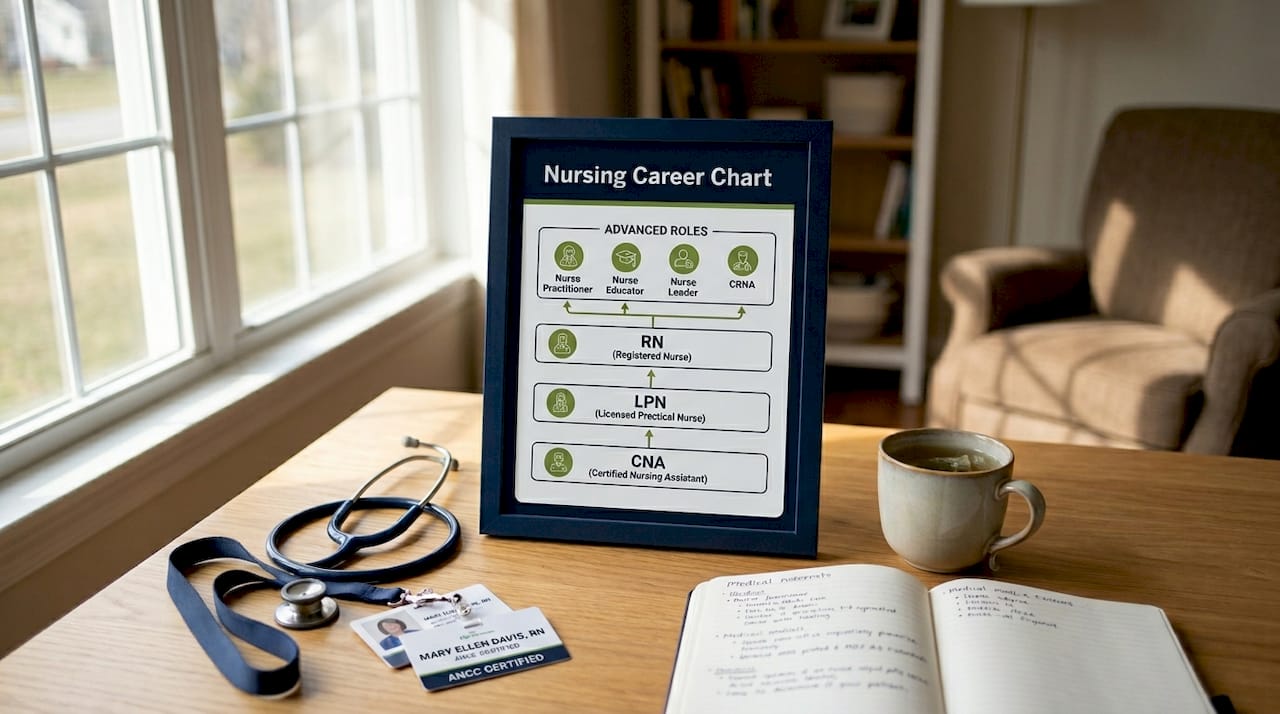
Nursing career advancement pathways are commonly structured as career ladders with multiple clearly defined rungs combining education, experience, and licensure. The ladder model is not just a metaphor. It is a formal framework used by hospitals, nursing schools, and credentialing bodies to map progression from entry-level roles to advanced practice and leadership. Understanding this structure before you commit to any single path saves you from costly detours.
The foundational rungs begin with Certified Nursing Assistant (CNA) and Licensed Practical Nurse (LPN/LVN) roles, then move into Registered Nurse (RN) preparation via diploma, Associate Degree in Nursing (ADN), or Bachelor of Science in Nursing (BSN). Graduate-level rungs include the Master of Science in Nursing (MSN), Doctor of Nursing Practice (DNP), and research-focused PhD. Degree, certification, and licensure shape both career advancement and earning potential at every stage. Misaligning your licensure with your target role is one of the most common reasons nurses stall despite years of education.
2. Entry-level and RN licensure pathways
The first formal decision point in nursing career growth is choosing your entry-level credential. CNAs and LPN/LVNs provide direct patient care under RN supervision and serve as practical stepping stones before committing to a full RN program. Both roles offer real clinical exposure that strengthens applications to RN programs.
RN preparation routes include the hospital-based diploma (rare but still available), the two-year ADN, and the four-year BSN. The BSN is now the preferred minimum at Magnet-designated hospitals and most large health systems. All three routes require passing the NCLEX-RN to earn licensure, but the BSN opens more doors immediately after graduation.
Pro Tip: Plan your entry-level credential with your five-year target role in mind. If you want to specialize in oncology or become a Nurse Practitioner, starting with a BSN-track program eliminates a bridge program later and keeps your timeline tighter.
3. Bridge programs and degree completion pathways
Bridge programs are the most underused tool in nursing education pathways. The RN-to-BSN is the most common, designed for ADN-prepared nurses who want to meet BSN requirements without repeating clinical coursework. Most programs are fully online and take 12 to 24 months to complete. Schools like Western Governors University and Chamberlain University offer accelerated formats that fit around full-time work schedules.
Beyond the RN-to-BSN, the RN-to-MSN bridge skips the BSN entirely for nurses targeting advanced practice or education roles. The LPN-to-RN bridge serves licensed practical nurses ready to move into full RN scope. Each bridge program has specific admission requirements tied to licensure status, GPA, and clinical hours, so verifying those requirements early prevents application delays.
4. Clinical ladder programs for bedside advancement
Clinical ladder programs are workplace-based advancement models that recognize nursing expertise without requiring a role change. Clinical ladders affirm bedside nurses by making their growth visible and rewarding it with compensation and title progression. This matters because many nurses feel forced to leave direct care to advance, and clinical ladders eliminate that false choice.
AdventHealth's electronic clinical ladder program is one of the most cited examples in the field. Their system reduced RN turnover below 6% for participants, compared to an overall turnover rate of around 14.8%. That gap represents real retention value for hospitals and real career stability for nurses. AdventHealth also integrated self-care components into the ladder, recognizing that nurse wellbeing and professional development are not separate concerns.
Successful ladder programs use point- or portfolio-based credentialing systems managed electronically and reviewed annually to reduce administrative burden. Points are earned through board certification, specialty skills, community involvement, and professional development activities. The result is a transparent, maintainable system that nurses can actively manage.
Pro Tip: If your employer has a clinical ladder, treat it like a formal credential. Document every certification, committee role, and continuing education hour. Nurses who actively manage their ladder portfolios advance faster and negotiate higher compensation at review time.
5. Specialty and advanced practice nursing pathways
Advanced Practice Registered Nurse (APRN) roles represent the highest tier of clinical nursing and require graduate-level education. The four APRN designations are Nurse Practitioner (NP), Clinical Nurse Specialist (CNS), Certified Registered Nurse Anesthetist (CRNA), and Certified Nurse Midwife (CNM). Each requires an MSN or DNP, national certification, and state licensure specific to the role.
Specialty pathways within nursing are equally structured. Pediatric nursing career pathways include roles such as Clinical Nurse Educator, Transition to Practice Coordinator, and Pediatric Nurse Practitioner, all supported by the Pediatric Nursing Certification Board (PNCB). Oncology, informatics, critical care, and psychiatric nursing each have their own certification bodies and competency frameworks. Choosing a specialty early allows you to target graduate programs with matching concentrations and build clinical hours in the right setting.
Common specialty focus areas nurses pursue include:
- Pediatrics via PNCB certification and PNP graduate programs
- Oncology through the Oncology Nursing Certification Corporation (ONCC)
- Nursing informatics combining clinical expertise with health IT systems
- Psychiatric and mental health via ANCC's PMHNP certification pathway
- Critical care through AACN's CCRN and ACNPC credentials
Compensation increases significantly with APRN credentials. Nurse Anesthetists consistently rank among the highest-paid nursing roles in the United States, with median salaries well above the general RN average.
6. Nursing leadership and executive advancement pathways
Leadership roles in nursing follow a distinct track that requires both clinical experience and formal management credentials. The progression typically moves from Charge Nurse to Nurse Manager to Director of Nursing and ultimately to Chief Nursing Officer (CNO). Each level demands a broader scope of responsibility and, at the upper tiers, specific executive certifications.
The ANCC offers two primary nurse executive credentials. The NE-BC certification requires an active RN license, a BSN (with a master's degree recommended), 2,000 documented leadership hours in the past three years, and 30 continuing education hours in nursing administration. The Nurse Executive Advanced certification (NEA-BC) targets senior leaders with a master's degree and broader organizational scope. Documenting leadership hours is the most common bottleneck for nurses pursuing executive credentials. Start tracking the moment you step into any supervisory capacity.
| Credential | Degree required | Leadership hours | Target role |
|---|---|---|---|
| NE-BC | BSN (MSN recommended) | 2,000 hours in 3 years | Unit to department manager |
| NEA-BC | Master's degree | 2,000 hours in 3 years | Senior executive, CNO level |
Pro Tip: Keep a running leadership log in a spreadsheet or app from your first charge shift. Include dates, scope, number of staff supervised, and decisions made. When you apply for NE-BC or NEA-BC, this log becomes your eligibility evidence.
7. Graduate education pathways: MSN, DNP, and PhD
Graduate education is the gateway to advanced practice, leadership, education, and research roles. The MSN is the standard entry point for NP and CNS roles and takes two to three years post-BSN. The DNP is a practice-focused terminal degree designed for clinicians who want to lead at the systems level without pursuing academic research. The PhD in Nursing is research-focused and leads to faculty, policy, and scientific roles.
Choosing between a DNP and a PhD depends entirely on your target role. If you want to practice clinically at the highest level or lead quality improvement initiatives in a health system, the DNP is the right credential. If you want to conduct original research, teach at research universities, or shape national nursing policy, the PhD is the better fit. Both degrees require significant time and financial investment, so aligning your choice with your five-year plan prevents expensive course corrections.
The AACN's Essentials framework guides DNP and BSN curricula across accredited programs, giving you a consistent benchmark when comparing schools. Accreditation through the Commission on Collegiate Nursing Education (CCNE) or the Accreditation Commission for Education in Nursing (ACEN) is non-negotiable when selecting a graduate program.
8. Nursing education and faculty pathways
Nursing faculty roles are among the most overlooked nursing advancement options, yet they directly address the national nursing shortage by training the next generation. A master's degree is the minimum requirement for most clinical faculty positions, while tenure-track roles at research universities require a PhD or DNP. Faculty positions offer schedule flexibility, intellectual engagement, and the ability to shape curriculum.
Clinical nurse educator roles within hospitals sit at the intersection of practice and education. These nurses design orientation programs, lead competency assessments, and support staff through new technology rollouts. The National League for Nursing (NLN) offers the Certified Nurse Educator (CNE) credential for those in academic settings, providing formal recognition of teaching expertise.
9. Nurse informatics and technology pathways
Nursing informatics is a specialty that combines clinical knowledge with information technology to improve patient outcomes and health system efficiency. Informatics nurses work with electronic health record (EHR) systems like Epic and Cerner, analyze clinical data, and lead technology implementation projects. The role has grown significantly as health systems invest in digital infrastructure.
The ANCC offers the Informatics Nursing certification (RN-BC) for nurses with at least two years of RN experience and 2,000 hours in informatics practice. A bachelor's degree is required, and graduate education strengthens candidacy for senior informatics roles. Nurses with both clinical credibility and technology fluency are in high demand and command salaries that rival many APRN roles.
10. Non-traditional and emerging nursing career options
Non-traditional nursing advancement options include nurse entrepreneurship, legal nurse consulting, telehealth practice, and international nursing roles. Internal mobility strategies such as cross-training, mentorship programs, and employer-sponsored tuition support are particularly valuable in rural and underserved areas where external hiring is difficult. Visible internal ladders retain staff and give nurses career flexibility without requiring them to leave their communities.
Nurse entrepreneurs build businesses around their clinical expertise, from wellness coaching and private practice to consulting and product development. Legal nurse consultants work with law firms on medical malpractice and personal injury cases, earning consulting fees that often exceed standard nursing salaries. Telehealth nursing has expanded dramatically and now offers full-time remote roles across specialties including triage, chronic disease management, and behavioral health. For nurses exploring how multiple employer arrangements fit into a broader career strategy, these non-traditional paths often provide the income diversification and schedule control that traditional roles cannot.
Key takeaways
Effective nursing career advancement requires aligning education, licensure, certification, and workplace opportunities into a single intentional plan rather than pursuing each element in isolation.
| Point | Details |
|---|---|
| Start with your target role | Map your required credentials backward from your goal before choosing a degree program. |
| Clinical ladders reward bedside nurses | AdventHealth's program cut RN turnover below 6% by making bedside advancement visible and compensated. |
| Leadership credentials require early tracking | ANCC NE-BC eligibility requires 2,000 documented leadership hours, so log them from your first supervisory shift. |
| Graduate degree choice shapes your ceiling | DNP leads to clinical leadership; PhD leads to research and faculty roles. Choose based on your five-year target. |
| Non-traditional paths are legitimate careers | Informatics, entrepreneurship, and legal consulting offer strong compensation and schedule control for experienced nurses. |
What I have learned about advancing in nursing without losing yourself
From where I sit at Flexiblenursingcareers, the nurses who advance most effectively are not the ones who chase every credential. They are the ones who pick a direction early and build deliberately toward it. The biggest mistake I see is nurses accumulating continuing education hours without a target role in mind. Hours without direction do not add up to advancement. They add up to a crowded resume.
Strategic career planning is most effective when nurses start with their target role and build a roadmap of education, certifications, and training to meet its requirements. That sounds obvious, but most nurses I talk to have not written down their five-year target role. Write it down. Then work backward.
I also think the nursing profession undersells clinical ladder programs to bedside nurses. Too many nurses believe advancement means leaving the bedside. It does not. A well-structured ladder program gives you title progression, compensation increases, and professional recognition without abandoning the work you love. If your employer does not have one, advocate for it or find an employer who does.
The balance between advancing and burning out is real. Pursuing a DNP while working full-time is possible, but it requires honest scheduling and a support system. The nurses who succeed in graduate programs while working are the ones who treat their degree like a shift: scheduled, protected, and non-negotiable.
— Flexible
Find nursing roles that match where you are headed
Your career plan only works if your current job supports it. Flexiblenursingcareers connects nurses with flexible positions that align with their skills, schedule, and advancement goals, whether you are building clinical hours for an NE-BC application, completing a DNP practicum, or exploring part-time nursing options that protect your study time.

The platform matches you to real-time job opportunities based on your availability and specialty, so you spend less time searching and more time advancing. Sign up, set your preferences, and start finding roles that fit your life. Find your next role on Flexiblenursingcareers today.
FAQ
What are the main nursing career advancement pathways?
The main pathways include educational progression (ADN to BSN to MSN to DNP/PhD), clinical ladder programs, specialty certification, APRN roles, and nursing leadership credentials like the ANCC NE-BC. Each pathway combines education, licensure, and documented experience.
How do I qualify for the ANCC NE-BC certification?
You need an active RN license, a BSN degree (master's recommended), 2,000 leadership hours in the past three years, and 30 continuing education hours in nursing administration. Tracking leadership hours from your first supervisory role is the most important preparation step.
Can bedside nurses advance without leaving direct care?
Yes. Clinical ladder programs at institutions like AdventHealth allow bedside nurses to advance in title and compensation by earning points through certifications, specialty skills, and professional development, without moving into management.
What is the difference between a DNP and a PhD in nursing?
The DNP is a practice-focused terminal degree for clinical leaders and advanced practitioners. The PhD is research-focused and leads to faculty, policy, and scientific roles. Your target role determines which degree fits your career plan.
How does nursing informatics fit into career advancement?
Nursing informatics is a recognized specialty combining clinical expertise with health IT. The ANCC RN-BC informatics certification requires two years of RN experience and 2,000 informatics practice hours. Senior informatics roles offer salaries comparable to many APRN positions.