
The role of availability in job matching is one of the most consequential factors in a healthcare professional's career, yet most nurses treat it as an afterthought on their resume. Your availability is not just a scheduling detail. It is the single piece of information that determines whether a job offer ever reaches you. When it is vague, outdated, or misrepresented, the entire matching process breaks down. This guide unpacks how availability actually works in healthcare hiring, what mistakes cost nurses opportunities they never even know they missed, and how to use your schedule as a career asset.
Table of Contents
- Key takeaways
- The role of availability in job matching, explained
- How availability shapes hiring outcomes
- Pitfalls that hurt your availability communication
- Strategies to make your availability work for you
- My take on availability and healthcare careers
- Find your match with Flexiblenursingcareers
- FAQ
Key takeaways
| Point | Details |
|---|---|
| Availability drives matching outcomes | Precise availability information is what connects you to the right role at the right time. |
| Vague availability backfires | Saying "available anytime" often signals poor self-awareness and leads to mismatches with employers. |
| Speed matters on both sides | Slow hiring processes cause qualified candidates to accept other offers before a decision is made. |
| Technology relies on your input | Algorithms only match well when the availability data you provide is specific and current. |
| Strategic management pays off | Treating availability as a career tool, not a formality, directly improves satisfaction and retention. |
The role of availability in job matching, explained
Availability in healthcare hiring means more than telling an employer what days you can work. It covers your start date, the hours you can commit to, the shift types you prefer, and whether those parameters are fixed or open to adjustment. Each of these details feeds directly into how a job match gets made.
When employers and staffing platforms review candidates, availability is often evaluated before credentials. A perfectly qualified nurse who is not available for night shifts will never appear in a search for night shift openings, regardless of years of experience. Clear availability on resumes helps employers quickly assess suitability and plan coverage with far less back-and-forth.
There are three practical categories of availability in healthcare:
- Fixed availability: You are available on specific days and hours only. This suits nurses with family commitments or second jobs and works well when communicated clearly.
- Flexible availability: You can adjust your schedule within reasonable limits. This is the most attractive category for employers filling variable shift needs.
- Open availability: You have no scheduling restrictions. This sounds ideal but can raise concerns about reliability or lead to placement in roles that do not align with your career goals.
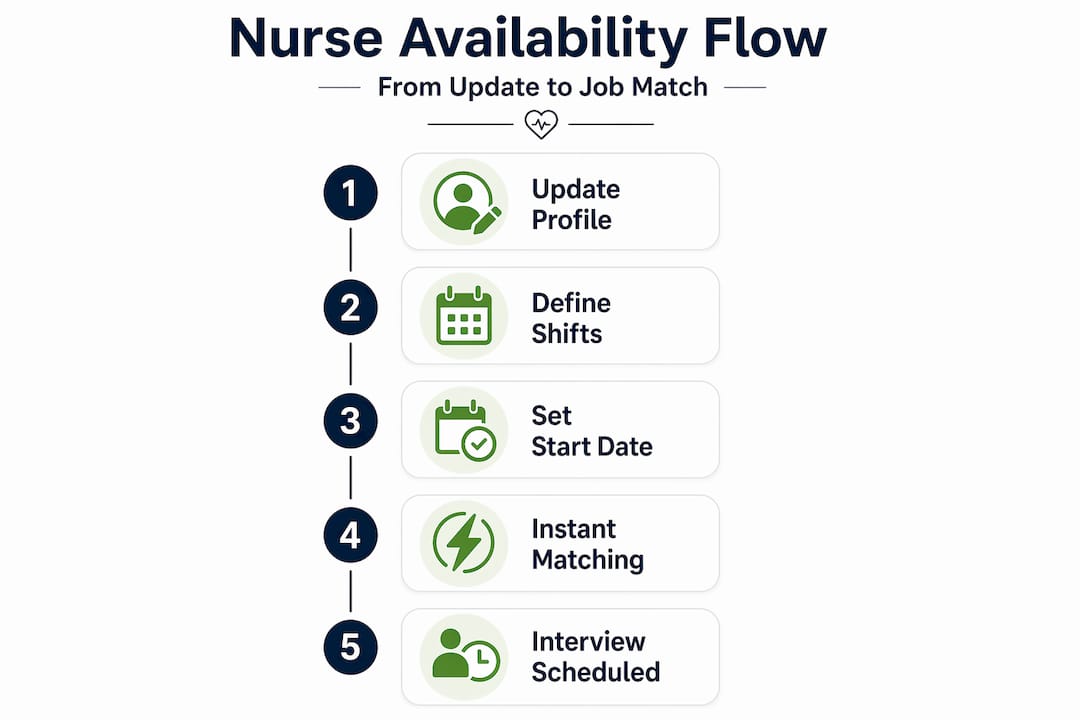
The technology behind modern platforms like Flexiblenursingcareers relies on this information to run real-time matching. Algorithms factor in availability alongside skills, location, and preferences. When the input is precise, the match quality improves dramatically. When it is generic, the algorithm defaults to a wide net that often misses the most suitable roles for you.
| Availability type | Employer perception | Best for |
|---|---|---|
| Fixed | Predictable, lower placement volume | Nurses with set personal commitments |
| Flexible | Highly desirable, faster matches | Nurses seeking work-life balance |
| Open | Maximum coverage, risk of misalignment | Nurses prioritizing income over schedule |
How availability shapes hiring outcomes
The gap between what candidates communicate and what employers need is where most failed matches happen. It is not always about skills. It is about timing and schedule alignment that was never properly established.
Research tells a stark story here. 47% of job seekers encountered ghost jobs in 2026, listings that misrepresent actual hiring intent or availability of positions. For healthcare professionals, this means spending real time and energy on opportunities that do not exist as advertised.
Hiring speed compounds the problem. Lengthy hiring processes mean that top candidates who are actively seeking roles accept other offers before a slower employer reaches a decision. In nursing, where demand is high and good candidates move fast, a delay of even a few days can close the door permanently.

The communication piece is just as important as the speed. When employers go silent after an interview, qualified nurses assume the role is filled and move on. Proactive communication after each round is what keeps candidates available and engaged throughout the process.
Here is where the ripple effect shows up in your career:
- Accepting a role that conflicts with your actual schedule leads to burnout within months.
- Taking a position with poor shift alignment reduces your capacity to pick up additional work you actually want.
- Unclear availability leaves you out of the running for urgent healthcare vacancies that require a fast response.
- Mismatched schedules hurt your work-life balance, which is the primary reason most nurses seek flexible roles in the first place.
Pro Tip: Update your availability profile every time your personal schedule changes, even slightly. A platform matching you to roles based on three-month-old availability data is working against you.
Pitfalls that hurt your availability communication
Most nurses make availability mistakes not from carelessness but from not knowing what good availability communication looks like. The patterns below appear repeatedly in healthcare hiring and all of them have a cost.
Overgeneralizing your schedule. Writing "available anytime" on an application feels like the safe choice. It reads as flexible and eager. In practice, it signals to employers that you have not thought carefully about your needs, and it opens the door to shift assignments that conflict with your real life.
Failing to update across platforms. You might adjust your availability on one job board and forget the others. This creates conflicting data that confuses both recruiters and matching algorithms. Fair matching systems require accurate user input to function equitably. When your data is inconsistent, the system cannot serve you well, regardless of how good the underlying technology is.
Misunderstanding how algorithms read availability. Most nurses assume a platform searches for their skills first and availability second. In real-time matching systems, availability often filters first because it eliminates incompatible roles immediately. If you think listing broader hours will show more results, you are right, but the quality of those results drops sharply.
Juggling multiple employers without clarity. Working for multiple employers is increasingly common, but it adds complexity to availability management. Nurses who do not track their committed hours carefully end up double-booking or appearing unreliable to both employers.
Here are the most important steps to correct these patterns:
- Write your availability in specific terms: days, shift types, and hours per week.
- Set a calendar reminder to review and update your availability every 30 days.
- Keep a simple log of committed hours when working with multiple employers.
- Learn how each platform you use reads and weights availability in its matching process.
- If your schedule is changing soon, note your future availability alongside your current one.
Pro Tip: When listing availability for a healthcare role, include your start date alongside your shift preferences. Recruiters plan coverage weeks in advance, and knowing when you can start is as valuable as knowing when you can work.
Strategies to make your availability work for you
Availability is not just a scheduling fact. It is a positioning tool. Nurses who treat it that way get matched faster, get better offers, and report higher job satisfaction than those who leave it as a checkbox.
The first move is defining your availability with precision before you apply for anything. This means sitting down and mapping out your week, your personal commitments, your preferred shift types, and the minimum hours you need to meet your financial goals. Nurses who do this get hired for healthcare jobs faster because they eliminate back-and-forth during screening.
Second, use flexible scheduling as a competitive edge rather than a limitation. If you can genuinely work evening and weekend shifts, say so clearly. These are the shifts most employers struggle to fill. Flexible availability in those windows makes you a priority candidate, not just a qualified one.
Third, take advantage of platforms that allow dynamic availability updates. Static job boards lock your profile in place until you manually edit it. Real-time matching platforms let you adjust your schedule as it changes, which means your matches stay relevant without requiring you to restart the entire job search process.
Fourth, prepare for interviews with availability clarity already worked out. Top candidates treat availability strategically because accepting one offer closes the door to others. Know your non-negotiables going in. Know which shifts you can flex on and which you cannot. This makes you credible and saves everyone time.
Fifth, consider part-time nursing options if your availability is genuinely limited. These roles are not a step down. They are a recognized career path that many nurses use to maintain clinical skills while managing other life priorities. Listing yourself accurately as part-time available, rather than full-time available with caveats, gets you into the right pipeline from the start.
My take on availability and healthcare careers
I have seen hundreds of healthcare professionals lose roles they genuinely wanted, not because they lacked skills or experience, but because their availability information was unclear or outdated at exactly the wrong moment. It is the most preventable reason for a failed job match.
What I find most underestimated is how much technology depends on the human side of this equation. Fair algorithms fail in practice when candidates do not understand how to input their data effectively. A platform can be brilliantly designed and still deliver poor matches if nurses treat availability as a formality rather than a decision.
I also think the industry bears responsibility here. Asynchronous hiring formats have caused more than a 50% drop in application continuation among qualified candidates. When healthcare employers let good nurses disengage through slow or automated processes, they lose the very people who were available and interested.
The future of flexible healthcare careers belongs to nurses who understand that availability is a real-time, strategic variable. Not a fixed fact. Update it, own it, and use it to get placed where you actually want to work.
— Flexible
Find your match with Flexiblenursingcareers
You have the skills. Getting matched to the right role, at the right time, comes down to putting your availability to work for you.

Flexiblenursingcareers connects nurses and healthcare professionals with jobs built around their real schedules. The platform uses real-time matching based on your availability, preferences, and experience, so you spend less time searching and more time working in roles that fit. No lengthy application queues. No scheduling mismatches buried three rounds into a hiring process. You log in, set your availability, and start receiving relevant opportunities right away. When your schedule changes, your matches change with it. Sign in to NurseFlex Jobs and start finding roles that fit your life, not the other way around.
FAQ
What does availability mean in healthcare job matching?
Availability in healthcare job matching refers to the specific days, hours, and shift types a candidate can work, along with their start date. Employers and matching platforms use this information to filter and prioritize candidates for open roles.
How does availability affect job matching success?
Clear, specific availability helps matching algorithms and recruiters identify suitable roles faster and with less scheduling conflict. Vague or outdated availability reduces match quality and can exclude you from roles you are otherwise qualified for.
Why do slow hiring processes hurt candidate availability?
When hiring takes too long without communication, candidates accept other offers and are no longer available. Research shows that proactive post-interview communication is critical to keeping qualified candidates engaged until a decision is made.
Can working multiple jobs affect how I should list my availability?
Yes. Nurses working across multiple employers need to track committed hours carefully and update each platform to reflect their actual remaining availability. Inaccurate data across platforms creates conflicts and damages your reliability with employers.
How often should I update my availability on job platforms?
Review and update your availability at least once a month, or immediately after any schedule change. Real-time matching platforms can only deliver accurate results when your availability reflects your current situation, not the one you had when you first signed up.