
Most healthcare workers have spent at least one stretch of their career feeling trapped. Trapped by a schedule they didn't build, a shift they couldn't drop, or a recruiter who went silent for days. Understanding why healthcare workers use staffing platforms starts with recognizing that the traditional system was designed around facility needs, not worker needs. That's changed. Digital staffing platforms now put schedule control, pay transparency, and shift access directly in your hands. This article breaks down how these platforms work, what they actually deliver, and how to use them to your advantage.
Table of Contents
- Key takeaways
- Why healthcare workers use staffing platforms: the digital shift
- Real benefits staffing platforms deliver for you
- Healthcare staffing platform comparison: types and trade-offs
- How staffing platforms reduce burnout and improve retention
- Practical tips for getting the most from staffing platforms
- My perspective on what staffing platforms actually change
- Start finding flexible shifts with Flexiblenursingcareers
- FAQ
Key takeaways
| Point | Details |
|---|---|
| Speed of placement | Staffing platforms compress hiring timelines from weeks to same-day or next-day shift access. |
| Schedule control | Workers choose their own shifts, locations, and volume, which directly reduces burnout. |
| Platform types differ | Job marketplaces and direct staffing agencies serve different needs. Knowing the difference helps you choose wisely. |
| Credential prep matters | Completing your digital credentialing upfront unlocks faster shift claiming across all platforms. |
| Flexibility drives retention | 78% of healthcare executives say schedule flexibility is the top factor nurses weigh in workforce decisions. |
Why healthcare workers use staffing platforms: the digital shift
The healthcare staffing model has not kept up with the reality of modern clinical work. Chronic staff shortages, post-pandemic burnout, and tight budgets created conditions where both nurses and facilities needed something faster and more flexible than traditional agency contracts.
Digital staffing platforms answered that need. Unlike a traditional agency where a recruiter acts as gatekeeper between you and available jobs, these platforms let you interact directly with open shifts. You log in, see what's available in your area and specialty, and claim a shift in minutes. That's the core mechanical shift.
Here's what that actually looks like in practice:
- Instant shift claiming: You open the mobile app, filter by location and shift type, and claim an open shift without waiting for a recruiter callback.
- Real-time availability management: You set your own calendar. The platform matches open shifts to your declared availability, not to a recruiter's pipeline.
- Automated credentialing: AI-driven credential verification reduces the time and effort traditionally spent faxing documents. Upload once and you're verified across facilities on the network.
- AI-powered matching: The system filters shifts by your license type, specialty, and preferred location, so you're not scrolling through irrelevant postings.
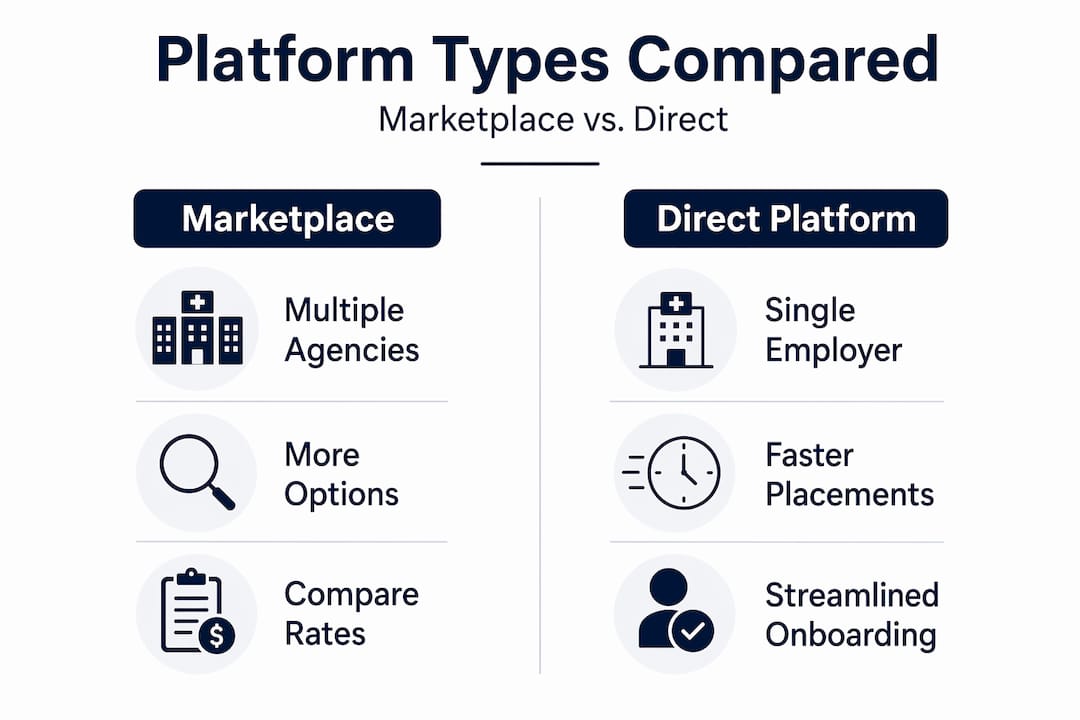
There's an important distinction worth understanding early: job marketplaces aggregate listings from multiple agencies or employers, while direct staffing platforms connect you to a single network or employer. Each serves a different purpose, and knowing that difference is how you choose the platform that fits your career goals.
Pro Tip: Before you create your first platform profile, gather your active licenses, certifications, immunization records, and references in a single digital folder. Most platforms use the same credential set. Uploading once saves weeks.
Real benefits staffing platforms deliver for you
The reason this section matters is that the benefits are concrete and measurable, not marketing language. Here are the six advantages that consistently show up when healthcare workers compare platform-based work to traditional staffing or permanent employment.
- Schedule flexibility. You decide when you work. Platforms let you pick up shifts that fit your life instead of accepting what a scheduler assigns.
- Faster hiring. Placement timelines compress from weeks to hours for many shifts, especially in high-demand markets.
- Increased earning potential. Gig-style platforms often show rate variations by shift. Peak-demand shifts pay more. You can target those.
- Pay transparency. You see the hourly rate before you accept a shift. No negotiating. No surprises.
- Less recruiter dependency. You move at your own pace without waiting on a third party to process your paperwork or match your preferences.
- Control over location and shift type. Filter by facility, distance, shift length, and unit type. You're not locked into whatever a recruiter has available.
"Mental health and poor work-life balance are top concerns for nursing staff. Staffing platforms offer instant shift claiming and scheduling control as a direct response to those pressures." — Healthcare workforce research, 2026
The market signals back this up. Healthcare accounts for 51% of global temporary staffing platform revenue, and that number reflects where the demand actually is. Workers are choosing platforms. Facilities are meeting them there.
One underappreciated benefit is that platforms also help you understand why nurses work multiple employers without the friction of managing multiple agency relationships. You can maintain income variety and clinical diversity from a single app.
Healthcare staffing platform comparison: types and trade-offs
Not all platforms are built the same. A healthcare staffing platform comparison reveals three broad categories, each with real trade-offs.
| Platform type | How it works | Best for | Pay transparency | Recruiter involvement |
|---|---|---|---|---|
| Job marketplace | Aggregates listings from many agencies and employers | Broad search, travel nurses | Varies by agency | Moderate to high |
| Direct staffing platform | Connects workers directly with one employer network | Local per diem, fast access | High | Low to none |
| AI talent marketplace | Uses machine learning to match workers to shifts in real time | Specialty matching, speed | High | Minimal |
The distinction between job marketplaces and direct agencies is practical, not just academic. A job marketplace gives you breadth. You compare rates, agencies, and facilities side by side. A direct staffing platform gives you speed and simplicity. You're working within one ecosystem with a known pay structure. Understanding that distinction is how you tailor your approach rather than defaulting to the first platform you find.
AI talent marketplaces sit in a third category. Hospitals using AI-powered marketplaces see faster hiring timelines and lower costs than those relying on traditional agencies. For you as a worker, that means faster confirmation on shifts you claim and fewer gaps between available opportunities.
Pro Tip: Savvy healthcare workers often use both types concurrently. A job marketplace expands your options, while a direct platform gives you a reliable income floor.
Platform features worth comparing beyond the basics include shift ratings, facility reviews, 24/7 support, and billing transparency. Platforms that offer pay breakdowns and facility-specific feedback produce measurably better worker satisfaction. Before committing to any platform, check whether it shows you total pay per shift, lists facility ratings, and offers accessible support if something goes wrong on a shift.
How staffing platforms reduce burnout and improve retention
Burnout in healthcare is not a mindset problem. It's a structural one. Rigid schedules, mandatory overtime, and unpredictable hours combine to create conditions where even experienced clinicians exit the workforce entirely. Staffing platforms directly address some of those structural drivers.
Here's where platforms make a measurable difference on burnout specifically:
- You control shift volume. If you're recovering from a tough week, you take fewer shifts. No one penalizes you for it.
- You control duration. Prefer 8-hour shifts over 12s? Filter for them. The platform doesn't force you into a facility's preferred format.
- You control location. Avoid facilities with poor working conditions. Platforms with reviews let you make that call before you show up.
- Shift fill speed reduces stress. Facilities fill open shifts faster through platforms, which means fewer instances of understaffed units asking on-duty nurses to cover unexpectedly.
- Flexibility supports retention. When 78% of healthcare executives cite schedule flexibility as the top factor nurses consider, that's telling you what workers actually need.
Digital platforms also serve as what researchers call a "reliable bench" for healthcare facilities. You, as a per diem or platform-based worker, fill gaps without replacing permanent staff. That model works in your favor because demand for per diem and gig-style shifts tends to stay consistent, giving you predictable access to work even outside of a permanent role. You can also explore part-time nursing options alongside gig work to create a schedule structure that genuinely fits your life.
Practical tips for getting the most from staffing platforms
Choosing the right platform is step one. Using it well is what determines your actual results.
- Match the platform to your specialty. A general nursing marketplace may not have the ICU or OR-specific shifts you need. Find platforms that serve your clinical area.
- Complete credentialing before you apply for shifts. Automated credentialing workflows are only fast after your documents are uploaded and verified. Front-load that work.
- Use AI matching filters actively. Don't scroll through everything. Set your license type, specialty, location radius, and preferred shift length. Let the algorithm do the filtering.
- Check pay transparency before accepting. Platforms that show total pay including any travel stipends or differentials give you real data to compare. If a platform only shows a range, ask for the breakdown.
- Avoid credential lapses. If a license or certification expires, you're immediately locked out of shifts. Set calendar alerts 60 days before any credential expires.
- Balance gig work with permanent positions thoughtfully. Many nurses maintain a part-time permanent role for benefits while using platforms for income flexibility. Understand how your permanent employer's exclusivity policies apply.
Pro Tip: Platforms that offer 24/7 support and shift ratings are worth prioritizing over those that pay marginally more. A higher rate means nothing if you show up to a chaotic facility with no support line to call.
You can also read about how to get hired fast in healthcare to understand how platform-based job seeking fits into a broader career strategy in 2026.
My perspective on what staffing platforms actually change
I've watched the healthcare staffing space shift considerably, and the honest version of that story has some uncomfortable parts worth naming.
Traditional staffing agencies were not built for workers. They were built for facilities. The recruiter model created delays, information asymmetry, and a dynamic where you were often the last person to know the details of your own placement. That's not a small complaint. It's a structural design problem.
What digital staffing platforms actually change is the information balance. When you can see pay rates, facility reviews, and shift availability in real time, you make decisions from knowledge instead of dependency. That's a real shift in power, not a feature upgrade.
What I've learned watching experienced nurses use these platforms is that the ones who get the most out of them treat it like any other professional tool. They invest time upfront in credentialing, they learn the filters, and they don't chase the highest single rate without checking facility reviews. The workers who struggle are the ones who sign up expecting the platform to do all the work.
The uncomfortable truth about traditional agencies is that incumbents are now integrating platform technology themselves, because they recognized that digital flexibility is no longer optional. You benefit from that shift. But the underlying structure of who serves whom only changes when you use these tools actively and selectively.
Healthcare is not going to solve its staffing shortages through permanent hiring alone. The staffing agency role in hospitals is evolving, and workers who understand the new digital layer will have more options, better rates, and more control over their careers than those who don't.
— Flexible
Start finding flexible shifts with Flexiblenursingcareers

Flexiblenursingcareers connects registered nurses and healthcare professionals with flexible shift opportunities through NurseFlex Jobs, a platform built specifically for clinical workers who want real control over when and where they work. You can set your availability, specify your specialty, and access open shifts without going through a recruiter or waiting days for confirmation. The platform uses real-time matching to surface shifts that fit your license and schedule, and the sign-up process is built to get you working fast.
If you're ready to move away from rigid schedules and start choosing your own shifts, sign in or create your account on NurseFlex Jobs and see what's available in your area today.
FAQ
Why do healthcare workers prefer staffing platforms over agencies?
Healthcare workers prefer staffing platforms because they provide direct shift access, pay transparency, and schedule control without waiting on a recruiter. Platforms compress placement timelines from weeks to hours for many shift types.
What is the difference between a job marketplace and a direct staffing platform?
A job marketplace aggregates listings from multiple agencies so you can compare options, while a direct staffing platform connects you to one employer network with a consistent pay structure. Each serves a different career need.
How do staffing platforms help reduce burnout for nurses?
Staffing platforms give nurses control over shift volume, duration, and location, which directly addresses the rigid scheduling that drives burnout. Research shows schedule flexibility is the top workforce factor nurses weigh when making career decisions.
Are staffing platforms safe for managing healthcare credentials?
Yes. Reputable platforms use automated credentialing workflows that securely store and verify your licenses and certifications. Completing your credentials upfront unlocks faster shift access and keeps you compliant across all facilities in the network.
Can you use multiple staffing platforms at the same time?
Yes, and experienced healthcare workers often do. Using a job marketplace alongside a direct staffing platform gives you broader options while maintaining a reliable income source through a single trusted network.