
A travel nurse housing stipend is tax-free money paid on top of your hourly wage, but only if you keep a qualifying tax home under IRS Publication 463. Weekly stipends typically run $700 to $1,600 depending on the market. Before you sign anything, run the numbers against local rent and confirm your tax home is documented.
TL;DR:
- Stipends are typically based on 60% to 80% of GSA lodging rates, with high-cost cities offering closer to $1,600 weekly, and rural areas nearer to $700.
- Maintaining a permanent tax home through documented address and expenses is crucial; informal guidelines like the 50-mile rule are not officially binding.
- Your real stipend profit is calculated by subtracting monthly rent divided by 4.33 from your weekly stipend, and exceeding your stipend with rent reduces tax-free benefits.
- Housing options such as Furnished Finder or shared apartments can significantly increase net profit, especially when utilities are split and leases are flexible.
- Agency-provided housing makes sense for short, unfamiliar, or high-demand markets; compare rental costs to stipends to evaluate financial viability before signing contracts.
Table of Contents
- What Determines Your Travel Nurse Housing Stipend Amount
- Understanding the IRS Tax-Home Rules Behind Tax-Free Stipends
- How to Calculate Your Real Stipend Profit
- Housing Options That Change Your Stipend Math
- Deciding Between the Stipend and Agency-Provided Housing
- Recordkeeping That Protects Your Tax-Free Status
- Finding Stipend-Friendly Assignments Faster
- What I Check First in Every Contract
- Find Assignments Built Around Your Housing Strategy
- Check These Sources Yourself
- Sources
- FAQ
What Determines Your Travel Nurse Housing Stipend Amount
Agencies do not pull stipend numbers out of thin air. Most build their offers around GSA per diem rates, the same lodging maximums the federal government uses for employee travel in a given county. A typical agency pays somewhere between 60% and 80% of that GSA lodging maximum as your weekly housing stipend, then adds a separate meals and incidentals component that sometimes gets folded into one combined number.
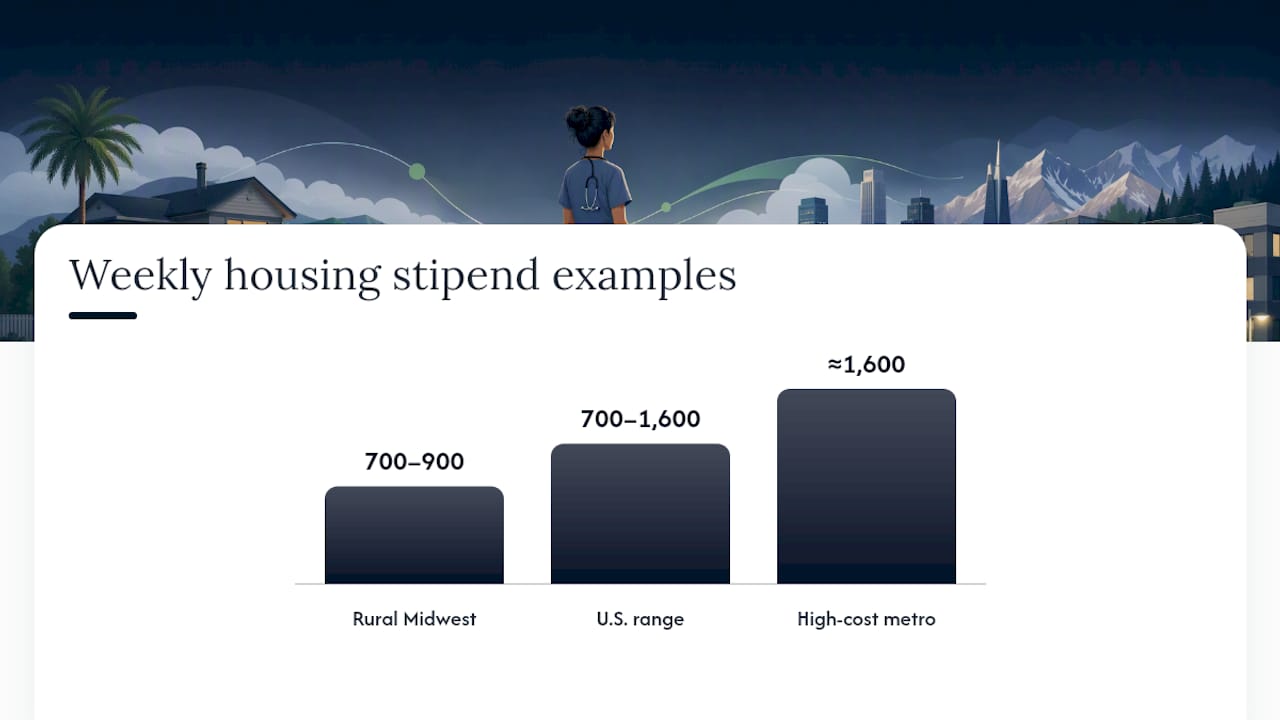
That's why identical assignments in different cities produce wildly different offers. A contract in a high-cost metro like San Francisco or New York can carry a stipend near the top of the $700 to $1,600 weekly range, according to industry pay-package breakdowns. A rural Midwest assignment might land closer to $700 to $900 a week because the local GSA lodging cap is lower.
Terminology gets muddy fast, so keep these distinctions straight:
- Housing stipend: the lodging-only portion, meant to cover rent.
- M&IE (meals and incidentals): a separate per diem, sometimes taxable if not itemized correctly.
- Combined stipend: some agencies lump housing and M&IE into one number, which makes it harder to compare offers apples to apples.
Ask every recruiter for an itemized breakdown before comparing two contracts. A detailed guide on housing stipend ranges walks through how these numbers shift by city size and season.
Understanding the IRS Tax-Home Rules Behind Tax-Free Stipends
Your stipend stays tax-free only if the IRS considers you to have a genuine tax home. IRS Publication 463 defines a tax home as the general area of your main place of work or business, not necessarily where your family lives. If you don't maintain one, the IRS can reclassify you as an itinerant worker, and every dollar of that stipend becomes taxable income.
A stat worth remembering: agencies commonly base stipends on 60% to 80% of the GSA lodging maximum, but that percentage means nothing to the IRS. Tax-free status hinges entirely on your tax-home status, not on how the stipend was calculated.
Three tests generally support a valid tax home:
- You perform part of your work in the area and maintain a permanent residence there for lodging while working.
- You have duplicate living expenses, meaning you pay for your permanent home while also paying for lodging on assignment.
- You haven't abandoned your permanent residence, and you return to it between assignments.
The 50-mile guideline that many agencies mention isn't an official IRS threshold, but it's the informal benchmark most tax professionals use to judge whether your permanent residence is far enough from an assignment to justify duplicate expenses. Common audit triggers include working the same metro area for over a year, having no documented permanent residence, or failing to show duplicate housing costs.
Keep these on hand as proof of a qualifying tax home:
- Lease or mortgage statement for your permanent residence.
- Utility bills in your name at that address.
- Bank statements showing rent or mortgage payments continuing during travel assignments.
- Records of return trips home between contracts.
A tax-home and filing guide covers how to organize this paperwork before tax season, not during it.
How to Calculate Your Real Stipend Profit
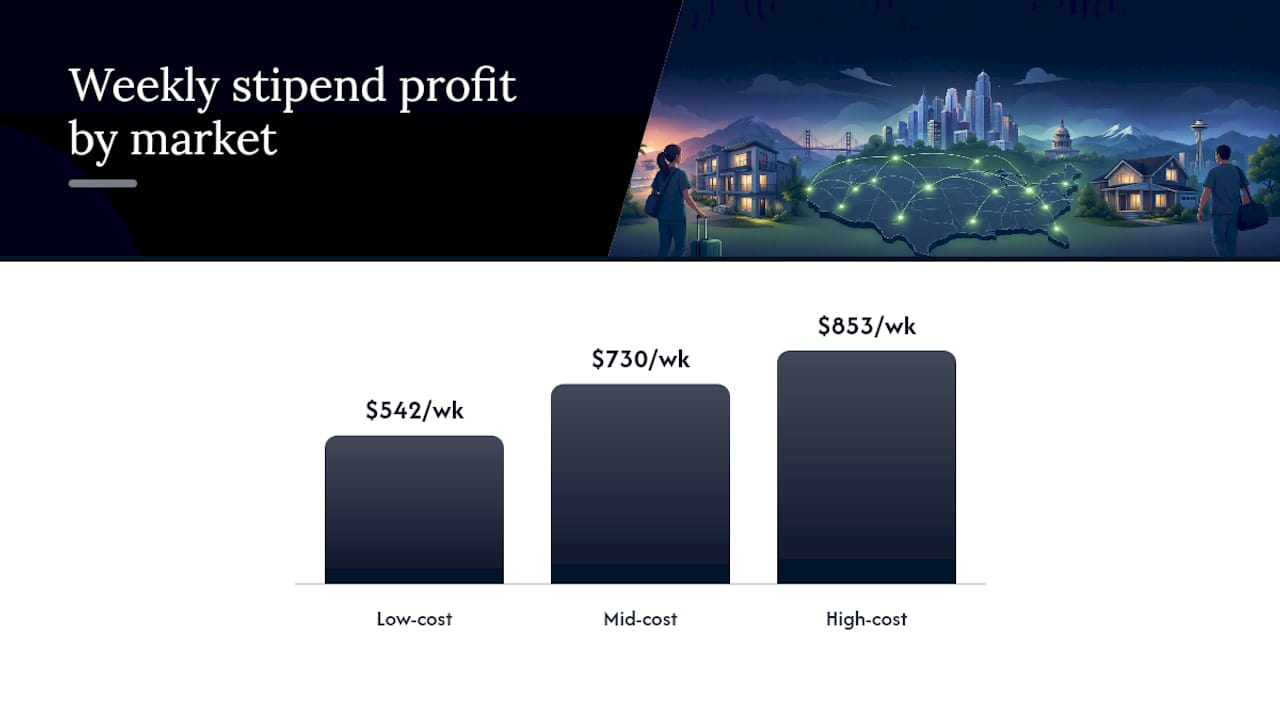
The math is simple once you have both numbers: weekly stipend minus monthly rent divided by 4.33 equals your weekly stipend profit. That 4.33 figure converts a monthly rent number into an average weekly cost, which is the format stipend calculators use for apples-to-apples comparisons.
Here's how that plays out across three market types over a standard 13-week contract:
| Market type | Weekly stipend | Monthly rent | Weekly rent (rent ÷ 4.33) | Weekly profit | 13-week total profit |
|---|---|---|---|---|---|
| Low-cost | $750 | $900 | $208 | $542 | $7,046 |
| Mid-cost | $1,100 | $1,600 | $370 | $730 | $9,490 |
| High-cost | $1,500 | $2,800 | $647 | $853 | $11,089 |
Two edge cases deserve attention:
- If your rent exceeds the weekly stipend, you're subsidizing housing out of your taxable wages, which erodes the whole point of a tax-free allowance.
- If a facility's stipend runs noticeably above the GSA lodging maximum for that county, some agencies flag it or split the overage as taxable, so confirm how your contract handles any excess.
Housing Options That Change Your Stipend Math
Where you actually live determines whether your stipend becomes real profit or just covers rent. Furnished Finder built its entire platform around travel nurse housing, with month-to-month furnished units that typically run $1,000 to $2,200 a month depending on market. Travel Nurse Housing (travelnursehousing.com) offers a similar model with listings specifically vetted for short-term healthcare assignments. Both tend to beat standard Airbnb monthly rates, which often carry cleaning fees and service charges that eat into stipend profit.
Shared apartments and roommate setups cut costs further, sometimes by 30% to 50% versus a solo unit, though vetting a roommate on a 13-week timeline takes real diligence. Extended-stay hotels solve short-notice housing but rarely make financial sense for full contracts. Platforms like June Homes also offer stipend-friendly monthly billing with invoice documentation that simplifies tax-home recordkeeping.
A few tactical moves consistently protect your margin:
- Split utilities explicitly in writing before move-in, not after the first bill.
- Prefer month-to-month leases over fixed terms whenever the price difference is small.
- Keep a contingency fund equal to at least one month's rent in case an assignment cancels early.
- Start your housing search the moment you sign, not after your start date.
Pro Tip: Ask for an early-termination clause tied specifically to assignment cancellation. If the hospital ends your contract early, you shouldn't be stuck paying rent on a lease built for a job that no longer exists.
Reserve agency-provided housing as a bridge option for the first week if you can't lock in your own place before arrival, then transition once you've toured the area.
Deciding Between the Stipend and Agency-Provided Housing
Agency housing beats the stipend route in a few specific situations, and recognizing them upfront saves headaches.
- Short assignments under eight weeks, where the hassle of setting up and breaking a lease outweighs potential stipend profit.
- Unfamiliar markets where you can't reliably judge safe neighborhoods or realistic rent from a distance.
- Tight housing inventory, common in rural hospital towns or during major local events that spike short-term rental demand.
To compare value fairly, price out what the agency's unit would cost you to rent yourself, then subtract that from your stipend. If the gap is small, guaranteed housing removes risk for little lost profit. Before choosing, ask the agency who covers utilities, whether the unit is shared, and what happens to your housing if the contract ends early or guaranteed hours fall through.
Recordkeeping That Protects Your Tax-Free Status
The IRS doesn't take your word for a tax home. It wants paper. Keep these on file, ideally scanned and backed up, for at least three years after filing:
- Lease or mortgage documents for your permanent residence, dated and signed.
- Utility bills showing continuous service at that address during travel assignments.
- Bank or card statements proving rent or mortgage payments kept flowing while you traveled.
- Travel records, gas receipts, or flight confirmations showing trips back home between contracts.
- Voter registration or mailing address updates that stayed anchored to your permanent home.
The most common mistake is treating a storage unit or a family member's spare room as a tax home without any duplicate expense to back it up. IRS guidance on travel expenses makes clear that reimbursements tied to a legitimate business purpose and a real tax home hold up; a P.O. box does not.
Finding Stipend-Friendly Assignments Faster
Comparing stipends across dozens of facility postings by hand eats hours you'd rather spend prepping for your next contract. Real-time job matching narrows that search by pairing your preferred markets and pay expectations against open assignments as they post, instead of you scrolling job boards manually.
When you're filtering options, look specifically for listed stipend amounts, the target city or county, and whether hours are guaranteed. A high stipend attached to a facility with no guaranteed hours protection carries more risk than a moderate stipend with solid hour guarantees.
Ask every recruiter for an itemized pay breakdown before you sign. Separating hourly wage, housing stipend, and M&IE into distinct line items is the fastest way to catch a combined stipend that's quietly lower than it looks.
What I Check First in Every Contract
Before anything else, I look at the stipend's relationship to the GSA number for that county, whether hours are guaranteed, and cancellation protections. Proof of tax-home status comes next. My negotiation move is simple: ask for the maximum stipend allowed for that city and request an itemized breakdown before comparing offers.
— Flexible
Find Assignments Built Around Your Housing Strategy
Once you know your target stipend range and tax-home plan, the slow part is usually the search itself. This platform speeds up exactly that step, helping users find nursing assignments more efficiently by filtering postings based on pay structure, location, and availability.

If housing stipend amount and guaranteed hours are your top filters, use them directly when you build your profile. Visit the nursing jobs page to create a profile and start matching with facilities that fit the compensation structure you've mapped out here.
Check These Sources Yourself
- GSA per diem lookup for county-level lodging maximums.
- IRS Publication 463 for tax-home rules.
- HUD Fair Market Rents for local rent comparisons.
- Types of short-term healthcare assignments for housing-length context.
This article is general information, not a substitute for advice from a qualified financial advisor. Consult a qualified financial professional about your own circumstances before acting on anything here.
Sources
- GSA: Per Diem Rates
- IRS Publication 463, Travel, Entertainment, Gift, and Car Expenses
- Travel Nurse Housing guide and stipend calculator
- What Is a Travel Nurse Pay Package? (Complete Breakdown for 2026)
- HUD USER: Fair Market Rents
FAQ
What is the 12/24 rule for travel nurses?
It's an informal industry guideline suggesting you shouldn't work more than 12 months in any 24-month window in the same metro area, since staying longer weakens your claim to a duplicate tax home under IRS rules.
How much is a housing stipend usually?
Weekly housing stipends typically range from $700 to $1,600, depending on the local GSA lodging maximum and how much of that maximum the agency chooses to pay.
What is the average stipend for a travel nurse?
Most contracts land in the $1,000 to $1,200 weekly range for housing, though high-cost metros push toward the top of the $700 to $1,600 band and rural markets sit closer to the bottom.
How much money can you make renting to travel nurses?
Landlords renting furnished units through platforms like Furnished Finder or Travel Nurse Housing often charge monthly rents that vary depending on local market conditions, though actual returns depend heavily on local rental rates and vacancy between contracts.