
A guaranteed-hours clause is a written promise in your travel nursing contract that your staffing agency will pay you for a minimum number of hours per week, even if the facility cancels your shifts. That promise is only as strong as the written language in your contract. A recruiter's verbal assurance means nothing if it isn't documented.
Before you sign anything, take three steps:
- Ask for the clause in writing. Request the exact guaranteed-hours language from your recruiter before the contract is finalized.
- Confirm cancellation thresholds and pay timing. Find out how many shifts can be canceled before the guarantee kicks in, and when that pay hits your account.
- Run a break-even calculation. Compare the guaranteed-hours offer against any higher-rate/no-guarantee alternative. If the facility cancels even one or two shifts per 13-week assignment, the math often favors the guarantee.
According to the BluePipes Blog, the final enforceable guarantee for a traveler is what the staffing agency puts in the nurse's written contract, not what the hospital promises the agency.
Pro Tip: Never start an assignment without a signed contract that includes the exact guaranteed-hours clause. "We'll add it later" is a red flag.
Key Takeaways
Guaranteed hours protect your pay only when the clause is written precisely, the cancellation allowance is defined, and the agency has a track record of honoring it.
| Point | Details |
|---|---|
| Get it in writing | A verbal recruiter promise is unenforceable; require the exact clause in your signed contract. |
| Check cancellation allowance | Know how many shifts can be canceled before guarantee pay triggers, and get that number defined. |
| Run the break-even math | Compare the rate difference between a guarantee offer and a no-guarantee offer against the unit's likely cancellation frequency. |
| Document every cancellation | Screenshot or save written notice of every canceled shift to support any pay dispute. |
| Use Flexiblenursingcareers | The platform surfaces travel assignments with transparent contract terms and recruiter support for guarantee clause negotiation. |
Table of Contents
- What are travel nurse guaranteed hours and who sets them?
- Common types of guaranteed-hours policies and how they differ
- What your assignment contract must include before you sign
- How do guaranteed hours convert to actual pay? Worked examples
- What protections should you demand if shifts get canceled?
- Negotiation checklist: what to ask, accept, and refuse
- How Flexiblenursingcareers helps you find assignments with clear guarantees
- The part of guaranteed hours most nurses overlook
- Find assignments with transparent contract terms on Flexiblenursingcareers
- Sources
What are travel nurse guaranteed hours and who sets them?
Guaranteed hours are a contractual commitment, not a benefit. The hospital-to-agency contract establishes the facility's promise to the agency. The agency then reflects some version of that promise in your contract. The two don't always match, and the gap between them is where nurses lose money.
Here's how the chain works:
- The hospital guarantees a minimum number of billable hours to the agency per week.
- The agency uses that guarantee to offer you a written hours commitment in your assignment contract.
- You are protected only by what the agency writes into your contract, not by what the hospital told the agency.
Hospitals include these clauses to lock in staffing predictability. Agencies include them to attract experienced travelers and reduce turnover mid-assignment. Neither party is doing it purely as a favor to you.
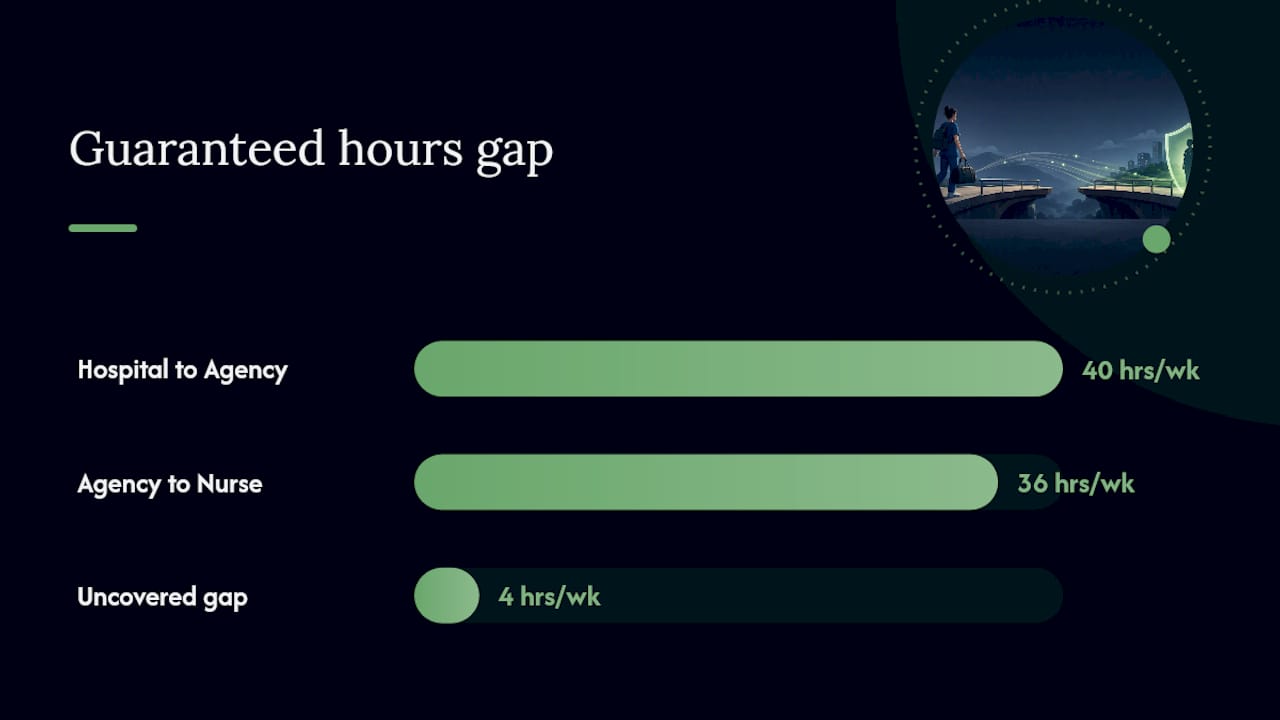
The terms can diverge significantly. A hospital might guarantee the agency 40 hours per week, but your agency contract might only commit to 36. That four-hour gap is legal, and it's common. Always ask your recruiter to show you the hours figure in your specific contract, not the facility's general policy.
| Contract Level | Who Makes the Promise | What It Covers |
|---|---|---|
| Hospital to Agency | Facility | Billable hours the agency can invoice |
| Agency to Nurse | Staffing Agency | Hours you are paid for, including canceled shifts |
| Verbal Recruiter Promise | No legal party | Nothing — unenforceable without written contract |
Common types of guaranteed-hours policies and how they differ
Not every guarantee works the same way. Knowing the format before you sign tells you exactly how much protection you actually have.
Full assignment guarantee covers 36–40 hours per week for the entire contract length, typically 13 weeks. If the facility cancels a shift, you still receive pay for those hours. This is the strongest form and the one most experienced travelers push for.

Partial or minimum guarantees commit to a floor, say 32 hours per week, while allowing the facility to cancel up to a set number of shifts without triggering the guarantee. You're protected against major cancellations but exposed to smaller ones.
Shift-level guarantees pay you for each individual scheduled shift if it's canceled, rather than measuring against a weekly total. This format benefits nurses on irregular schedules but can be harder to track.
Pro Tip: Ask whether the guarantee resets weekly or accumulates across the assignment. A weekly reset means a bad week can't be "made up" by a good one later.
Three clauses commonly limit what a guarantee actually covers:
- Volunteer departure: If you agree to leave early when the unit is overstaffed, most contracts treat that as a voluntary action and exclude it from the guarantee. Never agree to volunteer departure without a written cap on how often it can be invoked.
- Floating requirements: If your contract requires you to float to other units or facilities within a hospital system, canceled shifts on your home unit may not count against the guarantee if the agency argues you could have worked elsewhere. Check whether floating across state lines triggers any multi-state licensing obligations before you accept.
- Make-up shift language: Some contracts allow the facility to offer replacement shifts instead of paying the shortfall. If you can't take those shifts for any reason, you may forfeit the guarantee pay. Get the make-up window defined in hours, not "as available."
What your assignment contract must include before you sign
A strong travel nursing contract includes six non-negotiable elements when guaranteed hours are part of the deal.
- Exact guaranteed hours per week and per assignment total (e.g., a typical minimum number of guaranteed hours per week multiplied by the contract length equals the total minimum guaranteed hours.)
- Cancellation allowance — the number of shifts or hours the facility may cancel without triggering guarantee pay.
- Payment timing — when guarantee pay is issued (same pay cycle as worked hours, or a separate cycle).
- Make-good language — whether replacement shifts are offered, the window to accept them, and what happens if you decline.
- Pre-start cancellation terms — travel and housing reimbursement if the assignment is canceled before your first shift.
- Notice period — how many hours in advance the facility must notify you of a cancellation.
Here is model clause language you can request from your recruiter:
Use this checklist before signing:
- Guaranteed hours per week stated as a specific number
- Cancellation allowance defined (shifts or hours, not "as needed")
- Pay timing confirmed in writing
- Make-up shift window defined with a hard deadline
- Pre-start cancellation reimbursement included
- Notice period for cancellations specified (minimum 2 hours recommended)
- Volunteer departure cap included
- Float requirements listed with geographic limits
Pro Tip: Ask your recruiter to define "canceled shift" in writing. A facility that sends you home after two hours may argue the shift wasn't canceled. Your contract should specify that any shift where you work fewer than your scheduled hours counts as a partial cancellation.
How do guaranteed hours convert to actual pay? Worked examples
The math is straightforward, but running it before you accept an offer can change your decision.
Example A: Full guarantee vs. higher rate
Scenario: Two sample offers for a travel nursing assignment illustrate break-even math between guaranteed hours and higher hourly rates.
Calculations depend on the stated weekly guaranteed hours, hourly rates, and contract length. The break-even analysis compares lost income from cancellations against higher pay without a guarantee.
Travelers should run personalized calculations based on their exact contract figures and local cancellation risk.
The BluePipes framework recommends treating the guarantee like insurance: if local cancellation risk is high, the lower rate with a guarantee often produces more predictable income over a full year.
Example B: Prorated partial-week cancellation
Your contract guarantees 36 hours/week. In week 4, the facility cancels one 12-hour shift. You work 24 hours.
- Hours worked: 24 × $50 = $1,200
- Guarantee shortfall: 12 hours × $50 = $600
- Total week 4 pay: $1,800 (same as a full week)
If your contract includes a make-up shift offer and you accept it, the $600 shortfall pay is replaced by actual worked hours. Your gross is the same, but your tax picture changes slightly because worked hours may affect overtime thresholds.
A note on taxes: Guarantee pay is wages and is fully taxable. Housing and travel stipends may be tax-free under IRS rules if you maintain a tax home, but that status has specific requirements. Consult IRS Publication 463 or a tax professional before assuming any reimbursement is non-taxable. The BLS Occupational Outlook Handbook for registered nurses provides useful context on typical pay structures, though individual contract terms vary widely.
What protections should you demand if shifts get canceled?
Cancellations happen. Your contract should make them costly for the agency and facility, not for you.
Standard protections to require:
- Broken-assignment pay: If the assignment is terminated early by the facility or agency, you receive pay for the remaining guaranteed hours or a lump-sum equivalent.
- Guarantee pay timeline: Shortfall pay must be issued within the same pay cycle as worked hours, not "at the end of the assignment."
- Pre-start cancellation reimbursement: If the assignment is canceled before your first shift, the agency covers documented travel and housing costs you have already incurred.
- Written cancellation notice: Any cancellation must be delivered in writing (email or text), not just verbally. This creates a paper trail for disputes.
Red flags in contract language:
- "Cancellations at the facility's discretion" with no defined limit
- Volunteer departure language with no cap on frequency
- Make-up shift offers with no deadline ("as scheduling allows")
- Guarantee pay issued "at the agency's convenience" rather than on a set cycle
Pro Tip: Screenshot every text or email where a recruiter or charge nurse tells you a shift is canceled. If a pay dispute arises, that documentation is your strongest evidence.
If the agency claims the hospital didn't honor its guarantee, that's the agency's problem, not yours. Your contract is with the agency. Document the shortfall, submit a written pay dispute to the agency's payroll department, and escalate to agency leadership if you don't receive a response within one pay cycle. For assignments that cross state lines, check whether floating requirements create any licensing compliance issues through NCSBN before accepting a float to a different state.

Market conditions also matter. When hospitals face budget pressure, they sometimes push agencies toward more restrictive guarantee terms. Knowing that context helps you understand why an agency might offer a lower guarantee than you expected, and gives you leverage to push back.
Negotiation checklist: what to ask, accept, and refuse
Use these scripted questions before you accept any offer.
Ask your recruiter:
- "Can you send me the exact guaranteed-hours clause from my contract before I sign?"
- "How many shifts per week can the facility cancel before the guarantee triggers?"
- "When is guarantee pay issued — same cycle as worked hours?"
- "Is there a volunteer departure cap, and what is it?"
- "What happens to my housing stipend if the assignment is canceled pre-start?"
Ask the hiring manager (if you get a call):
- "What is the typical cancellation frequency on this unit?"
- "Does the unit float to other facilities in the system, and does that affect my guarantee?"
Red-flag answers that should prompt a rewrite:
- "We rarely cancel, so the guarantee clause isn't really relevant" — if it's rarely relevant, there's no reason not to include it.
- "The guarantee is handled at the agency level, not something we control" — this is true, but a hiring manager who can't confirm the unit's cancellation history is a risk signal.
- "We can add that language after you start" — never acceptable.
Concession trade-off: If the facility requires limited floating within the same hospital system, you can accept that in exchange for a stronger cancellation pay clause or a shorter notice period requirement. Float requirements are manageable; unlimited cancellation risk is not.
Break-even decision framework:
- Calculate the weekly rate difference between the guarantee offer and the no-guarantee offer.
- Divide that weekly difference by your hourly rate to find how many hours of cancellation per week make the guarantee worthwhile.
- If the unit's historical cancellation rate exceeds that threshold, take the guarantee.
For travel nursing jobs in high-demand specialties like ICU or ER, cancellation rates tend to be lower. For med-surg or step-down units with more variable census, the guarantee is usually worth the rate concession.
How Flexiblenursingcareers helps you find assignments with clear guarantees
Finding a travel nursing assignment with transparent contract terms used to mean calling multiple recruiters and hoping someone would share the actual clause language. Flexiblenursingcareers takes a different approach.
The platform matches you to assignments in real time based on your specialty, availability, and contract preferences, including whether you want guaranteed-hours language included. You see the contract terms before you commit, not after.
What that means in practice:
- Real-time job matching surfaces assignments where facilities have already agreed to minimum-hours commitments.
- Recruiter support is available to help you request specific clause language before signing.
- Contract documentation is handled through the platform, so guarantee terms are recorded and accessible if a dispute arises.
- If an assignment doesn't meet your minimum guarantee threshold, you can filter it out before wasting time on a recruiter call.
Pro Tip: Before contacting a recruiter through Flexiblenursingcareers, write down your minimum acceptable guarantee (hours per week, cancellation allowance, pay timing). Having that list ready shortens the negotiation and signals to recruiters that you know your contract.
You can also check agency reviews on the platform to see how other nurses rate agencies on contract transparency and guarantee follow-through.
The part of guaranteed hours most nurses overlook
Most contract guides focus on getting the clause in writing. That's necessary, but it's not sufficient. The clause has to be specific enough to be enforceable.
Vague language like "hours guaranteed subject to facility census" is almost useless. Census-based carve-outs let facilities cancel freely and argue the guarantee never applied. The model clause in this guide closes that gap by defining cancellations explicitly and tying guarantee pay to the same pay cycle as worked hours.
The other thing experienced travelers know: a guarantee is only as reliable as the agency behind it. An agency that has a history of disputing shortfall pay or delaying guarantee payments is a worse partner than one offering a slightly lower rate with a clean payment record. That's why checking agency reviews before you sign matters as much as reading the clause itself.
Find assignments with transparent contract terms on Flexiblenursingcareers
Nurses who know what they want from a contract shouldn't have to fight for basic transparency. Flexiblenursingcareers connects you directly to nursing jobs where contract terms, including guaranteed-hours language, are visible before you apply.

You get real-time matching to assignments that fit your specialty and schedule, recruiter support to negotiate clause language, and a documented record of your contract terms from day one. No chasing recruiters for clause wording. No signing blind.
Before you reach out, prepare three things: your minimum acceptable weekly guarantee, your cancellation allowance threshold, and your preferred pay timing. Bring those to your first recruiter conversation and you'll move faster. Search travel nursing assignments on Flexiblenursingcareers today and filter for roles that match your contract standards.
Sources
- Everything About Travel Nursing Guaranteed Hours | BluePipes Blog
- Registered nurses | Occupational Outlook Handbook | BLS
- IRS
- National Council of State Boards of Nursing (NCSBN)