
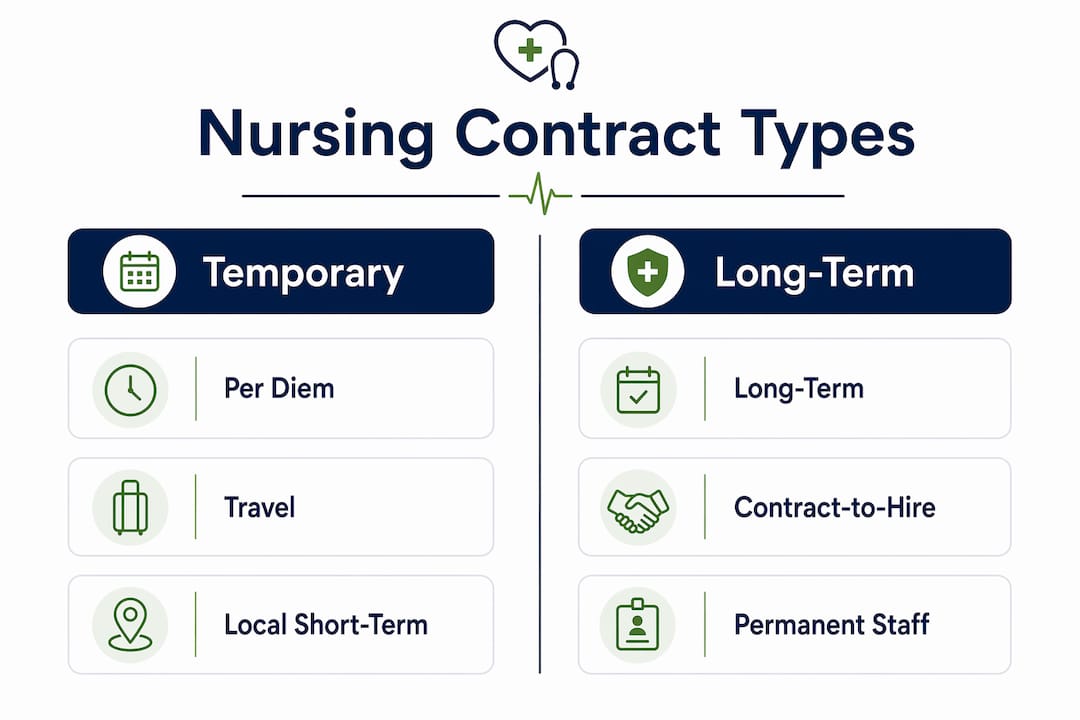
The main flexible nursing contract types are per diem/PRN, travel nursing, local short-term/internal travel, long-term/contract-to-hire, and permanent float staff. Your best fit comes down to one axis: how much income stability you need versus how much schedule and location freedom you want. The Nurse Licensure Compact (NLC) shapes which options are available to you across state lines, and the IRS determines how your stipends are taxed. Flexible nursing careers connects nurses to all of these contract types through real-time matching.
Here is the quick decision guide:
- Per diem/PRN: Maximum schedule control; you pick your shifts. Best if you want to set your own hours and can handle income variability.
- Travel nursing: Geographic mobility plus higher weekly pay. Best if you are willing to relocate for 8–26 weeks at a time.
- Local short-term/internal travel: Variety without relocation. Best if you want unit or hospital rotation while keeping your home base.
- Long-term/contract-to-hire: Steadier income with limited mobility. Best if you want a bridge to a permanent role or a longer assignment in one place.
- Permanent/float staff: Full stability and benefits. Best if predictability and employer-sponsored retirement and health coverage are your top priorities.
Table of Contents
- What does a nursing contract actually cover?
- Per diem (PRN) nursing: what to expect and who it fits
- Travel nursing: structure, pay packages, and what flexibility really means
- Local short-term and "local travel" contracts: flexibility without relocation
- Long-term contracts and contract-to-hire roles: when stability and flexibility overlap
- How do the contract types compare at a glance?
- How to choose the right contract for your goals
- How tech-driven staffing platforms speed up finding flexible contracts
- Key Takeaways
- What staffing specialists see nurses get wrong
- Find flexible nursing contracts faster with Flexiblenursingcareers
- Useful sources and next reads
What does a nursing contract actually cover?
A nursing contract is a written agreement that defines your employment relationship with a hospital, health system, or staffing agency. It spells out expected hours, pay structure, assignment length, and the conditions under which either party can end the arrangement.
A few terms come up in almost every contract conversation:
- Per diem/PRN: Latin for "as needed." You work on an as-called basis with no guaranteed hours in most programs.
- W-2 employee: You are on payroll, with taxes withheld. Most agency travel nurses are W-2 employees of the agency, not the hospital.
- Tax-free housing stipend: A non-taxable allowance for housing costs when you maintain a permanent tax home elsewhere. The IRS requires you to have a legitimate tax home to qualify; stipends paid without that basis are taxable wages.
- Pay package: The full compensation picture: base hourly rate, stipends, travel reimbursement, and any completion bonus.
- Contract-to-hire: A fixed-term contract with a defined pathway to permanent employment if both sides agree.
Licensing portability is the other term you need to understand before accepting any assignment. The NLC allows nurses in compact states to practice in other compact states under a single multistate license. If your home state is not part of the compact, or if your assignment state is not, you will need a separate state license before you can work there. That process can take weeks, so check NLC status early.
On taxes: housing and travel stipends are tax-free only when you qualify under IRS rules. If you do not maintain a permanent tax home, the IRS treats those stipends as ordinary wages. Plan for irregular income by setting aside a consistent percentage of each paycheck, especially if you move between contract types during the year.
Per diem (PRN) nursing: what to expect and who it fits
Per diem nursing gives you the most direct control over your schedule of any contract type. You join a hospital's on-call pool or an agency's PRN roster, and you pick up shifts based on your availability and the facility's open slots. Many programs have no guaranteed minimum hours.
Pay is typically higher per hour than staff rates, which compensates for the lack of benefits. The exact structure depends on who employs you. Contract nursing through an agency means you are a W-2 employee of that agency, and benefits (if any) come from the agency. Direct-hire hospital PRN roles may offer limited benefits once you hit a minimum hours threshold, but most do not include full health or retirement packages.
Pros and cons for your lifestyle:
- Pro: You set your schedule. No mandatory overtime, no fixed days.
- Pro: Higher hourly rates than comparable staff positions.
- Con: Income swings week to week, especially when census is low.
- Con: Few or no employer-sponsored benefits in most programs.
- Con: Last-minute cancellations are common; some facilities cancel PRN shifts with little notice.
Red flags to watch for in PRN offers: vague or missing cancellation policies, no written minimum shift commitment, unclear rules about holiday or weekend obligations, and agencies that cannot explain how your pay is classified (taxable vs. stipend).
Pro Tip: Stabilize your PRN income by targeting a specific weekly shift count and combining it with a small part-time role at a second facility. Two PRN rosters give you more shift options and reduce the risk of a slow week at one hospital wiping out your income.
Travel nursing: structure, pay packages, and what flexibility really means
Travel nursing is built around a specific employment model: the agency is your legal employer, and the hospital is the client. You are a W-2 employee of the agency, which handles payroll, taxes, and benefits. The hospital directs your clinical work but does not employ you directly.
The industry standard contract length is commonly a few months, with typical assignments ranging from a couple to several months. Extensions are common when both the nurse and the facility want to continue. Most travel nurses complete one assignment and move to the next, though some extend repeatedly at the same hospital for a year or more.
Pay package components typically include:
- A base hourly rate (taxable)
- A weekly tax-free housing stipend (when you qualify under IRS rules)
- A meals and incidentals stipend (also tax-free when eligible)
- Travel reimbursement at the start and end of the assignment
- Completion bonuses on some contracts
Experienced travel nurses almost exclusively prefer taking the housing stipend rather than agency-provided housing. You control the quality and location of your lodging, and if you find cheaper housing, you keep the difference.
Weekly gross pay by specialty (2026 industry examples): med-surg $1,800–$2,400; ICU $2,200–$2,900; CVICU/NICU/PICU $2,400–$3,200. Crisis-rate ceilings during the pandemic reached $4,000–$8,000 per week, but those figures normalized after 2023–2024 and are not the current baseline.
Licensing is the main logistical hurdle. If your home state is in the NLC, you can work in other compact states without a separate license. Non-compact assignments require you to apply for a state license, which adds lead time to your start date. Factor that into your timeline when evaluating offers.
Pros and cons:
- Pro: Higher weekly gross pay than most other contract types.
- Pro: Geographic freedom; you choose where to go.
- Pro: Rapid skill exposure across different systems and patient populations.
- Con: Benefits are thinner than permanent staff packages; health coverage often requires a waiting period.
- Con: Housing, tax home maintenance, and licensing costs add up.
- Con: Less job security; contracts can be cancelled, though written notice terms vary.
For nurses interested in travel nursing jobs, understanding the full pay package before signing is the single most important step.
Local short-term and "local travel" contracts: flexibility without relocation
Not every nurse can or wants to relocate. Local short-term contracts and internal travel programs give you unit variety and often a pay bump without requiring you to leave your region.

Health systems like SSM Health run tiered flexible nursing programs that include PRN tiers (PRN 1, 2, 3), internal travel programs, and float teams. Each tier has formal rules: minimum shifts per pay period, holiday requirements, and defined benefits eligibility. These are structured programs, not informal arrangements.
Internal travel pools are typically W-2 hospital employment, which means you get higher taxable wages and stronger benefits compared with agency travel models. The trade-off is less geographic choice. You rotate across units or campuses within the system rather than choosing assignments nationwide.
For a deeper look at how these assignments are structured, the types of short-term healthcare assignments guide covers the mechanics in detail.
Who this fits best:
- Nurses with family or community ties that make relocation impractical.
- Nurses who want clinical variety without the tax-home complexity of national travel.
- Nurses who value employer-sponsored benefits and prefer not to manage their own housing stipend.
- New-to-flexible-work nurses who want to test contract-style scheduling before committing to full travel.
The main drawback is that your assignment options are limited to your health system's footprint. You also may have less say in which unit you float to on a given shift.
Long-term contracts and contract-to-hire roles: when stability and flexibility overlap
Long-term contracts typically run 3–12 months at a single facility. They look more like a staff position from the outside but retain the defined end date and contract structure of temporary work. Notice terms and extension clauses vary, so read those sections carefully before signing.
Contract-to-hire roles add a conversion pathway. You work on contract for a defined trial period, and if both sides agree, you convert to permanent staff with full benefits. This model is common when a facility wants to evaluate fit before committing to a permanent hire, and it gives you a low-risk way to assess a workplace before accepting a permanent offer.
Pay and benefits in long-term contracts usually fall between agency travel rates and permanent staff rates. You get more stability than short-term travel, but the per-hour rate is typically lower than crisis or short-term travel pay. Benefits eligibility often kicks in after a waiting period, and retirement contributions may not match what a permanent staff position offers.
When long-term or contract-to-hire makes sense:
- You want to build depth in a specialty without the disruption of frequent moves.
- You are between permanent roles and need income continuity.
- You are evaluating a facility for a potential permanent position.
- You prefer a predictable schedule but are not ready to commit to indefinite employment.
One practical note: extension clauses can work in your favor or against you. A clause that lets the facility extend without renegotiating pay locks you into your original rate even if market rates rise. Ask for a renegotiation window at each extension.
How do the contract types compare at a glance?
The table below maps each contract type across the six dimensions that matter most when you are making a decision.
| Contract Type | Best For | Typical Length | Pay and Benefits | Relocation Required | Scheduling Flexibility | Licensing Needs |
|---|---|---|---|---|---|---|
| Per diem/PRN | Maximum schedule control | Ongoing/no fixed term | High hourly, few/no benefits | No | High (you choose shifts) | Current state license |
| Travel nursing | Geographic mobility + higher weekly pay | 8–26 weeks | High weekly gross, stipends, thin benefits | Yes (typically) | Moderate (set per contract) | NLC or state license per assignment |
| Local short-term/internal travel | Variety without relocation | Varies by program | Moderate-high hourly, stronger benefits | No | Moderate | Current state license |
| Long-term/contract-to-hire | Stability + potential permanent role | 3–12 months | Moderate hourly, improving benefits | Sometimes | Low-moderate | Current state license |
| Permanent/float staff | Full stability and benefits | Indefinite | Lower hourly, full benefits, retirement | No | Low (employer-set schedule) | Current state license |
Quick decision rules:
- Choose per diem if schedule control is your top priority and you can handle income variability.
- Choose travel nursing if higher weekly pay and the freedom to move between locations matter most.
- Choose local short-term if you want variety but need to stay in your region and keep your benefits.
- Choose long-term or contract-to-hire if you want a bridge to a permanent role or prefer a predictable assignment.
- Choose permanent/float staff if stability, employer-sponsored health coverage, and retirement contributions are non-negotiable.
How to choose the right contract for your goals
Start by defining your three priorities in order: income level, schedule control, and location. Most nurses can rank these clearly once they write them down. Your top priority narrows the field fast.
Questions to ask every recruiter or hiring manager:
- What is the exact contract length, and what are the extension terms?
- What is the cancellation or early termination policy, and how much notice is required from each side?
- How is the housing stipend calculated, and is it tax-free or taxable? Can you provide a written pay breakdown?
- Who covers licensing fees and continuing education costs?
- When does health insurance coverage begin, and what does it include?
- Are there mandatory overtime or on-call requirements?
- What is the process if the facility cancels the contract early?
Red flags to watch for:
- No written contract offered before your start date. Several states, including Connecticut, require written agreements between temporary staffing agencies and facilities; a facility or agency that resists putting terms in writing is a warning sign regardless of state law.
- Vague or missing cancellation clauses.
- Stipends described as "tax-free" without any explanation of IRS eligibility requirements.
- An agency that cannot or will not provide a written pay breakdown showing each component separately.
Pro Tip: When a recruiter describes a stipend verbally, ask them to send a written example of a previous pay package for a comparable assignment. Real numbers on paper reveal whether the "tax-free" portion is structured correctly and whether the total package is competitive.
Check your flexible healthcare roles checklist to confirm you have the credentials each contract type typically requires before you apply.
How tech-driven staffing platforms speed up finding flexible contracts
Traditional job searches for flexible nursing work meant calling agencies, submitting paper credentials, and waiting days for a callback. Technology-driven platforms have changed that process significantly.
Modern staffing platforms typically offer:
- Profile-based matching: Your skills, specialty, license status, and availability are matched against open assignments in real time.
- Centralized credential management: Licenses, certifications, and immunization records are stored and verified once, then shared with facilities as needed.
- Real-time shift and assignment alerts: You see openings as they post, not after they have been filled.
- Faster start dates: Verified credentials on file mean less back-and-forth before an assignment begins.
University health systems source temporary nursing staffing through multi-year vendor agreements, which means the facilities posting on staffing platforms are often operating under formal, structured contracts. That is good for nurses: it means the terms are more standardized and the facilities are accountable.
Flexiblenursingcareers centralizes credential management and speeds match times, which is a practical advantage when you are targeting short lead-time contracts. For nurses exploring nursing jobs across per diem, travel, local short-term, and long-term roles, having one profile that surfaces across all contract types saves real time.
For a broader look at how temporary clinical staffing works from both the facility and nurse perspective, that guide covers the mechanics in detail.
Key Takeaways
Choosing the right nursing contract comes down to matching your income needs, schedule preferences, and location flexibility to the contract type built for exactly that combination.
| Point | Details |
|---|---|
| Per diem/PRN trade-off | Higher hourly pay comes with income variability and few or no employer-sponsored benefits. |
| Travel nursing standard | Weekly gross ranges from $1,800 to $3,200 depending on specialty. |
| NLC check first | Verify your home state's NLC status before accepting any multi-state assignment to avoid licensing delays. |
| Total compensation matters | Compare the full pay package (base rate, stipends, benefits, bonuses), not just the hourly rate. |
| Flexiblenursingcareers | Connects nurses to per diem, travel, local short-term, and long-term roles through real-time matching and centralized credential management. |
What staffing specialists see nurses get wrong
The most common mistake nurses make when evaluating flexible contracts is comparing hourly rates without accounting for the full compensation picture. A travel nurse earning $2,200 per week gross with a tax-free housing stipend is in a very different financial position than a per diem nurse earning a higher hourly rate but paying full out-of-pocket health insurance premiums. The math only works when you run the whole package.
The second pattern that comes up repeatedly is licensing delays. Nurses accept an assignment in a non-compact state, assume the license will arrive quickly, and then find themselves unable to start on the agreed date. The fix is simple: start the license application before you sign the contract, not after.
Housing stipend misunderstandings are the third consistent issue. Nurses sometimes assume any stipend labeled "tax-free" actually qualifies under IRS rules. It does not, unless you maintain a legitimate permanent tax home. If you have given up your permanent residence to travel full-time, those stipends become taxable wages. Get that clarified in writing before you sign.
From the hiring side, the nurses who get extensions and renewals share three traits: they show up reliably, they demonstrate specialty competence quickly, and they are willing to float when the unit needs it. Flexibility in practice, not just on paper, is what convinces a facility to keep you.
Find flexible nursing contracts faster with Flexiblenursingcareers
Sorting through per diem rosters, travel agency offers, and local short-term postings on your own takes time you do not have. Flexiblenursingcareers gives you one place to find verified listings across every contract type covered in this guide, from PRN shifts to 26-week travel assignments, without the back-and-forth of traditional agency calls.

Your profile stores your credentials once. The platform matches you to open roles based on your specialty, license status, and availability in real time. Facilities posting through Flexiblenursingcareers operate under structured agreements, so the contract terms you see are the terms you get. Create your profile, upload your credentials, and browse nursing jobs now to see what is available in your specialty and region.
Useful sources and next reads
Use these resources to verify licensing requirements, check pay benchmarks, and go deeper on specific contract types.
Licensing and regulatory resources:
- American Nurses Association: Travel Nursing Overview — NLC compact state list and travel nursing policy guidance.
- Connecticut General Statutes § 19a-118a — Example of state-level written agreement requirements for temporary staffing agencies; check your own state's rules.
Pay and labor market data:
- Bureau of Labor Statistics: Registered Nurses — Authoritative national employment and wage data for RNs.
- PMC/NIH: Nursing workforce research — Peer-reviewed research on nursing staffing models and workforce flexibility.
Contract mechanics and staffing structures:
- Medscape: Contract Nursing 101 — Practical breakdown of per diem, agency, and hospital-employed contract differences.
- SSM Health: Flexible Nursing Options — Real example of a health system's tiered PRN, internal travel, and float program structures.
Flexiblenursingcareers resources for next steps:
- Flexible Healthcare Roles Checklist for Nurses — Credential and experience requirements by contract type.
- What Is Temporary Clinical Staffing? — How temporary staffing agreements work from both sides.
- Types of Short-Term Healthcare Assignments — Deeper detail on local and regional short-term options.
Partner resource:
- Pediatric Private Duty Nursing Salary Guide — Pay and contract structure specifics for nurses in private-duty pediatric roles.