
Temporary clinical staffing is defined as the practice of hiring qualified healthcare professionals on a short-term basis to fill immediate or fluctuating workforce gaps in medical facilities. The industry standard term for this practice is contingent clinical staffing, though "temporary clinical staffing" is the phrase most administrators use day to day. Travel nursing assignments typically run 8–13 weeks, placing them squarely between per-diem shifts and permanent hires. Healthcare organizations rely on this model to maintain safe staffing ratios without the long-term cost of full-time employment. Flexiblenursingcareers connects nurses and allied health professionals to these short-term roles through real-time job matching based on skills, availability, and location.
What is temporary clinical staffing and how does it work?
Temporary clinical staffing is a workforce model where healthcare facilities bring in credentialed professionals for defined, short-term assignments. The model covers a wide range of roles and contract structures, making it one of the most flexible tools available to hospital administrators and clinic managers.
The most common form is travel nursing. Travel nurses fill staffing gaps in underserved and high-demand areas across the country, taking assignments that typically run 8–13 weeks. That duration is long enough to provide meaningful continuity of care, yet short enough to redeploy staff where need shifts next.

Locum tenens is the physician equivalent. A locum tenens provider steps into a vacant attending or specialist role for weeks or months, keeping patient access intact while a facility recruits permanently. Mid-level providers, including nurse practitioners and physician assistants, fill locum roles as well.
Allied health professionals round out the temporary clinical workforce. Physical therapists, respiratory therapists, medical imaging technologists, and laboratory scientists all take short-term contracts through staffing agencies for healthcare. Their assignments follow the same credentialing and compliance standards as nursing roles.
Temp-to-perm arrangements give both the facility and the clinician a trial period before committing to a permanent hire. The clinician works a standard temporary assignment, and if the fit is right, the facility converts the role to full-time employment. This model reduces the risk of a costly mis-hire.
Pro Tip: When evaluating a temp-to-perm arrangement, define conversion terms in the original contract. Specify the trial duration, the conversion fee structure, and the timeline for the permanent offer. Ambiguity here creates friction later.
| Staffing type | Typical assignment length | Primary use case |
|---|---|---|
| Travel nursing | 8–13 weeks | Census surges, vacancy coverage |
| Locum tenens | 2 weeks to 6 months | Physician or specialist gaps |
| Allied health contract | 8–26 weeks | Therapy, imaging, lab shortfalls |
| Temp-to-perm | 8–13 weeks with conversion option | Permanent hire evaluation |
What benefits do temporary clinical staffing solutions offer healthcare facilities?
Flexible staffing models give healthcare organizations the ability to scale their workforce up or down without long-term financial commitments. That flexibility is the core operational advantage, and it cascades into several measurable benefits.
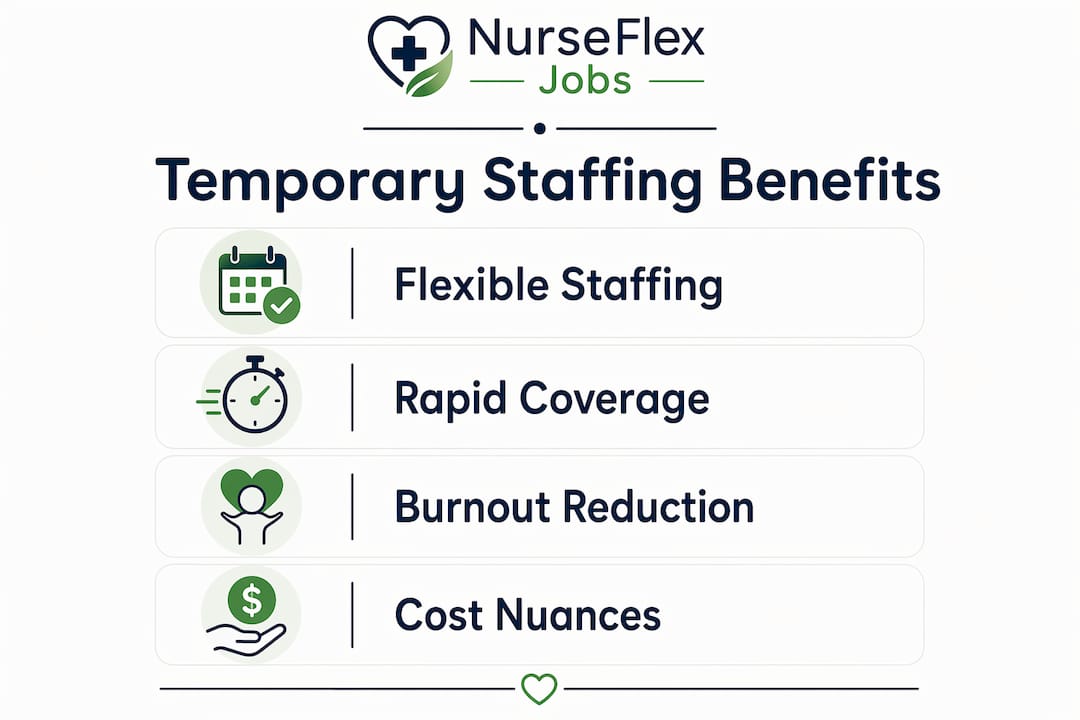
Rapid gap coverage. Staffing agencies reduce time-to-fill for temporary clinical roles, enabling facilities to maintain adequate coverage during peak demand or emergencies. A hospital facing a sudden surge in flu-season admissions can have credentialed nurses on the floor within days rather than weeks.
Burnout reduction. Temporary staff provide relief that mitigates permanent staff burnout and reduces the risk of emotional exhaustion among healthcare workers. When a unit runs short-staffed for months, the nurses who stay absorb extra shifts and emotional load. Bringing in temporary staff breaks that cycle before it causes permanent attrition.
Improved care quality. Matching the right clinical skills to specific assignments improves patient outcomes. A cardiac step-down unit that needs a nurse with telemetry certification gets exactly that, rather than pulling a general med-surg nurse who lacks the specialty background.
Scalability during demand surges. Seasonal demand, natural disasters, and public health emergencies create staffing needs that no permanent workforce can fully absorb. Temporary clinical staffing lets facilities scale precisely to the demand curve, then scale back without layoffs.
"The real value of temporary staffing is not just filling a seat. It is putting the right clinical skill in the right place at the right time, so that patient care does not degrade while you solve a longer-term workforce problem."
The cost argument is more nuanced than administrators often expect. Agency bill rates for temporary staff are higher per hour than permanent salaries. The offset comes from avoided overtime costs, reduced agency-of-last-resort premiums, and the elimination of benefits costs for short-term roles. Facilities that track total cost of vacancy, including overtime, agency premiums, and adverse patient outcomes, consistently find that planned temporary staffing is cheaper than reactive gap-filling.
What challenges do healthcare administrators face with temporary staffing?
Temporary clinical staffing solves real problems, but it introduces its own set of operational challenges. Administrators who go in without a plan often find that the short-term fix creates longer-term friction.
-
Credentialing and compliance. Credentialing and compliance checks are critical to maintaining patient care quality and meeting regulatory standards. Every temporary clinician must hold a current license in the state where they practice, carry appropriate malpractice coverage, and meet facility-specific competency requirements. Credentialing a travel nurse from scratch can take two to four weeks. Partnering with an agency that pre-credentials its clinicians cuts that timeline significantly.
-
Continuity of care. Rotating temporary staff through the same unit disrupts care relationships, particularly in behavioral health, oncology, and pediatrics. Patients and families build trust with familiar faces. The solution is to request extended assignments or repeat placements from the same clinician when possible.
-
Cultural integration. Temporary clinicians arrive with different unit cultures, documentation habits, and communication norms. Permanent staff sometimes resist the disruption. A structured onboarding process, even a brief one, reduces friction and accelerates productivity.
-
Retention of permanent staff. Facilities that rely heavily on temporary staffing risk signaling to permanent employees that the organization cannot retain talent. That perception, if left unaddressed, accelerates voluntary turnover among the very staff the facility most wants to keep.
-
Contract management. Temporary staffing contracts contain terms around cancellation policies, overtime rates, housing stipends, and extension options. Administrators who do not read these terms carefully face unexpected costs when census drops or an assignment ends early.
Pro Tip: Assign a dedicated internal coordinator to manage all temporary staffing relationships. One person who owns vendor communication, credentialing tracking, and contract renewals prevents the administrative gaps that lead to coverage failures.
How do healthcare facilities implement temporary staffing effectively?
Effective implementation of a temporary clinical workforce starts before the first agency call. Facilities that treat temporary staffing as a reactive emergency measure pay more and get worse results than those who build it into their workforce plan.
Evaluate and select staffing agencies carefully. Not all staffing agencies for healthcare operate at the same standard. Assess agencies on their credentialing process, their speed of placement, their clinician pool depth in your specialty areas, and their track record with facilities similar to yours. Ask for references from other nurse managers or administrators.
Understand contract terms before signing. Key terms to review include the bill rate structure, overtime thresholds, cancellation clauses, housing and travel stipend arrangements, and the process for replacing a clinician who is not performing. A contract that looks affordable at the base rate can become expensive if cancellation penalties apply every time census drops.
Build a credentialing checklist. Work with your compliance team to create a standard checklist for temporary clinical staff. The checklist should cover state licensure verification, background check, drug screening, BLS or ACLS certification, and any facility-specific competency assessments. Share this checklist with your agency partners so they can pre-screen candidates against your requirements.
Integrate temporary staff into the unit culture. Assign a permanent staff mentor to each temporary clinician for the first week. Brief the unit on the temporary clinician's background and specialty. Include temporary staff in huddles and team communications. These steps reduce the "us versus them" dynamic that undermines unit cohesion.
Track performance and outcomes. Measure temporary staff performance using the same metrics you apply to permanent employees: patient satisfaction scores, incident reports, documentation accuracy, and peer feedback. This data informs future agency selection and helps you identify high-performing clinicians worth requesting for repeat assignments or temp-to-perm conversion.
Pro Tip: Request the same travel nurse for a repeat assignment when performance is strong. Agencies can often accommodate this, and a returning clinician requires far less onboarding time, which directly reduces your cost per covered shift.
Key takeaways
Temporary clinical staffing is the most direct tool healthcare administrators have for maintaining safe staffing ratios without permanent hiring commitments, and its effectiveness depends on credentialing rigor, agency selection, and deliberate staff integration.
| Point | Details |
|---|---|
| Core definition | Temporary clinical staffing fills short-term workforce gaps with credentialed professionals on defined assignments. |
| Assignment length | Travel nursing and allied health contracts typically run 8–13 weeks, balancing flexibility with care continuity. |
| Primary benefit | Temporary staffing reduces burnout among permanent staff and maintains patient care quality during demand surges. |
| Key challenge | Credentialing and compliance checks must be completed before a temporary clinician can practice at your facility. |
| Best practice | Partner with agencies that pre-credential clinicians and assign an internal coordinator to manage all temporary staffing contracts. |
The staffing model most administrators underestimate
Working in healthcare staffing, I have watched administrators treat temporary staffing as a last resort rather than a planned resource. That mindset is expensive. Facilities that call an agency at 11 PM because a shift is uncovered pay crisis rates and get whoever is available. Facilities that build a temporary staffing strategy in advance, with vetted agency partners and pre-approved credentialing pipelines, pay standard rates and get clinicians who match their unit's needs.
The trend I find most significant is the shift toward technology-driven matching. Platforms that match clinicians to assignments based on verified skills, real-time availability, and location preferences cut placement time dramatically. That speed matters most in emergency situations, but it also changes how administrators think about workforce planning. When you know you can fill a gap in 48 hours rather than two weeks, you stop hoarding permanent headcount as a buffer and start planning more precisely.
The future challenge is not supply. There are enough nurses and allied health professionals in the workforce. The challenge is matching them to the right roles at the right time. Facilities that build that capability now, through strong agency relationships and technology-enabled matching, will have a structural advantage in every future staffing crisis.
— Flexible
Flexible nursing jobs through Flexiblenursingcareers
Flexiblenursingcareers connects registered nurses and allied health professionals to short-term clinical roles across the country. The platform uses real-time job matching to align your skills, availability, and location preferences with open assignments, so you spend less time searching and more time working.

Whether you are a travel nurse looking for your next 13-week assignment or an administrator trying to fill a nursing vacancy fast, Flexiblenursingcareers has the tools to connect you quickly. Browse current openings in the nursing jobs listings to find temporary and flexible roles that match your specialty and schedule. Healthcare employers can also post open positions and access a pre-credentialed clinician pool through the employer portal.
FAQ
What is temporary clinical staffing?
Temporary clinical staffing is the practice of placing credentialed healthcare professionals in short-term roles at medical facilities to cover workforce gaps. Assignments typically run 8–13 weeks for travel nurses and allied health professionals.
How long do temporary clinical staffing assignments last?
Most travel nursing and allied health contracts run 8–13 weeks. Locum tenens physician assignments can range from two weeks to six months depending on the facility's need.
What roles are included in temporary clinical staffing?
Temporary clinical staffing covers travel nurses, locum tenens physicians and mid-level providers, allied health professionals such as physical therapists and respiratory therapists, and temp-to-perm contract roles.
How do staffing agencies for healthcare handle credentialing?
Reputable staffing agencies pre-credential clinicians by verifying state licensure, completing background checks, confirming certifications, and assessing specialty competencies before placing them at a facility.
What is the difference between temporary staffing and direct hire?
Temporary staffing places clinicians on short-term contracts with no long-term commitment, while direct hire healthcare places clinicians directly into permanent employment with the facility from the start.