
Filling a temporary nursing vacancy fast means deploying a qualified nurse to your unit within hours, not days, to maintain uninterrupted patient care. Every hour a shift goes uncovered raises patient-to-nurse ratios, increases adverse event risk, and strains your permanent staff. Providers like Team Carer Agency and Revolve Staffing have demonstrated that same-day placements confirmed within one to two hours are achievable, compared to the four to eight hours typical across the industry. The industry term for this process is rapid nurse deployment, and it depends on three factors working together: operational readiness inside your facility, a pre-screened nurse pool outside it, and technology that connects both in real time.
How to fill a temporary nursing vacancy fast: what you need ready first
Speed starts inside your facility, not with a phone call to a staffing agency. Healthcare managers who consistently achieve rapid nurse deployment treat internal preparation as a non-negotiable prerequisite, not an afterthought.
The most important internal tool is a shift request packet. This document contains everything a staffing provider needs to match and deploy a nurse without back-and-forth delays. Proper documentation including certifications and patient acuity avoids disruptions and late cancellations. A complete packet includes:
- Unit name, floor, and bed count
- Shift times and expected patient acuity level
- Required certifications (BLS, ACLS, PALS, specialty credentials)
- EHR platform in use (Epic, Cerner, Meditech) and charting expectations
- Parking, badge access, and orientation contact name
- Dress code and any unit-specific protocols
Beyond documentation, your facility needs a dedicated staffing coordinator with authority to approve placements without waiting for a department head. Delays caused by approval chains are one of the most common reasons a two-hour fill becomes a six-hour fill. This coordinator should have direct lines to at least two staffing providers and access to your internal on-call nurse pool.
Technology infrastructure matters too. Facilities that use a digital staffing platform, rather than relying solely on phone calls, cut request-to-confirmation time significantly. Submitting requests via phone, portal, email, or text gives providers multiple simultaneous channels to act on, rather than waiting for a single line to free up.
Pro Tip: Pre-load your shift request packet as a saved template in your staffing portal or shared drive. When a vacancy opens at 2 a.m., your coordinator submits in under three minutes instead of building the document from scratch.
Credential verification is the other internal bottleneck. Facilities that maintain a pre-approved vendor list with current nurse license records on file can skip the verification step entirely for repeat placements, cutting deployment time by 30 to 45 minutes per shift.

What is the step-by-step process to deploy a nurse quickly?
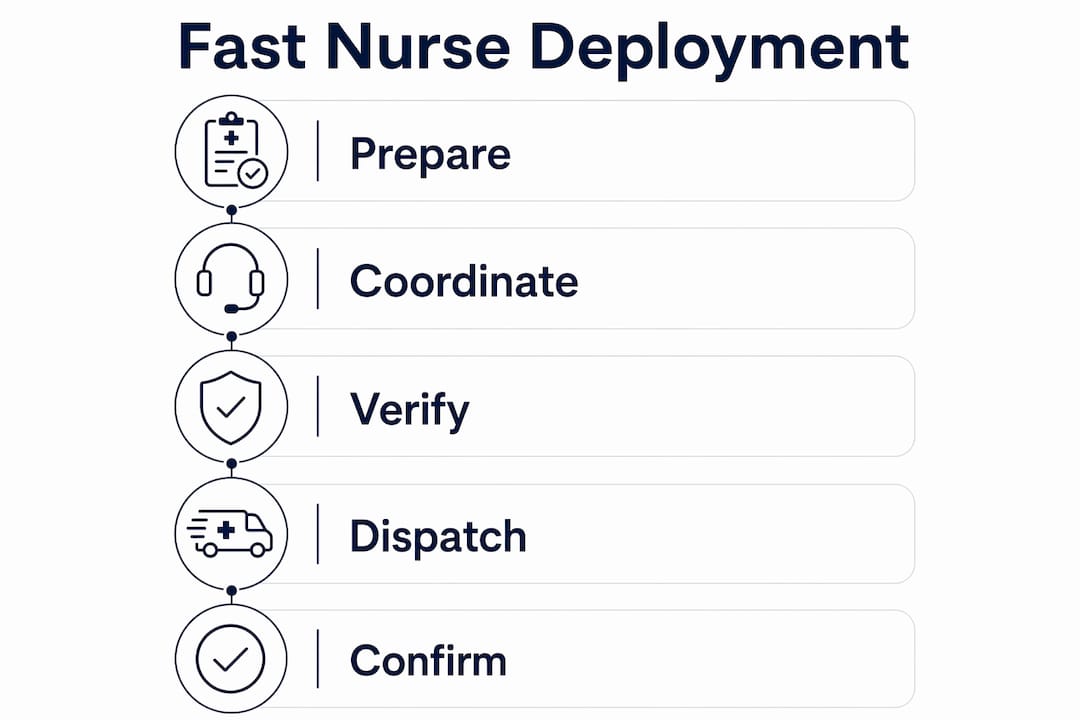
Once your internal systems are ready, the execution sequence determines whether you fill the shift in 90 minutes or miss it entirely. Follow this workflow every time a vacancy opens.
-
Identify the gap immediately. The moment a nurse calls out or a shift goes uncovered, your staffing coordinator receives the alert. Do not wait until 30 minutes before the shift starts. Early notification is the single biggest lever in rapid nurse deployment.
-
Activate your internal on-call pool first. Contact qualified nurses on your internal roster before reaching out to external providers. Internal placements are faster because credentialing is already complete and unit familiarity reduces orientation time.
-
Submit to your external staffing provider simultaneously. Do not wait to hear back from internal candidates before contacting your agency. Requesting a nurse takes minutes with a 24/7 dispatch system, so parallel outreach maximizes your chances of a fast fill.
-
Run credentialing and compliance checks in parallel. Do not sequence these steps. While the provider matches a nurse to your request, your compliance team verifies the nurse's license, certifications, and background check status. Mobilization and credential verification occurring simultaneously is the defining feature of high-speed staffing operations.
-
Confirm deployment readiness with the nurse directly. Once matched, your coordinator contacts the nurse to confirm shift time, unit location, parking, and badge access. This call takes five minutes and prevents the most common on-site arrival problems.
-
Maintain contact until the nurse is on the floor. Send a confirmation text 30 minutes before shift start. Have your charge nurse or unit manager ready to receive and orient the incoming nurse. A warm handoff reduces the time before the nurse is clinically productive.
Pro Tip: Build a group text thread with your top three staffing contacts. When a vacancy opens, one message reaches all three simultaneously. The first confirmed placement wins, and you avoid the dead time of sequential calls.
For urgent healthcare vacancies that span multiple units or multiple days, assign a single point of contact on both sides. One coordinator at your facility and one account manager at the agency eliminates the communication fragmentation that slows multi-shift fills.
What staffing models and provider features enable the fastest fills?
Not all temporary nurse staffing providers operate at the same speed. The features below separate providers that fill shifts in under two hours from those that take most of a day.
| Feature | What it means for speed |
|---|---|
| 24/7/365 dispatch with on-call nurse networks | Requests submitted at midnight receive the same response time as those submitted at noon |
| Pre-screened multi-state nurse pools | Providers with national reach fill volume requests without geographic bottlenecks |
| Tech-enabled skill matching | Algorithms match nurse certifications and specialty experience to unit requirements in seconds, not hours |
| Parallelized compliance processing | License verification, background checks, and nurse matching run at the same time rather than in sequence |
| Replacement guarantee | Providers like Fastaff Travel Nursing offer no-cost nurse replacement if the initial placement is unsuitable |
The parallelized compliance model is the most operationally significant feature on this list. A case study from Mayday Healthcare showed that 54 shifts filled with 100% compliance within 24 hours across multiple states was achievable precisely because credentialing did not wait for matching to finish. Facilities that require sequential processing, where compliance must clear before matching begins, add hours to every placement.
Provider size and network depth also matter for high-volume needs. A regional agency with 200 nurses on its roster cannot fill 20 simultaneous ICU shifts. Partnering with a provider that maintains a national pre-screened pool gives you coverage capacity that scales with your census fluctuations. For facilities that work with staffing agencies in hospitals, understanding how an agency structures its bench is as important as knowing its hourly rate.
Technology platform quality is the third differentiator. Providers that offer a self-service portal with real-time nurse availability, instant confirmation notifications, and digital onboarding documents reduce the administrative burden on your coordinator and accelerate every step of the process.
What challenges slow down rapid nurse staffing and how do you fix them?
Even well-prepared facilities run into obstacles. Recognizing these problems before they occur lets you build mitigation into your process rather than scrambling to fix them mid-shift.
-
Incomplete shift requests. Incomplete or inaccurate shift request information is the leading cause of placement delays. A provider cannot match a nurse to a unit they cannot characterize. Fix this by standardizing your shift request packet and training every coordinator to submit it complete on the first attempt.
-
Credentialing bottlenecks across state lines. Multi-state placements require verification of compact nursing licenses or individual state licenses. Facilities that do not pre-verify this with their provider before a vacancy opens lose hours during the credentialing step. Confirm your provider's compact license verification process before you need it.
-
Skill or unit mismatch. A nurse matched on paper may lack the specific unit experience your charge nurse expects. Reduce this risk by including patient acuity level and unit-specific protocols in your shift request packet. Providers with granular matching capabilities, rather than broad specialty categories, produce better first-placement accuracy.
-
High-volume simultaneous needs. When census spikes affect multiple units at once, even strong providers face resource strain. Maintain relationships with at least two providers so you can distribute volume requests rather than overwhelming a single agency.
-
Communication gaps after placement confirmation. A confirmed placement that does not show up on time is operationally equivalent to no placement at all. Require a direct confirmation call between your coordinator and the placed nurse, not just an agency-to-agency confirmation.
The facilities that fill shifts fastest are not the ones with the best agency relationships. They are the ones with the best internal processes. An agency can only move as fast as the information you give them.
For a broader view of how to build a streamlined hiring process that supports rapid fills across all clinical roles, the operational principles are consistent: standardize documentation, parallelize verification, and assign clear ownership at every step.
Key takeaways
Rapid nurse deployment succeeds when internal preparation, parallelized compliance, and 24/7 dispatch technology work together from the moment a vacancy opens.
| Point | Details |
|---|---|
| Prepare a shift request packet | Pre-built documentation with certifications, acuity, and EHR context eliminates back-and-forth delays. |
| Parallelize credentialing and matching | Running compliance checks simultaneously with nurse matching cuts placement time by 30 to 45 minutes per shift. |
| Use 24/7 dispatch providers | Agencies with always-on dispatch and pre-screened nurse pools confirm placements within one to two hours. |
| Activate internal pools first | Internal on-call nurses deploy faster because credentialing is already complete and unit familiarity reduces orientation. |
| Maintain contact through arrival | A confirmation call and warm handoff reduce on-site delays and get the nurse clinically productive faster. |
What I've learned about fast fills that most guides won't tell you
Most articles on temporary nurse staffing focus entirely on the external provider. Pick the right agency, pay the right rate, and the problem solves itself. That framing is wrong, and it costs facilities hours every time a vacancy opens.
The real bottleneck in most rapid placements is internal. I have seen facilities with excellent agency relationships still take six hours to fill a shift because no one had authority to approve the placement without a supervisor sign-off. The agency had a nurse ready in 45 minutes. The facility spent five hours in an approval loop.
The shift request packet is not a bureaucratic formality. It is the single document that lets a provider act without asking a single follow-up question. Facilities that treat it as optional are the same ones that call back frustrated because their nurse showed up to the wrong unit with the wrong certifications.
Technology matters, but not in the way most managers expect. The value of a digital staffing platform is not the algorithm. It is the elimination of phone tag. When your coordinator can submit a request at 3 a.m. and receive a confirmation notification without waking anyone up, you have removed the human latency from the process. That is where the real time savings live.
My strongest recommendation is this: run a mock rapid fill drill with your team before you need it. Submit a test request, time the internal steps, and identify where the process stalls. You will find the bottleneck in 20 minutes, and fixing it costs nothing.
— Flexible
Fill shifts faster with Flexiblenursingcareers
Flexiblenursingcareers connects healthcare managers with qualified nurses through a technology-driven platform built for speed. You get 24/7 access to a pre-screened nurse network, real-time job matching based on clinical skills and availability, and digital onboarding that removes the paperwork delays that slow traditional placements.

Whether you need one nurse for a night shift or coverage across multiple units, Flexiblenursingcareers matches you with candidates who fit your unit requirements, not just your specialty category. Sign in or create your account at NurseFlex Jobs to post your first vacancy and see confirmed matches within hours. For care homes and domiciliary settings, qualified care staff options are also available through partner networks.
FAQ
How fast can a temporary nursing vacancy be filled?
Emergency same-shift placements can be confirmed within 30 to 60 minutes with a 24/7 dispatch provider and a complete shift request packet, compared to the four to eight hour industry average.
What information does a staffing agency need to place a nurse quickly?
Agencies need unit name, shift times, required certifications, patient acuity level, and EHR platform details. Incomplete requests are the leading cause of placement delays and late cancellations.
Can multiple nursing shifts be filled across states within 24 hours?
Yes. Activating pre-screened nurse networks while running credentialing in parallel makes it possible to fill dozens of shifts across multiple states within a single day, as demonstrated in documented multi-state case studies.
What is the difference between temporary and travel nurse staffing?
Temporary nurse staffing covers short-term or single-shift gaps, typically filled within hours. Travel nursing involves longer assignments of 8 to 26 weeks and requires more lead time for placement and licensing.
How do I reduce the risk of a no-show after placement confirmation?
Require a direct confirmation call between your coordinator and the placed nurse, not just agency-level confirmation. Send a reminder text 30 minutes before shift start and have a charge nurse ready for a warm handoff on arrival.