
A streamlined hiring process in healthcare is a coordinated, technology-enabled workflow that compresses time-to-hire, accelerates candidate screening, and addresses credentialing delays to quickly onboard and deploy qualified providers. Healthcare talent acquisition has evolved well beyond posting jobs and waiting. Today, the most effective recruitment operations combine AI-powered sourcing, automated interview scheduling, and proactive credentialing into a single integrated system. Tools like UKG Rapid Hire, AI voice agents such as Lyn, and credentialing platforms like Medallion represent the current standard for organizations serious about filling critical roles fast. This guide gives healthcare administrators and HR professionals a direct, evidence-based roadmap for building that system.
How can automation and AI accelerate candidate sourcing and screening in healthcare hiring?
Automation is the single most effective lever for reducing time-to-hire in healthcare recruitment. AI-powered sourcing tools scan candidate databases, match on skills and licensure, and push qualified applicants into your pipeline without manual effort. The result is a faster, higher-volume funnel that human recruiters alone cannot replicate.
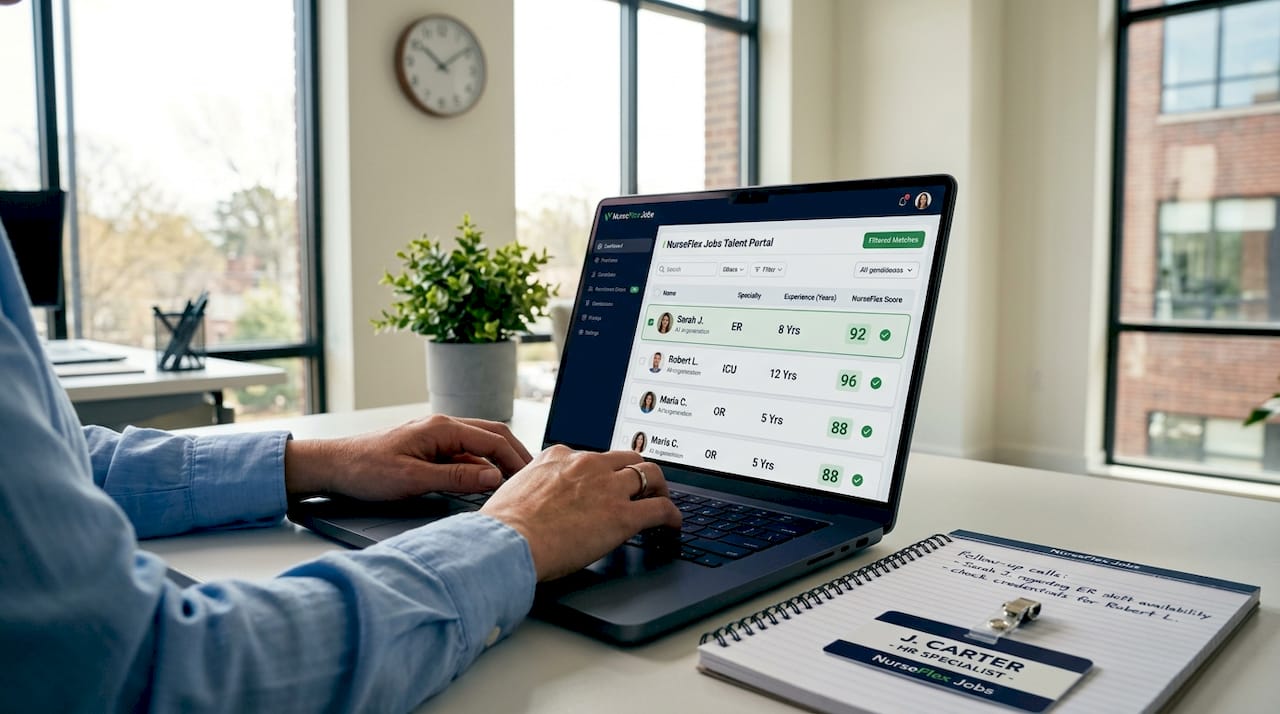
The numbers are specific and significant. UKG Rapid Hire enabled NHS Management to reduce time-to-hire by 66%, cut time-to-interview from 3.5 days to 5 minutes, and triple apply-to-hire conversion rates. That compression means a candidate who applied Monday morning can be scheduled for an interview before lunch. Candidate experience ratings exceeded 90%, which directly reduces dropout rates at the top of the funnel.
AI voice agents take this further. Healthcare systems using 24/7 AI interviewing complete 75% of candidate interviews within 24 hours, with interviews finishing 6.5 times faster than traditional phone screens. That speed matters in a market where qualified nurses and allied health professionals receive multiple offers within days of applying. Lyn, an AI voice agent that integrates with Workday and major applicant tracking systems, conducts multi-role interviews in a single session, removing the need for separate scheduling across departments.
Key automation capabilities that drive efficient healthcare recruitment include:
- AI sourcing and matching: Automatically identifies candidates based on licensure, specialty, and availability
- Chatbot pre-screening: Handles initial qualification questions around shift preferences, certifications, and location
- Automated scheduling: Eliminates back-and-forth email chains by offering candidates real-time calendar slots
- AI voice interviews: Conduct structured screening conversations at any hour without recruiter involvement
- ATS integration: Platforms like SkyHire can be fully live within 5 to 7 business days, replacing legacy manual workflows end-to-end
Pro Tip: Deploy AI voice interviews for your first-round screening and configure them to run 24/7. Candidates who work night shifts or have childcare constraints will complete interviews at 11 p.m. rather than dropping out of a process that only offers 9-to-5 slots.
What are credentialing and enrollment bottlenecks, and why must hiring processes address provider readiness?
Hiring speed alone does not solve a staffing shortage. A provider who accepts an offer on day one but cannot see patients for four months is not a staffed position. This is the credentialing and enrollment bottleneck, and it is the most commonly overlooked gap in simplified hiring in healthcare.
"Real streamlining requires addressing both candidate pipeline speed and post-hire operational readiness. Organizations that optimize only selection pipelines risk ongoing capacity shortfalls." — Hospitalogy
Credentialing and payer enrollment produce average delays of 90 to 120 days post-hire before providers become operational and billable. That window represents real revenue loss and real patient access gaps, regardless of how fast your recruiting team moved. Understanding how to upload credentials efficiently is a practical first step toward compressing that window.
| Bottleneck Stage | Typical Delay | Revenue Impact |
|---|---|---|
| CAQH profile setup and verification | 2 to 4 weeks | Provider cannot bill any payer |
| Hospital credentialing committee review | 4 to 8 weeks | Provider cannot practice at facility |
| Payer enrollment processing | 60 to 90 days | Claims denied or held pending approval |
| State licensure verification | 1 to 6 weeks | Varies by state and specialty |
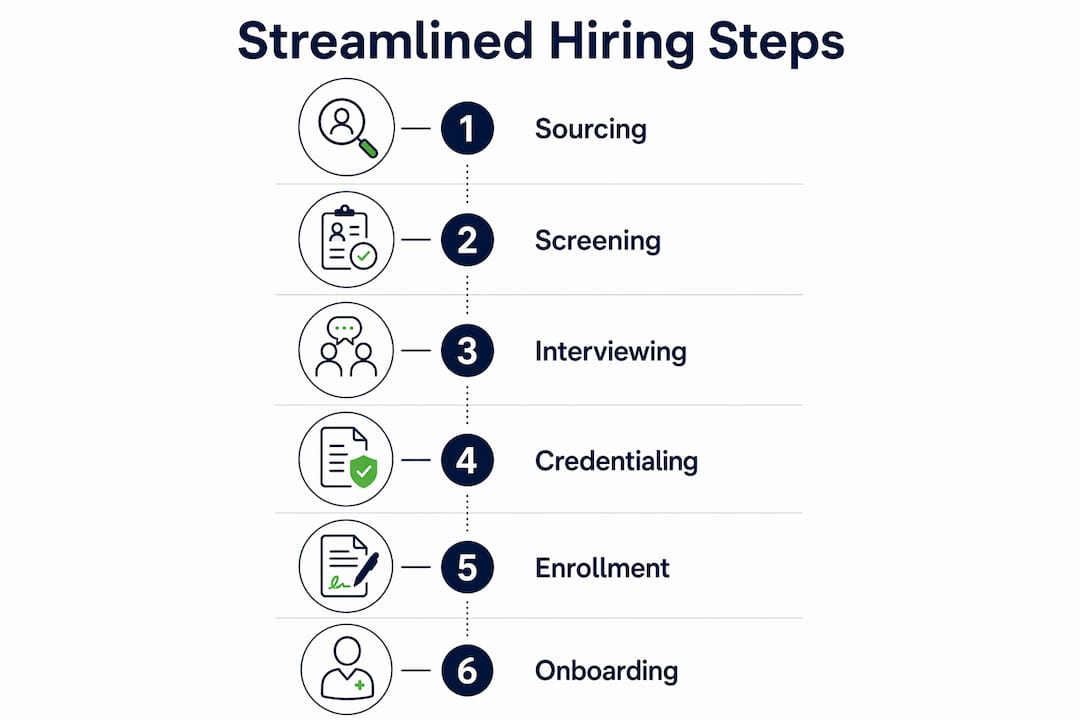
Submitting provider enrollment applications before the provider's start date can reduce delay by 30 to 60 days and recover $15,000 to $50,000 per provider in otherwise lost revenue. That figure is not theoretical. It represents billing that would have occurred had the enrollment been submitted earlier. Automated credentialing platforms reduce intake time from 8 days to under 2 hours and cut credentialing turnaround by up to 80%, enabling providers to onboard up to 40 times faster. The technology exists. The gap is adoption.
Synchronous vs. one-way video vs. AI voice: which interview format works best?
Interview format is a practical decision with measurable consequences for screening throughput and candidate completion rates. Each format carries specific tradeoffs that healthcare HR teams need to weigh against their volume and urgency.
Traditional live phone or video interviews require coordinated scheduling between recruiter and candidate. First-round phone screens typically run 30 to 60 minutes, and recruiters spend an equivalent amount of time reviewing notes and coordinating next steps. At high volume, this format creates a bottleneck that slows the entire pipeline.
One-way asynchronous video interviews remove the scheduling problem. Candidates record responses to preset questions on their own time, and recruiters review recordings in about 10 to 15 minutes per candidate. These interviews typically run 8 to 15 minutes with 3 to 8 questions. The limitation is completion rate. Invite-to-scorecard completion caps at roughly 60 to 70%, meaning nearly one in three candidates drops out before finishing. For high-volume healthcare roles, that dropout rate represents real pipeline loss.
AI voice interviews address the completion gap directly. Healthcare systems using Lyn and similar tools report completion rates of 75 to 84%, driven by 24/7 availability and a conversational format that candidates prefer over rigid video recording. AI voice also handles multi-role screening in a single session, which is a practical advantage for health systems hiring across nursing, therapy, and administrative roles simultaneously.
Pro Tip: Pair one-way video with AI voice interviewing rather than choosing one. Use AI voice for initial screening to maximize completion, then route top candidates to a short one-way video for hiring manager review. This two-stage approach captures the speed of automation and the visual context managers want.
What practical strategies can healthcare HR implement to optimize the recruitment process?
Optimizing the recruitment process in healthcare requires action across three distinct phases: candidate acquisition, interview and selection, and post-hire readiness. Treating these as separate workstreams is the most common reason organizations see fast hiring followed by slow deployment.
Phase 1: Candidate acquisition
- Host high-throughput community hiring events with open attendance and no RSVP requirement. Candidates bring updated resumes and meet decision-makers directly, compressing multiple funnel steps into a single afternoon. STRHS Lawrenceburg's model of no-registration hiring events demonstrates how direct recruiter-to-candidate interaction reduces logistics friction.
- Activate AI sourcing tools to continuously scan job boards, licensure databases, and internal talent pools for qualified candidates.
- Deploy chatbot pre-screening on your careers page to qualify applicants in real time, 24 hours a day.
Phase 2: Interview and selection
- Configure AI voice interviews for first-round screening with a maximum of 5 to 6 questions and a strict time limit per response
- Route completed interviews to hiring managers within the same business day using automated scoring and summary tools
- Track completion rates weekly and adjust question length or format when rates drop below 70%
Phase 3: Post-hire operational readiness
- Submit CAQH profiles and payer enrollment applications on the day an offer is accepted, not after the start date
- Operate a strict weekly follow-up cadence with each payer to track application status and resolve missing documentation
- Use dedicated credentialing platforms to reduce manual data entry errors that trigger payer rejections
Pro Tip: Shift your primary performance metric from time-to-offer to time-to-billable. Hire-to-operational metrics reveal the true staffing capacity impact and force credentialing into the same accountability framework as recruiting.
Tracking healthcare workforce trends alongside your internal metrics helps you anticipate demand spikes before they become crises. The organizations that avoid emergency hiring scrambles are the ones monitoring market signals continuously, not reactively.
How do efficient hiring processes impact organizational performance and patient care?
The business case for efficient healthcare recruitment is quantified and direct. UKG Rapid Hire's deployment at NHS Management generated $2.2 million in new annual revenue by enabling the organization to reopen previously closed units. Those units were closed not because of a lack of patients, but because of a lack of staffed providers. Faster hiring directly restored capacity and revenue simultaneously.
"Healthcare systems using 24/7 AI interviewing achieve annual savings averaging $5 million per facility by reducing vacancies and premium labor reliance." — Incredible Health
Reduced vacancy rates also cut overtime costs and reliance on agency or travel nurses, who typically cost 40 to 60% more per shift than permanent staff. Every week a position stays open is a week of premium labor spend. Faster hiring eliminates that ongoing cost, and the savings compound across a large organization with dozens of open roles at any given time.
The connection to staff burnout is equally direct. Chronic understaffing forces existing nurses and clinicians to absorb additional patient loads, accelerating fatigue and turnover. Faster hiring breaks that cycle. When new staff arrive and become operational quickly, workload distribution normalizes and retention improves among existing employees. The automation role in job placement is no longer a future consideration. It is the current standard for organizations that want to compete for talent and maintain care quality.
Key takeaways
A streamlined hiring process in healthcare requires integrating AI-powered screening, proactive credentialing, and hire-to-billable tracking to close the gap between offer acceptance and operational deployment.
| Point | Details |
|---|---|
| AI cuts time-to-interview dramatically | UKG Rapid Hire reduced time-to-interview from 3.5 days to 5 minutes, tripling apply-to-hire conversion. |
| Credentialing delays cost real revenue | Average 90 to 120 day post-hire delays mean providers cannot bill; early enrollment submission recovers $15,000 to $50,000 per provider. |
| AI voice interviews outperform video | AI voice achieves 75 to 84% completion vs. 60 to 70% for one-way video, with 24/7 availability as the key driver. |
| Track hire-to-billable, not just hire-to-offer | Hire-to-operational metrics expose credentialing gaps that time-to-offer numbers hide entirely. |
| Faster staffing restores revenue and reduces burnout | Reopening closed units and cutting premium labor reliance generates measurable financial returns and improves staff retention. |
What I've learned from watching healthcare hiring get stuck at the finish line
The most common mistake I see healthcare organizations make is treating credentialing as someone else's problem. Recruiting closes the offer, hands off the file, and considers the role filled. Then 90 days pass and the provider still cannot see patients. The vacancy metric looks resolved. The revenue gap is very much open.
The technology for fast candidate selection is genuinely impressive in 2026. AI voice agents, automated scheduling, and real-time ATS integrations have removed most of the friction from the front end of hiring. But the organizations getting the best results are the ones that extended that same discipline to the back end. They submit enrollment applications the day an offer is signed. They run weekly payer follow-up calls. They measure time-to-billable with the same rigor they apply to time-to-offer.
There is also a tendency to over-automate the candidate experience and lose the human element entirely. AI voice screening is effective. It is not a replacement for a recruiter who can answer a nervous candidate's question about shift flexibility or benefits. The best processes I have seen use automation to handle volume and speed, then bring in a real person at the moment a candidate needs reassurance or information. That handoff point is where good candidates become committed hires.
My recommendation: test your async interview configuration on a small cohort before rolling it out at scale. Measure completion rates, collect candidate sentiment, and adjust question count and time limits based on actual data. What works for a 10-question video interview will not work for an AI voice screen. Treat it as a product you are iterating, not a switch you flip once.
— Flexible
How Flexiblenursingcareers supports faster healthcare staffing
Flexiblenursingcareers, through the NurseFlex Jobs platform, is built specifically for the speed and complexity that healthcare hiring demands. The platform matches registered nurses and allied health professionals to open roles in real time, based on skills, licensure, and availability. Credential verification is built into the onboarding flow, reducing the manual back-and-forth that slows most hiring teams down.

If you are managing urgent staffing needs and need qualified candidates moving through your pipeline today, NurseFlex Jobs removes the friction from both sides of the process. Candidates arrive pre-screened and credential-ready. You spend less time chasing paperwork and more time filling shifts. Sign in or create your account to start matching with healthcare professionals who are ready to work now.
FAQ
What is a streamlined hiring process in healthcare?
A streamlined hiring process in healthcare is an integrated, technology-enabled workflow that reduces time-to-hire through AI sourcing, automated screening, and proactive credentialing. The goal is to move qualified providers from application to operational deployment as fast as possible.
How much can AI reduce time-to-hire in healthcare?
AI-powered solutions like UKG Rapid Hire have reduced time-to-hire by 66% and cut time-to-interview from 3.5 days to 5 minutes. Healthcare systems using 24/7 AI interviewing complete 75% of candidate interviews within 24 hours.
Why does credentialing slow down healthcare hiring even after an offer is made?
Credentialing and payer enrollment add an average of 90 to 120 days post-hire before a provider can practice and bill. Submitting enrollment applications before the start date can recover 30 to 60 days and $15,000 to $50,000 in otherwise lost revenue per provider.
What interview format has the highest completion rate for healthcare candidates?
AI voice interviews achieve completion rates of 75 to 84%, compared to 60 to 70% for one-way video interviews. The 24/7 availability of AI voice is the primary driver, allowing candidates to complete screening on their own schedule.
What metric should healthcare HR teams track beyond time-to-offer?
Hire-to-billable, also called hire-to-operational, is the metric that reflects true staffing capacity. It accounts for credentialing and enrollment delays that time-to-offer numbers do not capture, giving HR and operations a shared view of when a new hire actually contributes to patient care and revenue.