
Direct hire healthcare is defined as a staffing model where a healthcare facility employs a clinician or administrator directly onto its payroll from day one, with full permanent employment status and benefits. No temporary period, no agency as the employer of record. The facility owns the employment relationship entirely. This model is used by hospitals, outpatient clinics, long-term care facilities, and health systems nationwide, often with the assistance of staffing partners like GHR Healthcare or similar recruitment firms. Understanding how it works, what it costs, and when to use it gives both hiring managers and job-seeking professionals a real edge.
What is direct hire healthcare and how is it defined?
Direct hire means the healthcare facility hires the employee directly onto payroll from day one, providing full benefits and all employment obligations. The industry also refers to this as permanent placement, a term you will encounter frequently in healthcare recruitment conversations. The staffing agency, if one is involved, acts only as a sourcing and screening partner. It never becomes the employer of record.
This distinction matters more than most administrators realize. In temporary staffing, the agency is the legal employer. It handles payroll taxes, workers' compensation, and benefits for the clinician. In direct hire, all of that transfers immediately to the healthcare facility. The facility gains full control over the employee's schedule, performance management, and career development from the first day of work.

Hospitals and large health systems use direct hire most often for specialized roles: registered nurses with ICU certifications, surgical technologists, licensed clinical social workers, and department directors. These are positions where institutional knowledge, cultural alignment, and long-term retention matter far more than short-term flexibility. Direct hire positions are typically long-term with an expectation of job stability and cultural fit within the healthcare organization, making them the preferred model for roles requiring specialized certifications.
How does the direct hire healthcare recruitment process work?
The healthcare recruitment process for direct hire follows a defined sequence, and knowing each step helps both employers and candidates move faster.
- Job definition and sourcing. The healthcare facility defines the role, required credentials, and compensation range. A staffing partner like GHR Healthcare or a digital platform such as Flexiblenursingcareers then sources candidates from its network, job boards, and passive candidate databases.
- Screening and credentialing. The staffing partner conducts initial screening, verifies licenses through state nursing boards or the National Practitioner Data Bank, and checks references. Digital credentialing portals have cut this step from weeks to days for many facilities.
- Candidate presentation. The agency presents a shortlist of qualified candidates to the hiring manager. At this stage, the facility takes over. It conducts its own interviews, skills assessments, and cultural fit evaluations.
- Offer and acceptance. The facility extends the offer directly. Salary, benefits, start date, and employment terms are negotiated between the facility and the candidate, not the agency.
- Onboarding. The new hire joins the facility's payroll on day one. The staffing agency's role ends at placement. Direct hire agencies assist in sourcing and screening, but the employee works directly for the healthcare employer from the start.
One detail that surprises many administrators: the agency never touches payroll. That separation is what makes direct hire structurally different from every other staffing model. You can upload credentials for quick placement through modern platforms, which removes one of the biggest bottlenecks in the process.
Pro Tip: Prepare a complete credential packet before the search begins. Facilities that have licenses, certifications, background check authorizations, and references ready in a digital format cut their time-to-offer by several days compared to those who gather documents reactively.
What are the cost structures and fee models for direct hire staffing?
Direct hire placement fees typically range from 18% to 25% of the candidate's first-year salary, with 20% being the most common rate. For a registered nurse earning $120,000 annually, a 20% fee equals $24,000 paid to the recruiting firm upon successful hire. That is a significant upfront cost, but it is also a one-time payment.
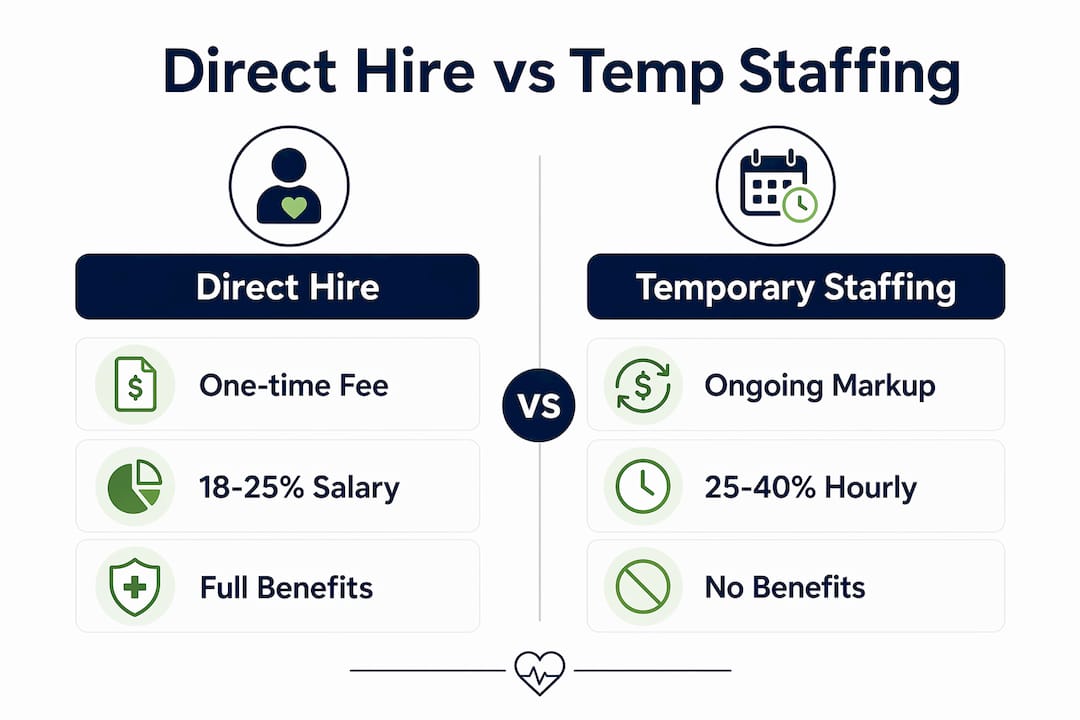
| Staffing model | Fee structure | Typical cost range | Ongoing cost |
|---|---|---|---|
| Direct hire | One-time contingency fee | 18%–25% of first-year salary | None after placement |
| Contract-to-hire | Hourly markup during contract, conversion fee at hire | Markup + reduced placement fee | None after conversion |
| Temporary staffing | Ongoing hourly markup | 25%–40% per hour billed | Continuous while worker is placed |
Direct hire fees are one-time contingency fees paid upon the candidate's start date, unlike temporary staffing markups, which are ongoing hourly fees. Temporary staffing markups typically range from 25% to 40% and include costs for payroll taxes, workers' compensation, and benefits for contingent workers. For a nurse billing at $50 per hour, a 35% markup adds $17.50 per hour to the facility's cost, every hour that nurse works.
Run the math over 12 months at 40 hours per week and the temporary staffing cost exceeds $36,000 in markup alone. The direct hire fee of $24,000 looks considerably more attractive when framed that way. The break-even point for most healthcare roles falls somewhere between 6 and 9 months of employment. After that, direct hire is the less expensive model by a wide margin.
Pro Tip: Negotiate a replacement guarantee into your direct hire agreement. Most reputable staffing firms offer a 60 to 90-day replacement clause at no additional fee if the placed candidate leaves within that window. Get it in writing before signing.
Healthcare administrators comparing costs should also factor in the health insurance implications for contractors versus direct employees, since benefit costs shift entirely to the facility under direct hire but are absorbed by the agency under temporary arrangements.
How does direct hire compare to contract-to-hire and temp staffing?
The three primary healthcare staffing models serve different operational needs, and choosing the wrong one creates either unnecessary cost or unnecessary risk.
Direct hire commits the facility to permanent employment immediately. The candidate joins the team, receives full benefits, and is treated as a long-term employee from day one. There is no evaluation window built into the structure. The facility relies on the screening process to make the right call upfront.
Contract-to-hire usually involves a 3 to 6 month evaluation period as a contingent employee before conversion to permanent status. During this time, the candidate is paid through the staffing firm. The facility evaluates performance, cultural fit, and reliability before committing to permanent employment. This model is often described as a "low regret" option because it allows employers to assess performance before making a permanent commitment. The tradeoff is that strong candidates sometimes decline contract-to-hire offers because they want immediate job security.
Temporary staffing offers maximum flexibility with no permanent commitment. It works well for census-driven fluctuations, leave coverage, and short-term project needs. The cost per hour is higher, but the facility carries no long-term employment obligation.
Key differences at a glance:
- Direct hire: Immediate permanent employment, full benefits from day one, one-time placement fee, facility is employer of record
- Contract-to-hire: Temporary period of 3 to 6 months, agency is employer of record during contract, conversion fee or reduced placement fee at hire
- Temporary staffing: No permanent commitment, agency remains employer of record, ongoing hourly markup of 25% to 40%
Time-to-fill for direct hire roles averages about 6 weeks, compared to contract staffing which often takes 15 days. The longer timeline reflects the elevated decision-making involved in permanent employment. For urgent vacancies, temporary or contract staffing fills the gap while a direct hire search runs in parallel. Understanding how staffing agencies operate within hospitals helps administrators decide which model fits each specific vacancy.
What are the benefits and drawbacks of direct hire in healthcare?
Direct hire delivers specific advantages that temporary and contract models cannot replicate, but it also carries real tradeoffs that administrators need to weigh honestly.
Core benefits:
- Team stability. Permanent employees build institutional knowledge, mentor newer staff, and reduce the disruption that comes with constant turnover. Facilities with high direct hire ratios consistently report stronger team cohesion.
- Full benefits from day one. Health insurance, retirement contributions, paid time off, and professional development funding all apply immediately. This matters to experienced clinicians who will not accept a contract position when a permanent role is available elsewhere.
- Cultural alignment. The direct hire process includes cultural fit evaluation, which temporary placements rarely prioritize. A nurse who fits the unit's communication style and values reduces friction and improves patient outcomes over time.
- No ongoing markup costs. Once the placement fee is paid, the facility's labor cost is the employee's salary and benefits. There is no agency markup running in the background.
Real drawbacks to acknowledge:
- Longer time to fill. Six weeks is the average, and complex roles can take longer. Facilities with immediate vacancies cannot always wait.
- Upfront placement fee. A $24,000 fee on a single hire is a real budget line item. Smaller facilities and independent practices feel this more acutely than large health systems.
- No trial period. If the hire does not work out after the replacement guarantee window closes, the facility absorbs the cost of a new search.
A common misconception worth correcting directly: many administrators assume direct hire means recruiting without any outside help. Staffing partners frequently assist with sourcing and screening in direct hire arrangements. The defining feature is not the absence of a recruiter. It is the absence of an intermediary employer.
Key takeaways
Direct hire healthcare is the most cost-effective permanent staffing model for specialized clinical roles when the facility can absorb a 6-week fill timeline and a one-time placement fee.
| Point | Details |
|---|---|
| Definition is precise | Direct hire means the facility is the employer of record from day one, not the staffing agency. |
| Fee structure is one-time | Placement fees of 18%–25% of first-year salary are paid once, unlike ongoing temp markups. |
| Timeline is longer | Direct hire averages 6 weeks to fill versus 15 days for contract staffing. |
| Agencies still assist | Staffing partners source and screen candidates without becoming the employer of record. |
| Long-term cost advantage | After 6 to 9 months, direct hire is less expensive than continuous temporary staffing markups. |
What I've learned about direct hire after years in healthcare staffing
Most administrators approach direct hire as a last resort after temp staffing fails. That is the wrong order of operations. For any role you expect to fill with the same person for two or more years, direct hire should be the first call, not the fallback.
The facilities I have seen struggle with direct hire almost always share one problem: they treat the placement fee as a sunk cost rather than an investment with a calculable return. When you map the fee against 24 months of avoided temp markups, the math is not close. Direct hire wins by a significant margin for any stable, long-term role.
Technology has changed the timeline equation more than most people realize. Platforms that use automation in job placement have compressed credential verification and candidate matching from weeks to days. The 6-week average is already shrinking for facilities that use digital-first recruitment tools. Administrators who still rely on paper credentialing packets and phone-tag reference checks are adding 2 to 3 weeks to their own timelines unnecessarily.
The one piece of advice I give every hiring manager: define your must-have criteria before the search starts, not during it. The most expensive direct hire mistakes happen when the job description shifts mid-search, the shortlist gets rejected for unstated reasons, and the search restarts from scratch. Clear criteria upfront protect both the facility's budget and the recruiter's time.
— Flexible
Find your next direct hire placement with Flexiblenursingcareers
Flexiblenursingcareers connects healthcare professionals and facilities through a technology-driven platform built for permanent placement and direct hire staffing. You get real-time job matching based on your credentials, availability, and specialty, without the back-and-forth of traditional recruitment.

Whether you are a registered nurse seeking a permanent role or an administrator filling a specialized vacancy, Flexiblenursingcareers removes the friction from the process. The platform's digital credentialing tools and skills-based matching mean you spend less time on paperwork and more time on the work that matters. Sign in or create your account at NurseFlex Jobs to access direct hire healthcare job listings and staffing solutions today.
FAQ
What is direct hire in healthcare?
Direct hire in healthcare is a staffing model where a healthcare facility employs a clinician or administrator directly as a permanent employee from the first day of work. The facility is the employer of record, handling payroll, benefits, and all employment obligations.
How is direct hire different from temp staffing?
In temporary staffing, the staffing agency is the employer of record and charges an ongoing hourly markup of 25% to 40%. In direct hire, the facility is the employer from day one and pays a single one-time placement fee of 18% to 25% of the candidate's first-year salary.
How long does a direct hire healthcare search take?
Direct hire roles average about 6 weeks to fill, compared to roughly 15 days for contract staffing. The longer timeline reflects the permanent employment decision and more thorough screening process.
Do staffing agencies get involved in direct hire placements?
Yes. Staffing agencies frequently source and screen candidates for direct hire roles, but they do not become the employer of record. The hiring facility takes over the employment relationship entirely from day one.
What is a typical direct hire placement fee in healthcare?
Placement fees typically range from 18% to 25% of the candidate's first-year salary, with 20% being the most common rate. For a $120,000 salary, that equals a one-time fee of $24,000 paid upon the candidate's start date.