
Casual nursing employment is a work arrangement where nurses accept shifts on an as-needed basis, with no guaranteed hours and no long-term contract. Known in many American healthcare settings as PRN nursing (from the Latin pro re nata, meaning "as needed"), this model gives you full control over when you work. Hospitals, outpatient clinics, and community health centers all rely on casual nurses to fill gaps in their staffing rosters. Understanding casual nursing roles means knowing both the freedom they offer and the financial trade-offs you will need to plan around.
What does casual nursing employment explained actually mean?
Casual nursing is a scheduling method, not a clinical specialty. Felician University's nursing program defines PRN or casual nursing as working shifts offered on an as-needed basis, with no employer obligation to provide regular hours. That distinction matters. You are not changing your clinical skills or specialty. You are changing how and when you are called to work.
Casual nursing roles appear across nearly every healthcare setting: acute care hospitals, long-term care facilities, surgical centers, and home health agencies. The arrangement suits nurses who want schedule autonomy, nurses returning after a career break, and experienced clinicians who want to supplement a part-time permanent role. Flexiblenursingcareers connects nurses with exactly these kinds of flexible positions across multiple facility types.

What are the requirements for casual nursing positions?
Most facilities set a clear baseline before accepting casual nurses onto their rosters. Almost all hospitals and staffing platforms require at least 12 months of post-graduation clinical experience before you can take casual shifts. That requirement exists because casual nurses typically receive minimal orientation and must function independently from day one.
Beyond experience, you will need:
- A current, unrestricted RN or LPN license in the state where you plan to work
- Basic Life Support (BLS) certification, current and valid
- Advanced Cardiovascular Life Support (ACLS) for roles in emergency, ICU, or cardiac units
- Manual handling and patient safety certifications, depending on the facility
- Specialty-specific credentials for high-acuity units (for example, CCRN for critical care or CNOR for perioperative nursing)
Pro Tip: Verify your state's Board of Nursing website for any state-specific endorsement requirements before applying to casual roles across state lines. Compact Nursing License states allow multi-state practice, which expands your casual shift options significantly.
Specialty units carry the strictest requirements. An ICU casual shift, for instance, typically demands documented critical care experience in addition to ACLS. Verify current standards directly with each facility's nursing recruitment team, since requirements vary by unit and market.
How does casual nursing work: scheduling, shifts, and pay?
Casual nursing operates on a fully variable schedule. Some weeks you may work zero shifts. Other weeks you may work the equivalent of full-time hours. Shifts are offered anywhere from a few hours to several weeks in advance, depending on the facility's staffing system and census fluctuations.
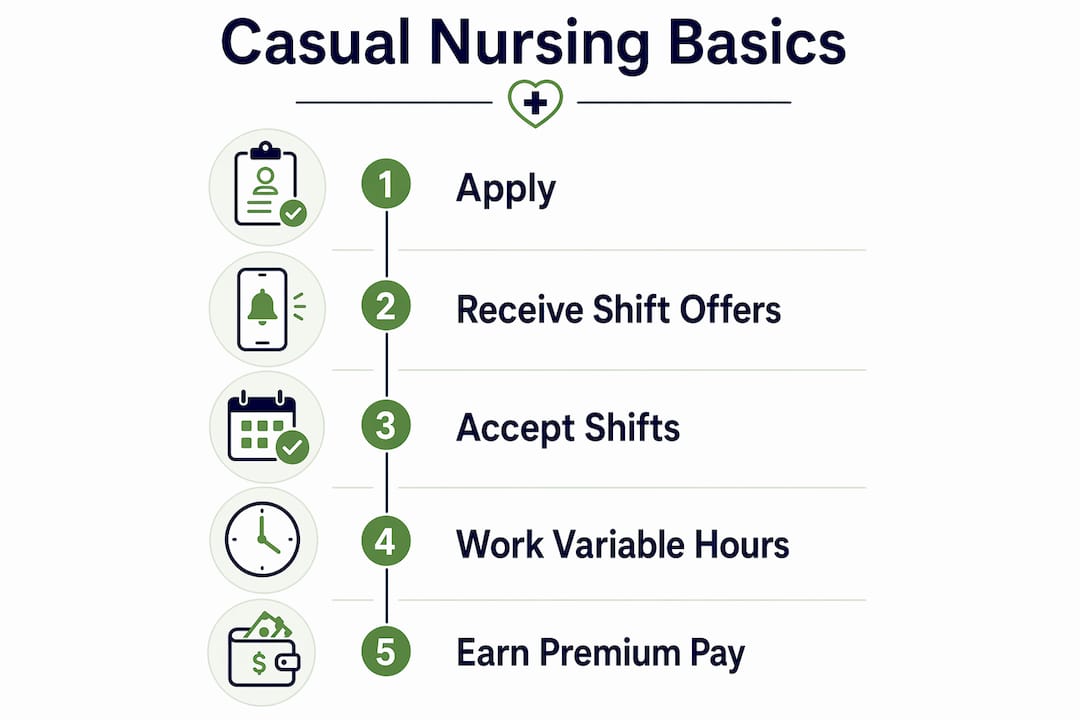
The pay premium is the clearest financial incentive. Casual nurses earn $9 to $30 more per hour than permanent staff in the same role. That premium compensates for the absence of employer-provided benefits. Specialist roles push rates even higher. ICU and cardiovascular OR nurses in competitive markets can earn $55 to $75 per hour on casual contracts.
| Role | Typical permanent hourly rate | Typical casual hourly rate |
|---|---|---|
| Med-Surg RN | $35–$45 | $44–$65 |
| ICU RN | $45–$60 | $55–$75 |
| ER RN | $40–$55 | $50–$70 |
| LPN (general) | $22–$30 | $30–$45 |
Rates vary by market, facility type, and shift timing. Night and weekend differentials apply on top of casual premiums.
Pro Tip: Track your shift offers over 90 days when you first start casual work. That data tells you the realistic weekly average you can count on, which is critical for budgeting and deciding whether to pick up a second income source.
Learning to control your nursing work hours is a skill that separates nurses who thrive in casual roles from those who burn out or face financial stress.
Benefits and challenges of casual nursing vs. permanent roles
Casual nursing delivers real advantages, but it also creates real gaps. Understanding both sides before you commit is the difference between a good career decision and a costly one.
Benefits of casual nursing work:
- Full schedule control: you choose which shifts to accept and which to decline
- Higher hourly pay that can exceed permanent rates by a meaningful margin
- Ability to work across multiple facilities and expand your clinical exposure
- Flexibility for caregiving responsibilities, continuing education, or personal priorities
- No mandatory overtime or forced scheduling
Challenges to plan for:
- No employer-provided health insurance, paid time off, sick leave, or retirement benefits
- Individual health insurance for a 40-year-old nurse typically costs $400 to $700 per month. That figure must come directly out of your hourly premium before you compare casual pay to permanent pay.
- No guaranteed income makes budgeting harder, especially in slow census periods
- No employer 401(k) matching means you fund retirement entirely on your own
- Casual nurses are often the first to lose shifts when a facility overstaffs
The benefits gap is the defining factor in whether casual nursing is financially beneficial or a trap. Calculating your true hourly advantage means subtracting health insurance costs, lost PTO value, and retirement matching from the premium rate. For nurses with a working partner who carries family health coverage, the math often works strongly in favor of casual work. For nurses without that safety net, the numbers can flip quickly.
Many nurses find that working multiple employers solves both the income variability problem and the benefits gap, especially when one employer offers part-time benefits alongside casual shift access.
How can nurses successfully enter and manage a casual nursing career?
Starting casual nursing the right way reduces financial risk and increases your chances of getting consistent shift offers. Follow these steps to build a stable casual practice:
- Start with an internal casual pool. Internal casual pools at your current facility let you earn premium pay while keeping your existing workplace relationships and EMR familiarity. Facilities prefer internal casual nurses because onboarding time drops to near zero. Your shift acceptance rate will be higher than an external agency nurse's.
- Secure your benefits before you go fully casual. If your partner's employer offers family health coverage, enroll before you leave a permanent role. If not, price individual marketplace plans and factor that cost into your decision.
- Register on real-time scheduling platforms. Platforms like Flexiblenursingcareers match you to shifts based on your skills, availability, and location. Real-time matching means you see open shifts as they post, not days later through a recruiter.
- Maintain all certifications proactively. Expired BLS or ACLS pulls you off the roster immediately. Set calendar reminders 90 days before any certification expires.
- Treat schedule management as a job. Successful casual nurses actively manage unpredictable routines and treat work-life balance as an ongoing process. Check shift boards regularly, communicate your availability clearly, and build relationships with charge nurses who influence who gets called first.
- Diversify across two or three facilities. Relying on one facility for all your casual income is high risk. If that unit overstaffs or closes temporarily, your income stops. Two or three rosters give you backup options.
For a broader look at how casual nursing fits within the full range of flexible options, the part-time nursing job guide covers PRN, bank, and part-time contracts side by side.
Key Takeaways
Casual nursing employment is financially viable when nurses account for the full benefits gap before comparing hourly rates to permanent roles.
| Point | Details |
|---|---|
| PRN means as-needed | Casual nursing offers no guaranteed hours; schedule variability is high by design. |
| Pay premium is real but conditional | Casual nurses earn $9–$30 more per hour, but health insurance costs $400–$700 monthly. |
| One year of experience is required | Most facilities mandate 12 months of post-grad clinical experience before casual shifts. |
| Internal pools are the best entry point | Starting casual at your current facility reduces onboarding friction and increases shift offers. |
| Benefits gap determines true value | Subtract insurance, PTO, and retirement costs from the premium to find your real hourly gain. |
What I have learned about who actually succeeds in casual nursing
Casual nursing suits a specific type of nurse, and I have seen the pattern clearly through years of watching healthcare professionals navigate this choice. The nurses who thrive are not necessarily the most experienced clinicians. They are the ones who treat casual work as a business decision, not just a lifestyle preference.
The single biggest mistake I see is nurses calculating their hourly rate without subtracting the benefits gap. A $15 per hour premium sounds significant. Subtract $600 per month in health insurance, lost PTO worth roughly two weeks of pay, and zero retirement matching, and that premium shrinks fast. For some nurses, the real net gain is modest. For others, it is still worth it because the schedule freedom has genuine value they are willing to pay for.
Casual nursing is not a good fit if you are the sole income earner in your household without a financial cushion. It is an excellent fit if you have a partner with family health benefits, if you are testing a new specialty before committing to a permanent role, or if you are building toward a semi-retired schedule. Adaptability is not optional in this model. Casual nursing requires active management of your schedule, your certifications, and your finances simultaneously. Nurses who approach it that way build careers that are both flexible and financially sound.
— Flexible
Flexible shift options available through Flexiblenursingcareers
Flexiblenursingcareers was built for nurses who want shift control without the friction of traditional recruitment. The platform matches you to casual and flexible nursing shifts in real time, based on your skills, license, and availability.

You can sign up, set your preferences, and start seeing shift offers quickly. No lengthy application process. No waiting for a recruiter to call back. Facilities post open shifts directly, and you choose what fits your schedule. Whether you are entering casual nursing for the first time or expanding your roster across multiple facilities, sign in to NurseFlex Jobs and see what is available in your area today.
FAQ
What is casual nursing employment?
Casual nursing employment is a work arrangement where nurses accept shifts on an as-needed basis with no guaranteed hours or permanent contract. It is widely known in the United States as PRN nursing.
How much do casual nurses earn compared to permanent staff?
Casual nurses typically earn $9 to $30 more per hour than permanent staff in the same role. Specialist roles such as ICU nursing can reach $55 to $75 per hour in competitive markets.
What certifications do casual nurses need?
Most facilities require a current nursing license, valid BLS certification, and at least 12 months of post-graduation clinical experience. High-acuity units such as ICU also require ACLS and specialty credentials.
Do casual nurses get health insurance or paid time off?
Casual nursing roles do not include employer-provided health insurance, paid time off, sick leave, or retirement benefits. Nurses must self-fund these costs, which should be factored into any comparison with permanent pay rates.
Is casual nursing a good long-term career option?
Casual nursing is financially viable long-term when nurses have access to partner health benefits or a secondary income source. Without a plan to cover the benefits gap, the higher hourly rate can be offset by out-of-pocket costs.