
You can move from a travel nursing contract into a permanent staff role, and many nurses do it in 3–6 months with the right plan. The fastest path is converting your current assignment. The second-fastest is searching externally while you finish your contract. Either way, the steps are clear and the timeline is manageable.
Your 90-second action checklist:
- Confirm your license is active and in good standing in the state where you want to work permanently.
- Start a conversation with your nurse manager about your interest in staying on as staff.
- Update your resume with unit-specific metrics, EHR systems, and procedures from your current assignment.
- Ask your recruiter whether the facility posts direct-hire openings or accepts internal conversion requests.
- Collect two to three references from your current assignment before it ends.
Expected timelines:
- Converting your current assignment: 4–12 weeks from first conversation to offer
- Searching externally for permanent nursing positions: 8–24 weeks from application to start date
Do this in the next 10 minutes: Send your nurse manager a short message. Something like: "I've really enjoyed this assignment and I'd love to explore whether there's a path to joining the team permanently. Would you have 10 minutes to chat this week?" That single message starts the clock.
Table of Contents
- Is permanent staff nursing actually right for you right now?
- How to turn your travel experience into a hiring advantage
- How to convert your current assignment into a permanent offer
- What changes in pay and benefits when you go permanent
- How recruiters can help you move from travel to permanent
- What hiring managers actually look for when converting a traveler
- Your first 6 months as a permanent nurse: a practical plan
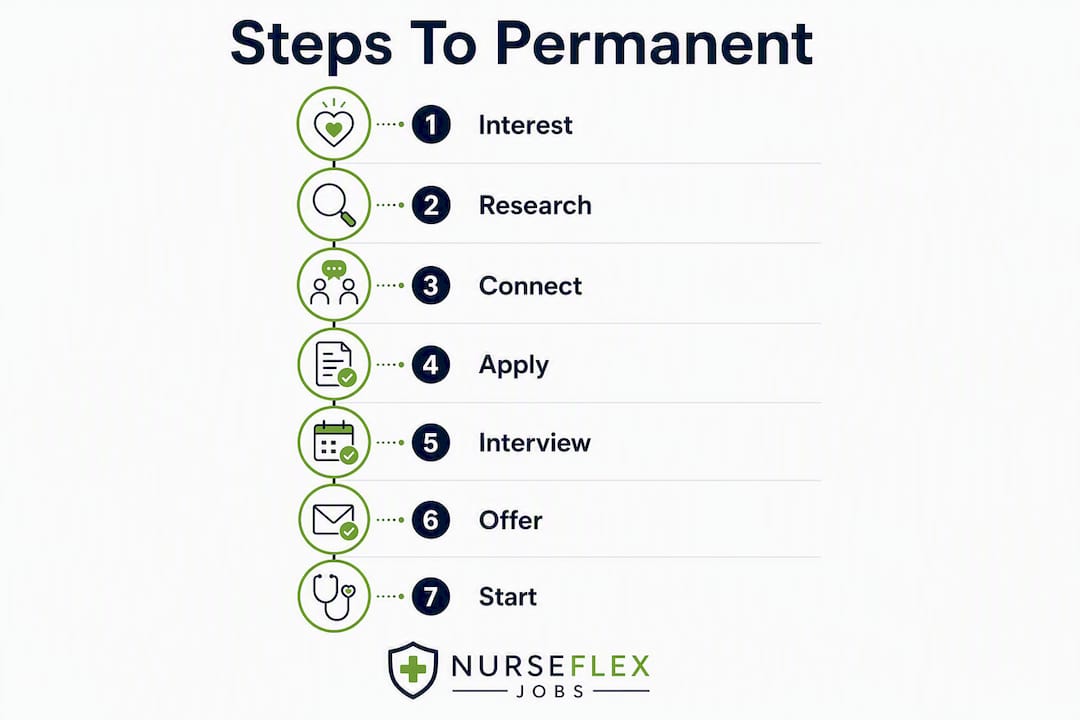
- Timeline and checklist: from interest to first day
- How Flexiblenursingcareers helps you make the move
- Key Takeaways
- A straight take on what actually works in this transition
- Ready to find your permanent nursing role?
- Useful sources
Is permanent staff nursing actually right for you right now?
The answer matters before you apply anywhere. Nurses move toward permanent roles for real reasons: predictable schedules, employer-paid health insurance, retirement matching, paid time off, and the chance to build lasting relationships with a team and patient population. Those are genuine advantages. But not every travel nurse is ready to give up the flexibility and pay premium that travel contracts offer.
Career advisors consistently recommend getting clear on your priorities before you start applying. Choosing a permanent role for the wrong reasons, like burnout from moving or a slow assignment market, tends to lead to early exits.
Score your priorities. Rank these from most to least important to you right now:
- Weekly take-home pay
- Employer-paid health insurance and retirement matching
- Predictable schedule and location
- Career growth, leadership, or specialty advancement
- Community, team relationships, and belonging
- Proximity to family or a specific city
If stability, benefits, and community rank in your top three, permanent staff nursing fits your current priorities. If pay and flexibility still top the list, you may want to extend your travel career while building toward a transition.
Ask yourself these questions:
- Do you want to pursue a BSN, MSN, or specialty certification? Permanent roles often include tuition reimbursement that travel contracts don't.
- Are you planning to settle in a specific city for family, a partner, or personal reasons?
- Do you want a leadership track, charge nurse role, or unit educator position? Those paths require tenure.
- Are you tired of re-proving yourself every 13 weeks?
Pro Tip: Before committing, try a 12-week assignment in the city and unit type you're considering for permanent work. If you finish it and still want to stay, that's a reliable signal. If you're relieved to leave, you have useful information.
How to turn your travel experience into a hiring advantage
Travel nursing builds a skill set that permanent staff candidates rarely match: rapid onboarding, cross-unit clinical competence, EHR familiarity across multiple systems, and the ability to perform under pressure in unfamiliar environments. Hiring managers know this. Your job is to frame it clearly so they see it.

The mistake most travel nurses make is listing assignments chronologically without connecting them to outcomes. A hiring manager reading "13-week ICU contract, Houston, TX" learns almost nothing. The same experience written as a concrete result tells a different story.
Resume bullets that work:
- "Managed 4–5 ICU patients per shift across 3 facilities using Epic and Meditech; completed orientation independently within 3 days at each site."
- "Floated to step-down and telemetry units as needed; maintained zero medication errors across 26-week assignment."
- "Contributed to HCAHPS improvement initiative; unit scores increased during assignment period."
Keep bullets ATS-friendly: lead with an action verb, include the unit type, name the EHR system, and add a metric wherever you have one.
Interview phrases that land well:
- "I've onboarded to five different units in three years. I know how to read a new team quickly and contribute without needing a lot of hand-holding."
- "I'm familiar with Epic, Cerner, and Meditech. I can typically navigate a new system independently within a shift or two."
- "Travel nursing taught me to prioritize fast, because I didn't have the luxury of a long ramp-up. That's a habit I bring to every unit."
Collect this documentation before your assignment ends:
- Competency sign-offs and skills checklists from each assignment
- Preceptor or charge nurse feedback, even informal written notes
- Unit-level quality metrics if your manager will share them
- A written reference from your nurse manager or charge nurse
How to convert your current assignment into a permanent offer
Converting your current assignment is usually the fastest route to a permanent staff role. The facility already knows your work, you already know the unit, and the manager skips the onboarding risk that comes with an external hire. Hospitals frequently prefer this path because a traveler who already knows unit workflows and EHR systems shortens training time and reduces costs.

The timing matters. Start the conversation after you've demonstrated value, typically 4–8 weeks into your assignment, not in week one and not in the final days of your contract.
Step-by-step conversion approach:
- Build visible value first. Show up on time, complete orientation requirements early, volunteer for charge coverage if appropriate, and be the nurse others want to work with.
- Talk to your charge nurse or a trusted colleague first. Ask casually whether the unit typically converts travelers and whether there are open staff positions. This gives you information before you make a formal ask.
- Request a brief meeting with your nurse manager. Keep it low-pressure. You're expressing interest, not issuing an ultimatum.
- Loop in your agency recruiter. Some contracts include a conversion fee or a waiting period. Your recruiter can clarify the terms and may be able to negotiate directly with the facility.
- Follow up in writing after your conversation.
Conversation script for your nurse manager:
Follow-up email template:
Common obstacles and how to handle them:
- Budget freeze or headcount hold: Ask to be considered when the next position opens and request that your manager note your interest in writing.
- Contract conversion fee: Your recruiter negotiates this. Many facilities absorb it after a defined waiting period, often 90 days.
- No current openings: Ask about related units or sister facilities within the same health system.
What changes in pay and benefits when you go permanent
Permanent roles often pay less per week than travel contracts, but the total compensation picture looks different when you account for what travel pay excludes. Weekly take-home on a travel contract is higher partly because it includes tax-free stipends for housing and meals that disappear when you're a permanent employee. The comparison that matters is total annual value, not hourly rate.
Federal and state government nursing positions illustrate the benefits gap clearly. A permanent federal RN role can include 26 days of annual leave, 13 sick days, 11 paid federal holidays, and up to 5% employer 401(k) contributions after vesting. Private hospital postings regularly include sign-on bonuses and tuition reimbursement. One sample hospital posting lists a $10,000 sign-on bonus alongside tuition reimbursement and competitive benefits.
Total compensation comparison: travel contract vs. permanent staff
| Category | Travel Contract | Permanent Staff Role |
|---|---|---|
| Hourly/weekly pay | Higher gross weekly pay | Lower base, but stable |
| Housing/meal stipends | Included (tax-free) | Not included |
| Paid time off | Typically none | Up to 26 days annual leave, 13 sick days, 11 paid federal holidays (example federal role) |
| Employer retirement match | Rarely included | Up to 5% match after vesting (example federal role) |
| Health insurance | Limited or self-paid | Employer-subsidized |
| Sign-on/relocation bonus | Occasional | Common in high-demand units (e.g. $10,000 sign-on bonus in sample posting) |
| Tuition reimbursement | Rare | Frequently offered |
| Schedule predictability | Variable by contract | Consistent |
When you evaluate an offer, use a total compensation framework that adds the dollar value of benefits to the base salary before comparing. Retirement matching and tuition reimbursement materially change lifetime compensation compared to short-term travel pay.
Negotiation tips:
- Ask for the sign-on bonus in writing before you accept. Many facilities have flexibility here, especially in high-demand specialties.
- Request a relocation allowance if you're moving. Even $1,500–$2,500 is worth asking for.
- Ask for the full benefits summary, not just the highlights. You want the actual PTO accrual schedule, the vesting timeline for retirement, and the premium cost for health insurance.
- If the base salary is below your target, ask whether the facility has a salary band and where your experience places you within it.
Red flags to watch for:
- Vague PTO language ("competitive time off") with no accrual schedule in writing
- Missing benefits summary at the offer stage
- Clauses that rescind sign-on bonuses if you leave before 24 months without defining what counts as voluntary termination
- Pressure to start within days, leaving no time to review the full offer
Pro Tip: Ask HR for the full benefits guide, not just the summary sheet. The guide shows the actual premium costs, deductibles, and vesting schedules. Those details can shift the value of an offer by thousands of dollars per year.
How recruiters can help you move from travel to permanent
Recruiters can speed your transition significantly if you treat them as partners rather than just job-delivery services. The best agency recruiters have direct relationships with hiring managers, know which facilities are actively converting travelers, and can surface direct-hire opportunities before they appear on public job boards.
Recruiter-assisted transitions work best when you're transparent about your timeline and priorities. A recruiter who doesn't know you want to go permanent can't help you get there.
Questions to ask your recruiter:
- Do you place nurses in direct-hire or permanent positions, or only travel contracts?
- Which facilities in my target area have converted travelers to staff recently?
- What's the typical time from expressing interest to receiving a permanent offer at those facilities?
- Will you submit me directly to the hiring manager, or only through HR?
- Can you help me understand the conversion fee terms in my current contract?
Materials to give your recruiter before they submit you:
- Updated resume with unit-specific metrics and EHR systems listed
- Copies of active nursing licenses and any specialty certifications
- Competency records and skills checklists from recent assignments
- Two to three professional references with contact information
Pro Tip: If you're working with more than one recruiter, be upfront with each of them. Tell them which facilities you've already been submitted to. Duplicate submissions to the same facility can disqualify you entirely, and it damages your relationship with both recruiters.
What hiring managers actually look for when converting a traveler
Managers who convert travelers to permanent staff aren't taking a chance. They're making a low-risk hire based on direct observation. The nurses who get offers are the ones who made the manager's job easier during the assignment.
The specific evidence managers rely on includes reliability (no call-outs, on-time arrivals), clinical competence validated through unit-specific competency checks, EHR proficiency, and peer feedback. Cultural fit matters too. A nurse who integrated into the team, communicated well, and showed up for colleagues is far easier to advocate for than one who was technically skilled but kept to themselves.
Top proof points managers use to justify conversion:
- Consistent attendance and punctuality throughout the assignment
- Completed all required competencies ahead of schedule
- Positive peer and charge nurse feedback
- Demonstrated EHR proficiency without ongoing support
- Contributed to unit quality metrics or process improvements
- Followed infection-prevention protocols without prompting
Who to list as references and how to prepare them:
List your current or most recent nurse manager first, followed by a charge nurse or senior colleague from the same unit. Before you submit their names, call them. Tell them you're applying for permanent positions and ask whether they're comfortable speaking to your clinical performance, reliability, and unit fit. Give them specific examples to mention: a difficult patient situation you handled well, a time you helped a colleague, a competency you completed early.
Practical evidence to collect before your assignment ends:
- Shift logs or attendance records if your facility provides them
- Written performance notes from your preceptor or manager
- Any formal or informal feedback from charge nurses
- Documentation of any quality improvement contributions
Your first 6 months as a permanent nurse: a practical plan
Early retention in a permanent role depends on three things: clarity about what's expected of you, completing competency requirements on time, and building real relationships with your team in the first 90 days. Travel nurses sometimes underestimate how different the rhythm feels when you're no longer the temporary person.
30-60-90 day plan:
- Days 1–30: Complete all required orientation modules and unit competencies. Introduce yourself to every team member by name. Identify your go-to charge nurse and your informal mentor. Ask your manager for a written list of 30-day expectations.
- Days 31–60: Take on a full patient assignment independently. Request informal feedback from your preceptor or charge nurse. Attend at least one unit meeting and contribute a comment or question. Start tracking your own performance against the unit's quality metrics.
- Days 61–90: Schedule a check-in with your manager. Ask directly: "Am I meeting your expectations? Is there anything I should be doing differently?" Complete any remaining competencies. Identify one process or workflow you could improve.
Months 4–6:
Focus shifts from proving competence to contributing at a higher level. Identify one measurable contribution you can make: a workflow suggestion, a patient education improvement, or volunteering to precept a new traveler. Begin preparing for your first formal performance review by documenting your contributions. If you're interested in a charge nurse role, specialty certification, or tuition reimbursement for school, month 5 or 6 is the right time to raise it with your manager.
Pro Tip: At the six-month mark, you have standing to renegotiate. If your schedule doesn't match what was discussed at hire, or if your role has expanded beyond the original job description, that conversation is appropriate and expected. Managers respect nurses who advocate for themselves professionally.
Timeline and checklist: from interest to first day
The typical pathway from deciding you want a permanent role to your first day on staff runs 4–12 weeks if you're converting your current assignment, and 8–24 weeks if you're searching externally. The difference comes down to how much groundwork is already done.
Some states allow temporary practice permits while full licensure is processed. Pennsylvania, for example, permits temporary practice with a requirement to obtain full licensure within one year in certain postings. Check your target state's board of nursing for current rules.
Step-by-step checklist:
- Verify your nursing license is active in the target state (or apply for endorsement)
- Confirm any specialty certifications are current (BLS, ACLS, PALS as applicable)
- Gather immunization records (flu, hepatitis B, TB test, COVID documentation)
- Collect competency records and skills checklists from recent assignments
- Prepare a reference list with three contacts and their current phone numbers
- Update your resume with the most recent assignment's metrics and EHR systems
- Request a background check authorization form from HR early (processing takes time)
Typical time windows for each step:
| Step | Conversion (current assignment) | External search |
|---|---|---|
| License verification | 1–5 business days | 1–5 business days |
| License endorsement (new state) | 2–8 weeks | 2–8 weeks |
| Background check | 3–7 business days | 3–7 business days |
| Reference collection | 1–2 weeks | 1–2 weeks |
| Offer to onboarding orientation | 1–3 weeks | 2–4 weeks |
| Total estimated timeline | 4–12 weeks | 8–24 weeks |
Fast-track tips:
- Start license endorsement paperwork the moment you identify your target state, not after you receive an offer.
- Keep a digital folder with all documents ready to send: licenses, certifications, immunizations, competencies, references.
- Ask HR at the new facility what their background check vendor is and whether you can initiate it in parallel with the offer process.
How Flexiblenursingcareers helps you make the move
Flexiblenursingcareers uses technology-driven matching to connect travel nurses with permanent and direct-hire opportunities based on your actual skills, license, and availability, not just your job title. The platform's instant matching reduces the time between expressing interest and receiving relevant permanent role options.
How to use the platform for your transition:
- Register your profile and upload your current nursing license and specialty certifications.
- Add your competency records and unit experience to your profile so matching is based on clinical fit, not just location.
- Set your direct-hire interest flag so the system surfaces permanent positions alongside travel contracts.
- Engage with a Flexiblenursingcareers recruiter to discuss your target facilities, timeline, and compensation priorities.
- Track submissions and recruiter outreach through your profile dashboard.
The platform's healthcare job matching approach gives travel nurses a faster path to permanent roles than standard job boards, where travel experience often gets filtered out by ATS systems that don't recognize contract-based work history.
Key Takeaways
Moving from travel to permanent staff nursing is a practical, achievable goal when you convert your current assignment first, compare total compensation carefully, and use recruiter and platform support to help shorten the timeline.
| Point | Details |
|---|---|
| Convert your current assignment first | Start the manager conversation at 4–8 weeks in; it's faster and less competitive than external search. |
| Compare total compensation, not just hourly pay | Add PTO, retirement matching, health insurance, and tuition reimbursement before comparing offers. |
| Collect documentation on every assignment | Competency records, references, and performance notes are your hiring evidence for permanent roles. |
| Use your 30-60-90 day plan | Clarity on expectations and early relationship-building in the first 90 days drives long-term retention. |
| Flexiblenursingcareers speeds the match | Set your direct-hire interest flag on Flexiblenursingcareers to receive permanent role matches alongside travel options. |
A straight take on what actually works in this transition
The conventional advice for travel nurses going permanent tends to focus on the resume and the interview. Those matter, but they're not where most transitions succeed or fail. The real variable is timing and relationship.
Nurses who convert successfully almost always do one thing differently: they treat the assignment like an audition from day one, not from the moment they decide they want to stay. By the time they have the manager conversation, the answer is usually yes, because the manager has already been thinking about how to keep them.
The nurses who struggle are the ones who wait too long, approach the manager in the final two weeks of a contract, or skip the internal path entirely and apply externally to the same facility. That last move is particularly counterproductive. Applying through HR for a position at a facility where you're currently on assignment, without telling your manager, creates confusion and occasionally disqualifies you from both the staff role and a contract extension.
On compensation: most travel nurses overestimate how much they'll miss the weekly pay premium and underestimate how much the benefits are worth. A 5% employer retirement match on a $75,000 salary is $3,750 per year, compounding. Employer-subsidized health insurance can be worth $6,000–$12,000 annually compared to self-paid coverage. Those numbers change the math significantly over a five-year horizon.
One more thing worth saying plainly: budget cycles are real. A manager who wants to hire you permanently may not have headcount approved until the next fiscal quarter. That's not a rejection. Ask when the next budget cycle opens, put a follow-up date on your calendar, and keep the relationship warm. Patience at that stage costs you nothing and keeps the door open.
Ready to find your permanent nursing role?
Flexiblenursingcareers connects travel nurses directly with permanent staff openings matched to your clinical skills, license, and availability. You skip the generic job board filters and go straight to positions where your travel background is an asset, not a question mark.

Create your profile, upload your license and competency records, and set your direct-hire preference. A Flexiblenursingcareers recruiter will reach out with matched permanent role options and walk you through the next steps. The fastest way to start is to complete your license and specialty information first. That's what drives the most accurate matches.
Browse permanent nursing jobs on Flexiblenursingcareers and set your direct-hire flag today.
Useful sources
- From Contract to Permanent: How to Transition from Travel to Staff Nursing, GQR — Recruiter-backed career advice on framing travel experience, starting manager conversations, and evaluating permanent offers.
- Registered Nurse, Inpatient Community Living Center, Federal Government Jobs — Example of a permanent federal RN posting with full benefits detail: leave accrual, federal holidays, and 401(k) matching terms.
- Registered Nurse, Selinsgrove Center, GovernmentJobs.com — State hiring announcement showing temporary practice permit terms and full licensure timeline requirements.
- Registered Nurse, Telemetry HV7 FT Nights, Taskium — Sample hospital posting listing a $10,000 sign-on bonus and tuition reimbursement as negotiable offer components.
- Flexible Nursing Contract Types: Choose What Fits You, Flexiblenursingcareers — Explains the differences between travel, temp-to-perm, and permanent contracts for nurses comparing their options.
- Nursing Job Offer Evaluation: A Practical Guide for Nurses, Flexiblenursingcareers — Step-by-step framework for calculating total compensation and comparing permanent offers against travel contracts.
- Why Healthcare Platforms Beat Job Boards for Nurses, Flexiblenursingcareers — Explains how technology-driven platforms surface direct-hire opportunities faster than standard job boards for nurses with contract work histories.