
Nursing job offer evaluation is the structured assessment of every critical job dimension, including compensation, role quality, growth potential, work culture, and risk, to determine whether a position truly fits your career and personal goals. Most nurses focus on hourly rate alone and miss the factors that predict long-term satisfaction. A structured scoring method rates offers across five dimensions on a 1–5 scale, where scores above 40 signal a high-quality, sustainable offer and scores below 30 merit caution or negotiation. Treating this process as a systematic nursing job offer assessment, rather than a gut-check, protects your income, your wellbeing, and your career trajectory.
What is nursing job offer evaluation and why does it matter?
Nursing job offer evaluation is the formal process of reviewing all elements of a job offer before you accept or decline. It goes far beyond comparing salaries. The five core dimensions are compensation, role quality, growth trajectory, organizational culture, and risk factors. Each dimension carries equal weight in determining whether a position will sustain your career long term.
Nurses who skip this process often discover hidden problems within weeks of starting. Total compensation, including work-life fit, is a more accurate predictor of job satisfaction than hourly wage alone. That finding matters because a high base rate can mask poor scheduling, weak leadership, or a unit culture that drives burnout.
The scoring framework works like this: rate each of the five dimensions from 1 to 5, then add the scores. A total above 40 points to a strong offer. A total below 30 signals you need to negotiate or walk away. This method turns a subjective decision into a repeatable, evidence-based one.
What key elements should you evaluate in a nursing job offer?
A thorough nursing job offer comparison covers five distinct areas. Each one requires specific questions and documentation before you sign anything.
Compensation includes more than base pay. You need to account for shift differentials, overtime policies, sign-on bonuses, health insurance premiums, retirement matching, and paid time off accrual. Rate this dimension based on the full picture, not the headline number.

Role quality covers your actual day-to-day responsibilities, the resources available to you, and the success metrics your manager will use to evaluate your performance. Ask what the unit expects from you in your first 90 days. Vague answers are a warning sign.
Growth trajectory addresses whether the facility supports your advancement. Look for clinical ladder programs, continuing education funding, specialty training, and leadership pathways. Facilities that openly share growth criteria promote sustained career development. Those that cannot answer your questions likely do not invest in staff progression.
Culture and management fit determines whether you will want to stay. Ask about team retention, leadership style, and how conflicts are handled. Interview interactions reveal employer red flags such as team tension and high turnover, which predict future unhappiness more reliably than pay.
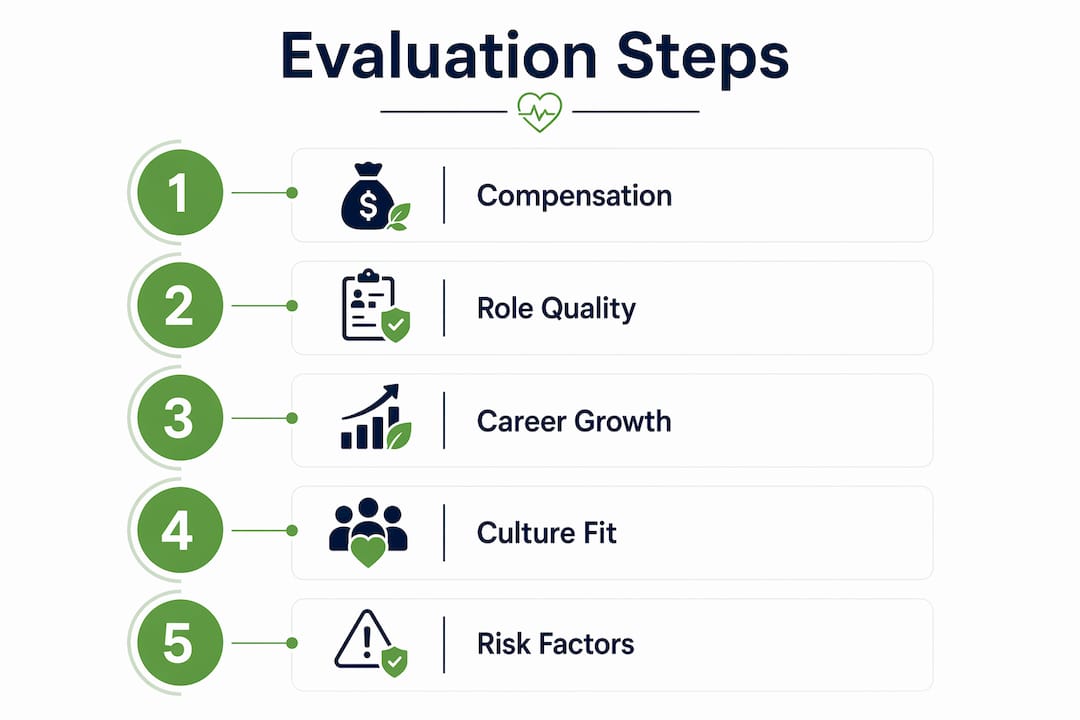
Risk factors include job stability, probation policies, guaranteed hours, and the facility's reliance on travel nurses. A unit that runs heavily on travelers often signals chronic understaffing.
Pro Tip: Score each dimension immediately after your interview while details are fresh. Waiting 24 hours lets bias creep in and details fade.
| Dimension | What to ask | Score range |
|---|---|---|
| Compensation | Full pay breakdown, differentials, benefits | 1–5 |
| Role quality | Responsibilities, resources, 90-day expectations | 1–5 |
| Growth trajectory | Clinical ladder, education support, certifications | 1–5 |
| Culture and management | Retention rates, leadership style, team dynamics | 1–5 |
| Risk factors | Guaranteed hours, probation terms, traveler reliance | 1–5 |
A combined score above 40 indicates a strong offer. Below 30 means negotiate or decline.
How do you assess compensation and benefits in nursing job offers?
Compensation assessment starts with separating base pay from total compensation. Base pay is what you see on the offer letter. Total compensation includes every financial element attached to the role.
Request a written breakdown of shift distribution and weekend assignment percentages before you accept. Lack of documented shift disclosure can reduce your take-home pay unexpectedly within six weeks of starting. Verbal promises about flexible rosters carry no weight without documentation.
Watch for hidden terms buried in offer letters. Facilities often advertise attractive base rates but hide penalty pay structures, minimum hours requirements, and shift cancellation policies in the fine print. These terms directly affect your financial stability and your ability to plan your life.
Review these specific items in writing before you sign:
- Hourly base rate and night or weekend shift differentials
- Overtime policy and whether overtime is mandatory
- Health, dental, and vision insurance premiums and coverage levels
- Retirement plan match percentage and vesting schedule
- PTO accrual rate and whether unused PTO pays out at separation
- Union dues if the unit is unionized
- Sign-on bonus repayment terms if you leave early
Pro Tip: Ask HR to send the full benefits summary document, not just the highlights sheet. The summary shows actual premium costs and coverage limits, which the highlights sheet often omits.
Benefits beyond the paycheck matter as much as salary for nurses working multiple employers or managing irregular schedules. A lower hourly rate with strong retirement matching and full health coverage can outperform a higher rate with minimal benefits over a five-year period.
How to evaluate career growth, work environment, and job stability in nursing offers
Career growth evaluation starts with a direct question: does this facility have a clinical ladder program? A nursing career ladder is a formal advancement framework that ties pay increases and title changes to demonstrated clinical competencies. Facilities without one often have no structured path for promotion.
Ask specifically about certification support, specialty training access, and tuition reimbursement. These details reveal how much the organization invests in its staff. A facility that funds your certifications signals it plans to keep you long term.
Work environment assessment requires you to look past the tour and the recruiter's pitch. High staff turnover, heavy reliance on travelers, and unclear leadership are key red flags that signal unit instability and stress. These factors correlate strongly with job dissatisfaction and burnout. Ask the unit manager directly: what is the current staff-to-traveler ratio on this unit?
Job stability evaluation covers probation policies and performance review timelines. A 90-day probation period with vague performance criteria puts you at risk. Ask what specific outcomes are expected during probation and how performance is documented. Clear criteria protect you and signal a well-managed unit.
Pro Tip: Request a brief informal conversation with a current staff nurse before you accept. Peer feedback reveals unit culture faster than any interview with management.
Red flags to watch for during the evaluation process:
- No documented shift distribution or weekend assignment policy
- Inability to name a clinical ladder or advancement program
- High traveler-to-staff ratio with no explanation
- Vague or absent performance criteria during probation
- Leadership turnover within the past 12 months
Addressing these issues before you accept is far easier than addressing them after you start. Evaluation and negotiation are integrated steps that together secure a viable and well-fitted offer.
What are common negotiation triggers and red flags during job offer evaluation?
A negotiation trigger is any condition in a job offer that requires discussion before you can reasonably accept. Triggers are not deal-breakers by default. They are gaps or ambiguities that need resolution.
Common negotiation triggers include:
- Unclear success metrics for the first 90 days
- Missing documentation of shift allocation or weekend assignments
- Sign-on bonus repayment clauses with no grace period
- Vague job descriptions that do not match what the manager described in the interview
- Benefits that differ from what was discussed verbally
Red flags are more serious. High staff turnover, inconsistent pay practices, and vague job descriptions signal systemic problems that negotiation alone cannot fix. If a facility cannot explain its turnover rate or refuses to document shift policies, that is a structural issue, not a paperwork oversight.
Timing and etiquette matter during negotiation. Professional etiquette requires directing compensation and benefit discussions to HR or recruiters after a verbal offer is extended. Raising salary questions with a hiring manager during the interview can damage the impression you worked to build. Wait for the formal offer, then engage HR directly.
Pro Tip: Frame negotiation questions as requests for clarification, not demands. "Can you help me understand how shift assignments are documented?" gets better results than "I need guaranteed weekends off."
Questions to ask HR or your recruiter after receiving an offer:
- Can you send me the written shift distribution policy for this unit?
- What does the performance review process look like during probation?
- Is the sign-on bonus subject to a repayment clause, and what are the terms?
- How is overtime assigned, and is it ever mandatory?
Key takeaways
A thorough nursing job offer assessment across all five dimensions, including compensation, role quality, growth, culture, and risk, is the most reliable way to avoid regret and protect your long-term career.
| Point | Details |
|---|---|
| Use a scoring framework | Rate compensation, role quality, growth, culture, and risk on a 1–5 scale; above 40 is a strong offer. |
| Request written documentation | Always get shift distribution, weekend policies, and benefits summaries in writing before signing. |
| Treat negotiation as part of evaluation | Address triggers like vague metrics or missing documentation before you accept, not after. |
| Assess culture through interviews | Ask about turnover rates and traveler reliance; these predict satisfaction better than pay alone. |
| Defer salary talks to HR | Direct compensation discussions to HR after a verbal offer to protect your professional standing. |
What I've learned from watching nurses accept the wrong offers
Most nurses I have worked with who regret a job choice made the same mistake. They accepted a high hourly rate without asking a single question about the unit's culture or shift policies. Within two months, they were working mandatory overtime on a unit with 40% traveler staff and a manager who had been in the role for three months. The pay was real. Everything else was a surprise.
The true value of a nursing job offer is measured by how well it fits your lifestyle, values, and career plan. That is not a soft idea. It is the difference between staying in a role for three years and leaving after six months.
What actually works is treating the evaluation as a two-way interview. You are assessing the employer as much as they are assessing you. Ask the hard questions about turnover, shift documentation, and advancement criteria. A good employer will answer them directly. An employer who deflects or gets defensive is showing you exactly who they are.
Negotiation is not a separate step that happens after evaluation. It starts the moment you identify a trigger. Unresolved issues do not disappear after you sign. They become the daily friction that wears you down. Address them early, address them professionally, and you will make a far better decision.
— Flexible
How Flexiblenursingcareers helps you evaluate and find the right role
Flexiblenursingcareers connects nurses with flexible, skills-matched job opportunities that fit your schedule, specialty, and career goals.

The platform uses real-time job matching based on your skills, availability, and preferences, so you spend less time sorting through mismatched listings and more time evaluating offers that actually fit. Nurses on the platform report faster hiring timelines and access to a wider range of positions than traditional job boards provide. When you are ready to put your nursing job offer assessment skills to work on real opportunities, Flexiblenursingcareers gives you the options worth evaluating. Sign in or create your account to see current openings matched to your profile.
FAQ
What is nursing job offer evaluation?
Nursing job offer evaluation is the structured review of all critical job dimensions, including compensation, role quality, growth, culture, and risk, to determine whether a position fits your career and personal goals. A scoring framework rating each dimension from 1 to 5 helps make this process objective and repeatable.
How do you evaluate nursing job offers beyond salary?
Assess total compensation including shift differentials, benefits, and retirement matching, then score role quality, growth opportunities, unit culture, and job stability. Candidates who assess organizational culture during the interview phase make better long-term decisions than those who focus on pay alone.
What are red flags in a nursing job offer?
High staff turnover, heavy reliance on travel nurses, vague job descriptions, and undocumented shift policies are the most common red flags. These factors correlate strongly with burnout and job dissatisfaction.
When should you negotiate a nursing job offer?
Negotiate after you receive a formal verbal offer, and direct all compensation discussions to HR rather than the hiring manager. Address negotiation triggers, such as missing documentation or unclear success metrics, before you sign.
What score indicates a strong nursing job offer?
Using the five-dimension scoring framework, a total score above 40 out of 25 indicates a high-quality, sustainable offer. A score below 30 signals the need for negotiation or reconsideration before acceptance.