
A nursing career ladder is a structured framework that defines how nurses advance through clinical, leadership, and educational milestones within a healthcare organization. Most programs recognize four distinct levels tied to experience, certifications, and demonstrated competencies. Understanding this framework is the single most direct path to turning years of bedside experience into recognized professional growth. Organizations like Kaiser Permanente have formalized these structures into programs that reward clinical excellence with title changes, pay increases, and expanded responsibilities. Whether you are a new graduate RN or a seasoned bedside nurse, the nursing career ladder explained here gives you a clear map of where you stand and where you can go.
What is a nursing career ladder and how does it work?
A nursing career ladder, also called a clinical ladder program, is a competency-based advancement model that rewards nurses for growing their skills, education, and contributions beyond basic job performance. The term "clinical ladder" is the standard industry phrase you will see in hospital policy documents and nursing literature, while "nursing career ladder" is the broader, more commonly searched version of the same concept.
The ladder works by defining clear criteria at each level. A nurse does not simply advance by staying employed longer. Advancement requires documented evidence of clinical outcomes, committee participation, continuing education, and often specialty certification. This distinction matters because it shifts career growth from a passive process into an active one you control.
Most programs tie ladder advancement directly to compensation. Moving from Level 2 to Level 3 at a major health system typically comes with a pay differential, a title change, and greater autonomy in practice. That combination of recognition and financial reward is why career frameworks improve both nurse retention and job satisfaction at the organizational level.

What are the typical levels of a nursing career ladder?
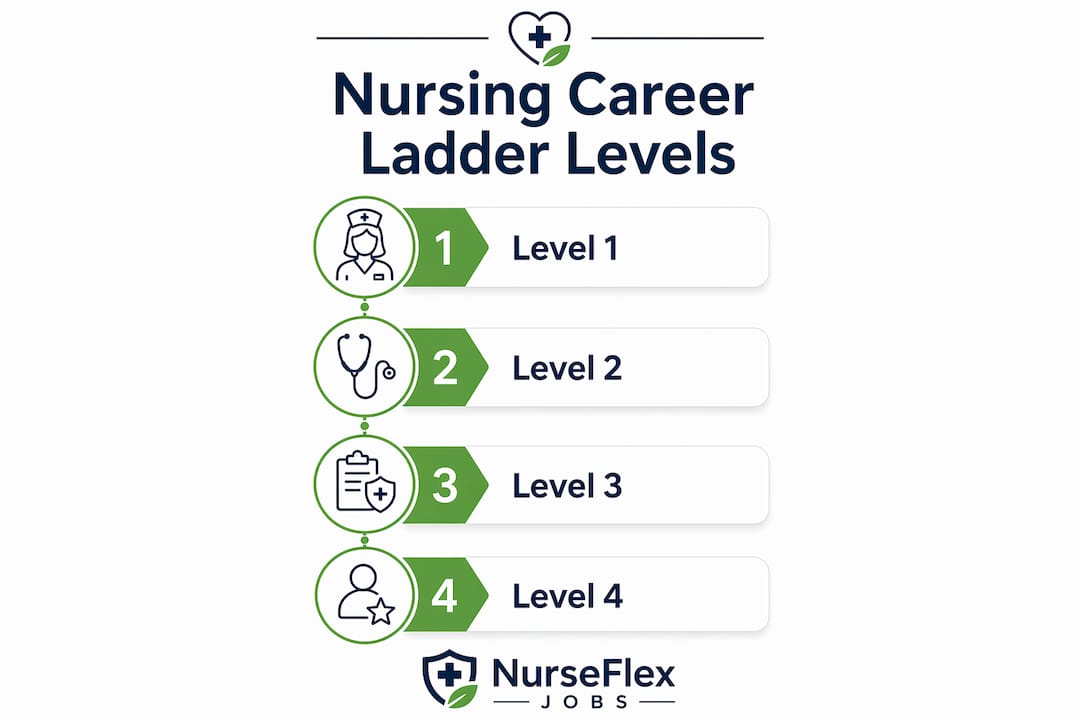
Clinical ladder programs typically define four levels based on experience thresholds, certifications, and advanced education. Here is how those levels break down across most health systems:
| Level | Title | Experience Required | Key Criteria |
|---|---|---|---|
| Level 1 | Competent RN | 1+ year | Basic clinical competency, orientation complete |
| Level 2 | Proficient RN | 2+ years | Unit involvement, continuing education credits |
| Level 3 | Expert RN | 3+ years + certification | Specialty certification, preceptor or charge role |
| Level 4 | Distinguished RN | 5+ years + advanced degree | Graduate education, leadership or research contribution |
Level 3 is where most nurses first encounter a real barrier. Specialty certification through bodies like the American Association of Critical-Care Nurses (AACN) or the Oncology Nursing Certification Corporation (ONCC) becomes a hard requirement, not a suggestion. Level 4 often expects a master's degree or enrollment in a DNP program, which is why many nurses pursue an MSN while working full time.
Beyond the clinical track, many organizations offer a parallel leadership track. A nurse who wants to move into management can pursue a charge nurse role at Level 2 and a nurse manager position by Level 4 without necessarily holding the same clinical certifications required on the bedside track. Both tracks count as legitimate nursing career progression.
Pro Tip: Before applying for a ladder advancement, request your organization's specific rubric in writing. Criteria vary significantly between health systems, and knowing the exact point values or documentation requirements before you start saves months of wasted effort.
How do nursing career paths connect to the ladder?
The nursing career ladder does not exist in isolation. It sits inside a broader set of nursing career paths that span from associate-degree entry to doctoral practice. Understanding where the ladder fits within those paths helps you plan years ahead, not just one promotion at a time.
The most common educational routes into nursing are the Associate Degree in Nursing (ADN), the Bachelor of Science in Nursing (BSN), the Accelerated BSN (ABSN) for career changers, the Master of Science in Nursing (MSN), and the Doctor of Nursing Practice (DNP). Each degree unlocks different roles and ladder levels.
| Role | Minimum Degree | Median Annual Salary (U.S.) | Typical Ladder Entry |
|---|---|---|---|
| Staff RN | ADN or BSN | ~$81,000 | Level 1 or 2 |
| Clinical Nurse Specialist (CNS) | MSN | ~$100,000 | Level 3 or 4 |
| Nurse Practitioner (NP) | MSN or DNP | ~$124,000 | Advanced practice track |
| CRNA | DNP (required by 2025) | ~$203,000 | Separate credentialing path |
The timeline from BSN to Nurse Practitioner averages four to six years, combining two to three years of clinical experience with two to three years of graduate education. That timeline means the decisions you make at Level 2 on the clinical ladder directly affect when you can qualify for NP programs.
One distinction worth understanding: moving from staff RN to NP is a role change, not a ladder advancement. The clinical ladder governs progression within a role category. Transitioning to an advanced practice role like CNS or CRNA involves a separate credentialing and licensure process entirely. Both paths represent nursing advancement opportunities, but they operate under different rules.
Specialty certifications accelerate progress on both tracks. Certifications from the American Nurses Credentialing Center (ANCC) or specialty organizations signal clinical depth that graduate admissions committees and ladder review panels both value. Earning one before applying to an MSN program strengthens your application and your ladder standing at the same time.
What strategies help nurses advance on the career ladder?
Advancing on the nursing career ladder requires deliberate action, not just time on the floor. The following strategies are grounded in what actually moves nurses forward, not what sounds good in a career seminar.
-
Document everything. Managers rarely track individual contributions, so nurses must document clinical outcomes, quality improvement projects, and committee work themselves. Keep a running folder with dates, patient outcome data, and project summaries. This portfolio becomes your advancement application.
-
Take on visible roles early. Serving as a charge nurse, preceptor, or unit council member builds the leadership evidence that Level 3 and Level 4 require. These roles also increase your compensation and influence without requiring a graduate degree right away.
-
Treat every clinical rotation as a network. Soft skills like conflict resolution and team management are evaluated alongside technical qualifications for management roles. The colleagues and charge nurses you work beside during rotations become references, mentors, and hiring managers later.
-
Plan lateral moves strategically. Career advancement is not always linear. A move from med-surg to informatics or nursing education can build skills that accelerate your return to a higher clinical or leadership level. Lateral moves are not setbacks. They are often the fastest path to a better fit.
-
Pursue continuing education in your specialty. Generic CEUs satisfy license renewal but do not satisfy ladder requirements. Target continuing education credits that align with your clinical area, since most programs require those credits to be specialty-specific.
Pro Tip: If your organization does not have a formal ladder program, build your own documentation system anyway. Hospitals that lack formal ladders still use advancement criteria informally during performance reviews and promotion decisions.
How do healthcare organizations implement nursing career ladders?
Large health systems build career ladder programs around three core requirements: minimum clinical hours, regular performance evaluations, and continuing education tied to the clinical specialty. Kaiser Permanente's clinical expert roles require nurses to average at least 24 clinical hours per week and complete 30 continuing education credits in their clinical area over the preceding two years. Those numbers are not arbitrary. They reflect a competency threshold that separates nurses who maintain active clinical depth from those who have drifted toward administrative work.
Performance evaluations at the midpoint level or above are a standard gate in most programs. A nurse cannot self-nominate for Level 3 with a below-average performance rating, regardless of certifications held. This design keeps the ladder tied to actual practice quality, not just credential accumulation.
The organizational benefits of these programs extend beyond individual nurses. Structured career development leads directly to workforce retention and stronger nursing competencies across units. Hospitals with active ladder programs report higher engagement scores and lower turnover, which matters enormously given current staffing pressures across the U.S. healthcare system.
A well-designed career development model connects clinical practice, management, and education so that advancement stays achievable across specialties. The Institute for Functional Nurses offers one example of how continuing education and coaching resources can support nurses pursuing advanced competencies outside traditional hospital programs.
"Career frameworks serve organizations as workforce tools by improving nurse retention through visible growth opportunities." — PMC Integrative Review of Specialized Nursing Career Frameworks
Flexible scheduling also plays a role in meeting ladder criteria. Nurses working part-time or flex arrangements need to verify that their clinical hours still meet the minimum thresholds their organization requires for advancement eligibility.
Key takeaways
The nursing career ladder is a competency-based framework with defined levels, documented criteria, and direct links to compensation, role expansion, and long-term career trajectory.
| Point | Details |
|---|---|
| Four standard levels | Most programs run from Competent (Level 1) to Distinguished (Level 4), each with experience and credential thresholds. |
| Documentation is non-negotiable | Nurses must self-track clinical outcomes and projects because managers rarely do it for them. |
| Lateral moves count | Moves into informatics, education, or different specialties build skills that accelerate future advancement. |
| Organizational requirements vary | Programs like Kaiser Permanente require 24 clinical hours per week and 30 specialty CEUs for advancement eligibility. |
| Ladder vs. role change | Advancing within the clinical ladder differs from transitioning to NP or CNS, which requires separate licensure. |
What I have learned watching nurses navigate the ladder
I have seen nurses treat the career ladder as a bureaucratic checkbox exercise, and I have seen nurses treat it as a genuine growth map. The ones who advance fastest share one habit: they start documenting before they think they need to. They do not wait until they are ready to apply for Level 3 to realize they have no record of the quality improvement project they led two years ago.
The other thing I notice is that nurses who advance most confidently are not always the ones with the most credentials. They are the ones who took the charge nurse shift nobody wanted, precepted the anxious new graduate, and showed up to the unit council meeting when the agenda was boring. Those moments build the visible leadership record that ladder applications require.
My honest view is that the ladder system rewards nurses who treat their career like a practice, not a job. That means continuous learning, intentional documentation, and a willingness to take on roles that stretch you before you feel ready. The nurses I see stall are usually waiting for the right moment. There is no right moment. There is only the next documented contribution.
If you are early in your career, start at Level 1 with the mindset of Level 3. If you are mid-career and have never formally applied for advancement, your portfolio likely already qualifies you. You just need to write it down.
— Flexible
Find your next nursing role with Flexiblenursingcareers
Climbing the nursing career ladder requires access to the right roles at the right time. Flexiblenursingcareers connects you directly with flexible nursing jobs matched to your skills, availability, and career goals, so you can meet clinical hour requirements, explore new specialties, and build the experience your next ladder level demands.

Whether you are a staff RN targeting Level 3 or an experienced nurse exploring advanced practice opportunities, sign in to NurseFlex Jobs to browse current openings and get matched in real time. No lengthy applications. No waiting. Just the roles that fit where you are going.
FAQ
What is a nursing career ladder in simple terms?
A nursing career ladder is a structured advancement program that defines how nurses move from entry-level clinical roles to expert or leadership positions based on experience, certifications, and documented contributions. Most programs use four levels with specific criteria at each stage.
How long does it take to advance on a nursing career ladder?
Advancement timelines vary by level and organization, but moving from Level 1 to Level 3 typically takes three to five years of active clinical practice combined with specialty certification and continuing education credits.
Do all hospitals have a nursing career ladder?
Not all hospitals have a formal clinical ladder program, but most large health systems and academic medical centers do. Nurses at organizations without formal programs can still build advancement portfolios that support promotion decisions and future job applications.
Can you advance without a graduate degree?
Yes. Specialty certifications, leadership roles like charge nurse or preceptor, and unit council participation increase compensation and influence without requiring a graduate degree, particularly at Levels 2 and 3 of most clinical ladder programs.
What is the difference between a clinical ladder and a nursing hierarchy?
A nursing hierarchy refers to the organizational reporting structure, from staff nurse to charge nurse to nurse manager to CNO. A clinical ladder is a parallel advancement track that recognizes clinical expertise and professional development within a role, independent of management authority.