
For most urgent clinical gaps, NurseFlex Jobs is the recommended same-day staffing solution. It combines real-time matching technology, pre-credentialed regional clinician pools, and a documented SLA for rapid deployment. When a sick call hits at 5 AM or a unit goes short mid-shift, you need a partner that can move without waiting for credential checks to start from scratch.
Here is what NurseFlex Jobs brings to an emergency fill:
- Real-time matching: Clinicians are matched to your open shift by skills, availability, and location, not by a recruiter scrolling a spreadsheet.
- Pre-credentialed pools: License verification, background checks, and certification validation are completed before an emergency, not during one.
- Roles covered: RNs (med-surg, ED triage), LPNs, CNAs, RTs, and select allied health professionals.
- Defined SLA: Response-time commitment is documented, not verbal.
- Activation: Contact Flexiblenursingcareers, have your unit, shift time, required role, and scope of duties ready.
Table of Contents
- What does "same-day" medical staffing actually mean?
- How do you choose the right same-day staffing partner?
- What should you have ready before you make the call?
- What do same-day staffing placements typically cost?
- How does NurseFlex Jobs deliver reliable same-day staffing?
- Emergency deployment team or same-day temp shift: which do you need?
- Key Takeaways
- What same-day placements have taught us
- NurseFlex Jobs is ready when you need same-day coverage
- Useful sources and resources
What does "same-day" medical staffing actually mean?
Same-day staffing and rapid-deploy staffing are often used interchangeably, but they describe different things. Same-day staffing means a clinician arrives on-site within the current calendar day. Rapid deployment, in emergency or disaster contexts, means a team is operational on-site within hours of the call.
The roles most reliably available for same-day fills are RNs in med-surg and ED triage, LPNs, CNAs, respiratory therapists, and some allied health roles. Physician deployment is rarer and typically reserved for disaster-level activations, where team composition is customized by provider type.
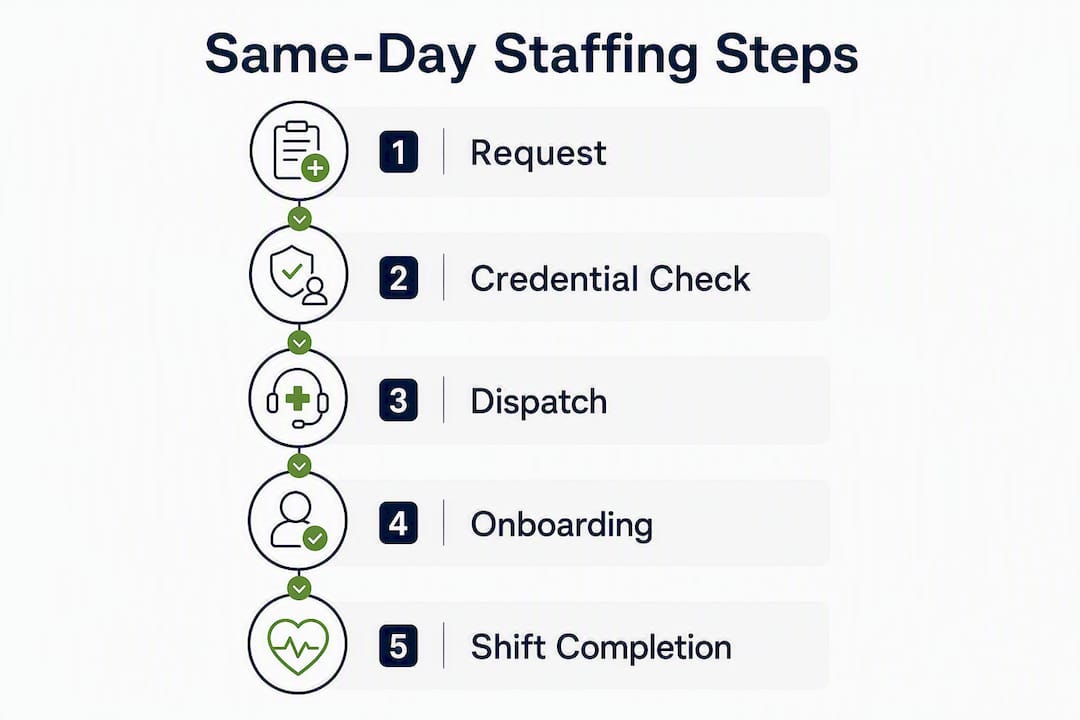
The practical timeline breaks down like this: dispatch can happen in minutes to a few hours when a local, pre-credentialed clinician pool is in place. Full clinical access, including EHR login and site-specific orientation, can take longer. True same-day readiness is achievable, but only when the provider has already done the credential work and the clinician is geographically close to your facility.

State licensure is another real constraint. A nationwide deployable team can fill gaps across regions, but travel time and jurisdictional licensing still affect how quickly a clinician can work independently at your site.
How do you choose the right same-day staffing partner?
Speed matters, but the wrong fast partner creates liability. Use this checklist when evaluating any quick medical staffing service.
- Ask for a documented SLA. Vague response-time promises are a red flag. Get the commitment in writing, including what happens if they miss it.
- Confirm pre-vetting is done before emergencies. Credential verification and background checks should be completed in advance, not triggered by your call.
- Check role coverage. Verify they can fill your specific roles: RN specialty, LPN, CNA, RT, or allied health.
- Ask about local clinician pools. Regional availability reduces travel delays and licensing friction.
- Request proof documents. License verification logs, background-check summaries, insurance certificates, and SLA language are all reasonable to request before signing.
- Clarify billing and cancellation terms. Itemized invoices, cancellation fees, and minimum-shift guarantees should be spelled out before you need them.
- Ask whether field supervision is included. Some providers send a supervisor with the clinician, which reduces the burden on your on-site team.
Pro Tip: Ask every vendor: "What happens if the clinician you send cannot access our EHR on arrival?" Their answer tells you how operationally prepared they actually are.
Red flags to watch for: no verifiable credential process, no documented onboarding plan, unclear billing terms, and any provider who cannot name the specific background-check vendor they use.
For a deeper look at what separates fast placements from failed ones, the rapid healthcare hiring guide on Flexiblenursingcareers covers the process in detail.
What should you have ready before you make the call?
The fastest placements happen when the facility is as prepared as the staffing partner. Before you pick up the phone, have these items ready.
Pre-call items:
- Unit name, floor, and shift times (start and end)
- Required role and any specialty certifications needed
- Expected scope of duties (charge nurse, bedside, float)
- Parking instructions and building entry process
- PPE requirements for the unit
On-arrival items to prepare now:
- Temporary ID or badge process
- EHR access plan: either a temporary login or a shadowing arrangement with a permanent staff member
- Name and contact of the on-site supervisor who will receive the clinician
- Site orientation owner (who walks them in and briefs them)
Back-office readiness:
- Billing code or PO reference for the shift
- Facility credentialing contact name
- Malpractice and insurance confirmation on file
After the shift, run a quick quality check: did the clinician complete the full shift, meet scope expectations, and hand off properly? A short feedback submission to your staffing partner triggers rapid replacement if needed and builds a record for future fills. The healthcare credential checklist from Flexiblenursingcareers is a practical reference to keep on hand.
What do same-day staffing placements typically cost?
Pricing for emergency medical staffing varies by role, notice window, and shift timing. No published standard rate applies across all providers, but the billing structures are consistent enough to compare.
| Billing model | When it applies | What to watch for |
|---|---|---|
| Shift-based flat rate | Standard temp fills with moderate notice | Confirm what "standard" notice means |
| Emergency deployment fee + hourly | Very short-notice or same-day fills | Surcharges for nights, weekends, specialty roles |
| Per-hour overtime-style billing | Short-notice single-shift fills | Minimum-hour guarantees may apply |
Same-day and last-minute medical staff placements typically carry a premium over standard temp rates. That premium is higher for specialty roles (ED RN, ICU RN, RT) and for shifts starting outside business hours. Weekend and overnight fills are almost always billed at a higher rate.
For clinicians, daily pay and per-shift pay options directly affect availability. Clinicians who can receive same-day or next-day pay are more likely to accept short-notice shifts, which is why platforms offering instant or daily pay tend to have deeper available pools for urgent fills.
Always request an itemized invoice example before your first placement. Cancellation policies vary widely: some providers charge a flat fee for cancellations within a certain window, others bill for a minimum number of hours regardless of shift length.
How does NurseFlex Jobs deliver reliable same-day staffing?
NurseFlex Jobs operates as a technology-driven marketplace, which changes the speed equation compared to a traditional agency model. The platform matches clinicians to open shifts in real time, based on verified skills, current availability, and location proximity.
Key capabilities for administrators:
- Pre-credentialed clinician pools: License checks, background checks, and certification validation are completed at registration, not at the point of dispatch.
- Real-time matching: Open shifts are matched to available, qualified clinicians without manual recruiter steps in between.
- Streamlined onboarding: Pre-shift documentation is handled digitally, and EHR access requests can be initiated before the clinician arrives.
- Marketplace model: A broader pool of registered clinicians means more options for same-day fills across RN, LPN, CNA, RT, and allied health roles.
When evaluating any rapid-deploy partner, request these documents before your first emergency: SLA terms in writing, background-check certificates, insurance and malpractice confirmation, and license verification logs. Providers that document these up front are operationally ready; those who cannot produce them quickly are not.
Emergency deployment team or same-day temp shift: which do you need?
These are two different tools. Using the wrong one wastes time and money.
Call an emergency or disaster deployment team when:
- A system-level event affects multiple service lines simultaneously
- A mass-casualty surge requires sustained, multi-role coverage over days
- Facility operational failure means entire departments need coverage
- You need field supervision and logistics support included with the team
Use a same-day temp staffing shift when:
- A single unit is short due to a sick call or no-show
- You need one or two clinicians for a specific shift
- You are bridging a gap while a permanent or travel hire is arranged
- Your on-site supervision is intact and you just need clinical bodies
Quick decision steps:
- Count the open roles. One or two? Same-day temp. Five or more across multiple units? Consider emergency deployment.
- Check your on-site supervision. If it is intact, temp staffing works. If supervision itself is compromised, you need a team with field supervision included.
- Assess the time horizon. A single shift? Temp. Multiple days of sustained shortfall? Emergency deployment or interim staffing.
For more on how these models differ structurally, the temporary hospital staffing guide on Flexiblenursingcareers covers both in plain terms.
Key Takeaways
Pre-credentialed, locally staged clinician pools are the single most reliable predictor of true same-day fill success, and NurseFlex Jobs is built around exactly that model.
| Point | Details |
|---|---|
| Pre-vetting is the speed driver | Credential checks done before emergencies make dispatch a logistics task, not a credentialing task. |
| EHR access delays are real | Clinician arrival and full clinical readiness are not the same; prepare EHR access before the shift starts. |
| Same-day premiums apply | Emergency and short-notice fills cost more; request itemized billing and cancellation terms before your first placement. |
| Match the tool to the need | Single-unit gaps call for same-day temp staffing; multi-unit or sustained shortfalls call for emergency deployment teams. |
| NurseFlex Jobs for rapid fills | NurseFlex Jobs offers real-time matching and pre-credentialed pools for same-day RN, LPN, CNA, RT, and allied health placements. |
What same-day placements have taught us
The conventional wisdom is that speed is the whole problem in emergency staffing. It is not. Speed is the symptom. The actual problem is preparation, and most facilities discover that gap at the worst possible moment.
The placements that go smoothly share three things: the clinician was already credentialed, the facility had a supervisor named and ready, and EHR access was arranged before arrival. When any one of those is missing, the shift starts late, the clinician works under unnecessary constraints, and patient care absorbs the friction.
The most common mistake administrators make when rushing an emergency fill is skipping the scope-of-work conversation. "We just need a nurse" is not enough information. The clinician needs to know exactly what they are walking into: patient load, acuity, charge responsibilities, and who to report to. Vague scope leads to mismatched placements, even when the credential match is perfect.
Balancing speed with quality is not a philosophical debate. It is a checklist. If your facility has the onboarding packet ready and your staffing partner has the clinician pre-credentialed, same-day placement works. If either side is unprepared, speed becomes a liability.
NurseFlex Jobs is ready when you need same-day coverage
When a shift opens unexpectedly, you need a platform that already has qualified clinicians ready to match, not one that starts the search after your call.

Flexiblenursingcareers connects hospitals and healthcare facilities with pre-credentialed RNs, LPNs, CNAs, RTs, and allied health professionals through NurseFlex Jobs, a real-time matching platform built for exactly this situation. You submit your open shift with role, unit, and shift time. The platform matches available, verified clinicians in your region. You get a confirmation with an expected arrival window, not a promise to call you back.
To get started, visit the NurseFlex Jobs employer page and have your unit details, required role, and shift time ready. Same-day fills are possible. The faster you submit, the more options you have.
Useful sources and resources
- Emergency Medical Staffing Services, Front Line EMS — primary reference for emergency deployment capabilities, pre-vetting standards, and field supervision practices cited throughout this article.
- Rapid Healthcare Hiring: What It Is and How It Works — Flexiblenursingcareers guide on how technology and process speed same-day placements.
- Healthcare Credential Checklist for Placement: 2026 Guide — practical checklist for verifying clinician credentials before an emergency fill.
- Types of Temporary Hospital Staffing Solutions — covers the full range of temp staffing models to help you choose the right approach.
- Same Day Healthcare Job Offers Explained for Nurses — explains clinician pay models and daily-pay options that affect same-day availability.
- NurseFlex Jobs Employer Activation Page — submit your open shift and connect with pre-credentialed clinicians for rapid placement.
This article provides general operational guidance for healthcare administrators. It is not legal or compliance advice. Confirm state-specific licensing requirements and facility credentialing standards with your compliance officer or legal counsel before activating same-day staffing arrangements.