
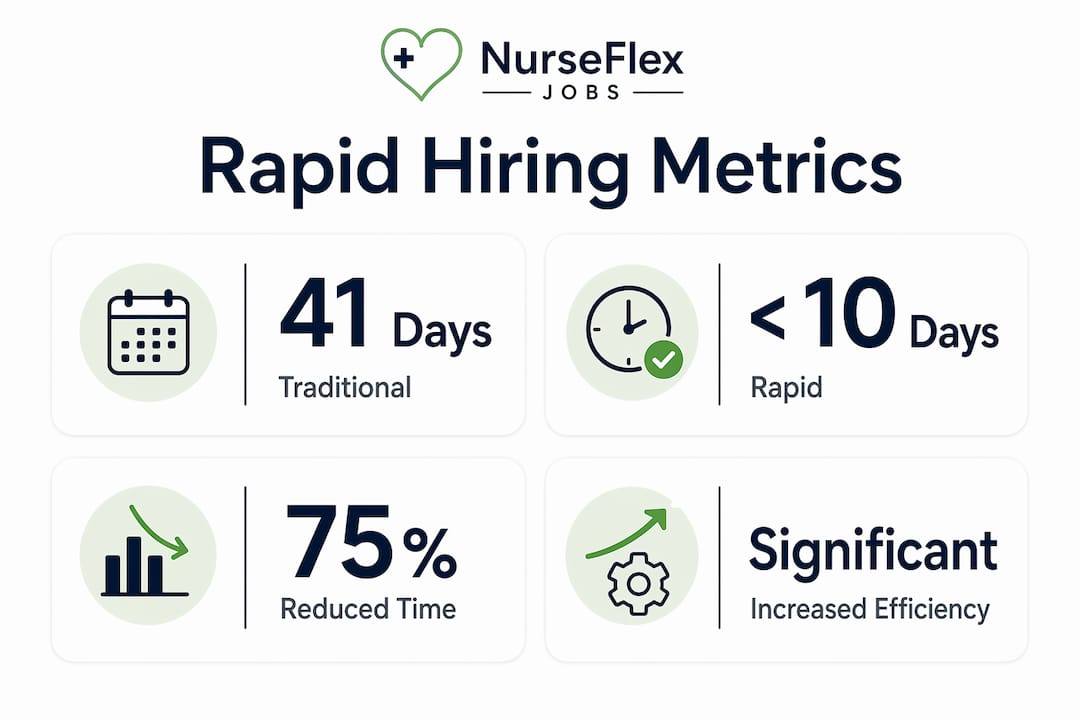
Rapid healthcare hiring is defined as a technology-driven recruitment approach that compresses the time from application to offer from weeks into days, using mobile-first workflows, AI screening, and parallel credential verification. The industry standard is slow by design: median time-to-hire in healthcare sits at 41 days, a figure that directly costs organizations revenue and patient care capacity. Tools like SMS text-to-apply, UKG Rapid Hire, and AI-driven scheduling are changing that math fast. Understanding fast healthcare recruitment is no longer optional for organizations facing chronic staffing shortages. It is the operational shift that separates facilities filling roles in 5 days from those still waiting 5 weeks.
How does rapid healthcare hiring work?
Rapid healthcare hiring works by replacing sequential, paper-heavy steps with parallel, mobile-first processes that move candidates through the funnel in 24–48 hours instead of weeks. Traditional healthcare recruitment runs each step one after another: post the job, wait for applications, screen manually, schedule a phone call, verify credentials, then extend an offer. Every handoff adds idle time. That idle time is where candidates drop off and positions stay vacant.
The rapid healthcare recruitment process redesigns that sequence in four key stages:
-
Mobile-first application. Candidates text a keyword to a short code, complete a brief pre-screening questionnaire via SMS, and enter the pipeline without filling out a lengthy online form. SMS text-to-apply workflows move candidates from first contact to interview scheduling within 24–48 hours, compared to the traditional 7–14 day window.
-
AI-driven screening. Automated tools review responses, flag qualified candidates, and send immediate follow-up messages. This replaces the manual review queue that overwhelms recruiters during high-demand periods. AI-driven screening delivers consistent, scalable speed while maintaining compliance standards.
-
Parallel credential verification. Instead of waiting for an offer acceptance before starting background checks and license verification, rapid hiring launches these steps simultaneously. Running credential checks in parallel cuts time-to-fill by 30–40% without lowering clinical standards.
-
Candidate self-scheduling. Rather than phone-tag between a recruiter and a candidate, automated scheduling tools let candidates pick their own interview slot. This single change removes one of the biggest bottlenecks in high-volume, shift-work healthcare roles.
Pro Tip: Set up your SMS keyword campaign before you post the job. Candidates who can apply by text within minutes of seeing a posting convert at significantly higher rates than those redirected to a desktop application portal.
What are the benefits of rapid healthcare hiring?

The benefits of rapid hiring are measurable, not theoretical. NHS Management implemented UKG Rapid Hire and cut time-to-hire from 15 days to 5 days, while reducing time-to-interview from 3.5 days to approximately 5 minutes. That is not a marginal improvement. It is a structural change in how fast a facility can staff a shift.
The apply-to-hire conversion rate at NHS Management jumped from 7% to 20% after implementation. That means three times as many applicants became employees, from the same candidate pool. Candidate experience ratings exceeded 90%, and the organization generated $2.2 million in additional revenue tied directly to faster staffing.
Here is what drives those outcomes:
- Reduced candidate drop-off. Speed functions as a trust signal; candidates disengage quickly from slow, confusing processes. A fast response tells candidates the organization is organized and values their time.
- Higher acceptance rates. Candidates who receive offers within days are less likely to have accepted competing offers. Fast offers win the talent race.
- Faster patient care coverage. Every day a clinical role sits vacant is a day of reduced care capacity. Rapid staffing solutions in healthcare translate directly into better patient outcomes.
- Lower recruiter burnout. Automation handles repetitive tasks. Recruiters focus on relationship-building and complex decisions instead of scheduling calls and chasing paperwork.
| Metric | Traditional Hiring | Rapid Hiring (Post-Implementation) |
|---|---|---|
| Time-to-hire | 41 days (industry median) | 5–10 days |
| Time-to-interview | 3.5 days | ~5 minutes |
| Apply-to-hire conversion | ~7% | ~20% |
| Candidate experience rating | Varies | 90%+ |
What challenges come with implementing rapid healthcare hiring?
Healthcare hiring is slow for legitimate reasons. Credential verification, license checks, background screenings, and compliance documentation are not optional. The challenge is not eliminating these steps. The challenge is redesigning workflows so they run faster without cutting corners.
The most common barriers organizations face include:
- Compliance integration. Launching credential and background checks in parallel with screening requires coordination between HR, compliance teams, and technology platforms. Organizations that treat these as separate departments create delays by default.
- Technology adoption resistance. Recruiters and hiring managers accustomed to phone-based workflows resist SMS and AI tools. Change management is as important as the technology itself.
- Measuring the right metrics. Many organizations track time-to-hire but ignore time-to-fill. Improving offer speed without redesigning onboarding only moves the bottleneck downstream. Both metrics need attention.
- Candidate trust in fast processes. Some candidates interpret a very fast process as a red flag. Clear communication at each step, explaining why the process is fast and what to expect next, builds confidence rather than suspicion.
The fix for most of these barriers is process sequencing, not technology spending. Throughput, not sourcing volume, limits rapid hire processes in healthcare. Before buying new software, map your current workflow and identify where candidates sit idle. Most organizations find 60–70% of their delay lives in scheduling and manual review, not in the steps themselves.
Pro Tip: Start your rapid hiring rollout with one role type, such as certified nursing assistants or medical assistants, before scaling. A focused pilot lets you fix workflow gaps without disrupting your entire recruitment operation.
Which tools and platforms support quick healthcare hiring strategies?
Several platforms have built specific features for the rapid healthcare recruitment process. The right choice depends on your organization's size, existing HR tech stack, and the role types you hire most frequently.
UKG Rapid Hire is the most documented solution for high-volume healthcare hiring. It integrates AI candidate sourcing, automated interview scheduling, and onboarding workflows into a single platform. The NHS Management case study is the clearest published evidence of its impact. It works best for mid-to-large healthcare systems with existing UKG infrastructure.
SMS recruiting platforms like GoHire focus on the top-of-funnel problem. They replace lengthy online applications with text-based workflows, making them ideal for frontline roles where candidates are mobile-first and unlikely to complete a desktop application. These tools pair well with any existing ATS.
AI screening tools from providers focused on healthcare compliance automate the initial candidate review and maintain documentation trails required for clinical hiring. They reduce recruiter workload while keeping audit records intact.
| Platform Type | Best Use Case | Key Feature | Typical Time-to-Interview |
|---|---|---|---|
| UKG Rapid Hire | Large health systems | End-to-end workflow integration | ~5 minutes post-apply |
| SMS recruiting tools | Frontline, high-volume roles | Text-to-apply, self-scheduling | 24–48 hours |
| AI screening platforms | Compliance-heavy roles | Automated review, audit trails | Same day |
| Specialty healthcare platforms | Nurses, allied health | Skills-based matching, real-time offers | Hours to 1 day |
Flexiblenursingcareers operates in the specialty healthcare platform category. It uses real-time job matching based on skills, availability, and preferences to connect nurses and healthcare workers with positions that fit their schedule, not just their credentials. The platform is built for the candidate who wants to start working fast without navigating a slow, generic job board.
When evaluating any rapid staffing solution in healthcare, ask three questions. Does it integrate with your existing credentialing and compliance workflow? Does it support mobile-first candidate experiences? And does it give you data on both time-to-hire and time-to-fill so you can measure real improvement?
Key takeaways
Rapid healthcare hiring works because it redesigns workflow sequencing and applies automation to idle-time bottlenecks, not because it skips compliance or clinical standards.
| Point | Details |
|---|---|
| Core definition | Rapid hiring compresses time-to-hire from 41 days to under 10 by running steps in parallel and using mobile-first tools. |
| SMS and AI are the entry points | Text-to-apply and AI screening move candidates from application to interview in 24–48 hours. |
| Parallel credentialing is the structural fix | Running background and license checks simultaneously with screening cuts time-to-fill by 30–40%. |
| Measurable ROI exists | NHS Management reduced time-to-hire by 67% and generated $2.2 million in additional revenue after implementation. |
| Throughput beats volume | Fixing scheduling and review bottlenecks matters more than sourcing more candidates. |
What i've learned after watching healthcare hiring evolve
The conversation around rapid healthcare hiring often gets framed as a technology problem. Buy the right platform, flip a switch, hire faster. That framing misses the real issue.
The organizations I've seen succeed with fast recruitment are not the ones with the most sophisticated tools. They are the ones that redesigned their process first and then chose technology to support it. The sequence matters. A great SMS platform dropped into a broken workflow just creates faster chaos.
What actually works is starting with an honest audit of where candidates sit idle. In most healthcare organizations, that audit reveals the same two culprits: manual scheduling coordination and sequential credential checks. Fix those two things, and you recover the majority of your delay without a major technology investment.
The compliance concern is real but often overstated as a reason to keep processes slow. Parallel verification does not mean skipping verification. It means starting it earlier. That distinction is worth repeating in every internal conversation about speeding up hiring.
Looking ahead, the next wave of rapid staffing solutions in healthcare will integrate predictive scheduling, where AI anticipates vacancy patterns before they occur and pre-qualifies candidate pools in advance. That shift moves recruitment from reactive to proactive. Organizations building those pipelines now will have a structural advantage when the next staffing surge hits.
Speed and care are not opposites in hiring. A fast, clear, respectful process tells candidates exactly what kind of organization they are joining.
— Flexible
Start hiring faster with Flexiblenursingcareers
Flexiblenursingcareers is built for the exact problem this article describes. The platform connects nurses and healthcare workers with flexible positions using real-time matching based on skills, availability, and location, cutting out the back-and-forth that slows traditional hiring down.

You can sign up and get matched to open roles without filling out a lengthy application. The process is mobile-friendly, credential-aware, and designed to get you working fast. For healthcare organizations, Flexiblenursingcareers reduces time-to-fill by connecting you directly to pre-qualified candidates ready to start. Sign in today and see how fast the right match can happen.
FAQ
What is rapid healthcare hiring in simple terms?
Rapid healthcare hiring is a recruitment method that uses SMS applications, AI screening, and parallel credential checks to fill clinical roles in days rather than weeks. The goal is to remove idle wait time from the hiring process without skipping compliance steps.
How long does rapid healthcare hiring typically take?
With tools like UKG Rapid Hire or SMS recruiting platforms, time-to-hire can drop from the industry median of 41 days to as few as 5 days. Time-to-interview can fall to under 5 minutes after a candidate applies.
Does rapid hiring sacrifice quality or compliance in healthcare?
No. Rapid hiring redesigns the sequence of steps, not the steps themselves. Running credential verification in parallel with screening maintains clinical standards while eliminating the idle time between sequential steps.
What roles benefit most from rapid staffing solutions in healthcare?
Frontline roles like certified nursing assistants, medical assistants, and registered nurses in high-volume settings benefit most. These are the positions where quick healthcare hiring strategies have the most direct impact on patient care coverage.
How do i measure whether rapid hiring is working?
Track both time-to-hire and time-to-fill separately. Improving offer speed without also redesigning onboarding only shifts the bottleneck. Apply-to-hire conversion rate is the single most useful metric for evaluating whether your rapid hiring process is actually converting candidates into employees.