
Healthcare job placement within 48 hours is achievable when you combine full credential readiness with a specialized staffing agency that maintains a pre-vetted talent pool. The industry term for this process is rapid deployment staffing, and it differs sharply from standard hiring. Average fill times for healthcare positions run 30 to 90 days. That gap exists because most candidates are not prepared when opportunity arrives. Agencies like Teamware Solutions and JPS Healthcare have built systems specifically to close that gap, and platforms like Flexiblenursingcareers make the same speed accessible to individual nurses and allied health professionals.
What does healthcare job placement in 48 hours actually require?
Rapid deployment staffing is not a shortcut. It is a compressed version of the same hiring process, executed faster because every party is prepared in advance. Candidate identification and screening can happen within 24–48 hours when agencies maintain pre-vetted databases and facilities are ready to review candidates immediately. The speed comes from removing delays, not from skipping steps.
The three parties that must align are the candidate, the staffing agency, and the hiring facility. If any one of them is slow, the 48-hour window closes. Your job as the candidate is to make sure you are never the bottleneck.

Credentials and licensure you must have ready
Your license, certifications, and background check must be current, verified, and uploadable before you contact any agency. Staffing agencies require current professional licensure, clear background checks, and up-to-date certifications as baseline requirements for rapid deployment. These are not negotiable, and they cannot be rushed after the fact.
The documents you need to have ready include:
- Active state nursing or allied health license (verified on your state board's website)
- BLS, ACLS, or specialty certifications relevant to your clinical area
- Current TB test or chest X-ray results (within the agency's required timeframe)
- Clear criminal background check (many agencies accept results within 90 days)
- Immunization records including flu, hepatitis B, and MMR
- Professional references from supervisors within the last two years
- Updated resume with accurate employment dates and unit-specific experience
Uploading credentials in advance enables instant job matching and removes the single biggest delay in the placement process. Agencies cannot submit you to a facility until your file is complete. Every day your documents sit unuploaded is a day lost.
Pro Tip: Scan and save all credential documents as clearly labeled PDFs before you begin your job search. Name files with your last name and document type, for example "Smith_BLS_2026." Agencies process organized files faster, and you will not scramble when an urgent role appears.
How do staffing agencies enable fast-track healthcare recruitment?
Specialized staffing agencies are the engine behind rapid healthcare job placement. They do not simply post jobs. They maintain pre-vetted talent pools, coordinate with facility HR teams, and manage the credentialing pipeline so that a match can move from identification to offer within hours.
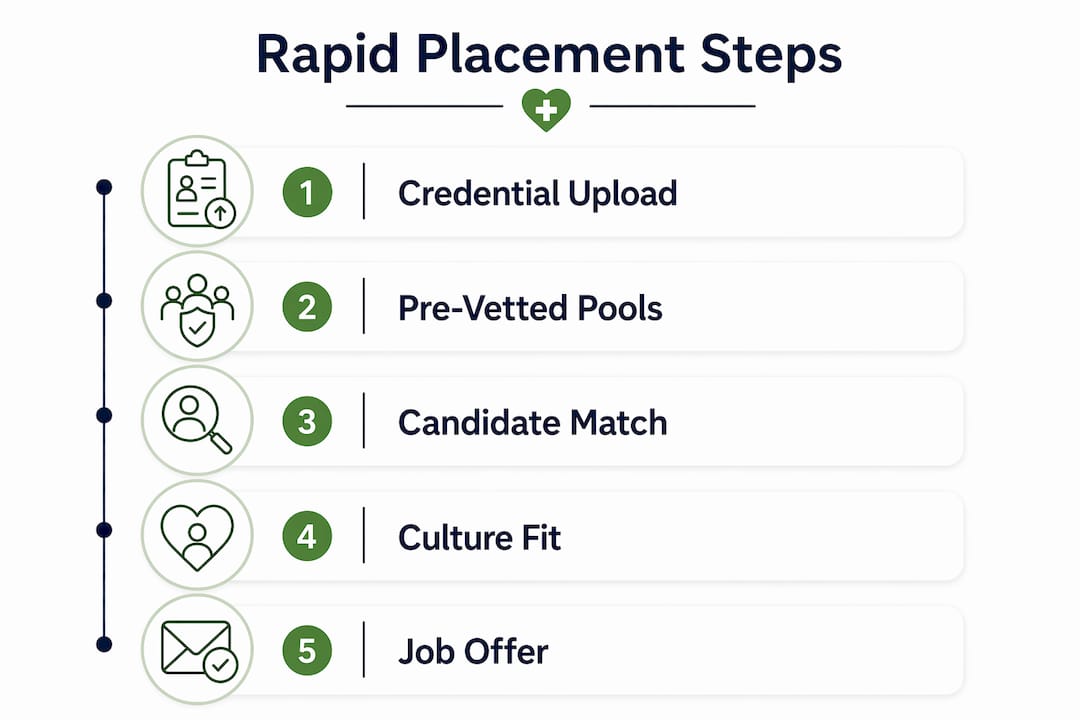
Pre-vetted talent pools allow agencies to submit candidates for urgent staffing needs within 24–48 hours while maintaining credentialing standards. That means the agency has already verified your license, checked your background, and confirmed your availability before a facility ever calls with a need. When the call comes, your file is ready to go.
The table below compares how standard hiring and rapid deployment staffing differ at each stage:
| Hiring Stage | Standard Process | Rapid Deployment Staffing |
|---|---|---|
| Candidate sourcing | Job posting, 1–2 weeks of applications | Pre-vetted pool, candidate identified in hours |
| Credential verification | Completed after offer | Completed before placement opportunity |
| Facility review | Scheduled interview, 3–5 business days | Same-day or next-day review of pre-cleared file |
| Offer timeline | Days to weeks post-interview | 24–48 hours post-interview |
| Onboarding start | 1–4 weeks after offer | As fast as 48–72 hours after offer |
JPS Healthcare applies credential verification and culture-fit screening even in rapid hiring cycles. That balance between speed and quality is what separates professional rapid deployment from a rushed, high-turnover hire. Agencies that skip culture fit to move faster tend to produce placements that do not last.
Pro Tip: Ask any agency you contact whether they maintain a pre-vetted pool or build candidate files from scratch. Agencies that pre-vet will place you faster. Agencies that start the credentialing process after you apply will add days or weeks to your timeline.
How to get a healthcare job fast: a step-by-step process
This process assumes your credentials are current and your documents are organized. If they are not, complete that work first. Speed in the application phase cannot compensate for an incomplete file.
-
Register with a rapid deployment agency or platform. Sign up with an agency that explicitly offers fast-track healthcare recruitment, such as Flexiblenursingcareers, Teamware Solutions, or a regional healthcare staffing firm with a pre-vetted pool. Do not register with general job boards that lack healthcare-specific credentialing infrastructure.
-
Upload all credential documents immediately upon registration. Do not wait until you find a role you want. Upload your license, certifications, background check, immunization records, and references the same day you register. Instant job matching depends on a complete profile.
-
Set your availability with precision. Specify the shifts, locations, and start dates you can commit to. Vague availability slows matching. If you can start within 48 hours, say so explicitly in your profile.
-
Respond to agency communications within the hour. When an agency contacts you about a role, respond immediately. Facilities reviewing pre-vetted candidates often have multiple options. The candidate who responds first and confirms availability fastest gets the offer.
-
Prepare for a brief phone or video interview. Even in rapid hiring, most facilities conduct a short interview. Job offers can arrive within 24–48 hours after that interview in a well-run process. Treat the interview as a confirmation call, not a full evaluation. Be ready to confirm your license number, start date, and shift preference on the spot.
-
Review and sign offer documents digitally. Use DocuSign or a similar tool to sign offer letters and onboarding paperwork without delay. Printing, signing, and scanning adds unnecessary time. Ask the agency in advance what format they use.
-
Complete facility-specific orientation requirements. Some facilities require a brief online orientation before your first shift. Complete it the same day you receive access. This is often the final step before your start date is confirmed.
What are the most common mistakes in rapid healthcare job placement?
The biggest misconception about 48-hour healthcare job placement is that it means you start working in 48 hours. It means you receive a job offer within 48 hours. Your actual start date depends on facility orientation schedules, shift availability, and onboarding paperwork. Setting that expectation correctly prevents frustration.
The most common mistakes that derail rapid placement include:
- Expired credentials. A license that lapsed even one day disqualifies you from rapid deployment. Check your expiration dates before you begin.
- Incomplete background check. Gaps in employment history or unresolved issues on a background check will pause your file. Address these before applying.
- Slow response time. Candidates who take 24 hours to reply to an agency message lose placements to candidates who replied in 20 minutes.
- Vague availability. Saying "I'm flexible" is not useful to a facility that needs a night shift RN starting Monday. Be specific.
- Applying to the wrong agency type. General staffing firms without healthcare-specific credentialing infrastructure cannot move at this speed. Choose agencies built for urgent healthcare vacancies.
"48-hour placement does not imply an instant start. A coordinated effort between the professional, the agency, and the employer is what makes it work." — Teamware Solutions
Facility readiness is equally critical. Even a fully prepared candidate cannot be placed in 48 hours if the hiring facility takes three days to review a submitted profile. When you work with an agency, ask whether their facility partners have committed to rapid review timelines. That question alone tells you whether the agency's 48-hour claim is realistic.
Key takeaways
Rapid healthcare job placement within 48 hours requires complete credential readiness, a pre-vetted agency relationship, and immediate responsiveness from all three parties: you, the agency, and the facility.
| Point | Details |
|---|---|
| Credentials must be pre-loaded | Upload all documents before searching so your file is ready when a role appears. |
| Pre-vetted agencies move fastest | Agencies with existing talent pools can submit you within hours, not days. |
| 48 hours means offer, not start date | Expect the job offer in 48 hours; your first shift may follow within days after onboarding. |
| Responsiveness is a competitive edge | Candidates who reply to agencies within the hour consistently win placements over slower applicants. |
| Facility cooperation is non-negotiable | Even a perfect candidate file stalls if the hiring facility does not review submissions promptly. |
What i have learned about 48-hour placement after years in healthcare staffing
The professionals who succeed in rapid deployment are not always the most experienced clinicians. They are the most prepared ones. I have seen highly qualified nurses lose placements to candidates with fewer years of experience simply because their license was pending renewal or their references were outdated.
The other thing most articles will not tell you is that the 48-hour window is as much about the facility as it is about you. A hospital that has not committed to rapid review processes will sit on a submitted profile for days. When you evaluate an agency, ask specifically which of their facility partners have agreed to same-day or next-day candidate review. That is the real indicator of whether you will see a genuine 48-hour offer.
Direct hire roles add one more layer. JPS Healthcare's approach of combining credential verification with culture-fit screening even in fast cycles is the right model. Speed without fit produces turnover, and turnover means you are back in the placement process in six months. A 48-hour offer that leads to a stable, satisfying position is worth more than a 24-hour offer that puts you in the wrong environment.
My advice: treat your credential file like a professional portfolio. Keep it current, organized, and ready to submit at any moment. The healthcare professionals who move fastest are the ones who never have to scramble.
— Flexible
Start your rapid placement with Flexiblenursingcareers
Flexiblenursingcareers is built specifically for healthcare professionals who need to move fast. The platform uses real-time job matching based on your skills, availability, and credentials, so you are connected to relevant roles the moment your profile is complete.

Sign up on NurseFlex Jobs and upload your credentials today. The platform's technology-driven matching removes the back-and-forth of traditional applications. Registered users with complete profiles are matched to open positions immediately, putting you in the fastest possible position to receive a 48-hour healthcare job offer. Your next shift could be closer than you think.
FAQ
What is rapid deployment staffing in healthcare?
Rapid deployment staffing is a hiring model where pre-vetted candidates with verified credentials are matched to open roles and receive job offers within 24–48 hours. It requires advance credentialing and agency pre-approval before a vacancy appears.
How do i qualify for 48-hour healthcare job placement?
Your license, certifications, background check, and immunization records must all be current and uploaded to your agency profile before you apply. Incomplete files are the most common reason candidates miss the 48-hour window.
Does a 48-hour job offer mean i start work in 48 hours?
No. A 48-hour offer means the job offer is extended within that timeframe. Your actual start date depends on facility orientation, shift scheduling, and onboarding paperwork, which typically adds a few additional days.
Which agencies offer fast-track healthcare recruitment?
Agencies like Teamware Solutions, JPS Healthcare, and Insight Global maintain pre-vetted talent pools that support rapid candidate placement within 24–48 hours. Platforms like Flexiblenursingcareers offer the same speed with real-time digital matching.
Why do most healthcare positions take longer than 48 hours to fill?
Standard healthcare fill times run 30 to 90 days because credential verification, interviews, and onboarding are completed sequentially after a candidate applies. Rapid deployment reverses this by completing credentialing before a vacancy opens.