
Instant job placement is defined as the rapid hiring process that connects candidates to job roles within hours or days by compressing traditional recruitment steps into a single, accelerated sequence. For healthcare job seekers, this means skipping weeks of waiting and moving directly from profile match to offer. Platforms like ZipRecruiter Instant Hire, LinkedIn Immediate Hire, and Indeed Immediate Hire have popularized this model across industries. In healthcare, where staffing shortages create daily pressure on facilities, expedited hiring is no longer a convenience. It is a necessity.
What is instant job placement and how does it actually work?
Instant job placement is the practice of hiring within hours or days by eliminating redundant steps in the traditional hiring funnel. Instead of submitting an application, waiting for a callback, completing multiple interview rounds, and then waiting for an offer letter, the entire process collapses into a real-time sequence. The candidate's profile is matched algorithmically to open roles, an interview is scheduled or conducted immediately, and an offer follows within a defined window.
The technology behind this model relies on three core components. First, AI-driven matching scans candidate profiles for skills, credentials, license status, and availability, then ranks candidates against open positions in real time. Second, instant interview platforms connect candidates and employers through video conferencing with automated scheduling, allowing candidates to choose available time slots within hours. Third, automated offer delivery sends a conditional offer directly to the candidate's dashboard, bypassing the traditional back-and-forth.

In healthcare, credential verification adds a critical layer to this process. A registered nurse cannot start a shift without a verified license, current certifications, and background clearance. Platforms built for healthcare instant placement integrate license verification databases directly into the matching engine. This means a candidate's credentials are confirmed before an offer is ever generated, not after.
Time-bound offers are a defining feature of the instant placement model. Offers typically expire within 24 to 48 hours, creating urgency on both sides. For healthcare facilities managing shift gaps, this structure guarantees a fast resolution. For candidates, it demands preparation and decisiveness.
Here is a step-by-step view of how the process typically unfolds:
- Create and complete your profile. Upload your nursing license, certifications, and availability windows. Incomplete profiles are skipped by matching algorithms.
- Get matched in real time. The platform's algorithm identifies open roles that fit your credentials, specialty, and location preferences.
- Receive an instant interview invitation. You select a time slot, often within the same day, and complete a video or automated interview.
- Review and accept the offer. A conditional offer arrives on your dashboard. You have 24 to 48 hours to accept before it expires.
- Complete onboarding. Background checks and final credential verification are completed, often in parallel, to get you to your first shift fast.
Pro Tip: Set up push notifications on any instant placement platform you use. Offers that expire in 24 hours disappear permanently if you miss them, and no amount of follow-up will recover that specific opportunity.
What are the benefits and limitations of instant job placement?
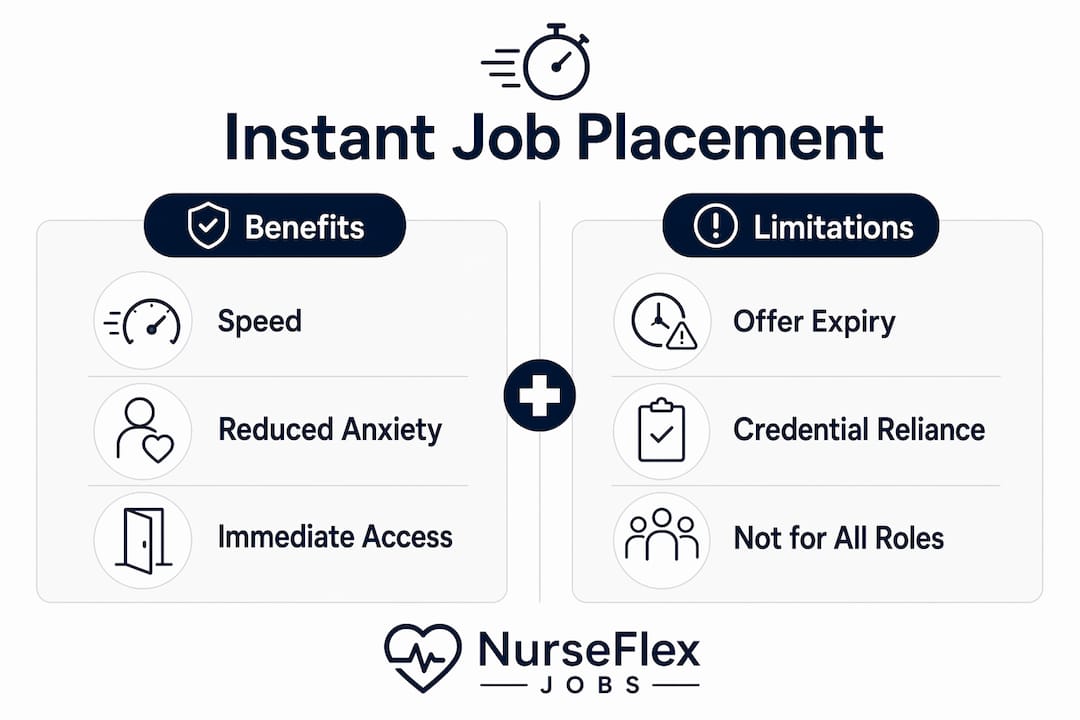
The most direct benefit of instant placement is speed. Hiring timelines shrink from weeks or months to hours or days, which matters enormously when you need income or when a facility needs coverage by next Monday. For healthcare workers between assignments or relocating to a new market, this speed removes the anxiety of an extended job search.
71% of job seekers rank faster hiring as their top priority when looking for new positions. In healthcare, where burnout and career transitions are common, that preference is even more pronounced. Instant placement gives you a clear timeline instead of an open-ended wait.
Real-time interview platforms increase hiring success rates by around 43% over traditional methods. That improvement comes from faster evaluations, immediate feedback, and reduced candidate dropout. When you know where you stand within hours rather than weeks, you can make better career decisions faster.
The limitations are real and worth understanding before you commit to this model:
- Speed does not guarantee a hire. Matching algorithms can surface your profile, but a facility may still pass if your specialty or availability does not fit their exact need.
- Offer expiration creates pressure. Missed instant offers are lost permanently, which means you need to be actively monitoring your platform notifications during your job search window.
- Credential readiness is non-negotiable. If your license renewal is pending or your certifications are outdated, the algorithm will not match you to urgent roles. The speed advantage collapses without a complete, verified profile.
- Role fit may be narrower. Instant placement works best for roles with standardized requirements, such as staff RN positions or per-diem shifts. Highly specialized or leadership roles often still require a longer vetting process.
- Competitive response times matter. Multiple candidates may receive the same offer simultaneously. The first qualified candidate to accept often wins the position.
Pro Tip: Before activating your profile on any instant placement service, spend 30 minutes reviewing your credential expiration dates. One lapsed certification can remove you from an entire category of matched roles without any notification.
How does instant placement compare to traditional healthcare hiring?
Traditional healthcare hiring follows a well-worn path: job posting, application review, phone screen, one or more in-person interviews, reference checks, credential verification, and finally an offer. The full cycle routinely takes four to eight weeks. For a hospital managing a sudden vacancy in an ICU, that timeline creates real patient care risk.
Direct Hire Authority in federal healthcare hiring offers a useful government-side comparison. Federal agencies can bypass competitive exam processes to fill critical healthcare roles faster when positions are hard to fill. This is the public sector's version of expedited placement, and it exists precisely because standard hiring timelines fail in urgent situations.
The table below summarizes the key differences between traditional hiring and instant placement for healthcare roles:
| Factor | Traditional hiring | Instant job placement |
|---|---|---|
| Time to offer | 4 to 8 weeks | Hours to 2 days |
| Interview rounds | 2 to 4 rounds | 1 real-time or automated interview |
| Credential verification | Post-offer, pre-start | Integrated before offer generation |
| Candidate experience | Extended uncertainty | Clear, fast resolution |
| Best suited for | Leadership and specialized roles | Staff, per-diem, and urgent vacancies |
| Offer structure | Negotiated over days | Time-bound, accept or decline within 48 hours |
The practical implication for healthcare job seekers is that these two models are not competing replacements. They serve different hiring situations. A travel nurse filling a 13-week contract gap is a natural fit for instant placement. A director of nursing search at a major health system is not. Understanding which model applies to your target role saves time and sets accurate expectations.
For a deeper look at how direct hire healthcare differs from instant placement, the distinction comes down to employer control versus platform automation. Direct hire puts a recruiter in the decision seat. Instant placement puts the algorithm there first.
How to prepare for and succeed in instant job placement
Preparation is the single variable you control entirely. Profile completeness directly affects matching algorithms and your chances of rapid placement. An incomplete profile is invisible to the system, regardless of your qualifications.
Here is what you need to have ready before activating your profile on any instant placement platform:
- Current, verified licenses. Upload your RN, LPN, or specialty license with the expiration date visible. Platforms that integrate with state licensing boards will verify automatically, but you still need the document ready.
- Active certifications. BLS, ACLS, PALS, and specialty certifications must be current. Expired certifications remove you from matched roles without explanation.
- Clear availability windows. Specify the shifts, days, and locations you can accept. Vague availability reduces your match rate. Precise availability increases it.
- Updated work history. List your clinical specialties, unit types, and years of experience accurately. Algorithms match on specifics, not generalities.
- A professional headshot and complete bio. Some platforms surface candidate profiles to hiring managers before the interview stage. First impressions still matter.
Once your profile is active, your job is to stay responsive. Instant offers go directly to candidate dashboards without traditional application steps, which means the platform will not call you. You need to check in daily and keep notifications on.
For the interview itself, treat a real-time video interview with the same preparation you would give an in-person meeting. Know your clinical background, have two or three specific patient care examples ready, and test your technology setup in advance. Platforms like those covered in the instant interview scheduling guide show that candidates who prepare for the format, not just the content, perform measurably better.
Pro Tip: Upload your credentials to your platform profile before you start applying anywhere. Credential verification is the most common bottleneck in healthcare instant placement, and having documents pre-loaded removes that delay entirely.
Key takeaways
Instant job placement works because profile readiness, real-time matching, and fast offer response together determine whether a healthcare professional gets hired in hours or waits weeks.
| Point | Details |
|---|---|
| Speed is the core advantage | Hiring timelines shrink from weeks to hours when all steps run in parallel. |
| Credential readiness drives match rates | Verified licenses and current certifications must be uploaded before activating your profile. |
| Offers expire fast | Most instant offers disappear within 24 to 48 hours, so active monitoring is required. |
| Instant placement suits specific roles | Staff, per-diem, and urgent vacancy roles fit this model best; leadership roles typically do not. |
| Preparation beats speed | Candidates who prepare profiles and interview formats in advance consistently outperform those who rely on speed alone. |
What I have learned from watching healthcare workers navigate instant hiring
I have watched a lot of healthcare professionals approach instant placement the same way they approach traditional job searching: update the resume, apply broadly, and wait. That approach fails here. The platform does not wait. The offer does not wait. The shift that needed filling yesterday does not wait.
The candidates who succeed with instant placement treat it like a shift they are already scheduled for. Their credentials are uploaded. Their availability is set. Their notifications are on. When an offer arrives at 7 p.m. on a Tuesday, they read it, evaluate it, and respond. The ones who check their email the next morning find the position already filled.
What I find genuinely underappreciated is how well instant placement and traditional hiring complement each other when used together. Use instant placement for immediate income and to build your local reputation with facilities. Use traditional hiring for the role you actually want long-term. Running both tracks simultaneously is not hedging. It is smart career management.
The one caution I would offer: do not let the speed of instant placement push you into a role that does not fit your clinical goals. A 48-hour offer window is real pressure, but it is not so short that you cannot spend 20 minutes reading the facility's reviews on Glassdoor or asking one clarifying question before you accept. Speed is the feature. Judgment is still yours.
— Flexible
Start your fast-track healthcare job search with Flexiblenursingcareers
Flexiblenursingcareers connects registered nurses and healthcare professionals to verified, urgent job opportunities through real-time matching built specifically for healthcare staffing. You sign up, upload your credentials, set your availability, and the platform surfaces roles that fit your exact profile.

No lengthy application queues. No waiting weeks for a callback. Flexiblenursingcareers integrates credential verification directly into the matching process, so facilities see your qualifications before they ever contact you. If you are ready to get hired fast and want access to same-day and next-day healthcare job offers, sign up on Flexiblenursingcareers today and activate your profile. Your next shift could be closer than you think.
FAQ
What is the instant job placement definition in simple terms?
Instant job placement is the process of hiring a candidate within hours or days by compressing traditional recruitment steps into a single accelerated sequence. It uses real-time matching, automated interviews, and time-bound offers to fill roles faster than conventional hiring.
How does instant job placement work for nurses specifically?
Nurses create a complete profile with verified licenses and availability, get matched to open roles by an algorithm, complete a real-time video interview, and receive a conditional offer within 24 to 48 hours. Credential verification happens before the offer is generated, not after.
What are the main benefits of instant job placement for healthcare workers?
The primary benefits are speed, reduced job search anxiety, and access to urgent positions with immediate start dates. Hiring timelines drop from weeks to hours, and candidates receive clear decisions rather than extended uncertainty.
What happens if I miss an instant job offer?
Missed instant offers are lost permanently and cannot be recovered through follow-up. You need active notifications and daily platform check-ins during your job search window to avoid losing matched opportunities.
Is instant job placement the same as same-day job offers?
They are closely related but not identical. Instant placement refers to the full accelerated hiring process, while same-day job offers are one specific outcome of that process. Not every instant placement results in a same-day offer, but same-day offers are only possible through instant placement methods.