
PRN nursing is paid, as-needed work where you fill staffing gaps on request with no fixed schedule guaranteed. PRN stands for the Latin pro re nata, meaning "as needed", and the title describes your employment status, not your clinical specialty. Here are eight common PRN job titles you'll see posted across U.S. healthcare settings:
- ER/Emergency Department RN PRN
- Med-Surg RN PRN
- ICU RN PRN
- Infusion/IV Team RN PRN
- School Nurse PRN
- Dialysis RN PRN
- Home Health RN PRN
- Telehealth Triage RN PRN
- Hospice RN PRN
Titles vary by employer and health system, but most PRN roles share the same baseline requirements: an active state license, current certifications, up-to-date immunizations, and a completed background check.
Key Takeaways
PRN nursing offers higher hourly pay and schedule control, but requires income flexibility, current credentials, and the ability to work independently with minimal orientation.
| Point | Details |
|---|---|
| PRN means as-needed | No fixed schedule or guaranteed hours; you work when the facility requests coverage. |
| Settings range widely | PRN roles exist in ERs, ICUs, infusion clinics, home health, schools, hospice, and telehealth. |
| Pay is higher but variable | Hourly rates exceed full-time equivalents, but shift cancellations directly reduce monthly income. |
| Credentials must stay current | License, BLS/ACLS, immunizations, and background check are required before any PRN shift. |
| Flexiblenursingcareers | Browse real-time PRN listings matched to your specialty and availability at Flexiblenursingcareers. |
Table of Contents
- What are PRN nursing positions and how do they work?
- What examples of PRN nursing positions exist across different settings?
- What does a PRN nursing schedule actually look like?
- How does PRN nursing pay work?
- Who is PRN nursing a good fit for?
- How do you find and land PRN nursing work?
- What does a single PRN shift look like in practice?
- PRN nursing is more strategic than it looks
- Flexiblenursingcareers connects you to PRN roles that match your schedule
- Sources
What are PRN nursing positions and how do they work?
PRN is an employment status, not a clinical specialty. You work when a facility needs coverage, and you decline when you don't. That distinction matters because it shapes everything from your paycheck to your orientation length.
How scheduling typically works:
- Per-diem shifts: You sign up for open shifts through a scheduling platform, phone call, or text. No shift, no pay.
- On-call pools: You're available during a defined window and called in if census rises. Some employers require 2–4 hours' notice; others expect you within 30 minutes.
- Internal float/PRN pools: The facility maintains its own roster of PRN staff who rotate across units based on need.
- Agency PRN: A staffing agency places you at client facilities. You're employed by the agency, not the hospital.
PRN nurses work across hospitals, ambulatory clinics, home health, schools, hospice, and telehealth, and the duties shift with the setting. Because employers treat PRN hires as a substitute workforce, orientation is usually shorter than what permanent staff receive. You're expected to be productive fast.
Pro Tip: Build a single credential folder, digital or physical, containing your nursing license, BLS/ACLS cards, immunization records, photo ID, and any specialty certifications. Facilities that can verify your documents in one pass move you to the schedule faster.
What examples of PRN nursing positions exist across different settings?
The range is wider than most nurses expect. Below are categorized examples with brief role notes so you can spot which settings match your background.
Hospital inpatient PRN roles
- ER RN PRN: Triage, stabilization, and rapid patient turnover. Expect unpredictable acuity and a high premium on independent decision-making.
- Med-Surg RN PRN: Bread-and-butter inpatient care covering post-surgical patients, medical admissions, and discharge planning. High demand across virtually every hospital.
- ICU RN PRN: Critical care monitoring, ventilator management, and drip titration. Most facilities require at least one year of ICU experience before hiring PRN.
- Perioperative/PACU RN PRN: Pre-op assessment, intraoperative support, or post-anesthesia recovery. Often scheduled around surgical block time, which means predictable hours even in a PRN model.
Outpatient and clinic PRN roles
- Infusion/IV Team RN PRN: Administering chemotherapy, biologics, or hydration therapy in an outpatient infusion center. Shifts are often 4–6 hours and tied to scheduled patient appointments.
- Ambulatory Clinic RN PRN: Covering patient education, triage calls, and procedure support in a physician office or specialty clinic.
- Dialysis RN PRN: Managing hemodialysis treatments for patients with end-stage renal disease. Dialysis centers run on fixed treatment schedules, so PRN shifts here are more predictable than in acute care.
Home- and community-based PRN roles
- Home Health RN PRN: Visiting patients in their homes for wound care, medication management, or post-acute follow-up. Hours depend on your caseload for the day, typically 6–8 hours.
- Hospice RN PRN: Providing comfort-focused care and family support for patients at end of life. On-call overnight shifts are common.
- School Nurse PRN: Covering student health needs during the school day, usually 6–7 hours. Districts often hire PRN nurses to fill in for the permanent school nurse.
Telehealth and remote PRN roles
Telehealth triage and remote-monitoring PRN roles are increasingly common, often scheduled for evening or weekend shifts when call volume spikes. You'll need a reliable internet connection, a quiet workspace, and familiarity with the facility's EHR platform. Teletriage RN PRN roles involve assessing patient symptoms over phone or video and directing care. Remote monitoring RN PRN roles track patient vitals through connected devices and escalate when readings fall outside protocol.
Occupational and specialty PRN roles
- Occupational Health RN PRN: Conducting pre-employment physicals, drug screens, and injury assessments at corporate or industrial sites. These roles are frequently PRN because demand spikes around new-hire cycles.
- Correctional Health RN PRN: Providing primary and urgent care inside jails or prisons. Correctional facilities often rely on PRN staff to cover nights and weekends.
| Setting | Typical shift types | Common hours |
|---|---|---|
| Hospital inpatient | 12-hour days or nights | 7 AM–7 PM / 7 PM–7 AM |
| Outpatient/clinic | Per-appointment blocks | 4–8 hours, weekdays |
| Home health | Caseload-based | 6–8 hours, weekdays |
| Hospice | On-call overnight | 8–12 hours, variable |
| School nursing | School-day coverage | 6–7 hours, weekdays |
| Telehealth | Evening/weekend shifts | 4–8 hours, evenings |
| Occupational health | Per-event or per-diem | 4–8 hours, variable |
What does a PRN nursing schedule actually look like?
PRN scheduling falls into several distinct models, each with different implications for income predictability and calendar control.
Common schedule types:
- Per-diem: You pick up open shifts as they appear. No shift posted, no income that week.
- On-call with advance notice: You're listed as available for a defined window, such as every other weekend, and called in with 48 hours' notice if staffing falls short.
- Guaranteed minimum shifts: Some employers offer a soft commitment, for example two shifts per month, in exchange for priority scheduling or a lower hourly rate.
- Weekend-only: You commit to one or two weekend shifts per month. Popular with nurses who hold a weekday full-time job.
- Holiday coverage: You're added to a holiday rotation and paid a premium rate for working Thanksgiving, Christmas, or New Year's.
- Block shifts: A set of consecutive shifts offered as a package, common in travel-adjacent PRN arrangements.
Concrete examples of what these look like on a real calendar:
- One 12-hour weekend shift per month at a community hospital ER
- On-call nights, Tuesday through Thursday, with a 4-hour call-in window
- Three 8-hour day shifts available per week at an outpatient infusion center, sign up as needed
- Every other Saturday, 7 AM–3 PM, at a dialysis center
Your schedule type directly affects how you should think about income. Per-diem with no minimum means your monthly earnings could be zero if no shifts post or you decline them all. A guaranteed minimum, even a small one, changes the math considerably.
How does PRN nursing pay work?
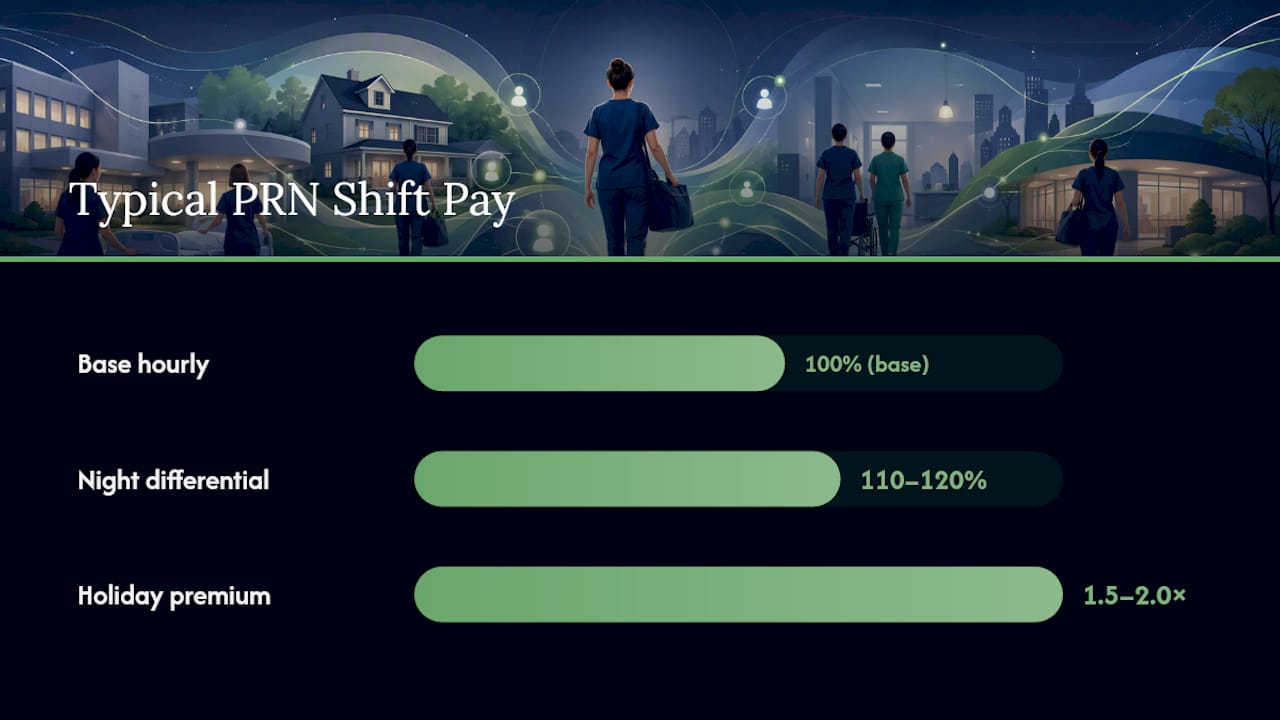
PRN nurses typically earn a higher hourly rate than their full-time counterparts in the same role, because the employer offsets the cost of benefits and schedule flexibility onto the hourly figure. The trade-off is that hours are not guaranteed.
The Bureau of Labor Statistics reports a median annual wage for registered nurses that serves as a useful baseline when evaluating any nursing offer, PRN or otherwise. Check the BLS Occupational Outlook Handbook for the most current figures, as the agency updates them on a regular publication cycle.
Compensation components to review in any PRN offer:
- Base hourly rate
- Night shift differential (commonly 10–20% above base)
- Weekend differential
- Holiday premium (often 1.5x or 2x base)
- Per-shift bonuses for hard-to-fill slots
- Mileage reimbursement for home health or multi-site roles
- Travel stipend for distant assignments
- Access to limited benefits such as a 401(k) without employer match
Some employers publish their rates openly. For example, posted part-time RN listings at health systems like Geisinger show how shift differentials are structured alongside base pay, which gives you a real-world benchmark before you negotiate.
Practical negotiation tip: Ask three specific questions before accepting any PRN offer: What is the cancellation policy if the facility cancels your shift after you've committed? Is there a guaranteed minimum number of hours per pay period? How is overtime calculated if you pick up extra shifts?
Who is PRN nursing a good fit for?
PRN suits nurses whose lives don't fit a fixed 36-hour week, and it's a poor fit for those who need income certainty above all else.
Nurses who tend to do well in PRN roles:
- Parents or caregivers managing variable home schedules
- RNs enrolled in graduate or advanced degree programs
- Clinicians supplementing a primary full-time or part-time job
- Nurses returning from medical leave, parental leave, or a career gap
- Experienced nurses who want to maintain clinical skills without a full-time commitment
Pros:
- Schedule control: you accept or decline shifts based on your availability
- Higher hourly rate than equivalent full-time roles in most markets
- Exposure to multiple units, facilities, or patient populations
- Clinical skill maintenance without a fixed schedule
Cons:
- No guaranteed income; slow weeks mean reduced pay
- Typically no employer-sponsored health insurance, paid time off, or retirement match
- Shorter orientation means you're expected to adapt quickly
- Last-minute cancellations can eliminate shifts you were counting on
Three questions to ask yourself before pursuing PRN:
- Can your household budget absorb a month with fewer shifts than expected?
- Do you have the availability to respond quickly when shifts post or calls come in?
- Is your license current in the state where you'd work, and can you realistically commute to the facilities in your target area?
If you answered yes to all three, PRN is worth pursuing. If income stability is non-negotiable right now, a part-time nursing role with guaranteed hours may be a better starting point.
How do you find and land PRN nursing work?
The search process is more targeted than a standard job hunt. Here's a practical sequence:
- Check employer career pages directly. Most large health systems post PRN openings on their own sites before listing them elsewhere.
- Apply to your current employer's internal PRN or float pool. If you already work at a facility, this is the fastest path. You skip most of the credentialing process.
- Register with staffing agencies. Agencies maintain relationships with multiple facilities and can place you in PRN shifts quickly, especially in high-demand specialties.
- Use job platforms. Search filters for "PRN," "per diem," or "as needed" narrow results fast. Browse nursing job listings to see what's currently posted in your area.
- Network with nurse managers. A direct conversation with a unit manager often surfaces PRN openings before they're formally posted.
Documents to have ready before you apply:
- Active RN or LPN license (verify it's current in the target state)
- BLS card (ACLS for critical care or ER roles)
- Immunization records: MMR, varicella, hepatitis B, annual flu, and TB test
- Resume with clinical highlights and unit-specific competencies
- Two or three professional references
- Background check authorization form
PRN roles typically require an active state license, current certifications, up-to-date immunizations, and a completed background check before you can be placed on the schedule. Having these documents organized and accessible cuts onboarding time significantly.
Sample questions to ask the hiring manager:
- How much notice do you typically give before a shift?
- What is your cancellation policy if you cancel a shift I've already confirmed?
- How long is orientation, and is it paid?
- Which charting system do you use, and will I receive training on it?
Pro Tip: Store your credentials in a cloud folder, such as Google Drive or Dropbox, organized by document type. Share the link with new employers during onboarding so they can verify everything in one step without back-and-forth emails.
What does a single PRN shift look like in practice?
Knowing the job title is one thing. Knowing what the first hour of a shift actually feels like is another.
12-hour ER PRN night shift: You arrive 15 minutes early to review the board and introduce yourself to the charge nurse. Orientation is minimal since you're expected to function independently. You'll likely manage a mix of triage overflow, fast-track patients, and one or two higher-acuity cases. Documentation happens in real time. Common surprises: a charting system you haven't used before, or a policy that differs from your home facility. Bring your own badge reel, a reliable pen, and snacks.
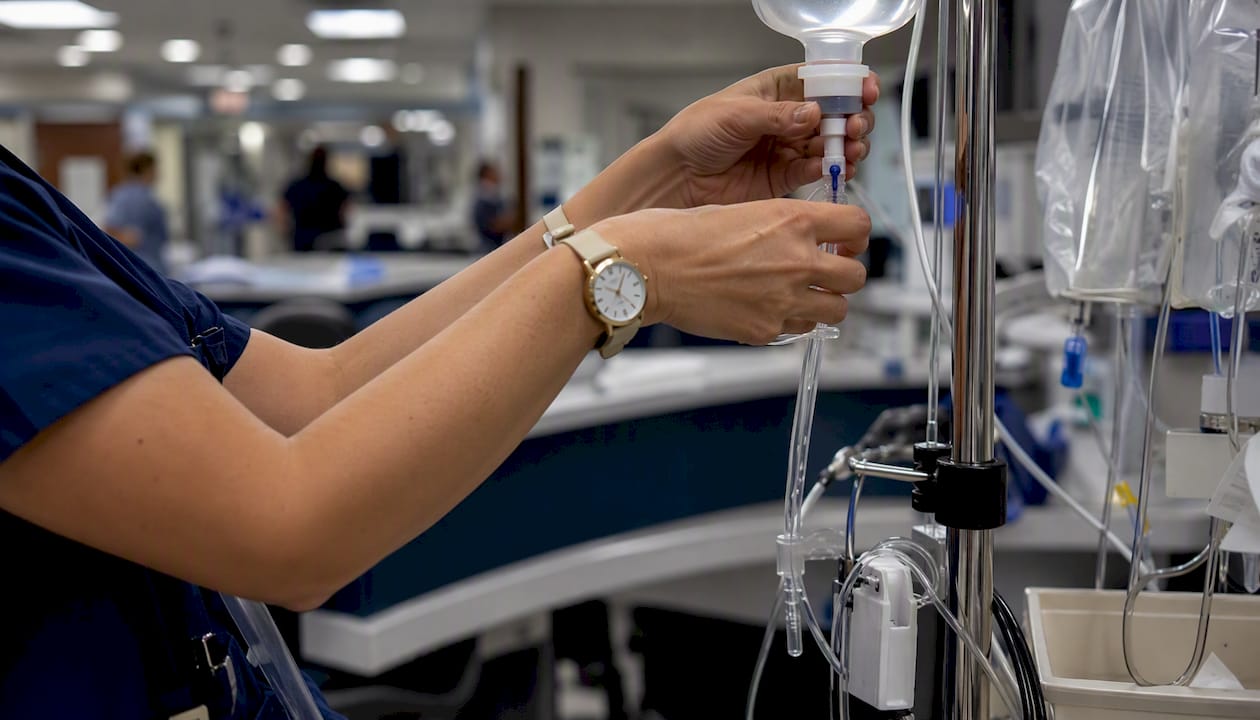
4-hour infusion PRN afternoon clinic: Check in with the clinic coordinator, review the patient schedule, and confirm which chair assignments are yours. Most patients are regulars who know the routine. Your job is IV access, medication administration, monitoring, and documentation. The shift ends when your last patient's infusion completes. Bring a copy of your BLS card since some clinics verify it at each visit.
8-hour school nurse PRN day: You'll cover the health office solo. Expect a mix of minor injuries, medication administration, and a few calls to parents. The permanent nurse usually leaves a brief handoff note. Familiarize yourself with the school's emergency action plan and the location of the AED before the first bell rings.
Teletriage PRN evening shift: Log into the facility's platform from home, confirm your headset and internet connection are working, and review the escalation protocol before your first call. Patients call in with symptoms ranging from mild to urgent. Your role is to assess, document, and direct. Familiarity with the EHR speeds everything up. Telehealth PRN roles reward nurses who are comfortable with remote monitoring platforms and clear verbal communication.

Pro Tip: For any PRN shift at a new facility, confirm your assignment the morning of, not the night before. Schedules change, and showing up to a unit that doesn't expect you wastes everyone's time.
PRN nursing is more strategic than it looks
Most nurses approach PRN as a fallback, something to do between "real" jobs. That framing undersells it. PRN is one of the few employment models in nursing that lets you control your clinical exposure, your schedule, and your income ceiling simultaneously.
The nurses who get the most from PRN work treat it like a portfolio. They hold one or two PRN relationships with facilities that match their specialty, keep their credentials current without being asked, and negotiate from a position of documented competence rather than availability alone. The flexibility is real, but so is the discipline it requires.
There's also a career-development angle that rarely gets discussed. Because PRN nurses rotate across units and facilities, they accumulate a breadth of clinical experience that full-time staff in a single unit simply don't. That breadth becomes a differentiator when applying for charge nurse roles, advanced practice programs, or leadership positions. A nurse who has worked ER PRN at three different health systems has seen three different approaches to triage, documentation, and team culture. That's not a gap on a resume. It's evidence of adaptability.
The one honest caveat: PRN is not a substitute for a financial plan. The income variability is real, and last-minute cancellations happen. Nurses who thrive in PRN roles typically have either a second income source, a financial cushion, or a guaranteed-minimum arrangement with at least one employer. Build that foundation first, then use PRN to expand your options.
Flexiblenursingcareers connects you to PRN roles that match your schedule
Searching for PRN shifts across dozens of hospital career pages is slow. Flexiblenursingcareers cuts that process down by matching you to flexible nursing jobs based on your specialty, availability, and location in real time. No lengthy applications. No waiting weeks for a callback.

The platform lists PRN openings across hospital inpatient units, outpatient clinics, home health, and telehealth roles, so you can compare shift types and settings in one place. Onboarding is built to move fast: upload your credentials once, and they're available to every facility you apply to through the platform. Sign up or browse current PRN listings at Flexiblenursingcareers to see what's available in your area today.
Sources
These resources give you authoritative, up-to-date information on RN wages, licensing, and worker protections relevant to PRN work.
- What Is a PRN Nurse? Definition, Schedule, and Career Path - Felician
- How to Become a PRN Nurse? | Salary & Career Outlook | Maryville Nursing
- Registered Nurses - Occupational Outlook Handbook - U.S. Bureau of Labor Statistics