
Evaluating nurse practitioner job offers is defined as the structured process of comparing total compensation, contract terms, work conditions, and professional growth potential before signing. Most NPs focus on base salary and miss the factors that determine long-term satisfaction. Specialty, geography, malpractice coverage, and workplace culture can shift the real value of an offer by tens of thousands of dollars. A thorough nurse practitioner role evaluation protects your income, your license, and your career trajectory.
How to evaluate nurse practitioner job offers using salary benchmarks
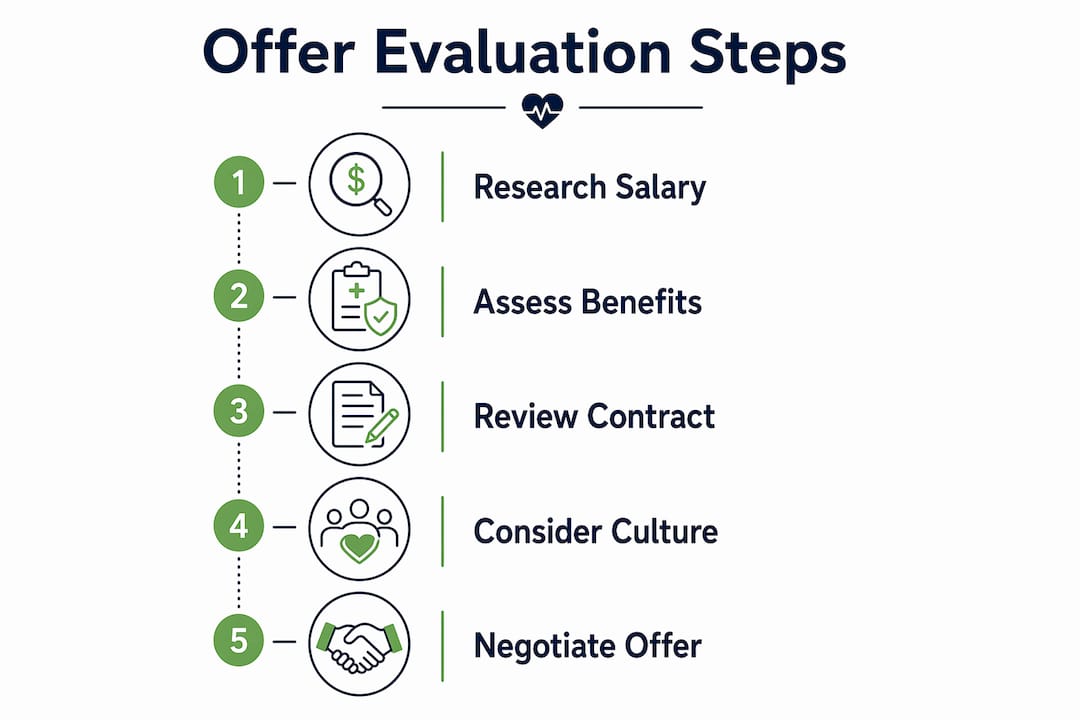
Salary benchmarking is the foundation of any sound NP offer evaluation. The Bureau of Labor Statistics Occupational Employment and Wage Statistics (OEWS) program publishes median and percentile wage data by state and occupation. The American Association of Nurse Practitioners (AANP) compensation survey adds specialty-level detail that BLS data alone cannot provide.
The median NP salary sits near $126,000 to $129,210 nationally, but new graduates typically start between $95,000 and $115,000. Those ranges shift significantly by specialty. Psychiatric mental health NPs (PMHNPs) and acute care NPs (ACNPs) earn $138,000 to $145,000, placing them well above the national median. That gap matters when you are comparing offers across specialties.

Geography creates an equally large spread. Specialty, practice setting, and location can shift NP salaries by $15,000 to $30,000 within a single state. An offer that looks competitive in rural Mississippi may be below market in San Francisco. Always adjust your benchmark to your specific metro area, not just the national figure.
Pay transparency laws give you an additional tool. California, Colorado, New York, Washington, and Illinois all require employers to post salary ranges. In those states, posted salary ranges let you walk into a negotiation with documented evidence rather than guesswork.
Pro Tip: Position every offer against the 25th, median, and 75th percentile for your state and specialty. Any offer below the 25th percentile warrants either re-negotiation or a clear explanation from the employer.
Use the salary insights tool on Flexiblenursingcareers to cross-reference BLS data with real-time market rates before your first conversation with a hiring manager.
What does total compensation include beyond base salary?
Base salary is one line in a contract. Total compensation is the full financial picture, and it often tells a different story. Total compensation includes signing bonuses, annual performance bonuses, continuing medical education (CME) funds, paid time off, retirement contributions, and health benefits.
Malpractice tail coverage is the single most overlooked clause in NP contracts. Tail coverage protects you from claims filed after you leave a position for acts that occurred during your employment. Tail coverage costs $3,000 to $8,000 out of pocket if your employer does not pay it. Always confirm in writing who covers this cost upon termination.
Non-compete clauses and termination terms deserve equal attention. A non-compete that restricts you from practicing within 25 miles for two years can effectively lock you out of your local market. Read termination clauses carefully. Some contracts require 90 days' notice from the employee but allow the employer to terminate with two weeks.
Translate every perk and liability into a dollar value before you compare offers side by side. A role paying $5,000 less per year but covering tail coverage, offering $3,000 in CME funds, and contributing 5% to a 401(k) may be worth more than the higher-paying offer. The nursing job offer evaluation guide on Flexiblenursingcareers walks through this calculation in detail.
Key contract elements to assess in every NP offer:
- Malpractice coverage type (claims-made vs. occurrence) and who pays tail coverage
- CME allowance (amount and whether unused funds roll over)
- Call duties (frequency, compensation, and whether call counts toward productivity targets)
- Productivity thresholds (RVU targets or patient volume expectations)
- Non-compete scope (geographic radius and duration)
- Termination notice period (both employer and employee obligations)
Pro Tip: Ask for the malpractice policy certificate before signing. If the employer hesitates, treat that as a red flag.
How to negotiate nurse practitioner job offers effectively
Negotiation is not confrontational. It is a professional exchange of documented evidence. 60% of NPs negotiate their salary, and those who do typically increase their offer by 5% to 15%. Failing to negotiate can cost $10,000 to $30,000 over the life of a single contract.
Follow this framework to negotiate with confidence:
- Build a value summary. Document your credentials, certifications, years of experience, and any specialty training. Attach market data from BLS OEWS and AANP surveys showing the median and 75th percentile for your role.
- Lead with evidence, not need. Frame your request around market data. "The median salary for a PMHNP in this state is $X" is more persuasive than "I need more money." Using objective market data frames the conversation as a business discussion, not a personal appeal.
- Negotiate the bundle, not just base pay. If the employer says the base salary is fixed, shift to CME allowances, scheduling flexibility, sign-on bonuses, and productivity thresholds. Negotiating bundled contract terms often yields more total value than pushing on base pay alone.
- Get everything in writing. Verbal agreements do not hold up. Every negotiated term, from an extra week of PTO to a reduced non-compete radius, must appear in the written contract before you sign.
- Avoid these common mistakes. Do not accept on the spot. Do not reveal your current salary unless required by law. Do not negotiate against yourself by lowering your ask before the employer responds.
Reviewing common NP job search mistakes before you start negotiating can save you from errors that are easy to avoid with preparation.
Does workplace culture affect NP job satisfaction more than salary?
Workplace culture affects NP retention more than most compensation packages. A lower-paying role with strong clinical support and a manageable patient load frequently produces better long-term outcomes than the highest-paying offer. Burnout, early resignation, and license risk all increase when support structures are weak.
The most reliable way to assess culture before accepting is the informational interview. Informational interviews with current or former staff surface issues like high turnover, poor physician collaboration, or unsustainable patient panels that never appear in a job posting. Ask directly: "What is the average patient panel size?" and "How are after-hours calls handled?"
Evaluate these factors when assessing workplace culture and professional growth:
- Mentorship availability: Is there a structured onboarding program or a designated clinical mentor for new NPs?
- Patient panel size: Panels above 2,000 patients in primary care signal potential overload.
- Advancement pathways: Does the practice offer a path to lead NP, department head, or clinical director roles?
- Specialty alignment: Does the role match your long-term specialty interest, or will it pull you away from your intended focus?
- Physician collaboration model: Are physicians accessible for consults, or are NPs expected to practice in isolation?
The NP role advancement guide on Flexiblenursingcareers provides a detailed framework for evaluating growth potential at prospective employers.
Key Takeaways
Thoroughly evaluating NP job offers requires comparing total compensation, contract terms, workplace culture, and growth potential, not base salary alone.
| Point | Details |
|---|---|
| Benchmark salary by specialty and state | Use BLS OEWS and AANP data; offers below the 25th percentile need scrutiny or re-negotiation. |
| Assess total compensation in dollar terms | Convert CME funds, tail coverage, PTO, and retirement contributions into a single comparable number. |
| Negotiate the full contract bundle | If base salary is fixed, negotiate CME allowances, scheduling, and productivity thresholds for greater total value. |
| Verify malpractice tail coverage in writing | Tail coverage costs $3,000 to $8,000; confirm who pays before signing any contract. |
| Evaluate culture through informational interviews | Speak with current or former staff to uncover turnover, support gaps, and patient load realities. |
What I have learned from watching NPs accept the wrong offers
The most consistent mistake I see is accepting an offer within 48 hours of receiving it. Urgency is almost always manufactured. Employers who pressure you to sign quickly are often the same ones who resist negotiation later.
The second mistake is treating salary as the only number that matters. I have watched experienced NPs take a $10,000 pay cut to escape a toxic workplace, and I have watched new graduates accept high salaries at practices with no mentorship, only to leave within 18 months. The total package, including culture, always wins over time.
Preparation changes everything. NPs who walk into negotiations with BLS data, a written value summary, and a clear list of priorities consistently secure better terms than those who rely on instinct. The data does not just help you ask for more. It helps you recognize a fair offer when you see one.
My advice: treat every offer as a business proposal. Read every clause. Ask every question. And never sign anything you have not had at least 48 hours to review.
— Flexible
Find NP roles worth evaluating on Flexiblenursingcareers
Flexiblenursingcareers connects nurse practitioners with job opportunities matched to their specialty, schedule, and compensation expectations.

The platform gives you access to telehealth NP roles with flexible scheduling and competitive pay, alongside a full catalog of nursing jobs across clinical settings. You can review employer profiles and compensation data before you apply, so you walk into every conversation already informed. Sign in or create a free account to start matching with roles that fit your criteria today.
FAQ
What is the median nurse practitioner salary in 2026?
The national median NP salary is approximately $126,000 to $129,210. New graduates typically start between $95,000 and $115,000, with specialty and geography creating significant variation.
How much can I increase my NP offer through negotiation?
NPs who negotiate typically increase their offer by 5% to 15%. Failing to negotiate at all can cost $10,000 to $30,000 over the life of a single contract.
What is malpractice tail coverage and why does it matter?
Tail coverage protects you from claims filed after you leave a position for acts that occurred during your employment. It costs $3,000 to $8,000 out of pocket if your employer does not cover it, making it a critical clause to confirm before signing.
Should I prioritize salary or workplace culture when evaluating NP offers?
Total compensation and workplace culture carry equal weight. A lower-paying role with strong mentorship and a manageable patient load often produces better long-term outcomes than a high-salary position with poor support structures.
What questions should I ask before accepting an NP job offer?
Ask about patient panel size, call duty frequency, malpractice coverage type, non-compete scope, and advancement pathways. Request a copy of the malpractice policy certificate and confirm all negotiated terms appear in the written contract.