
The fastest way to locate autonomous practice NP positions right now: search NurseFlex with the filters below, cross-check your target state's practice authority, and have your credential packet ready before you apply.
Start here in the next 30 minutes:
- Search NurseFlex nursing jobs using keywords "independent practice," "full practice authority," or "no physician oversight" and save two alerts
- Check the AANP JobCenter for NP-specific listings, where members get earlier access to new postings
- Browse telehealth employer career pages and FQHC career centers directly for panels with autonomous scope
- Pull your state NP license number, DEA registration, and national certification for quick copy-paste into applications
Immediate next steps:
- Set two saved searches on NurseFlex (one by role type, one by state)
- Confirm your target state grants full practice authority
- Assemble your application bundle: license, DEA, malpractice certificate, CV, and two references
Key Takeaways
NPs who locate autonomous practice NP positions fastest combine full-practice state targeting, specific search keywords, a complete credential packet, and direct screening questions that confirm scope before accepting any offer.
| Point | Details |
|---|---|
| Prioritize full-practice states | As of May 2026, 27 U.S. states, plus DC and Guam, grant full NP practice authority; target these for independent roles. |
| Use specific search terms | Search "independent practice," "full practice authority," or "no physician oversight" to filter listings. |
| Prepare your credential packet first | License, DEA, certification, malpractice certificate, and references ready before you apply. |
| Ask scope questions in every interview | Confirm panel ownership, prescribing sign-off, and malpractice coverage before accepting any offer. |
| Use NurseFlex for targeted matching | Flexiblenursingcareers matches you to autonomous roles by credentials and practice preference in real time. |
Table of Contents
- Where do employers post autonomous NP roles?
- Which states let you practice autonomously as an NP?
- How to search and filter job listings for autonomous NP roles
- What types of autonomous NP roles should you target?
- Licensure and documents to prepare before you apply
- What pay and employment models should you expect?
- How to evaluate listings and what to ask in interviews
- What does the timeline from application to first day look like?
- How practice authority shapes your career path
- What NPs get wrong when pursuing autonomy
- NurseFlex connects you to autonomous NP roles fast
- Sources
Where do employers post autonomous NP roles?
The best channels depend on how fast you need to move and what kind of autonomy you want.
The AANP JobCenter is the primary association-based board for NP-specific listings. AANP members get a preview window before postings go public, which matters when competitive autonomous roles fill in days. Specialty association career pages (AAFP, ACNP, and others) carry niche listings that general boards miss.
Beyond association boards, go directly to employer career pages. Telehealth companies post frequently and hire fast. FQHCs and Community Health Centers post on their own sites and on HRSA's Find a Health Center tool. Private primary-care practice owners often list on local medical society boards or through state NP associations rather than national platforms.
Other employer types worth targeting: corrections and detention health services (consistent autonomy, competitive pay), in-home evaluation companies, medical spas, and specialty clinics in full-practice states. Each of these settings tends to hire NPs specifically because they want independent clinical decision-making, not a physician extender.
For speed-to-hire, telehealth roles move fastest. FQHC panel positions take longer due to credentialing but offer funded, fully independent panels. Private practice partnerships sit in the middle.
Which states let you practice autonomously as an NP?
Practice authority is the single biggest variable in your job search. As of May 2026, 27 U.S. states plus the District of Columbia and Guam grant NPs full practice authority; the rest fall into reduced- or restricted-practice categories. Always confirm the up-to-date status on the AANP interactive map or your state board’s website.](https://www.nursepractitioneronline.com/specialties/), meaning you can evaluate, diagnose, order tests, and prescribe without mandated physician oversight. The remaining states fall into reduced or restricted practice categories.
| Practice Authority | What It Means for You | Examples |
|---|---|---|
| Full practice | Diagnose, prescribe, and open an independent clinic without physician oversight | Oregon, Colorado, Arizona, Virginia |
| Reduced practice | Some independent functions allowed; collaborative agreement required for others | Illinois, New York, Florida |
| Restricted practice | Career-long physician supervision or collaboration required | California, Texas, Georgia |
If your target state is reduced or restricted, you can still find roles with meaningful clinical autonomy inside a supportive employer structure. The key is to ask specific questions about day-to-day decision-making during interviews rather than relying on the job title alone.
To verify current status, use the AANP interactive map and your state board's website directly. Legislation changes frequently, so bookmark both and check before you apply or relocate. If autonomy is non-negotiable for you, prioritize full-practice states when evaluating offers.
How to search and filter job listings for autonomous NP roles
Generic searches return noise. These specific strings cut through it.
Copy-paste search terms to use:
"independent practice" NP OR "nurse practitioner""full practice authority" nurse practitioner"no physician oversight" NP"autonomous practice" nurse practitioner"panel ownership" NP primary care"1099" OR "contract" nurse practitioner telehealth
Filters to apply on job boards:
- Practice setting: outpatient, telehealth, community health, home health
- Job type: full-time, part-time, or contract (contract roles often carry more autonomy)
- License requirement: filter for your state or compact states
- Remote/telehealth: check this box to surface telehealth NP roles that frequently offer independent scope
- Compensation: set a salary floor to filter out roles that underpay for autonomous responsibility
Pro Tip: Set your saved searches to alert daily, not weekly. Autonomous NP roles in full-practice states fill quickly. Use a 50-mile radius for in-person roles and no radius for telehealth. Include a salary floor of $120K to filter out positions that bundle supervision requirements into the compensation model.
What types of autonomous NP roles should you target?
Not every autonomous role looks the same. Here is what to expect across the most common categories:
- Private primary care owner or partner: Full clinical and business autonomy. You own or co-own the panel. Requires business setup, credentialing with payers, and startup capital. Slowest to enter but highest long-term independence.
- Telehealth NP: Remote, often 1099 or W-2 contract. Fast to hire. Scope varies by platform, so confirm prescribing authority and panel ownership before accepting. Telehealth roles are the fastest path to remote autonomous practice.
- In-home evaluation NP: Regional travel, independent assessments, minimal supervision. Companies like Signify Health hire for in-home and telehealth NP roles that support autonomous scheduling and clinical decision-making.
- FQHC or CHC NP with panel ownership: Federally funded, stable salary, full panel management. Credentialing takes 60–90 days but the autonomy is well-defined and protected.
- Corrections NP: Consistent autonomous scope, competitive pay, and predictable hours. Hiring is steady and the clinical independence is real.
- Medical spa or aesthetic NP: High earning potential and schedule control. Requires additional training and, in some states, specific permits. Aesthetic and entrepreneurial NP pathways are often overlooked but offer genuine clinical independence.
- Consulting or content NP: Fully independent, project-based. Best suited to NPs with established clinical credibility and a professional network.
Telehealth and in-home roles hire fastest. FQHC and private practice ownership take more setup but deliver the deepest autonomy.
Licensure and documents to prepare before you apply
Having your documents ready before you apply cuts weeks off your timeline. Work through this list in order:
- State NP license: Confirm it is active and unrestricted. If you are targeting a new state, start the transfer or endorsement application now. Processing takes 4–12 weeks depending on the state.
- National certification: ANCC or AANPCB certificate, current and unexpired. Most employers require this before extending an offer.
- Compact or multi-state considerations: The NP Compact is not yet as widely adopted as the RN Compact, so verify whether your target state participates before assuming portability.
- DEA registration: Required for prescribing controlled substances. Apply at DEA.gov. Processing takes 4–6 weeks for new registrations.
- Malpractice coverage: Confirm your policy covers independent practice, not just employment-based coverage. Tail coverage matters if you are leaving a current employer.
- Immunization records and background check: Most employers require both. Get updated copies now so you are not waiting on them after an offer.
- Collaborative agreement (if required): In reduced-practice states, have a draft agreement ready or a physician contact willing to sign. This is a common bottleneck.
Use the flexible healthcare roles checklist to track each item. Items 1–5 should be ready before you apply. Items 6–7 can follow an offer if needed.
What pay and employment models should you expect?
Autonomous NP roles come in three main employment structures, and each one signals something different about the actual scope you will have.
- W-2 employee: Salary plus benefits, malpractice covered by employer. Common at FQHCs, telehealth companies, and corrections. Autonomy is real but bounded by employer policy.
- 1099 contractor: Higher gross pay, you cover your own malpractice and benefits. Common in telehealth and per-diem roles. Read the contract carefully for any supervision or co-signature requirements that would limit your scope.
- Practice owner or partner: Revenue tied to panel billing and productivity. Highest earning ceiling, highest financial risk. Requires business and billing knowledge.
Compensation signals to watch in listings: base salary plus productivity bonus (common at FQHCs), panel-based billing splits (private practice), and whether malpractice is occurrence-based or claims-made. A Circadia Health in-home NP listing advertises a base salary range of $150K–$200K with regional autonomy and independent assessments, which is a useful benchmark for in-home autonomous roles.
How to evaluate listings and what to ask in interviews
A listing that says "autonomous" does not always mean it. Use these questions to confirm scope before you accept.
- "Who has final sign-off on my prescribing decisions?"
- "Do I own my patient panel, or does the employer retain it if I leave?"
- "Is there a required physician co-signature for any order type?"
- "What is the process for ordering controlled substances?"
- "Does the malpractice policy cover independent practice, or only employment-based acts?"
- "What is the call or coverage structure, and who backs me up after hours?"
Red flags: vague language like "collaborative environment" with no specifics, no DEA support or reimbursement, employer-retained patient panels, and contracts that require physician co-signatures on routine orders. Document every answer during the screening call. Use them when evaluating the final offer and negotiating scope language into your contract.
What does the timeline from application to first day look like?
Expect generally 4–10 weeks from application to start date for most autonomous NP roles. Here is how that typically breaks down:
- Week 1: Application submitted, phone screen scheduled
- Week 2: Clinical interview, reference checks initiated
- Weeks 3–4: Offer extended, credentialing packet submitted
- Weeks 4–8: Credentialing, background check, DEA verification, malpractice binding
- Week 8–10: EHR access granted, prescriptive privileges activated, first day
Onboarding priorities for autonomous roles: confirm EHR access and prescribing setup before day one, verify ordering rights are active, confirm malpractice coverage is bound, and establish referral pathways for specialist handoffs.
Pro Tip: Build a single standardized credential packet as a PDF: license, DEA, certification, malpractice certificate, CV, and two reference contacts. Attach it to every application. Employers who receive a complete packet move to interview faster, and credentialing departments start the clock sooner.
How practice authority shapes your career path
Full-practice authority does more than remove a supervision requirement. It determines whether you can open an independent clinic, own a patient panel, bill directly under your own NPI, and build a business. NPs in full-practice states can pursue independent practice and manage patient panels in ways that are structurally unavailable in restricted states regardless of employer support.

If you are weighing relocation or a specialty shift, map your target state's authority first. A move from a restricted to a full-practice state can open private practice, direct-pay models, and panel ownership that are not available to you today. For NPs considering aesthetic, consulting, or entrepreneurial paths, nontraditional NP careers in full-practice states carry the fewest structural barriers to independent income.
What NPs get wrong when pursuing autonomy
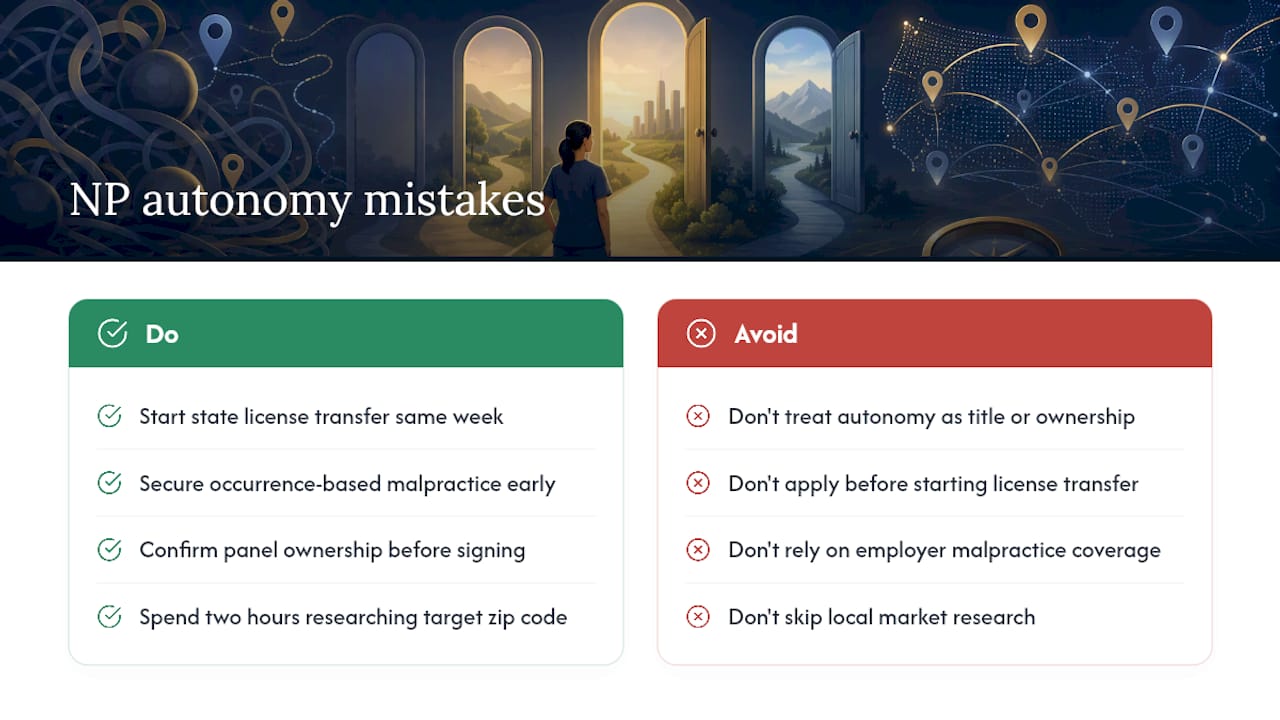
The most common mistake is treating autonomous practice as a job title rather than a legal and contractual status. Here is where NPs consistently run into trouble:
Underestimating licensing time. State license transfers take 4–12 weeks. NPs who apply to roles in a new state before starting the transfer process lose their place in hiring cycles. Start the application the same week you begin your job search.
Malpractice gaps. Employment-based malpractice does not cover independent practice. If you are moving to a 1099 or practice-owner model, you need your own occurrence-based policy before your first patient encounter. Ask your current insurer about tail coverage before you resign.
Unclear panel ownership. Many NPs accept roles assuming they own their patient relationships, then discover the employer retains the panel on departure. Ask question 2 from the interview list above before you sign anything.
Skipping market research. Opening an independent practice or taking a 1099 role without checking local payer mix, competition, and patient demand is a fast path to underutilization. Spend two hours on your target zip code before committing.
Quick self-check: Can you name your target state's practice authority category right now? Do you have an active DEA registration? Is your malpractice policy occurrence-based? If any answer is no, that is your first task before applying.
NurseFlex connects you to autonomous NP roles fast
Flexiblenursingcareers is built for exactly this search. The platform matches you to roles based on your credentials, availability, and practice preferences, so you are not scrolling through listings that require physician oversight or exclude your specialty.

Set up your profile in minutes, upload your credential packet, and apply the autonomous-practice filters to surface telehealth, FQHC, in-home, and independent primary care roles in your target states. The real-time matching means new listings reach you before they fill. For NPs targeting remote scope, the telehealth category surfaces roles specifically structured for independent NP practice.
Browse NurseFlex nursing jobs now, upload your credentials, and set your first autonomous-practice saved search today.
Sources
- Nursepractitioneronline
- Nurse Practitioner Jobs - AANP JobCenter | NP Jobs
- Beyond Primary Care: 11 Nontraditional Nurse Practitioner Careers | Wilkes University Online