
Start by building a one-page skills-and-availability checklist, then filter every job posting against it before you apply. That single step removes the weak matches that waste your time and keeps your search focused on roles where your credentials, population focus, and schedule actually fit.
Before you open a single job board, confirm these four things:
- State licensure: Which states are you currently licensed in, and do you hold a multi-state compact privilege?
- Population focus: What is your board certification (FNP, AGACNP, PMHNP, PNP, WHNP)?
- EHR comfort: Are you proficient in Epic, Cerner, or Oracle Health?
- Schedule limits: What shift lengths, call expectations, and commute distances are non-negotiable for you?
With those answers in hand, you can match NP skills to clinical positions in minutes rather than weeks.
Table of Contents
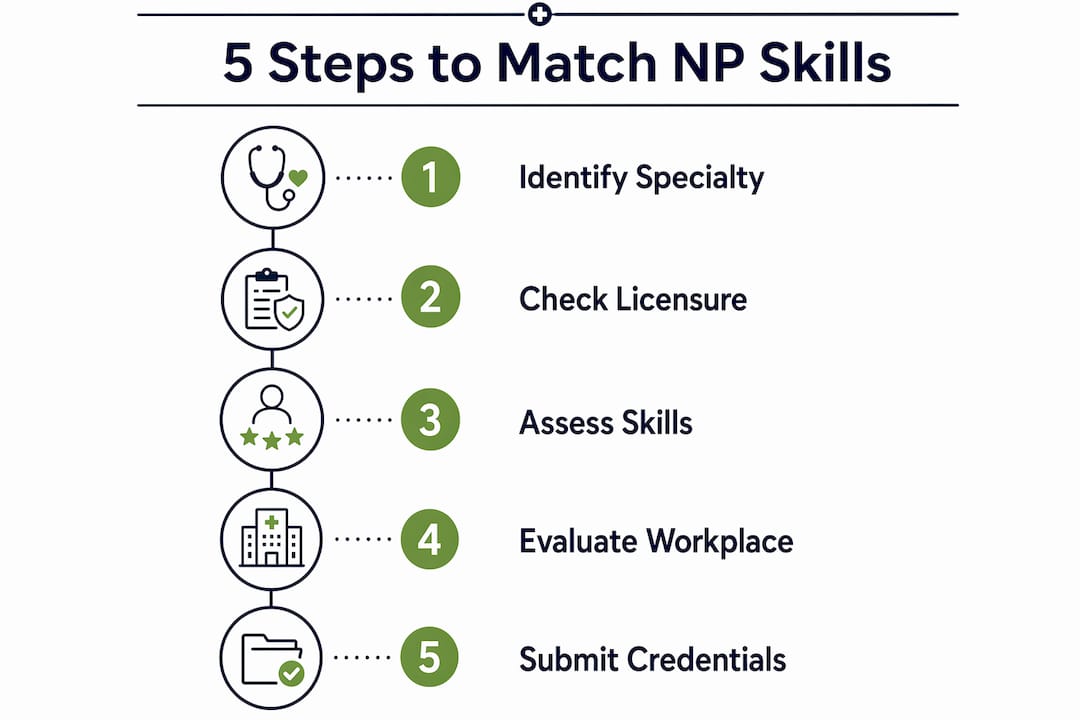
- How to match NP skills to clinical positions in five steps
- Which clinical roles fit your NP specialty?
- What state licensure and scope-of-practice checks do you need before applying?
- How do you assess workplace fit beyond clinical skills?
- How to screen out weak matches fast
- What documents do you need and how long does credentialing take?
- Skills-to-role worksheet: score and compare job postings
- Key Takeaways
- Why a skills-first approach shortens your NP job search
- NurseFlex Jobs helps you find flexible NP roles faster
- Useful sources and further reading
How to match NP skills to clinical positions in five steps
Effective NP job matching goes beyond credentials. It means aligning licensure, practice authority, patient volume, schedule, and institutional support before you invest time in any application.
-
Inventory your credentials and practical preferences. List every state where you hold an active license, your board certification and population focus, your EHR experience (name the specific modules you know), and your hard limits on shift length and call frequency.
-
Prioritize roles by scope-of-practice match and support level. A new FNP needs a different onboarding structure than a 10-year AGACNP. Rank openings by how well the advertised autonomy level matches your experience, and flag any role that expects independent practice in a restricted state.
-
Score postings with quick filters. Apply four filters in order: licensure state, population focus, call expectations, required EHR. A posting that fails any one of these is out. This keeps your shortlist to roles you can actually fill.
-
Prepare tailored application items for your top three. For each shortlisted role, write two resume bullet points that name the specific skills the posting emphasizes, and prepare one clinical scenario that demonstrates your fit for that setting.
-
Speed up verification before you get an offer. Contact your state board to confirm your license is in active status, check your DEA registration expiration date, and pre-assemble your credential packet so you can submit it the day an offer arrives.
Pro Tip: Set a 10-minute timer and run steps 1 and 3 back-to-back on the first posting you open today. If it passes all four filters, add it to your shortlist. If it fails one, close it and move on.
Which clinical roles fit your NP specialty?
AACN and NONPF require both core NP competencies and population-specific competencies for entry to practice. That two-layer requirement, core skills plus population focus, is the foundation of any honest role-mapping exercise.
| Role category | Population focus required | NP skills that matter most |
|---|---|---|
| Ambulatory primary care clinic | FNP or specialty-matched | Chronic disease management, preventive care, Epic/Cerner templates |
| Urgent care / retail clinic | FNP (broad fit) | Rapid assessment, procedural skills (suturing, splinting), high-volume EHR |
| Inpatient hospital medicine | AGACNP or ACNP | Acute assessment, order management, rounding efficiency, Epic inpatient |
| Telehealth (primary or urgent) | FNP, PMHNP, or specialty-matched | Telehealth platform proficiency, async documentation, patient communication |
| Behavioral health / psychiatry | PMHNP | Psychopharmacology, risk assessment, collaborative care model experience |
| Women's health / OB-GYN | WHNP or FNP with OB experience | Gynecologic procedures, prenatal care, family planning counseling |
| Pediatrics / pediatric specialty | PNP-PC or PNP-AC | Developmental assessment, vaccine schedules, family-centered communication |
NONPF's revised NP Role Competencies define measurable clinical behaviors expected at entry to practice, and those behaviors map directly to the skills column above.
A few practical notes on transferability:
- Telehealth is the most portable setting. FNPs, PMHNPs, and WNHPs all find telehealth roles that match their population focus, and async documentation skills transfer across platforms.
- Urgent care rewards procedural breadth. If your clinical hours included suturing, I&D, or splinting, name those procedures explicitly on your resume.
- Pediatric specialty roles often require PNP-AC certification for inpatient acuity. For pediatric care matching, confirm the acuity level before applying.
- NP specialization shapes both daily work and long-term career trajectory. Family NP offers the widest role flexibility; acute care tracks carry higher acuity and procedure demands.
What state licensure and scope-of-practice checks do you need before applying?
Skipping this step costs you interviews. Confirm the following before your shortlist is final:
- Compact privilege: The Nurse Licensure Compact covers RN and LPN licenses, not advanced practice. Verify whether the state where the role is posted requires a separate APRN license or recognizes your home state.
- Full practice authority (FPA): Several states plus DC grant FPA, meaning you can practice without a collaborative agreement. In restricted states, confirm the employer has a supervising physician in place before your start date.
- DEA registration: Many employers expect an active DEA number before day one, especially for primary care and urgent care roles. Check your registration expiration and budget 4–6 weeks for a new application if needed.
- Red flags to exit immediately: A posting that advertises "full autonomy" in a state without FPA, a vague collaborative agreement structure, or no mention of onboarding for a restricted-state role.
State regulations directly shape which clinical positions are legally available to you. Never assume a job title tells you the full scope.
How do you assess workplace fit beyond clinical skills?
Seasoned NPs consistently rank collaborative agreement clarity, EHR documentation burden, call expectations, and onboarding quality above base salary for long-term satisfaction. Here is what to probe:
- Documentation burden: Ask how many patients per shift and how long the average note takes. A 20-patient urgent care day with 5-minute notes is a different job than a 16-patient primary care panel with 15-minute SOAP notes.
- Call frequency: Get the exact call schedule in writing, not a verbal estimate.
- Onboarding structure: Ask for a written orientation timeline. NPs returning after a practice gap should prioritize roles with structured re-acclimation to local protocols and EHR templates.
- Mentorship availability: New NPs need a named preceptor or clinical lead. If the posting says "hit the ground running" with no preceptorship language, treat that as a warning.
Pro Tip: Before a formal interview, request a 15-minute informational call with the clinical lead or office manager. Ask one direct question: "What does the first 90 days look like for a new NP here?" The answer tells you more than the job description.
How to screen out weak matches fast
Mapping daily working preferences against employer requirements is faster than sending more applications. Use this two-minute triage:
- Does the posting name your population focus explicitly? If not, call before applying.
- Does it list the required EHR? If it lists one you have never used, factor in training time.
- Does it mention call expectations? No mention usually means call exists but is not disclosed.
- Does it describe onboarding? Vague postings with no orientation language often mean sink-or-swim starts.
For your resume, EHR proficiency in Epic or Oracle Health is frequently a hiring gate. List the specific modules you know (Epic Ambulatory, Epic Inpatient, Cerner PowerChart) rather than just the platform name. For telehealth roles, add the platform (Teladoc, Doxy.me, or your employer's system) and note async documentation experience. For urgent care, list procedures by name.
Pro Tip: Use common NP job search mistakes as a reverse checklist. If a posting triggers three or more of those patterns, remove it from your list without guilt.
What documents do you need and how long does credentialing take?
Prepare your credential packet before you start applying. Standard items:
- Active state NP license (and RN license if required separately)
- Board certification certificate (ANCC or AANP)
- DEA registration certificate
- Malpractice history / claims letter
- Immunization records (Hep B, TB, flu, COVID per employer policy)
- Background check authorization
- Two to three professional references with current contact information
Timelines vary by setting. Ambulatory and clinic roles typically credential in 2–4 weeks. Hospital credentialing runs 6–12 weeks because it requires medical staff office review. Rapid-matching platforms like NurseFlex Jobs compress the ambulatory timeline significantly when your packet is pre-assembled.
Build your NP professional profile online and upload your credential documents before your first recruiter conversation. That single step removes the most common delay.
Pro Tip: Tell every recruiter upfront: "My credential packet is complete and ready to submit." That phrase moves you to the top of the shortlist for time-sensitive flexible roles.
Skills-to-role worksheet: score and compare job postings
Copy this table and fill in one row per posting. Score each factor 1 (poor fit) to 3 (strong fit), then total the row.
| Factor | Weight | Role A (example: FNP telehealth) | Notes |
|---|---|---|---|
| Population focus match | High | 3 | FNP cert matches adult/family telehealth |
| Required procedures | Medium | 3 | Telehealth: none required |
| EHR requirement | High | 2 | Platform unfamiliar; training offered |
| Autonomy level | High | 3 | FPA state; no collaborative agreement |
| Onboarding support | High | 3 | 2-week structured orientation |
| Schedule fit | High | 3 | Async shifts; matches availability |
| Commute | Medium | 3 | Remote; no commute |
| Total | 20 / 21 | Strong fit |
Weight "high" factors at 3 points maximum and "medium" factors at 2. A total below 12 is a weak match; remove it. A total of 16 or above is worth a formal application.
Scoring job postings with a short worksheet reduces subjective attraction to roles that look appealing but do not fit your actual credentials and availability.
Key Takeaways
Skills-first matching, anchored in AACN/NONPF competency frameworks and a pre-assembled credential packet, shortens the NP job search and improves role longevity.
| Point | Details |
|---|---|
| Start with a checklist | Confirm licensure state, population focus, EHR comfort, and schedule limits before opening any job board. |
| Use the two-minute triage | Filter every posting by four criteria: licensure state, population focus, call expectations, required EHR. |
| Pre-assemble credentials | A complete credential packet ready before your first recruiter call removes the most common hiring delay. |
| Score, don't browse | Use the worksheet to score postings objectively; remove any role scoring below 12 without hesitation. |
| Use Flexiblenursingcareers | NurseFlex Jobs matches your skills, availability, and population focus to flexible roles in real time, cutting search time significantly. |
Why a skills-first approach shortens your NP job search
The conventional advice is to apply widely and let volume do the work. That approach fails NPs because NP roles are not interchangeable. Population-focus certification, state scope-of-practice rules, and EHR requirements create hard limits that no amount of application volume overcomes.
The AACN/NONPF competency frameworks are not just educational standards. They are a practical checklist for reading job descriptions. When you mark which competency domains a posting requires and compare them to your own, weak matches become obvious in under two minutes. That clarity is what makes skills-first matching faster, not just more organized.
NurseFlex Jobs applies the same logic at scale, translating your skills, availability, and preferences into real-time role matches so you spend your time on interviews that are already pre-filtered for fit.
NurseFlex Jobs helps you find flexible NP roles faster
Sending applications to every open NP posting is time-consuming and rarely lands the right role. NurseFlex Jobs takes a different route: you set your skills, population focus, and availability once, and the platform surfaces real-time matches from hospitals and clinics actively hiring for flexible positions.

Create your profile, upload your credential packet, and set your availability. NurseFlex Jobs filters by specialty, schedule, and location so you see only roles that fit your actual credentials. For NPs prioritizing remote work, the telehealth job directory shows current openings filtered by population focus and state licensure. Ready to shortlist roles that actually fit? Browse flexible NP positions on NurseFlex Jobs and get matched today.
Useful sources and further reading
| Resource | What it covers |
|---|---|
| AACN Population-Focused NP Competencies | Core and population-specific competency requirements for entry-to-practice NPs |
| NONPF NP Role Competencies | Measurable clinical behaviors from the NONPF define clinical expectations; use to map job requirements |
| NONPF Competencies and DNP Resources | Competency implementation guide, NPSCA tool, and curriculum mapping templates |
| NP Skills Guide (ResumeGeni) | Practical breakdown of core NP skills, EHR proficiency expectations, and FPA state data |
| Placement Service Matching Guide | Operational advice on removing weak matches, onboarding priorities, and credential packet prep |
| Flexiblenursingcareers Blog | NurseFlex Jobs articles on specialty matching, profile building, and availability filters |