A nurse practitioner's professional profile online is a digital identity that recruiters, patients, and collaborators use to evaluate your clinical expertise and career value. NPs with a strong LinkedIn presence receive 40 times more inbound job opportunities than those without one. That number is not a rounding error. It reflects how fundamentally hiring has shifted toward digital discovery. To build an NP professional profile online that actually performs, you need to optimize specific fields, use the right tools, and show up consistently. This guide covers every step.
What essential elements make an NP online profile stand out?
Your profile is not a digital résumé. It is a landing page for recruiters, and every field on it either earns attention or loses it.
Headline
The headline is the first thing a recruiter reads. A generic title like "Nurse Practitioner at XYZ Clinic" tells them nothing useful. The value-based headline formula follows this structure: Role | Key Skills | Unique Impact. An example that works: "Family NP | Chronic Disease Management & Telehealth | Reducing ER Readmissions by 30%." That headline answers three recruiter questions in under 15 words.

Headshot and banner
A professional headshot is not optional. Profile views increase up to 14 times with a high-quality photo compared to no photo or a casual snapshot. Your banner image should reinforce your specialty. A telehealth NP might use a clean, clinical background with a brief text overlay naming their focus area. Together, the headshot and banner create a first impression before a recruiter reads a single word.
About section
The About section is your pitch, not your job history. Write it in the first person, 300–500 words, and center it on a problem you solve. "I help underserved communities manage Type 2 diabetes through evidence-based protocols and patient education" is stronger than "Experienced NP with 8 years in primary care." Back every claim with a metric where possible.
Experience entries
Quantify every role. "Managed a panel of 1,200 patients" outperforms "Responsible for patient care." Metric-driven experience sections generate 20 times more profile views and 9 times more connection requests. Each entry should follow a results-first structure: what you did, at what scale, and what changed because of it.
Skills section
- List at least 20 skills, prioritizing those that match recruiter search terms
- Include clinical skills (Family Practice, Acute Care, Telehealth) alongside soft skills (Patient Education, Care Coordination)
- Recruiters filter candidates using structured skills fields; missing a key skill removes you from results entirely
- Prioritize skills that appear in job postings you want to attract
- Request endorsements from colleagues for your top five skills
Pro Tip: Search three job postings for your target role and copy the exact skill phrases they use. Paste those phrases into your Skills section word for word. Recruiter filters match exact strings, not synonyms.
How can nurse practitioners efficiently create and optimize their online profiles?
Speed matters. Most NPs avoid profile work because it feels time-consuming. AI-assisted tools can reduce profile setup to 20–60 minutes when you follow a structured process. Here is a step-by-step approach that works.
- Run keyword research first. Search LinkedIn for your target job title. Note the words that appear repeatedly in the top 10 job postings. These are your profile keywords.
- Select your headshot. Use a photo with a plain or blurred background, direct eye contact, and professional attire. Natural light beats studio setups for approachability.
- Write your headline. Apply the Role | Key Skills | Unique Impact formula. Keep it under 220 characters. Test two versions with colleagues before committing.
- Draft your About section. Open with the problem you solve. Follow with your clinical background, a key metric, and a call to connect. Write in the first person throughout.
- Complete your experience entries. For each role, write three bullet points: scope, method, and result. Avoid passive voice. "Led" beats "was responsible for."
- Build your skills list. Add 20–30 skills. Prioritize those pulled from your keyword research in step one.
- Request recommendations. Ask two or three colleagues or supervisors for written recommendations. A profile with recommendations signals credibility to both recruiters and AI search tools.
AI LinkedIn coaching tools identify profile gaps and suggest field-specific improvements. They analyze your current content against high-performing profiles in your specialty and flag weak sections. The output is a prioritized list of edits, not a generic checklist.
Pro Tip: Use a tool like linkedinpreview.com to preview how your headshot, banner, and headline appear together before publishing. Consistent branding assets signal reliability to recruiters and reduce the cognitive friction that causes them to move on.
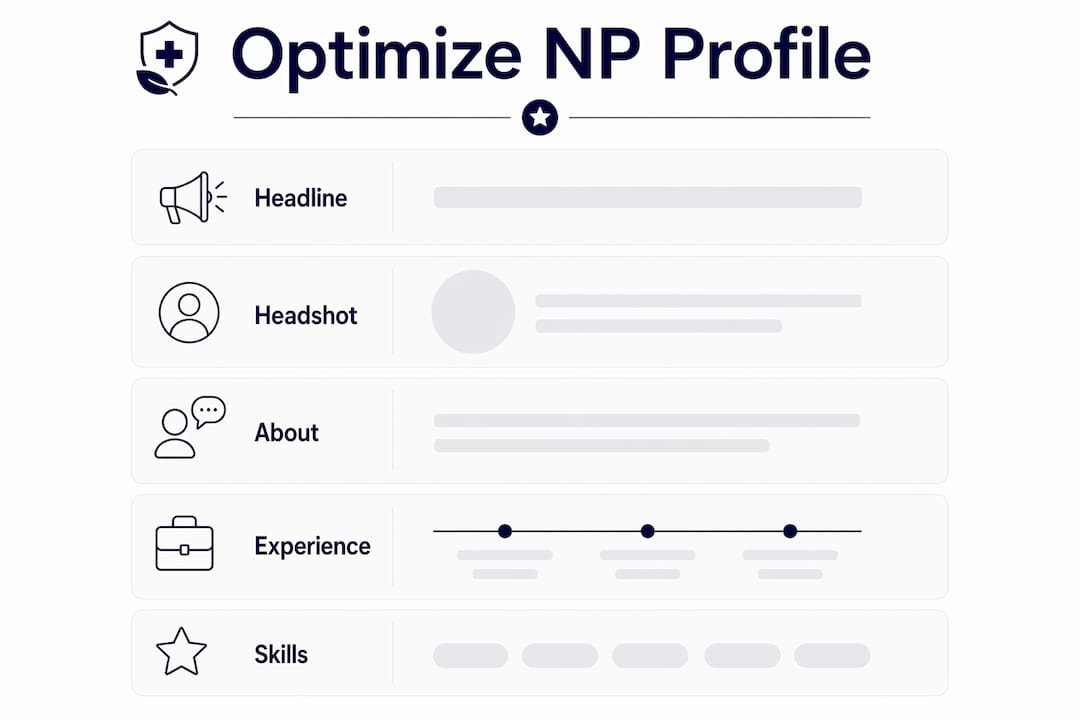
The table below shows which profile fields carry the most weight for NP recruiter visibility.
| Profile Field | Recruiter Impact | Priority Level |
|---|---|---|
| Headline | Appears in every search result | Critical |
| Headshot | Drives click-through on profile card | Critical |
| Skills section | Powers recruiter filter matching | Critical |
| About section | Converts views into outreach | High |
| Experience entries | Validates clinical credibility | High |
| Recommendations | Builds social proof | Medium |
What common mistakes should NPs avoid when building their online profiles?
Most NP profiles fail for the same six reasons. Recognizing them is faster than rebuilding from scratch.
- Vague headlines. "Nurse Practitioner" with no specialty or value statement tells a recruiter nothing. You disappear in a search result with 500 identical titles.
- Empty or incomplete skills sections. Recruiters use structured filters. If your skills field is blank or has fewer than 10 entries, you are invisible to automated searches.
- A résumé-style About section. Listing job titles and dates in the About section wastes the only narrative space on your profile. Write a pitch, not a timeline.
- Inconsistent branding. A casual photo paired with a clinical headline creates confusion. Visual and textual consistency converts profile views into recruiter outreach. Inconsistency does the opposite.
- No updates or engagement. A profile last updated in 2022 signals inactivity. Recruiters notice timestamps. So do AI search tools.
- Ignoring AI visibility. Personal branding in 2026 must be legible across AI assistants, not just Google. Consistent entity mentions across platforms, publications, and your profile increase the chance that AI tools surface your name in relevant searches.
"Your LinkedIn profile is a landing page, not a résumé. Every field either earns a recruiter's attention or loses it. The NPs who treat their profile as a living document, not a one-time task, are the ones who receive calls they did not apply for."
The fix for most of these mistakes takes under two hours. The cost of ignoring them is measured in missed opportunities.
How do strategic content and engagement boost an NP's online profile visibility?
Posting content is not optional if you want sustained visibility. A complete profile gets you found. Consistent content keeps you visible.
- Post five times per week. Consistent posting for 90 days increases engagement 3.5 times and compounds into significantly more inbound opportunities. Start with three posts per week if five feels like too much, then build up.
- Lead with insight, not announcements. "I started a new role at X" gets low engagement. "Here is what I learned managing 400 patients with uncontrolled hypertension in six months" gets shared. Clinical insight posts perform best for NPs.
- End every post with a question. Questions invite comments. Comments expand your reach to the commenter's network. A single well-placed question can triple a post's visibility.
- Engage with others' content deliberately. Leave substantive comments, not just reactions. A three-sentence comment that adds a clinical perspective builds your reputation faster than 50 likes.
- Track your metrics monthly. Monitor profile views, search appearances, and connection request volume. If numbers plateau after 30 days, adjust your content topics or posting time. Expect meaningful results after 90 days of consistent effort.
Nurse practitioners who use skills-based job matching platforms alongside active content strategies see faster results. A strong profile attracts inbound interest. A strong profile paired with active engagement accelerates it.
Key Takeaways
Building a strong NP professional profile online requires optimizing your headline, headshot, About section, experience entries, and skills field, then sustaining visibility through consistent content and engagement over at least 90 days.
| Point | Details |
|---|---|
| Headline formula matters | Use Role, Key Skills, and Unique Impact to appear in recruiter searches. |
| Headshots drive clicks | A professional photo increases profile views up to 14 times over no photo. |
| Skills field is a filter | Missing key clinical skills removes you from recruiter search results entirely. |
| Content builds visibility | Posting five times per week for 90 days compounds engagement and inbound leads. |
| Consistency signals credibility | Matching headshot, banner, and headline reduce recruiter hesitation and increase outreach. |
What I have learned from watching NPs build their profiles
The biggest mistake I see is waiting for the profile to be perfect before publishing it. NPs spend weeks drafting their About section and never post it. Meanwhile, a colleague with a rougher profile but a published headshot and a filled-in skills section is getting recruiter messages every week.
Start with the headline and headshot. Those two fields alone move you from invisible to findable. Then improve the rest in iterations. A profile that is 70% complete and live outperforms a perfect profile that sits in draft mode.
The second thing I have noticed is that clinical expertise does not automatically translate into online messaging. An NP who is exceptional at managing complex cardiac patients may describe themselves online as "experienced in cardiology." That phrase means nothing to a recruiter filter. "Heart Failure Management | LVAD Coordination | Reducing 30-Day Readmissions" means everything. Aligning your clinical language with recruiter search language is the single highest-return edit you can make.
Technology makes this faster than it used to be. AI tools identify gaps, suggest keywords, and generate draft copy in minutes. Use them. The NPs who advance their roles fastest are not the ones who avoid technology. They are the ones who use it to spend less time on setup and more time on patient care.
— Flexible
Your next step with Flexiblenursingcareers
Flexiblenursingcareers connects nurse practitioners with flexible, skills-matched job opportunities without the friction of traditional hiring. Once your profile is optimized, the next step is putting it in front of the right employers.

Flexiblenursingcareers uses real-time job matching based on your skills, availability, and specialty. That means your profile works for you the moment it is complete. Browse open nursing positions matched to your clinical background, or explore telehealth opportunities if remote practice fits your schedule. Sign up, complete your profile, and let the platform connect you with employers who are actively hiring for your exact skill set.
FAQ
How long does it take to build a strong NP profile online?
AI-assisted profile tools reduce setup to 20–60 minutes for the core fields. Full optimization, including recommendations and content strategy, takes two to four weeks of consistent effort.
What is the most important field on a LinkedIn profile for NPs?
The headline is the highest-impact field because it appears in every recruiter search result. Use the Role | Key Skills | Unique Impact formula to maximize visibility.
How often should nurse practitioners post on LinkedIn?
Posting five times per week for at least 90 days produces the strongest results. Clinical insight posts with a closing question generate the most engagement for NPs.
Do recruiter filters use the skills section to find candidates?
Yes. Recruiters filter by structured skills fields, and a missing skill removes you from search results entirely. List at least 20 skills using exact phrases from target job postings.
Does a professional headshot really make a difference?
A professional headshot increases profile views up to 14 times compared to no photo. It is the fastest single improvement you can make to your profile's click-through rate.