
Skills-based job matching is defined as the process of pairing job seekers with employment opportunities based on their demonstrated competencies and transferable skills rather than job titles or formal credentials. The industry term for this practice is "skills-based hiring," and it is reshaping how healthcare workers find flexible roles that fit their actual expertise and availability. 55% of business leaders have already adopted skills-based talent models, with another 23% planning to follow within 12 months. For nurses and healthcare professionals, this shift opens doors to flexible, well-matched positions that a traditional resume review would never surface.
What is skills-based job matching and how does it work in healthcare?
Skills-based job matching uses AI algorithms, competency frameworks, and structured skills data to connect healthcare workers with roles that fit what they can actually do. Instead of filtering candidates by job title or years in a specific role, the system evaluates your clinical competencies, certifications, soft skills, and availability against what an employer genuinely needs. The result is a match built on substance, not labels.

The technology behind this process relies on two core components. First, AI and large language models analyze your skills profile and cross-reference it against job requirements with up to 87% matching accuracy. That level of precision means fewer mismatched placements and faster hiring decisions for both sides. Second, structured competency frameworks like O*NET and ESCO provide the shared vocabulary that makes cross-role matching possible. Knowledge graphs like O*NET enable inference of transferable skills across healthcare roles, so your experience as a telemetry nurse, for example, can surface matches in cardiac step-down units or remote patient monitoring roles you may not have considered.
Here is what the matching process typically evaluates for healthcare workers:
- Core skills: Your primary clinical competencies, such as IV insertion, wound care, or medication administration
- Adjacent skills: Related capabilities you have developed, like patient education, electronic health record documentation, or triage protocols
- Growth skills: Areas where you show potential or are actively developing, such as telehealth delivery or care coordination
- Availability and scheduling preferences: Shift types, days, travel radius, and contract length preferences
- Credentials and licenses: Active RN license, BLS/ACLS certifications, and specialty credentials uploaded as verified documents
Availability is not a secondary factor in healthcare job matching. Platforms built for flexible healthcare work factor your schedule directly into the algorithm, so you only see roles you can realistically take. Learn more about how availability shapes nurse matching and why it matters as much as your clinical skills.
Pro Tip: When building your skills profile, add context to each skill. Instead of listing "wound care," write "wound care for post-surgical patients in a 40-bed acute care unit." AI systems link competencies to job requirements more accurately when you describe the setting and scope, not just the skill name.
What are the benefits of skills-based matching for healthcare workers?
The most direct benefit is a larger pool of job opportunities. Skills-based matching expands the candidate pool by 6x for general roles and 8.2x for specialized roles compared to title-based searches. That same math works in reverse for job seekers: your profile becomes visible to far more employers when the system evaluates what you can do rather than what your last job was called.
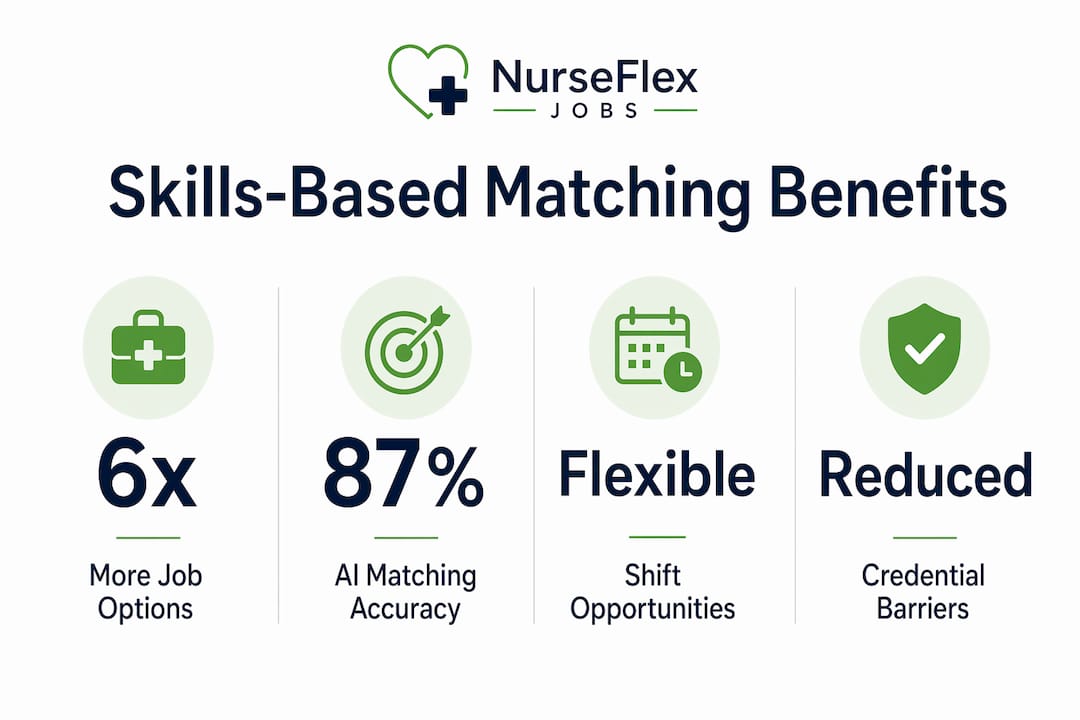
Beyond volume, the quality of matches improves significantly. Skills-based hiring predicts job performance more accurately than credential screening alone, which means you are more likely to land in a role where you will thrive and stay. For healthcare employers dealing with chronic turnover, that alignment reduces costly rehiring cycles. For you, it means less time adjusting to a poor fit and more time doing the clinical work you are trained for.
Here are the four most concrete benefits for healthcare job seekers in 2026:
- Reduced credential barriers. Skills-based hiring deprioritizes degree requirements, which matters for LPNs, medical assistants, and allied health professionals who hold deep practical expertise without advanced degrees.
- Flexible role access. Skills-based hiring shifts focus from past roles to future potential, making it easier to pivot into telehealth, home care, or per-diem work based on transferable competencies.
- Faster placement. When your skills profile is complete and verified, AI matching systems can surface relevant opportunities in real time rather than waiting for a recruiter to manually review your resume.
- Greater schedule control. Platforms that integrate availability into the matching algorithm only show you roles that fit your life, not just your license.
Pro Tip: Use healthcare-specific staffing platforms rather than general job boards. Specialized platforms carry competency frameworks built for clinical roles, which means the matching logic understands the difference between ICU and PCU experience. Read why healthcare platforms outperform job boards for nurses specifically.
Challenges in adopting skills-based matching in healthcare hiring
Skills-based hiring is not uniformly applied across healthcare employers. Adoption varies widely, and many organizations use hybrid models that mix skills evaluation with legacy criteria like degree requirements or years of experience in a specific title. This means you may encounter employers who claim to use skills-based hiring but still filter heavily on credentials. Understanding this inconsistency helps you set realistic expectations and tailor your approach per employer.
The technology itself has real limitations. Competency taxonomies like O*NET are powerful but static. Healthcare roles evolve faster than any taxonomy can be updated, which is why interoperable data systems are required to realize the full benefits of skills-based hiring. Removing a degree requirement from a job posting without building the underlying data infrastructure to evaluate skills accurately does not produce better matches. It just removes a filter without replacing it with anything meaningful.
Watch out for these common pitfalls as a healthcare job seeker:
- Keyword stuffing your skills profile. Modern AI matching systems value semantic coherence. Listing every possible clinical term without context harms your matching accuracy because the algorithm cannot determine how you actually apply those skills.
- Undervaluing soft skills. Communication, patient advocacy, and care coordination are weighted competencies in healthcare matching systems, not afterthoughts.
- Leaving credentials unverified. Unverified licenses and certifications reduce your match score on platforms that weight verified data more heavily.
- Ignoring adjacent skills. If you have experience with telehealth tools, EHR systems like Epic or Cerner, or care management software, list them explicitly. These are high-demand adjacent skills in 2026.
Hybrid models combining taxonomies and ontologies are the direction the industry is moving, and platforms that invest in this infrastructure will produce more accurate matches over time. Choosing platforms that use this approach gives you a structural advantage.
How to build your skills profile for better job matching in healthcare
A strong skills profile is the foundation of effective job skills alignment. The goal is not to list every task you have ever performed. The goal is to give the matching algorithm enough structured, contextual information to accurately place you in roles where you will succeed.
Follow these steps to build a profile that performs well in skills-based systems:
- Inventory your skills in three categories. List your core clinical skills, your adjacent skills (related tools, workflows, and specialties), and your growth skills (areas you are developing or have exposure to). Jobs described by core, adjacent, and growth skills enable more precise matching with weighted scoring, and your profile should mirror that structure.
- Add context to every skill. State the setting, patient population, and scope for each competency. "Pediatric triage in a Level II trauma center" is more useful to an algorithm than "triage."
- Upload verified credentials. Active licenses, specialty certifications, and completed training modules should be uploaded as verified documents. Uploading credentials directly improves your placement speed on platforms that weight verified data.
- Set precise availability. Specify shift types, days of the week, travel distance, and contract preferences. The more specific you are, the more relevant your matches will be.
- Use concrete outcomes. Where possible, describe results. "Reduced patient call-back rate by managing post-discharge follow-up calls for 15 patients daily" tells the system more than "patient communication."
Here is a quick reference for structuring your skills data:
| Skill category | Example for a registered nurse |
|---|---|
| Core skills | IV insertion, medication administration, wound care, telemetry monitoring |
| Adjacent skills | Epic EHR documentation, patient education, discharge planning, ACLS certification |
| Growth skills | Telehealth triage, care coordination, remote patient monitoring |
| Availability | Day shifts, Monday through Friday, 30-mile radius, per-diem or contract |
| Verified credentials | Active RN license, BLS, ACLS, NIHSS certification |
The role of automation in job placement is growing in healthcare, and platforms that use AI-driven matching reward profiles that are structured, specific, and verified. A complete profile is not just good practice. It is the mechanism that gets you in front of the right employer faster.
Key takeaways
Skills-based job matching gives healthcare workers access to more and better-fit roles by replacing credential filters with competency evaluation, and the quality of your skills profile directly determines the quality of your matches.
| Point | Details |
|---|---|
| Definition matters | Skills-based matching evaluates competencies and availability, not job titles or degrees. |
| AI accuracy is high | Zero-shot AI tools achieve up to 87% matching accuracy when profiles are structured and contextual. |
| Profile structure drives results | Organizing skills into core, adjacent, and growth categories improves weighted match scoring. |
| Adoption is uneven | Many employers use hybrid models, so tailor your approach based on each platform's criteria. |
| Verified credentials accelerate placement | Uploading active licenses and certifications directly improves your match speed and visibility. |
Why skills-based matching is the most practical career tool nurses have right now
I have watched healthcare workers spend months applying to roles that were technically a match on paper but completely wrong in practice. The job title said "RN," the candidate had the license, and the placement still failed because nobody asked the right questions about what the nurse actually did every day or what kind of schedule they could sustain.
Skills-based matching fixes that problem at the structural level. It forces both sides of the hiring equation to get specific. When a platform asks you to describe your wound care experience in context, or to verify your ACLS certification, it is not bureaucracy. It is the system doing the work that a rushed recruiter cannot.
What I find most compelling about this model for healthcare workers in 2026 is the pivot potential. A nurse with five years in a surgical unit has transferable competencies that map directly to home health, ambulatory care, and telehealth roles. Traditional hiring would never surface those connections because the job titles do not match. Skills-based systems see through the title to the actual capability, and that changes what is possible for your career.
The honest challenge is that not every platform does this well. Some use the language of skills-based hiring without the underlying infrastructure to back it up. The ones worth your time are built specifically for healthcare, integrate availability into the algorithm, and use verified credential data rather than self-reported keywords. Those platforms are not common, but they exist, and they are worth finding.
The future of healthcare staffing is a labor market where your skills, not your last employer's job title, define what you qualify for. That is a better system for workers who are good at what they do and want the flexibility to prove it.
— Flexible
Find flexible healthcare jobs matched to your skills on Flexiblenursingcareers
Flexiblenursingcareers connects nurses and healthcare professionals with flexible job opportunities matched to their actual clinical skills, credentials, and availability. The platform uses real-time, AI-driven matching to surface roles that fit your schedule and expertise without lengthy application processes.

Sign up, build your skills profile, and upload your credentials to get matched with per-diem, contract, and flexible shifts in your area. Flexiblenursingcareers is built specifically for healthcare workers who want roles that work around their lives, not the other way around. Sign in or create your profile to start matching with healthcare employers today.
FAQ
What is skills-based job matching?
Skills-based job matching is the process of connecting job seekers with employment opportunities based on their demonstrated competencies, transferable skills, and availability rather than job titles or formal degrees. AI algorithms and competency frameworks like O*NET power the matching logic.
How accurate is AI-based skills matching for healthcare jobs?
Zero-shot AI matching tools achieve up to 87% accuracy when matching resumes to job postings, according to a 2025 study. Accuracy improves further when candidates provide structured, context-rich skills profiles rather than keyword-heavy resumes.
What skills should nurses include in a skills-based profile?
Nurses should include core clinical skills (wound care, medication administration), adjacent skills (Epic EHR, patient education, discharge planning), and growth skills (telehealth, care coordination). Verified credentials like an active RN license and ACLS certification should also be uploaded directly to the platform.
Does skills-based hiring eliminate degree requirements in healthcare?
Skills-based hiring reduces reliance on degree requirements by evaluating competencies directly, but it does not eliminate licensure requirements for regulated roles. LPNs, medical assistants, and allied health professionals benefit most from reduced credential barriers in non-licensed support roles.
How does availability factor into healthcare job matching?
Platforms built for flexible healthcare work integrate your shift preferences, days of availability, travel radius, and contract type directly into the matching algorithm. This means you only receive matches for roles you can realistically accept, which reduces time-to-placement for both you and the employer.