
A complete healthcare profile is the single most direct factor separating candidates who get placed in days from those who wait weeks. Structured credential input, automated verification, and real-time job matching now define efficient healthcare recruitment. Healthcare organizations using AI-integrated platforms reduce time-to-hire by 40–50% compared to traditional workflows. That gap is not a minor efficiency gain. It represents the difference between filling a critical shift and leaving a unit understaffed. Flexiblenursingcareers is built around this reality, connecting healthcare professionals to placements through technology that rewards preparation and speed.
What does it take to complete your healthcare profile faster for hires?
The industry term for this process is "candidate profile optimization," and it covers every structured data point a hiring platform needs to verify, rank, and place you without manual delays. The goal is to give automated systems exactly what they need upfront so they never have to pause and ask.
Credential verification is the biggest screening bottleneck for 75% of healthcare organizations. That statistic explains why most hiring delays happen before a recruiter ever reads your name. The fix is not working harder. It is submitting the right data in the right format from the start.

Required credentials and verification sources
Your profile must include the following structured data points to clear automated screening:
- Active nursing or clinical license with license number, issuing state board, and expiration date
- BLS and ACLS certifications with issuing body (American Heart Association or American Red Cross) and expiration date
- DEA registration number (required for prescribing roles)
- Specialty certifications such as CCRN, CEN, or CNOR with credentialing body and dates
- Malpractice history disclosure status
- Shift availability by day, time block, and facility type preference
| Credential | Verification Source |
|---|---|
| State nursing license | State Board of Nursing database |
| BLS/ACLS certification | American Heart Association registry |
| DEA registration | DEA Diversion Control Division |
| Specialty certification | ANCC, BCEN, or CNOR credentialing bodies |
| Employment history | Direct employer contact or third-party background check |
AI-powered platforms verify licenses and DEA registration against primary sources in real time. Manual checks that once took days now take minutes. Candidates who input structured data bypass manual screening queues entirely and move directly to recruiter review.
Pro Tip: Format every expiration date as MM/DD/YYYY. Inconsistent date formats are one of the most common causes of automated verification failures.
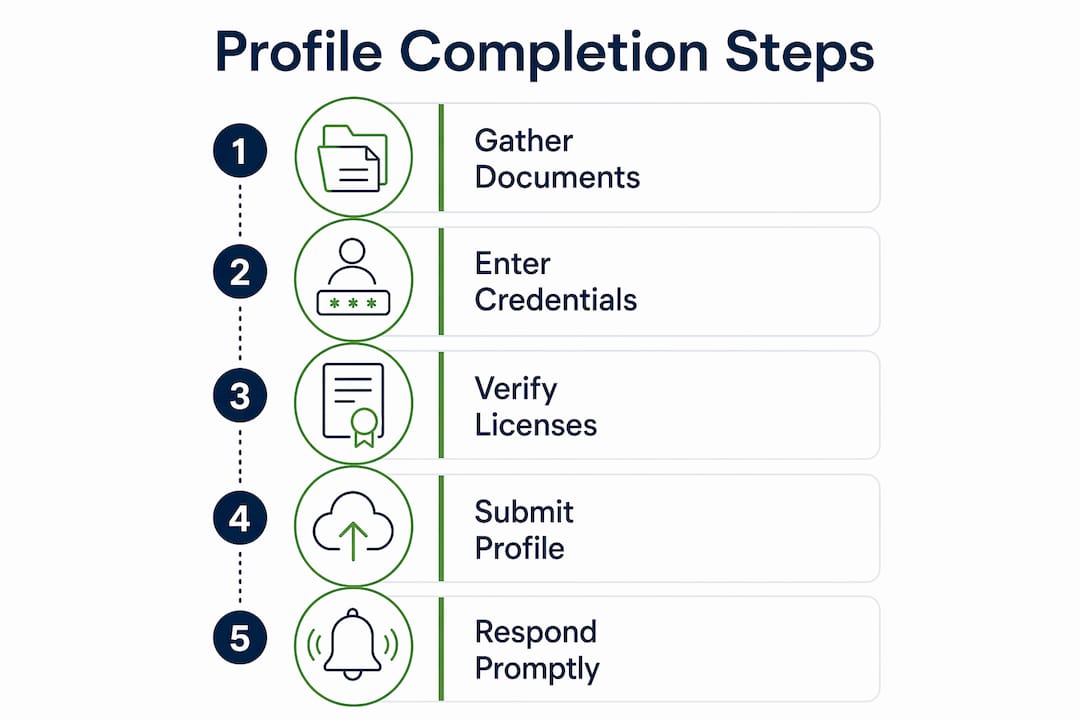
How to complete your healthcare profile step by step for faster job placement
Speed comes from preparation, not rushing. Follow these steps in order and you will move through the hiring pipeline faster than candidates who submit unstructured resumes.
-
Gather all license and certification documents before you start. Pull your state license number, certification cards, and DEA registration into one folder. Incomplete submissions force platforms to flag your profile for manual review, which adds days to your timeline.
-
Input credentials as structured data, not as a resume upload. Structured data input of license numbers and specialty experience bypasses manual screening queues. Fill every labeled field. Do not paste a resume into a text box and expect the system to extract the right information.
-
Upload supporting documents in accepted formats. Most platforms accept PDF and JPEG. Avoid Word documents or photos with poor lighting. Unreadable documents trigger manual review requests that delay your placement.
-
Complete the shift availability section in full detail. Specify days, time blocks (day, evening, night), and facility types you will accept. Platforms use this data to match you to open roles in real time. Vague availability means fewer matches and slower placement.
-
Activate scheduling automation and respond immediately. Candidates who respond to automated scheduling links within 1–2 hours are prioritized for the fastest interview slots. Treat every scheduling notification as time-sensitive.
-
Review your profile for completeness before submitting. Most platforms display a profile completion percentage. Do not submit below 100%. Incomplete profiles rank lower in automated candidate queues.
Pro Tip: Set your phone notifications to alert you immediately for any platform message. Time-to-engagement is tracked by hiring platforms and directly influences where you appear in the interview queue.
The role of automation in job placement is not to replace your judgment. It is to remove every delay that does not require human judgment. Your job is to feed the system clean, complete data so it can do its work.
What common mistakes delay healthcare profile completion and hiring?
Most hiring delays trace back to a small set of avoidable errors. Knowing them in advance puts you ahead of the majority of applicants.
68% of nursing candidates drop off mid-application when the process takes more than 20 minutes. That figure shows how quickly friction kills momentum. The candidates who finish are the ones who prepared their documents before opening the application.
The most damaging mistakes fall into four categories:
- Expired or missing credentials. An expired BLS card or unlisted specialty certification stops automated verification cold. Check every expiration date before you start.
- Unstructured resume submissions. Pasting a resume into a free-text field forces a recruiter to manually extract your data. That adds days and drops your ranking in automated queues.
- Slow response to follow-up communications. 62% of candidates expect a response within 72 hours, and platforms track your response speed in the other direction too. Slow replies push you down the priority list.
- Generic profiles not tailored to specific roles. A profile built for any job fits no job well. Adjust your specialty emphasis and availability details to match the specific role you are targeting.
| Common error | Impact on hiring timeline | Corrective action |
|---|---|---|
| Expired certification | Blocks automated verification | Renew before applying; upload new certificate immediately |
| Unstructured resume upload | Triggers manual review queue | Use structured input fields for every credential |
| Slow scheduling response | Loses priority interview slot | Enable push notifications; respond within 2 hours |
| Vague shift availability | Reduces job match volume | Specify days, shifts, and facility types in full |
| Missing DEA registration | Disqualifies prescribing roles | Add DEA number and expiration date upfront |
The streamlined hiring process in healthcare depends on candidates holding up their end of the workflow. Every error you avoid is a day you save.
How do AI and automation technologies speed up healthcare hiring?
AI does not just speed up hiring. It restructures the entire workflow so that multiple steps happen at the same time instead of one after another. AI screening enables parallel processing of credential verification and interview scheduling simultaneously. That parallel approach is what produces the 40–50% time-to-hire reduction.
Here is how each layer of automation works in practice:
- Structured data collection. AI platforms pull license numbers, certification data, and availability directly from labeled fields. No human reads your resume first.
- Real-time credential verification. The platform checks your license against the State Board of Nursing database and your BLS certification against the American Heart Association registry within seconds.
- Automated candidate ranking. Hiring managers see a prioritized queue of candidates ranked by experience, licenses, and role fit. Candidates with accurate, complete profiles rank at the top.
- Scheduling automation. The system sends you a scheduling link the moment your credentials clear. No back-and-forth emails. No waiting for a recruiter to find an open calendar slot.
- Asynchronous video screening. Asynchronous video screening reduces screening times from weeks to days by letting multiple stakeholders review your responses on demand. You record once; the hiring team reviews when they are ready.
Top healthcare candidates use technology plus responsiveness to move faster than their peers. The technology handles verification. Your responsiveness handles everything else.
Pro Tip: For asynchronous video screens, record in a quiet room with a neutral background and strong lighting. Hiring managers review dozens of recordings. Clear audio and a professional setting signal preparation before you say a word.
The role of technology in hospital hiring has shifted from administrative support to the primary driver of placement speed. Candidates who understand this shift prepare differently and place faster.
Key Takeaways
A complete, structured healthcare profile is the fastest path to placement because it removes every manual delay from the verification and ranking process.
| Point | Details |
|---|---|
| Structured data beats resumes | Input credentials into labeled fields to bypass manual screening queues and rank higher automatically. |
| Credential accuracy is non-negotiable | Expired or missing licenses block automated verification and add days to your timeline. |
| Response speed affects ranking | Platforms track time-to-engagement; responding to scheduling links within 2 hours secures priority slots. |
| AI runs parallel workflows | Credential verification and interview scheduling happen simultaneously, cutting time-to-hire by 40–50%. |
| Profile completeness drives matches | A 100% complete profile with detailed availability generates more real-time job matches than a partial one. |
What I have learned from watching candidates win and lose on speed
The candidates I see placed fastest are not always the most experienced. They are the most prepared. They walk into the application with every document ready, every field filled, and their phone notifications turned on. The candidates who wait weeks are often equally qualified. They just submitted incomplete profiles and responded to scheduling requests a day later than the candidates who got the slot.
The part most healthcare professionals underestimate is how much the platform itself is evaluating them before a recruiter ever looks at their name. Time-to-engagement is a real metric. Platforms track how quickly you respond and use that data to rank you. A candidate who responds to a scheduling link in 90 minutes signals reliability. A candidate who responds in 36 hours signals risk. Facilities filling urgent shifts cannot afford risk.
The shift to asynchronous video screening has changed the game in a way that favors prepared candidates. You now have the chance to present yourself on your own time, in a controlled environment, without the pressure of a live call. That is an advantage. Treat it like one. Prepare your setting, practice your answers, and record when you are at your best.
My honest advice: spend 30 minutes gathering every credential before you open a single application. That 30 minutes of preparation will save you days of waiting.
— Flexible
How Flexiblenursingcareers helps you get placed faster
Flexiblenursingcareers is built for healthcare professionals who want to move quickly from profile to placement.

The platform uses structured profile tools that guide you through every required credential field, so you never miss a data point that would slow down verification. Automated job matching connects your completed profile to open roles in real time, based on your licenses, specialties, and availability. Interview scheduling runs without back-and-forth coordination. You get a link, you pick a time, and you move forward. Browse current nursing jobs on Flexiblenursingcareers to see how fast a complete profile can get you placed. Healthcare facilities looking to fill roles quickly can also visit the employers page to start reviewing verified candidates today.
FAQ
What does a complete healthcare profile include?
A complete healthcare profile includes your active license number, all current certifications with expiration dates, DEA registration if applicable, specialty experience, employment history, and detailed shift availability. Every field must be filled with structured data, not free-text resume content.
How much faster does a complete profile get you hired?
Healthcare organizations using AI-integrated recruiting platforms reduce time-to-hire by 40–50% compared to traditional workflows. A complete, structured profile is the primary factor that activates those automated workflows.
Why do incomplete profiles slow down the hiring process?
Incomplete or unstructured profiles trigger manual review by a recruiter, which removes you from the automated fast track. Credential verification is the biggest screening bottleneck for 75% of healthcare organizations, and missing data is the most common cause.
How quickly should I respond to scheduling requests?
Respond within 1–2 hours. Platforms track response speed and prioritize candidates who engage quickly for the fastest interview slots. Waiting longer than a few hours can cost you a placement to a candidate who responded first.
Does asynchronous video screening replace live interviews?
Asynchronous video screening replaces the initial phone screen in most cases, not the final interview. It reduces screening times from weeks to days by letting hiring teams review your recorded responses on demand, which accelerates the overall process.