
The role of technology in hospital hiring is to replace slow, manual recruitment workflows with AI-driven screening, automated scheduling, and predictive workforce planning. Healthcare talent acquisition, the formal term for this discipline, has shifted from reactive job posting to proactive pipeline management. Hospitals using AI recruiting agents now reduce average nursing role time-to-fill from 78 days to under 20 days. That gap represents weeks of unfilled shifts, overtime costs, and agency spend. For HR professionals and administrators, understanding which digital tools for hospital staffing deliver real results is no longer optional.
How does the role of technology in hospital hiring reduce time-to-fill?
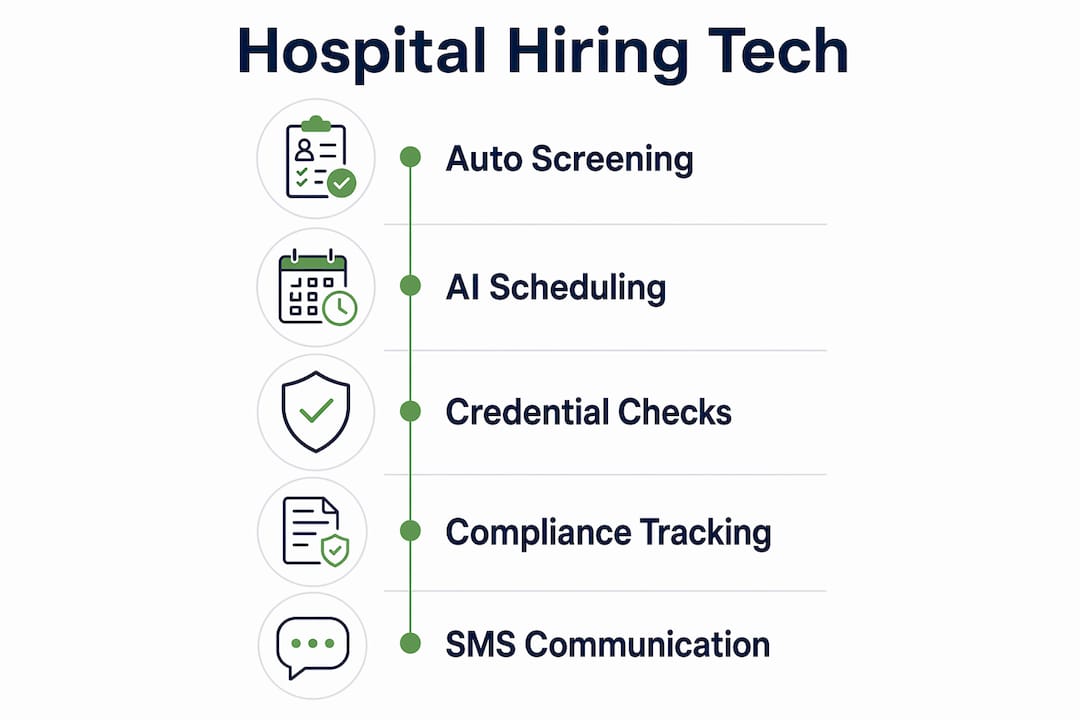
AI and automation cut time-to-fill by handling the tasks that consume the most recruiter hours. Screening, scheduling, and candidate follow-up are all repeatable, high-volume activities that AI manages faster and more consistently than any human team.
AI-powered interview platforms cut screening time by 60% and speed overall time-to-hire by 70%. That means a process that once took two months now closes in under three weeks. For a busy hospital HR team managing multiple open roles simultaneously, that compression changes everything.

AI-based screening tools handle 200–400 applications for a single RN role within 72 hours and produce a shortlist within 24 hours. Compare that to a recruiter manually reviewing the same stack over several days. The shortlist quality also improves because AI applies consistent criteria every time, without fatigue or bias drift.
The shift in recruiter responsibilities is equally significant. AI systems manage volume-intensive tasks so recruiters focus on evaluating candidates rather than filtering them. This is the core value of automation in hospital recruitment: it moves human judgment to where it actually matters.
- AI screens applications around the clock, not just during business hours
- Scheduling coordination happens automatically, eliminating back-and-forth emails
- Candidate follow-up messages go out on time, every time, without manual reminders
- Recruiters receive ranked shortlists, not raw application piles
Pro Tip: Integrate your AI recruiting platform directly with your existing HRIS, such as Workday or Oracle HCM, before launch. Disconnected systems create duplicate data entry and slow down the very workflows you are trying to accelerate.
What technology features matter most for healthcare compliance and credentialing?
Generic applicant tracking systems (ATS) fail healthcare organizations for one specific reason: they were not built for clinical credential management. A standard ATS tracks application status. A healthcare-specialized platform tracks license expiration dates, Joint Commission requirements, and HIPAA-related documentation workflows.
Generic ATS platforms lack clinical credential handling and compliance workflows that frontline healthcare hiring demands. Hospitals that use non-specialized tools end up managing credentials manually in spreadsheets alongside their ATS, which creates gaps and audit risk. Healthcare-specific platforms embed credential flagging directly into the hiring workflow.
| Feature | Generic ATS | Healthcare-Specialized Platform |
|---|---|---|
| Credential verification | Manual, external process | Built-in license tracking and alerts |
| Compliance workflows | Not included | HIPAA and Joint Commission support |
| Candidate communication | Email-based portals | SMS-native messaging |
| Shortlist quality | Keyword matching | Clinical credential-driven ranking |
| Audit readiness | Limited | Automated documentation trails |
SMS-native communication is one of the most underrated features in healthcare recruiting technology. SMS-native systems achieve 89% application completion rates versus 52% with portal-based systems. Frontline clinical staff, including nurses and allied health workers, respond to text far more reliably than to email or login portals. That 37-point gap in completion rates directly affects how many qualified candidates actually finish applying.
One area where AI must not replace human judgment is license verification and clinical competency assessment. AI should be limited to high-volume, low-risk tasks like administrative screening and scheduling. Applying AI to compliance-heavy decisions introduces legal and patient safety risk that no efficiency gain justifies.
Pro Tip: When evaluating healthcare recruiting platforms, ask vendors specifically how their system handles license expiration alerts and what happens when a credential lapses mid-hire. The answer tells you immediately whether the platform was built for healthcare or retrofitted for it.
How does technology reduce reliance on costly contingent staff?
The most expensive staffing problem in hospital HR is not a slow hiring process. It is a reactive one. When hospitals hire only in response to vacancies, they fill gaps with travel nurses and locum tenens staff at premium rates. Technology shifts that pattern by enabling proactive workforce planning.
The goal of a modern healthcare recruiting tech stack is cost optimization through better workforce forecasting and staffing balance, not just faster hiring. AI predictive analytics analyze historical turnover data, seasonal demand patterns, and department-level vacancy trends to flag shortfalls before they become crises. A hospital that knows three ICU nurses will likely leave in Q3 can begin sourcing in Q1.
- Predictive analytics identify high-turnover roles and departments before vacancies open
- AI-driven role matching surfaces internal candidates for lateral moves, reducing external hiring costs
- Proactive pipeline building keeps warm candidate pools ready for fast activation
- Reduced emergency hiring lowers dependence on agency and travel nurse contracts
- Better staffing balance cuts overtime costs by filling permanent roles faster
Technology also changes how hospitals use contingent staff. Rather than defaulting to agency nurses for any gap, data-driven sourcing lets HR teams reduce agency spend by maintaining a healthier ratio of permanent to contingent staff. The result is a more stable workforce and a lower cost per hire over time. Platforms like those described in guides on replacing agency staffing show how digital tools make that shift practical.
How do AI sourcing tools find passive healthcare candidates?
Most nurses and allied health professionals are not actively searching job boards. They are working. That means traditional sourcing on platforms like LinkedIn misses the majority of the available talent pool, particularly for specialized clinical roles.
The core limitation of keyword-based sourcing is that it finds candidates who describe themselves using the same words recruiters use. Clinical professionals often list credentials, certifications, and specialties in formats that keyword searches miss entirely. A search for "ICU RN" may skip a candidate whose profile lists "CCRN, Medical-Surgical Intensive Care."
AI sourcing tools solve this by reading credentials semantically. AI searches 800 million or more profiles across multiple data sources to find passive candidates based on clinical meaning, not just matching words. That reach extends well beyond LinkedIn to professional associations, licensing databases, and public clinical registries.
- Semantic credential matching reads clinical qualifications the way a nurse manager would, not the way a search engine does
- Multi-source aggregation pulls candidate data from licensing boards, professional networks, and clinical databases simultaneously
- Passive candidate identification surfaces nurses and allied health staff who are not actively applying but may be open to the right opportunity
- Personalized outreach uses candidate-specific data to send relevant messages rather than generic job alerts
- Credential-driven ranking scores candidates by clinical fit before a recruiter ever opens a profile
For sourcing passive healthcare candidates, this approach finds talent that traditional job board posting simply cannot reach. The quality of the resulting shortlist improves because matches are based on actual clinical qualifications rather than self-reported keywords.
Key Takeaways
Technology in hospital hiring works because AI handles volume and speed while human recruiters focus on judgment, compliance, and candidate relationships.
| Point | Details |
|---|---|
| AI cuts time-to-fill dramatically | AI recruiting agents reduce nursing role fill time from 78 days to under 20 days. |
| SMS beats portals for clinical staff | SMS-native systems achieve 89% completion rates versus 52% with portal-based tools. |
| Healthcare-specific platforms outperform generic ATS | Only specialized platforms handle credential tracking, license alerts, and compliance workflows. |
| Parallel processing saves weeks | Running credential verification alongside interviews cuts 1–3 weeks from total hiring time. |
| Proactive sourcing reduces agency costs | AI workforce forecasting lets hospitals build pipelines before vacancies open, lowering contingent staff spend. |
What I have learned from watching hospital HR teams adopt recruiting technology
The hospitals that get the most from recruiting technology are not the ones with the biggest budgets. They are the ones that change their process before they change their tools. I have seen well-funded health systems buy enterprise AI platforms and still fill roles slowly because their internal approval workflows were never updated to match the new speed.
The most common mistake is treating technology as a replacement for process design. AI can screen 400 applications in 72 hours. But if the hiring manager still takes two weeks to review the shortlist, the time savings disappear. The technology exposes bottlenecks it cannot fix on its own.
One practice that consistently shortens hiring timelines is running credential verification and preboarding in parallel with interviews rather than sequentially. This alone cuts 1–3 weeks from the total process. Most hospitals still do these steps in sequence out of habit, not necessity.
The other shift worth making is in how recruiters think about their role. AI in healthcare hiring acts as a hybrid intelligence layer, automating administrative tasks while supporting human decision-making. Recruiters who embrace that framing become more effective. Those who resist it spend their time competing with software at tasks the software will always win.
— Flexible
Find qualified healthcare staff faster with Flexiblenursingcareers
Flexiblenursingcareers connects hospital HR teams with pre-screened nursing and allied health professionals through a technology-driven platform built specifically for healthcare staffing. Real-time job matching pairs your open roles with candidates based on clinical credentials, availability, and location, without lengthy application cycles.

The platform handles high-volume sourcing and initial matching automatically, so your recruiters spend time on evaluation and onboarding rather than screening. Credential tracking and compliance support are built in, not bolted on. If your hospital is ready to reduce time-to-fill and lower agency spend, sign in or create your account at Flexiblenursingcareers and start matching with qualified candidates today.
FAQ
How does AI reduce time-to-fill for nursing roles?
AI recruiting agents reduce average nursing role time-to-fill from 78 days to under 20 days by automating screening, scheduling, and candidate communication. The result is a faster hiring cycle without sacrificing shortlist quality.
What is the difference between a generic ATS and a healthcare recruiting platform?
A generic ATS tracks application status but lacks clinical credential handling and compliance workflows. Healthcare-specialized platforms include license expiration alerts, Joint Commission support, and SMS-native communication built for frontline clinical staff.
Why does SMS outperform email portals in healthcare recruiting?
SMS-native systems achieve 89% application completion rates compared to 52% with portal-based tools. Frontline clinical staff respond to text messages far more reliably than to email or login-required portals.
Can AI handle license verification and clinical competency assessments?
AI should not be used for license verification or clinical competency decisions. These are compliance-heavy tasks where errors carry legal and patient safety risk. AI performs best on high-volume, low-risk tasks like initial screening and scheduling coordination.
How does technology help hospitals reduce agency staffing costs?
AI workforce forecasting identifies likely vacancies before they open, allowing hospitals to build candidate pipelines proactively. That reduces emergency hiring and lowers dependence on costly travel nurses and locum tenens contracts over time.