
A digital staffing platform replacement is the process of swapping a traditional agency-dependent recruitment system for an AI-powered solution that automates candidate sourcing, shift scheduling, and compliance management. Healthcare administrators who make this switch report faster time-to-fill, lower premium labor costs, and less manual work for their teams. Platforms like skyHire, ShiftMed, and Teambridge represent the current generation of tools purpose-built for this transition. If you are looking to replace agency staffing digital platform tools that no longer serve your facility's pace or budget, this guide covers what to look for, how the top options compare, and how to execute the switch without disrupting operations.
What features should you look for in a digital staffing platform replacement?
The right replacement platform does more than post jobs. It handles the full recruiting and shift-fill cycle from first contact to payroll update, with minimal human intervention.
Here are the core capabilities worth evaluating:
- AI-powered candidate screening and scheduling. skyHire's AI agents screen, engage, and schedule applicants 24/7 without human input, which matters when your facility runs three shifts and applications arrive at 2 a.m.
- Open shift management with intelligent routing. ShiftMed embeds AI directly into scheduling systems to fill open shifts with internal or on-demand workers before escalating to premium labor channels. This single feature drives most of the cost savings.
- Automated outreach and compliance checks. The platform should send targeted messages, verify credentials, and confirm qualifications without a recruiter manually checking each step.
- Data migration and HR integration. Any replacement must connect to your existing scheduling and HR systems. Bi-directional data flow prevents the operational burden of maintaining two systems at once.
- Real-time analytics. You need dashboards showing time-to-fill, fill rates, and labor costs. Without these, you cannot tell whether the new platform is actually performing better than what you replaced.
Pro Tip: Ask every vendor for their median time-to-fill benchmark before signing. Teambridge sets a target of under 10 minutes for shift fills. If a vendor cannot give you a number, that tells you something.
The platforms that score highest on staffing platform comparison reviews are the ones that combine all five capabilities in a single system rather than requiring you to stitch together separate tools.
How does AI shift scheduling improve staffing efficiency?
AI shift scheduling replaces the most time-consuming part of healthcare staffing: the manual call-out workflow. Traditional processes require a supervisor to call candidates one by one, wait for responses, confirm availability, and then update payroll and scheduling records manually.

AI collapses this workflow from 30 to 90 minutes down to 2 to 10 minutes by sending parallel SMS offers to multiple qualified candidates simultaneously and processing confirmations automatically. That time reduction is not marginal. It means a charge nurse can handle a call-out at 5 a.m. without spending an hour on the phone before their shift starts.
| Workflow Step | Manual Process | AI-Automated Process |
|---|---|---|
| Candidate outreach | Sequential phone calls | Parallel SMS to all qualified candidates |
| Confirmation | Manual verbal confirmation | Automated digital confirmation |
| Payroll update | Manual data entry | Automatic system update |
| Total time | 30 to 90 minutes | 2 to 10 minutes |
| Compliance check | Recruiter reviews credentials | Constraint-based matching at point of offer |
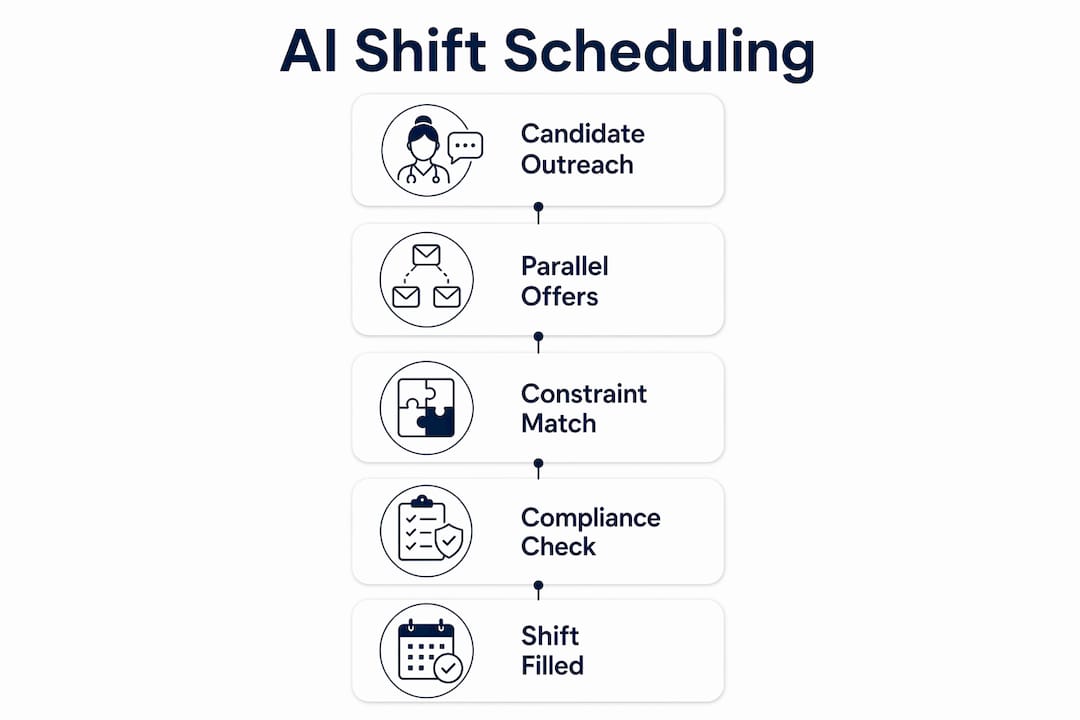
The compliance dimension matters as much as the speed. AI platforms use constraint-based matching to verify that a candidate holds the right license, has not exceeded hour limits, and meets unit-specific requirements before the offer goes out. Manual workflows rely on a tired supervisor remembering those rules at 5 a.m.
Bullhorn Amplify Digital Workers extend this logic to full-cycle recruiting. Their data shows 42% of candidate screens happen after hours, which means a platform that only works during business hours misses nearly half of all screening opportunities. Digital workers handle screening, outreach, matching, and submissions around the clock.
Pro Tip: Track your supervisor-free fill rate alongside time-to-fill. Teambridge recommends a supervisor-free fill rate above 90% as the real indicator that your AI platform is working. If supervisors are still manually intervening on most shifts, the automation is not configured correctly.
Comparing top digital platforms for replacing agency staffing in healthcare
Four platforms stand out in any honest staffing platform comparison for healthcare administrators in 2026.
skyHire is built as a full ATS replacement, not an add-on. It migrates your existing candidate data in days rather than months, which removes the biggest barrier most administrators cite when delaying a switch. The AI agents handle screening and scheduling continuously, and the system is designed specifically for healthcare and senior living environments where credential verification is non-negotiable.
ShiftMed focuses on open shift management at scale. In 2025, the platform filled 630,966 shifts and generated $189 million in labor savings by reducing premium labor spend. The structural labor premium gap in major U.S. markets runs $15 to $30 per hour, and ShiftMed's intelligent routing fills shifts internally before that gap ever gets triggered.
Juicebox takes a different approach with autonomous recruiting agents priced by active roles rather than per-seat licenses. The agents continuously refine candidate searches and draft outreach messages. Human recruiters approve and engage candidates, but the sourcing and initial contact happen without manual input. This model suits facilities that want to reduce recruiter workload without eliminating human judgment from the process.
Bullhorn Amplify targets staffing firms and larger health systems already using Bullhorn's ATS. Its Digital Workers automate high-volume tasks 24/7, and agencies using the platform achieved a 23% increase in weekly gross profit without adding headcount. That figure reflects what happens when recruiters stop spending time on administrative tasks and focus on relationship-building and closures instead.
The right choice depends on your primary pain point. If your problem is slow ATS and poor candidate experience, skyHire fits. If your problem is premium labor costs from unfilled shifts, ShiftMed is the more direct solution. If your problem is recruiter capacity, Bullhorn Amplify or Juicebox address that specifically.
How to switch staffing platforms without disrupting operations
Switching platforms fails most often because administrators underestimate the complexity of the transition, not the technology itself. A structured approach prevents the most common problems.
-
Audit your current workflows. Document every step in your current recruiting and shift-fill process. Identify where time is lost, where compliance errors occur, and where supervisors are manually intervening. This audit becomes your requirements list.
-
Define your non-negotiables. Credential verification, scheduling system integration, and payroll connectivity are typically non-negotiable for healthcare. Write these down before you talk to any vendor.
-
Evaluate platforms against your requirements. Use the feature list from Section 2 as your scorecard. Ask vendors for live demos using your actual use cases, not generic demos.
-
Plan data migration carefully. Rapid data migration is one of the most cited reasons healthcare teams choose skyHire specifically. Without structured stage and tag management during migration, recruiters face weeks of manual cleanup. Confirm with your vendor exactly what data transfers, in what format, and on what timeline.
-
Train staff before go-live. The platform will not perform if your team does not know how to use it. Focus training on the workflows that changed most, particularly shift-fill escalation rules and candidate communication settings.
-
Monitor metrics from day one. Set baseline measurements for time-to-fill, fill rate, and premium labor spend before switching. Compare weekly for the first 90 days. Understanding why healthcare workers use staffing platforms helps you set realistic performance benchmarks.
Pro Tip: Run the old and new systems in parallel for no more than two weeks. Longer than that, and your team will default to the familiar system. Set a hard cutover date and stick to it.
Common issues to watch during transition:
- Duplicate candidate records from incomplete data migration
- Escalation rules not configured to match your premium labor policy
- Staff reverting to manual call-out workflows out of habit
- Integration gaps between the new platform and your scheduling system
Common pitfalls when switching to a new digital staffing platform
Most platform transitions that underperform do so for predictable reasons. Knowing them in advance puts you ahead of the majority of administrators who discover them the hard way.
- Underestimating reactive shift coverage complexity. Filling a planned vacancy is straightforward. Filling a same-day call-out at 4 a.m. requires escalation logic, routing rules, and real-time notifications. Many platforms handle the former well and the latter poorly.
- Ignoring intelligent routing configuration. Automation in open shift management only saves money if the routing rules are set to exhaust internal and on-demand options before escalating to premium agency channels. If you skip this configuration step, the platform will route to agencies by default.
- Skipping constraint-aware matching setup. AI matching without properly configured compliance rules creates liability. A candidate who is offered a shift they are not licensed for is a compliance failure, not just an operational one.
- Neglecting staff training. The technology works. The people using it need time to trust it. Insufficient training is the most common reason fill rates do not improve in the first 60 days.
- Over-contacting top workers. AI platforms can send offers to the same high-availability workers repeatedly. Without frequency caps, you burn out your most reliable staff. Set contact limits per worker per week.
"The platforms that deliver the most value are the ones configured to match your specific escalation policy, not the ones with the longest feature list."
The role of automation in job placement is to remove friction, not to replace the judgment calls that protect your facility and your staff.
Key takeaways
Replacing a traditional agency staffing platform with an AI-powered digital solution reduces time-to-fill, cuts premium labor costs, and removes manual workflows that slow down healthcare recruitment.
| Point | Details |
|---|---|
| AI reduces shift-fill time | Automated parallel outreach cuts manual call-out workflows from 90 minutes to under 10 minutes. |
| Intelligent routing controls costs | Configuring escalation rules to exhaust internal options first prevents unnecessary premium agency spend. |
| Data migration speed matters | Platforms like skyHire that migrate in days prevent the dual-system burden that stalls transitions. |
| Metrics drive accountability | Track supervisor-free fill rate above 90% and median time-to-fill under 10 minutes as primary success indicators. |
| Training determines adoption | Staff who understand the new platform's escalation logic are the difference between a successful switch and a failed one. |
What I've learned from watching healthcare teams make this switch
The administrators who get the most out of a new digital staffing platform are not the ones who chose the most sophisticated tool. They are the ones who spent the most time on configuration before go-live.
I have seen facilities implement ShiftMed or skyHire and see minimal improvement in the first month, not because the platform failed but because the escalation rules were left at default settings. Default settings are built for average facilities. Your facility is not average. Your union rules, your credential mix, your shift patterns, and your premium labor thresholds are specific to you. Every routing rule needs to reflect that specificity.
The second thing I would tell any administrator is to stop measuring success by time-to-fill alone. Time-to-fill is a speed metric. What you actually care about is fill reliability and cost per filled shift. A platform that fills 95% of shifts in 15 minutes at standard pay rates beats one that fills 80% of shifts in 5 minutes but routes the remaining 20% to agency at a $25 per hour premium.
Pairing AI with human judgment, as research supports, is not a compromise. It is the correct architecture. AI handles volume, sequencing, and compliance checks. Humans handle relationship-building, exception cases, and the judgment calls that no algorithm should make alone. The facilities that treat these as competing approaches rather than complementary ones consistently underperform.
Finally, do not let vendor implementation timelines become your timeline. Push for rapid data migration. The longer you run two systems, the more your team hedges on the new one.
— Flexible
Start your digital staffing transition with Flexiblenursingcareers

Flexiblenursingcareers connects healthcare administrators with a technology-driven staffing platform built for real-time job matching based on skills, availability, and shift requirements. You can post open roles, review matched candidates, and fill shifts without the delays that come with traditional agency workflows. The platform is designed for healthcare professionals and the facilities that need them, with a sign-up process that gets you operational fast. If you are ready to move away from legacy agency tools and want a platform that works around your schedule, sign in or create your account at Flexiblenursingcareers and see how quickly your first shift fills.
FAQ
What does it mean to replace an agency staffing digital platform?
Replacing an agency staffing digital platform means switching from a traditional, agency-dependent recruitment system to an AI-powered tool that automates candidate sourcing, shift scheduling, and compliance management. The goal is faster fills, lower costs, and less manual work.
How long does it take to switch to a new digital staffing platform?
Implementation timelines vary by platform. skyHire completes data migration in days, not months, which is significantly faster than legacy ATS replacements. Most facilities reach full operational capacity within two to four weeks.
What metrics should I track after switching platforms?
Track median time-to-fill, supervisor-free fill rate, and premium labor spend as your three primary indicators. Teambridge recommends a supervisor-free fill rate above 90% and a median time-to-fill under 10 minutes as benchmarks for a well-configured AI platform.
Can AI staffing platforms handle compliance requirements for healthcare?
Yes. Platforms like skyHire and ShiftMed use constraint-based matching to verify credentials, license status, and hour limits before sending shift offers. This removes the compliance risk that comes with manual supervisor-driven workflows.
What is the biggest mistake administrators make when switching platforms?
The most common mistake is leaving escalation and routing rules at default settings. Intelligent routing configuration is what prevents open shifts from routing directly to premium agency channels, and it must be customized to your facility's specific labor cost thresholds and staffing policies.