
Why NP specialization matters in hiring decisions
Hiring a nurse practitioner without considering specialization is one of the most common and costly mistakes healthcare organizations make. The right specialty match connects clinical expertise directly to patient need, and that alignment shapes everything from care quality to how long an NP stays in the role.
NP specialization refers to the focused population focus an NP trains and certifies in, whether that is family health, psychiatric care, pediatrics, or acute adult care. Each specialty carries its own certification, scope of practice, and clinical competencies. Placing an NP outside that scope creates gaps in care and exposes your organization to compliance risk.
The workforce trend reinforces why this matters now. NP employment in specialty practices rose 35% between 2008 and 2016, and specialty practice hiring has continued accelerating since. While approximately 88% of NPs are certified in primary care, there is a growing trend of NPs moving into specialty practice, driven by higher compensation and increasing demand for complex clinical skills. The candidate pool for NP roles is therefore increasingly specialty-trained, and your hiring process needs to reflect that shift.Your candidate pool is increasingly specialty-trained, and your hiring process needs to reflect that.
Key reasons NP specialization drives better hiring outcomes:
- Patient outcomes improve when NPs practice within their certified population focus, applying targeted clinical skills rather than adapting general training to complex cases.
- Retention increases when NPs work in roles that match their specialty. Mismatched roles create frustration and early departure.
- Compliance risk drops when certification aligns with the practice setting, particularly in acute care and pediatric units.
- Team performance strengthens because specialty-matched NPs integrate faster with interdisciplinary teams who share the same clinical language.
- Recruitment becomes more targeted when your job descriptions specify the required specialty, attracting qualified candidates and filtering out poor fits early.
What are the main NP specialties and why do they matter for hiring?
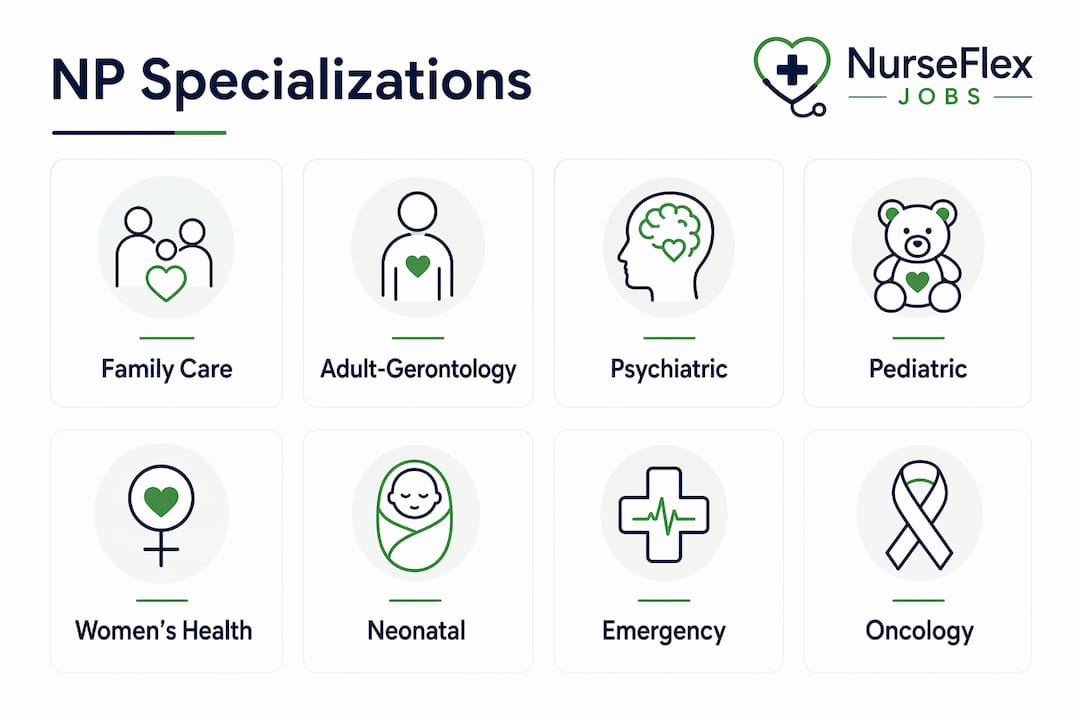
Understanding each specialty's clinical focus helps you write better job descriptions, ask sharper interview questions, and avoid mismatches before they happen. Here is a breakdown of the major NP specialties and their hiring relevance.
Family Nurse Practitioner (FNP): FNPs provide primary care across all age groups, from pediatric wellness visits to chronic disease management in older adults. They represent approximately 70% of new NP graduates, making them the most available specialty in the hiring market. That supply can be misleading, though. An FNP is not automatically the right fit for a specialty inpatient unit or a focused geriatric practice.

Adult-Gerontology Primary Care Nurse Practitioner (AGPCNP): AGPCNPs focus on adults and older adults in outpatient and community settings. With the U.S. population aging, demand for this specialty in primary care clinics and long-term care facilities is growing steadily.
Adult-Gerontology Acute Care Nurse Practitioner (AGACNP): AGACNPs manage complex, acutely ill adult patients in hospital settings, including ICUs and step-down units. This is a high-acuity role requiring specific acute care certification. Hiring an FNP for this role without that certification is a documented source of clinical misalignment.
Psychiatric-Mental Health Nurse Practitioner (PMHNP): PMHNPs diagnose and treat mental health conditions, prescribe psychiatric medications, and provide therapy. Demand for this specialty has surged with the national mental health crisis. In full-practice authority states, PMHNPs operate fully independently. In restricted states, they require physician collaboration, which directly affects how you structure the role.
Pediatric Nurse Practitioner (PNP): PNPs split into primary care (CPNP-PC) and acute care (CPNP-AC) tracks. If you are staffing a pediatric ICU, the acute care certification is the one that matters. Understanding pediatric NP specialization requirements before you post the role prevents a common and expensive hiring error.
Women's Health Nurse Practitioner (WHNP): WHNPs specialize in reproductive health, prenatal care, and gynecological services. They are a strong fit for OB/GYN practices, women's health clinics, and family planning centers.
Neonatal Nurse Practitioner (NNP): NNPs care for premature and critically ill newborns in neonatal intensive care units. This is one of the most specialized NP roles, with a narrow candidate pool and very specific certification requirements. Hiring timelines for NNPs tend to run longer than for generalist roles.
Emergency Nurse Practitioner (ENP): ENPs are trained for fast-paced emergency department environments, managing acute presentations across all age groups. Not all states have a formal ENP certification pathway, so verifying state-specific licensure requirements is part of the hiring process.
Oncology Nurse Practitioner: Oncology NPs manage cancer patients through diagnosis, treatment, and survivorship care. This specialty commands higher compensation and expects significant clinical autonomy. Specialty NPs in fields like oncology require organizations to offer clear autonomy and defined clinical roles to attract and retain top candidates.
How does specialty fit affect NP retention and clinical performance?
Specialty fit is one of the strongest predictors of NP job satisfaction and longevity. An NP hired into a role that matches their training and certification arrives ready to contribute, integrates with the clinical team faster, and experiences less role ambiguity. That translates directly into lower turnover.
The financial pressure on primary care organizations is real. Specialty NP roles offer higher compensation and greater clinical autonomy, pulling talent away from primary care settings. If your organization cannot match the specialty role to the NP's training and career goals, you are competing against settings that can.

Clinical performance also tracks closely with specialty alignment. An NP practicing within their certified population focus applies skills built specifically for that patient group. An NP stretched outside that focus may deliver adequate care, but the depth of clinical judgment that comes from specialty training is absent. In high-acuity settings, that gap shows up in patient outcomes.
Team dynamics shift too. Specialty-matched NPs share clinical vocabulary with the physicians and nurses they work alongside. That shared framework speeds up communication, reduces errors, and builds the kind of trust that makes interdisciplinary care work.
Pro Tip: When evaluating candidates, ask specifically about the patient populations they managed during their clinical training and any post-certification experience. A candidate's answer reveals whether their specialty preparation matches your patient mix, not just whether they hold the right credential.
How regulatory environment and organizational needs shape NP hiring
State-level practice authority is not a background detail. It determines what a hired NP can actually do in your setting, and it varies significantly across the country. Practice authority by state ranges from full independence to restricted practice requiring physician supervision. A PMHNP hired into a restricted-practice state cannot operate the same way as one hired in a full-practice state, even with identical credentials.
The APRN Consensus Model provides the national framework for aligning NP education, certification, and practice. It defines population foci, standardizes certification requirements, and guides state-by-state implementation. Most states have adopted parts of it, but full implementation remains uneven. Organizations that align their hiring practices with the Consensus Model reduce compliance risk and build more consistent NP roles across their workforce.
Approximately 88% of NPs are certified in primary care, yet specialty practice demand is growing. That gap creates real recruitment pressure for organizations hiring in specialty areas. Your job descriptions, compensation structures, and credentialing processes all need to account for the tighter supply of specialty-certified candidates.
Credentialing and licensing alignment also matters for accreditation. The Joint Commission requires health systems to credential providers in accordance with state regulations. An NP practicing outside their certified specialty creates an accreditation exposure, not just a clinical one.
Pro Tip: Before posting a specialty NP role, confirm both the required certification and your state's practice authority rules. A candidate who is perfectly qualified in one state may need a supervision agreement or additional credentialing in yours.
How to assess NP specialization during the hiring process
Assessing specialization goes beyond checking a certification box. The hiring process needs to surface whether a candidate's training, clinical experience, and career goals align with your specific patient population and practice setting.
Start with the job description. Specify the required population focus and certification, the acuity level of the role, and the patient demographics your organization serves. Vague descriptions attract a wide field of applicants but generate more mismatches to sort through.
During screening, verify certification through the issuing body directly. The American Nurses Credentialing Center (ANCC) and the American Association of Nurse Practitioners (AANP) both offer verification tools. Do not rely solely on a resume listing.
In the interview, go beyond credentials:
- Ask the candidate to describe the most complex cases they managed within their specialty and how they approached clinical decision-making.
- Ask how their training prepared them for the specific patient population your organization serves.
- Explore their familiarity with your state's practice authority rules and any prior experience working under a collaboration agreement if your state requires one.
- Discuss their expectations around clinical autonomy. Specialty NPs, particularly those in oncology, acute care, or psychiatric settings, often expect defined independence. Misaligned expectations here drive early departures.
Reference checks should include clinical supervisors who can speak to specialty-specific performance, not just general work habits. A reference from a primary care setting tells you little about how an NP will perform in your acute care unit.
Platforms like Flexiblenursingcareers are built to match NPs with roles that fit their specialty, reducing the screening burden on your hiring team and surfacing candidates who are already aligned with the role requirements.
What are the risks of hiring NPs without relevant specialization?
The risks are clinical, operational, and financial. They compound over time, and they are largely avoidable.
On the clinical side, organizations that employ NPs outside their certified specialty face decreased safety and care quality. Less than 50% of pediatric intensive care units even require their NPs to hold acute care certification, according to published research. That gap between what the role demands and what the NP is trained for creates real patient safety exposure.
Operationally, a mismatched NP takes longer to reach full productivity. They require more supervision, more orientation time, and more support from the clinical team. That burden falls on physicians and senior nurses who are already stretched.
The financial cost of a bad hire in a specialty NP role is significant. Recruiting, onboarding, and training a replacement takes months and pulls resources away from patient care. High turnover in specialty roles also signals instability to other candidates, making future recruitment harder.
Compliance exposure is another layer. If your state has adopted elements of the APRN Consensus Model and your NP's certification does not match their practice setting, you face potential licensing board scrutiny and accreditation risk. The Joint Commission's credentialing requirements make this a concrete organizational liability, not a theoretical one.
The workforce supply issue makes this risk harder to manage. With about 70% of new NP graduates entering the workforce as FNP-certified, the temptation to fill specialty roles with available FNPs is understandable. Resisting that temptation, or at minimum building a clear transition plan with additional training and supervision, is what separates organizations that manage specialty staffing well from those that cycle through mismatched hires.
Real-world examples of specialty-matched NP hiring improving outcomes
The evidence connecting specialty alignment to better patient outcomes comes from both research and practice-level experience across U.S. health systems.
Texas provides one of the clearest policy-level examples. After the Texas legislature enacted legislation in 2007 standardizing NP education and certification requirements consistent with the APRN Consensus Model, health systems in the state moved to align NP education, certification, and practice roles by 2011. The result was a more consistent workforce with clearer role definitions and reduced misalignment across practice settings.
In psychiatric care, the impact of hiring PMHNPs rather than generalist NPs for mental health roles shows up in care continuity. PMHNPs bring medication management expertise, diagnostic training specific to psychiatric populations, and familiarity with the treatment protocols that mental health patients require. Organizations that staff mental health units with specialty-certified PMHNPs report more consistent treatment plans and fewer medication-related complications than those relying on generalist NPs cross-trained into the role.
In pediatric acute care, the research is direct. The documented finding that fewer than half of pediatric ICUs require acute care certification for their NPs points to a systemic gap. Units that do require CPNP-AC certification benefit from NPs who trained specifically for critically ill children, with clinical competencies that primary care pediatric training does not cover.
Oncology NP programs at major cancer centers demonstrate the retention side of the equation. When oncology NPs are hired into roles with defined clinical autonomy and clear pathways for NP role advancement, they stay longer and build the disease-specific expertise that improves patient navigation through complex treatment protocols.
The pattern across these examples is consistent. Specialty fit at the point of hire is not just a credentialing formality. It is the foundation for the clinical performance, team integration, and patient safety outcomes your organization is accountable for delivering.
Ready to hire specialty-matched NPs for your team?

Flexiblenursingcareers connects healthcare employers with NPs who are already matched to your specialty needs. You get candidates filtered by certification, population focus, and availability, without the manual screening that slows down your hiring process.
Post your specialty NP role on Flexiblenursingcareers and reach qualified candidates faster. You can also browse NP specialties to understand the candidate landscape before you write your next job description.
Key Takeaways
Specialty-matched NP hiring directly improves patient outcomes, reduces turnover, and protects your organization from compliance risk.
| Point | Details |
|---|---|
| Specialty growth is accelerating | NP employment in specialty practices rose 35% between 2008 and 2016, and the trend has continued. |
| FNP supply does not equal specialty fit | About 70% of new NP graduates are FNP-certified, but FNPs are not the right match for every specialty role. |
| Regulatory alignment is required | State practice authority and the APRN Consensus Model both affect what a hired NP can do in your setting. |
| Misalignment creates patient safety risk | Organizations employing NPs outside their certified specialty face documented decreases in safety and care quality. |
| Specialty NPs expect autonomy | Oncology, acute care, and psychiatric NPs require clearly defined clinical independence to stay in a role long-term. |