
Nurse pay transparency means employers openly share salary ranges, pay bands, or the criteria behind them, instead of leaving nurses to guess during a job search or annual review. No single federal law requires this. Coverage depends entirely on your state and city. Start now: pull your local percentile from the BLS OEWS database, look for posted ranges on job listings, and check whether an anonymous nurse pay database confirms what you're seeing.
TL;DR:
- Over a dozen states now require some form of pay range disclosure, with California, Colorado, and New York leading in scope and enforcement.
- Nurse salary data should be cross-referenced from the BLS percentile, posted ranges, and anonymous platforms to ensure accurate market valuation.
- Publishing pay ranges can help reduce race, gender, and experience-based pay gaps, increasing transparency and trust among nursing staff.
- Employer objections to transparency include budget exposure and pay band maintenance, but nurses can strengthen their case with concrete data and phased proposals.
- Using real-time job platforms that display pay upfront and comparing multiple data sources can improve negotiation leverage and job search efficiency.
Table of Contents
- What Nurse Pay Transparency Actually Means in Practice
- Which States and Cities Require Pay Disclosure
- Where to Find Reliable Nurse Salary Data
- Why Pay Transparency Matters for Equity and Negotiation
- Employer Concerns and How Nurses Can Respond
- How to Prepare for a Pay Transparency Conversation
- How NurseFlex Jobs Helps You Spot Transparent Listings
- Where This Is Headed
- Find Roles That Post Pay Upfront
- Sources
What Nurse Pay Transparency Actually Means in Practice
Transparency isn't one policy. It's a spectrum, and where your employer sits on it changes what you can actually ask for.
At one end, a job posting lists a full pay range up front for a med-surg RN, for example, indicating minimum and maximum hourly wages without specifying exact figures. At the other end, you get "pay on request," where you have to ask a recruiter and hope for a straight answer. In between sits internal banding, where the employer has defined salary tiers by experience or certification but doesn't publish them externally.
A few formats you'll run into:
- Posted range disclosure: the job ad itself states a minimum and maximum.
- Pay-on-request: no published number, but employers must answer if asked.
- Internal pay bands: structured tiers tied to role, tenure, or credentials, often invisible to applicants.
- Salary-history bans: employers can't ask what you made at your last job, which shifts negotiations toward market data instead of your previous paycheck.
Transparency and equity aren't the same thing. A hospital can post a range and still pay two nurses with identical experience differently within that range. Visibility makes the gap easier to spot. It doesn't close it automatically.
Which States and Cities Require Pay Disclosure
More than a dozen states now require some form of pay-range disclosure, and the list keeps growing. Legal analysis from Cornell Law School notes that these laws vary widely in scope, timing, and enforcement, so a rule that applies in one state may not apply at all in the next one over.
States and cities with active pay-transparency requirements include:
- California: employers with 15+ employees must post pay ranges on job listings.
- Colorado: one of the earliest and broadest laws, covering nearly all employers with a presence in the state.
- New York: both the state and New York City require salary ranges on postings.
- Washington: requires ranges plus a description of benefits.
- Illinois, Minnesota, Maryland, Hawaii, and Connecticut: each has its own version, some triggered by employee headcount thresholds.
Employer duties typically fall into two camps: post the range at the time of the job ad, or disclose it upon request once a candidate reaches a certain stage. Timing matters. Some statutes only kick in after an offer is extended.
Healthcare employers aren't exempt just because staffing is urgent. Hospitals and health systems in covered states must follow the same posting rules as any other employer of similar size, though some laws carve out exceptions for internal promotions or government-run facilities.
Where to Find Reliable Nurse Salary Data
Guessing your worth is the fastest way to leave money on the table. Three sources, used together, give you a defensible number.
- Start with BLS OEWS. The Bureau of Labor Statistics tracks registered nurse wages under SOC code 29-1141, broken out by state and metro area, with percentiles from the 10th to the 90th updated annually. Filter to your metro area, not just your state. Pay in Sacramento and pay in rural Fresno County can differ by several dollars an hour.
- Cross-reference posted ranges. When a job ad lists a floor, midpoint, and ceiling, compare it against the BLS percentile for your experience level. If the posted ceiling sits below the 50th percentile for your metro, that's a red flag worth raising in negotiation.
- Check anonymous nurse-pay databases. These self-reported platforms add real-world texture BLS can't capture, like shift differentials or travel stipends, but sample size and geographic accuracy vary. Verify the sample includes your specialty and region before trusting the number.
Pro Tip: Negotiation guidance from NurseSalaryIntel suggests anchoring experienced or specialty-certified nurses at the 75th percentile of local BLS data, not the median. The median describes the average nurse. It doesn't describe you.
Why Pay Transparency Matters for Equity and Negotiation
Unexplained pay gaps shrink when everyone can see the same numbers. Peer-reviewed research on transparency policies and wage outcomes found measurable shifts in wage distribution once employers were required to disclose ranges, a pattern that tracks with what nurses have long suspected about their own units.
The mechanism is simple: silence protects whoever benefits from the status quo. Once a range is visible, a nurse with ten years of tenure can point to a specific number instead of hoping the recruiter offers something fair.
Where this plays out in nursing specifically:
- Race and gender gaps in nursing pay have been documented informally for years, but they're hard to prove without comparable data across similar roles.
- Travel versus staff pay disparities are stark and visible, sometimes showing travel nurses earning double the hourly rate of staff nurses doing identical work, a gap you can see in real listings like these PRN nursing position examples.
- Retention improves when nurses trust that pay decisions are consistent, because opaque pay is one of the fastest ways to lose good staff to a competing floor down the street.
Employer Concerns and How Nurses Can Respond
Most nurse managers don't oppose transparency out of malice. They're worried about real operational headaches.
Common objections include:
- Budget exposure: publishing ranges reveals labor costs to competitors and staff simultaneously.
- Band maintenance: someone has to keep pay bands updated as market rates shift, and that's ongoing work, not a one-time project.
- Confidentiality habits: some HR departments have never operated any other way and treat disclosure as a compliance risk rather than a recruiting tool.
Nurses advocating for change get further with data than with frustration. Bring your BLS metro data to the conversation. Propose a phased rollout, internal bands first, public postings later, rather than demanding everything at once.
Pro Tip: Frame the ask around retention costs, not fairness alone. Replacing one experienced RN often costs far more than the raise she was asking for, and that number tends to land harder with finance than an appeal to equity.
How to Prepare for a Pay Transparency Conversation
- Pull your BLS percentile for your metro area and role, focusing on the 75th percentile if you have specialty certification or five-plus years of experience.
- Screenshot posted ranges from at least three comparable job listings in your region, noting whether they're for staff or travel positions.
- Cross-check an anonymous nurse-pay database to confirm the posted ranges match what nurses actually report earning, not just what's advertised.
- Submit your own anonymized data to a reputable pay database after you accept an offer. This helps the next nurse asking the same question.
- Bring a written proposal to shared governance or your manager, not just a verbal request, referencing your specific data points.
Pro Tip: If your state has no disclosure law, supporting local legislation is a legitimate advocacy path. Several state bills have passed after nurse associations testified with wage data nearly identical to what you'd pull from BLS.
Comparing more than base pay also matters here. A nursing job offer evaluation guide can help you weigh differentials and stipends against the number you're negotiating.
How NurseFlex Jobs Helps You Spot Transparent Listings
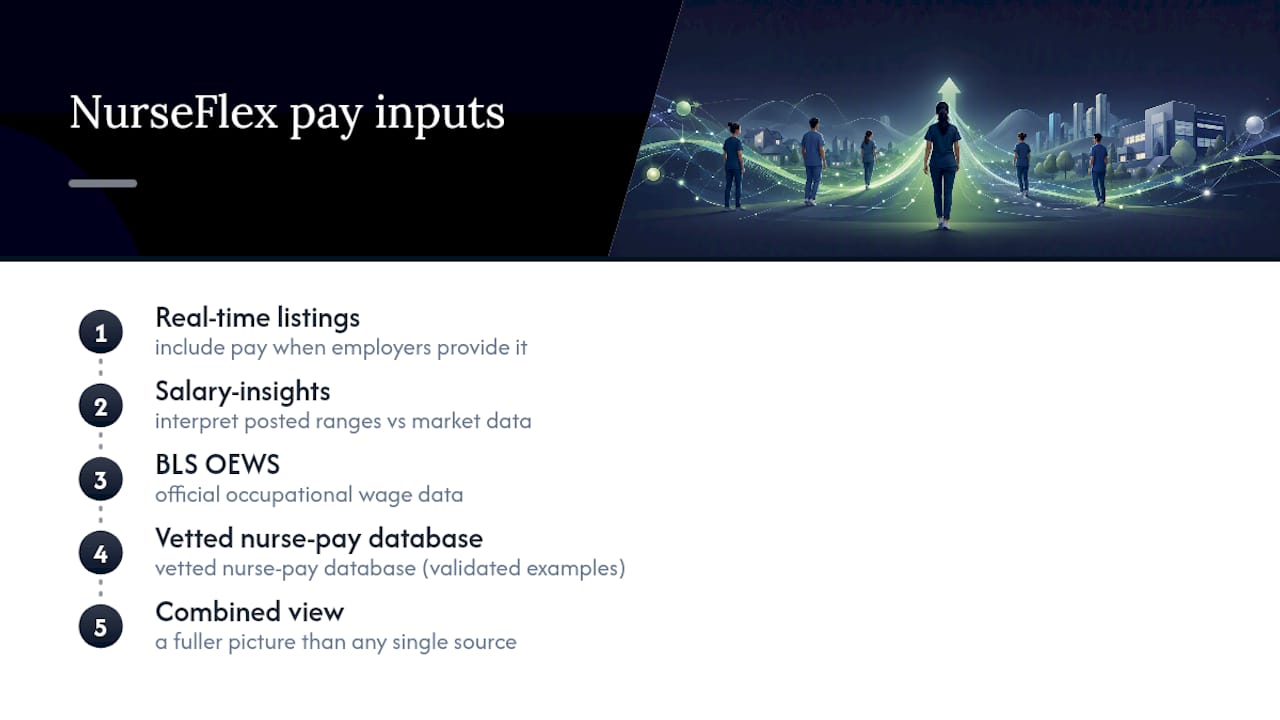
Some job platforms surface real-time job matches with details that let you compare postings quickly, including pay information where employers provide it. Resources like salary-insights help you interpret what a posted range actually means against current market data, so a number on a job ad isn't the only context you have. Pair it with BLS OEWS and a vetted nurse-pay database, and you've got a fuller picture than any single source gives you alone.
Where This Is Headed
Progress on nurse pay transparency is real but uneven. State laws are expanding faster than most employers are adapting internal practices, which means the burden still falls on individual nurses to do the homework. Use the data sources in this guide, contribute your own numbers where you can, and check NurseFlex Jobs's resources as one piece of a larger toolkit.
Find Roles That Post Pay Upfront
Job hunting shouldn't mean guessing what a floor pays until week three of interviews. Certain job platforms match you to open roles in real time based on your skills and availability, and some listings include pay details so you can compare offers before you apply, not after. Browse current nursing jobs to see ranges alongside shift and setting details, or check telehealth positions if remote flexibility matters more than location.

Pair any listing with the salary-insights hub before you negotiate. This is one tool among several, and it works best alongside BLS data and peer-reported numbers, not instead of them. If you're ready to see what's currently posted in your specialty, start browsing nursing jobs today.
Sources
For wage percentiles by state and metro, go straight to the BLS Occupational Employment and Wage Statistics for registered nurses. For legal context on how disclosure laws differ by jurisdiction, Cornell Law School's analysis breaks down the tradeoffs. For staffing industry perspective on how transparency affects hiring, Thriiiv's staffing background offers useful context on the recruiting side of the equation.
- Bureau of Labor Statistics — Occupational Employment and Wage Statistics (Registered Nurses, SOC 29-1141)
- Cornell Law School — Pay-transparency laws: the good, the bad, and the ugly
- Peer-reviewed study on pay transparency effects (DOI: 10.1093/haschl/qxad044)