
Supplemental nursing work is defined as temporary, contract-based nursing practice where registered nurses fill staffing gaps caused by fluctuating patient demand. This model is not a fringe option. Supplemental staffing accounts for 15% to 30% of the total healthcare workforce, making it one of the most significant labor strategies in modern healthcare. The four primary models are PRN (per diem), travel nursing, seasonal contracts, and local contracts. Each offers a different balance of flexibility, pay, and commitment. If you are a nurse weighing your options in 2026, understanding what is supplemental nursing work gives you a real advantage in building a career on your own terms.
What is supplemental nursing work, and why does it matter?
Supplemental nursing work is the industry term for any nursing role that fills temporary or variable staffing needs rather than a permanent position. The broader staffing industry also calls this "contingent nursing" or "float staffing," but supplemental nursing is the standard label used by state health departments and staffing agencies alike.
Healthcare facilities face predictable and unpredictable demand swings. A flu surge, a seasonal census spike, or a sudden resignation can leave a unit dangerously short. Supplemental shifts reduce costs by letting facilities manage those spikes without long-term employment commitments. That efficiency benefits both the hospital and the nurse who wants control over her schedule.

For nurses, supplemental work is best understood as a way of working rather than a job title. Individual schedule control often outweighs organizational loyalty in this model. You choose when you work, where you work, and at what level of commitment.
What are the main types of supplemental nursing jobs?
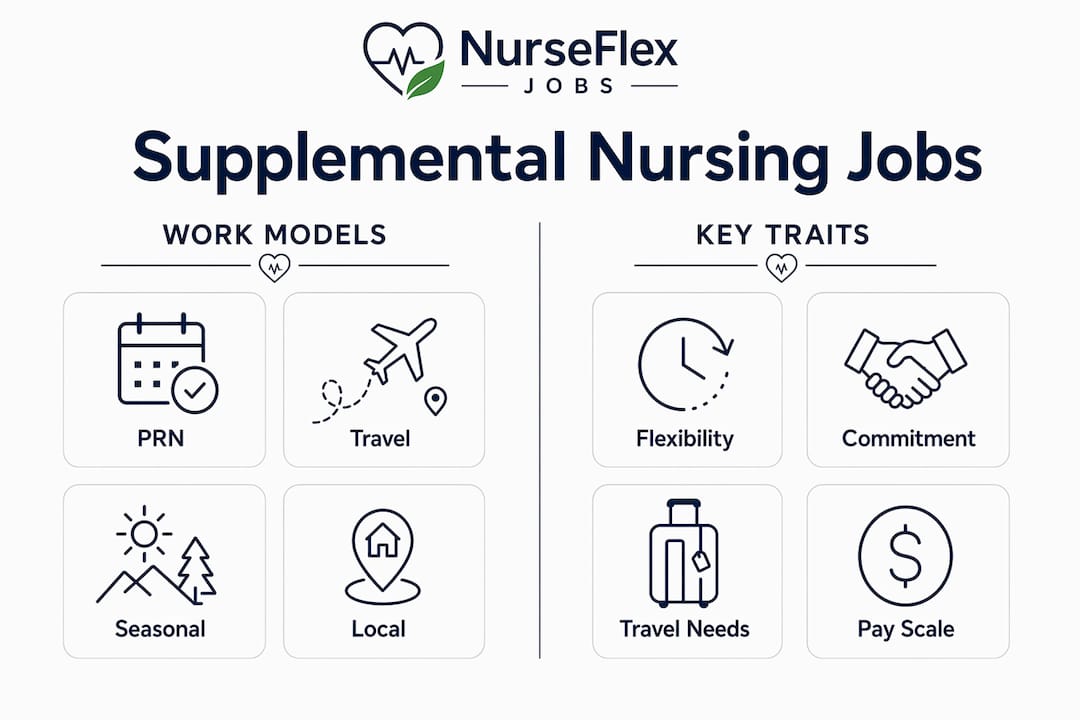
Supplemental nursing comprises four core models: PRN, travel nursing, seasonal contracts, and local contracts. Each model suits a different lifestyle and career goal.
PRN (per diem) nursing
PRN stands for "pro re nata," Latin for "as needed." PRN nurses pick up individual shifts at one or more facilities, often with as little as 24 hours' notice. This model suits nurses who want maximum schedule control and already live near the facilities they serve. Pay rates are typically higher per shift than permanent staff rates, compensating for the lack of benefits.
Travel nursing
Travel nursing involves contracts typically lasting 13 weeks at a facility outside your home region. Agencies handle housing stipends, licensing support, and travel reimbursement. Travel nursing contracts expose you to diverse patient populations and clinical systems, which accelerates professional growth faster than most permanent roles.
Seasonal and local contracts
Seasonal contracts run for a defined period tied to patient census patterns, such as winter respiratory surges or summer trauma spikes. Local contracts mirror travel contracts in structure but keep you within commuting distance of home. They offer the pay premium of contract work without relocation.
| Type | Flexibility | Commitment | Pay scale | Travel required |
|---|---|---|---|---|
| PRN (per diem) | Very high | Shift by shift | High per shift | No |
| Travel nursing | Moderate | 13-week blocks | Highest overall | Yes |
| Seasonal contract | Moderate | 4–16 weeks | High | Sometimes |
| Local contract | Moderate | 4–13 weeks | High | No |
Pro Tip: If you are new to supplemental work, start with local contracts or PRN at a familiar facility type. You build confidence in rapid onboarding before committing to a full travel assignment.
What credentials and requirements do supplemental nursing roles need?
Supplemental nursing roles carry a higher credentialing bar than most permanent positions. Facilities take on more risk with temporary staff, so they verify qualifications more thoroughly.
The baseline requirement is an active state RN license in good standing. Most agencies and facilities also expect one to three years of clinical experience in the specialty you are filling. A new graduate can rarely step into a supplemental ICU role. Specialty certifications such as ACLS, BLS, PALS, or TNCC strengthen your profile and often determine which assignments you qualify for.
Background checks are non-negotiable. States like Minnesota require Netstudy 2.0 background screening for supplemental nursing services agencies, and similar digital verification systems are spreading nationally. You should expect a full criminal history check, sex offender registry search, and OIG exclusion list review before your first shift.
Beyond licensure, supplemental nurses face additional credentialing steps that permanent staff skip. These include facility-specific orientation modules, competency checklists, and health screenings. Keeping a digital credential wallet with current copies of your license, certifications, immunization records, and background check results cuts your onboarding time significantly.
Pro Tip: Use a credential management app or a shared cloud folder to store every document in one place. When a new facility requests your packet, you send it in minutes instead of days.
What are the benefits and challenges of supplemental nursing?
Supplemental nursing offers real advantages, but it also demands skills that permanent roles rarely test. Knowing both sides prepares you to thrive rather than just survive.
The benefits are concrete
Supplemental roles offer schedule flexibility and clinical variety that permanent positions rarely match. You choose your days, your facilities, and often your unit type. Many supplemental nurses report higher hourly earnings than their permanent counterparts, particularly in high-demand specialties like critical care, OR, and emergency nursing.
Floating between multiple departments and hospitals builds a breadth of clinical experience that accelerates your resume and your confidence. Nurses who work supplemental roles across several facility types often develop stronger clinical judgment because they cannot rely on familiarity. Every shift requires you to read a new environment quickly.
The challenges are real
"Experienced supplemental nurses maintain success by focusing on patient safety and task completion instead of engaging in unit politics. The nurse who walks in, does excellent work, and leaves without drama gets called back every time." AORN, Perioperative Resource Nurse
Rapid onboarding is the hardest skill to build. You may have one orientation shift before you are expected to function independently. Floating supplemental nurses often face imposter syndrome and cultural friction when joining an established unit team. The antidote is focusing on clinical excellence rather than social integration.
Strategies that reduce supplemental nursing challenges:
- Arrive early to every shift and introduce yourself to the charge nurse first.
- Ask for a five-minute walkthrough of the unit layout, crash cart location, and charge nurse contact.
- Document local login credentials, charting templates, and key contacts in a small notebook during your first shift.
- Decline to engage in unit gossip or staff conflicts. Stay task-focused.
- Review the facility's EHR system tutorials online before your first shift when possible.
Pro Tip: Perioperative resource nurses who position themselves as versatile problem-solvers, not just gap-fillers, get the most consistent call-backs and the best assignments.
How do you become a supplemental nurse and build this career?
Becoming a supplemental nurse is a structured process, not an accidental one. The nurses who build lasting supplemental careers treat it as a specialty in its own right.
-
Confirm your eligibility. You need an active RN license, at least one to two years of clinical experience in your target specialty, and current certifications such as BLS and ACLS. Check your state's specific requirements before applying.
-
Identify your preferred model. Decide whether PRN, local contracts, or travel nursing fits your current life. A nurse with school-age children may prioritize local contracts. A nurse with no geographic ties may prefer travel assignments for the pay premium.
-
Connect with staffing agencies and platforms. Agencies match you with facilities and handle contract logistics. Platforms like Flexiblenursingcareers offer real-time job matching based on your skills, availability, and location preferences, cutting the time between application and first shift.
-
Build your credential packet. Gather your license verification, certifications, immunization records, background check, and references into one organized file. Facilities that receive a complete packet move faster.
-
Master rapid onboarding. Carrying a small notebook to document local login processes, charting templates, and key contacts during initial shifts is one of the most effective techniques experienced supplemental nurses use. It sounds simple. It works.
-
Invest in continuous development. Each new assignment is a learning opportunity. Track the EHR systems you have used, the unit types you have covered, and the skills you have added. That list becomes your competitive advantage.
-
Manage your paperwork proactively. License renewals, background check updates, and certification recertifications have hard deadlines. Missing one can pull you off an assignment. Set calendar reminders 90 days before each expiration.
Networking matters more in supplemental nursing than in permanent roles. Charge nurses and unit managers remember the supplemental nurses who performed well. A strong reputation at three or four facilities creates a steady stream of preferred assignments without constant agency searching. You can also review the flexible healthcare roles checklist to compare supplemental options against other flexible nursing paths before you commit.
Pro Tip: Work-life balance in supplemental nursing is self-managed. Set a maximum number of shifts per week before you start accepting assignments, and hold that boundary. Burnout hits supplemental nurses who say yes to every open shift.
Key Takeaways
Supplemental nursing is a defined career model, not a fallback option, and nurses who approach it with preparation and clear goals build both income and clinical depth faster than most permanent roles allow.
| Point | Details |
|---|---|
| Four core models exist | PRN, travel, seasonal, and local contracts each offer different flexibility and pay structures. |
| Credentialing is non-negotiable | Active licensure, specialty certifications, and background checks like Netstudy 2.0 are baseline requirements. |
| Rapid onboarding is the key skill | Documenting logins, workflows, and contacts in your first shift separates thriving supplemental nurses from struggling ones. |
| Schedule control is the primary benefit | Supplemental nurses choose when and where they work, which is the core advantage over permanent positions. |
| Proactive paperwork prevents gaps | Tracking license renewals and certification deadlines 90 days out keeps you assignment-ready year-round. |
Why supplemental nursing is a career strategy, not a compromise
I have watched nurses treat supplemental work as a temporary fix between "real" jobs, and I have watched others build entire careers around it with more clinical depth and earning power than most permanent staff. The difference is mindset and preparation.
The nurses who thrive in supplemental roles are not the ones who simply tolerate uncertainty. They are the ones who recognize that individual control over schedule is a genuine professional asset, not a consolation prize. They treat each new facility as a clinical rotation, not an inconvenience.
The uncomfortable truth about supplemental nursing is that it exposes gaps in your clinical confidence faster than any permanent role will. That is not a weakness of the model. That is the model working correctly. Nurses who lean into that exposure come out with broader competence and stronger judgment.
My advice for 2026: stop waiting until you feel "ready" for supplemental work. You get ready by doing it. Start with a local PRN role at a facility type you know well, build your credential packet, and take the first assignment. The adaptability you build in your first three months of supplemental work will serve your entire career.
— Flexible
Supplemental nursing jobs that fit your schedule
Flexiblenursingcareers connects nurses with supplemental roles across PRN, local contract, and travel assignments, matched to your specialty, availability, and location.

The platform uses real-time job matching, so you see open positions that fit your credentials and schedule rather than sifting through listings that do not apply to you. Whether you want one shift a week or a full 13-week travel contract, the options are there. Flexiblenursingcareers also reduces the time between application and first shift, which matters when you are ready to work now. Browse current supplemental nursing openings and find assignments that work around your life, not the other way around.
FAQ
What is supplemental nursing work in simple terms?
Supplemental nursing work is temporary, contract-based nursing where you fill staffing gaps at healthcare facilities rather than holding a permanent position. It includes PRN shifts, travel contracts, seasonal roles, and local contracts.
How much experience do you need for supplemental nursing jobs?
Most supplemental nursing roles require one to three years of clinical experience in the relevant specialty. New graduates rarely qualify for supplemental positions in high-acuity units like ICU or emergency departments.
Do supplemental nurses earn more than permanent staff?
Supplemental nurses typically earn higher hourly rates than permanent staff, particularly in high-demand specialties. Travel nursing contracts also include housing stipends and travel reimbursement, which increases total compensation.
What are the biggest challenges of supplemental nursing roles?
Rapid onboarding and adapting to new workflows are the hardest parts. Supplemental nurses often face imposter syndrome when joining established unit teams, which is best managed by focusing on clinical task completion rather than social integration.
How do I find supplemental nursing jobs in 2026?
Staffing agencies and platforms like Flexiblenursingcareers match you with supplemental roles based on your specialty, license, and availability. You can also review part-time and supplemental options to compare models before committing to a specific path.