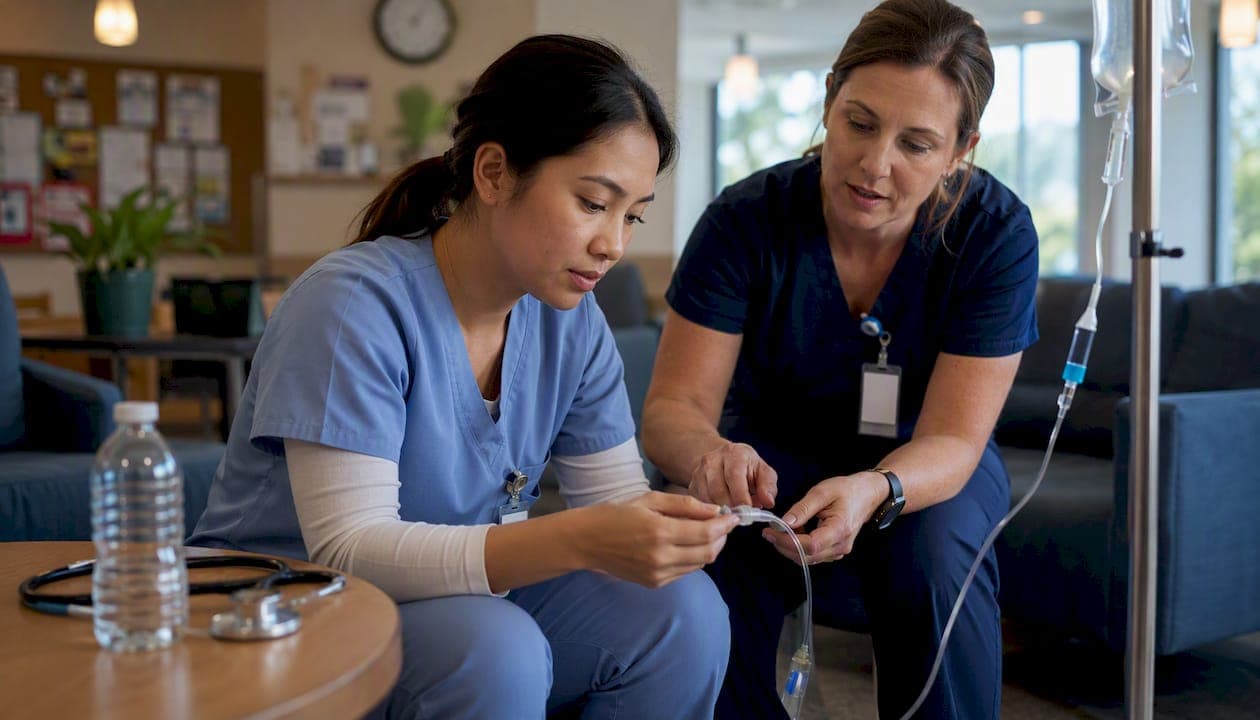
Hospital-run nurse externship programs give pre-licensure nursing students paid clinical hours under RN preceptors, plus a direct path to job offers after graduation. The strongest examples include Prisma Health's MedEx Academy Nurse Extern Program, Johns Hopkins Hospital's Nurse Externship, Sheppard Pratt's Nurse Extern Program, and BJC HealthCare's Summer Student Nurse Externship. Each is a structured, hospital-employed experience, not unpaid shadowing.
A nurse externship is pre-licensure clinical employment: you work as a paid staff member under a dedicated RN preceptor, performing hands-on patient care within your scope while still in nursing school.
Here are the programs this article profiles:
- Prisma Health MedEx Academy Nurse Extern Program
- Johns Hopkins Hospital Nurse Externship (JHH and affiliates)
- Sheppard Pratt Nurse Extern Program
- BJC HealthCare Summer Student Nurse Externship
- Kaiser Permanente Northern California Nursing Work-Study Internship
- Texas Health Fort Worth Nurse Intern Program
- University of Kansas Health System Summer Nurse Extern Program
- RWJBarnabas Health Student Nurse Externship
Table of Contents
- Examples of nurse externship programs: program profiles
- What you will actually do as a nurse extern
- Who qualifies, when to apply, and what paperwork you need
- Are externships paid, and do they lead to RN job offers?
- Treat your externship like an extended job interview
- Key Takeaways
- What most students get wrong about externships
- Paid clinical work while you wait for externship season
- Useful sources to verify program details and apply
Examples of nurse externship programs: program profiles
The table below gives you the fast facts. Full profiles follow.
| Program | Duration / Dates | Paid | Eligibility | Clinical Focus | Housing Support | Apply |
|---|---|---|---|---|---|---|
| Prisma Health MedEx Academy | Summer (dates vary) | Yes | Junior/senior BSN | Acute care, specialty units | Not publicly listed | Prisma Health careers page |
| Johns Hopkins Nurse Externship | Summer (dates vary) | Yes | Junior/senior BSN | Acute care, specialty | Not publicly listed | JHH nursing careers page |
| Sheppard Pratt Nurse Extern | Summer (dates vary) | Yes | Junior/senior BSN | Psychiatric/behavioral health | Not publicly listed | Sheppard Pratt careers page |
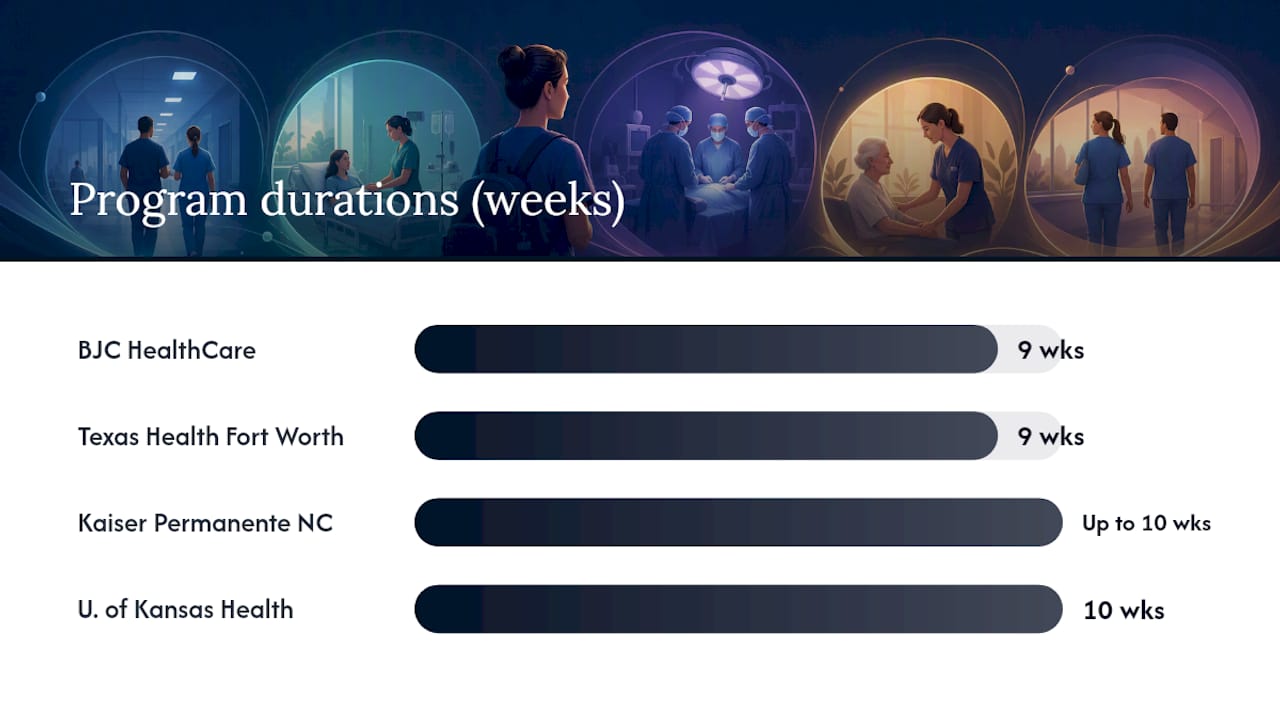
| BJC HealthCare Summer Externship | 9 weeks, May 18–Jul 18, 2026 | Yes | Junior/senior BSN | Acute care, multi-unit | Not publicly listed | Closes March 1, 2026 |
| Kaiser Permanente NC Work-Study | Up to 10 weeks, summer | Yes | Upper-level BSN | Acute care, clinical practicum | Not publicly listed | Via partner universities |
| Texas Health Fort Worth | 9 weeks, summer | Yes | Junior/senior BSN | Inpatient rotations | Not publicly listed | Texas Health careers page |
| U. of Kansas Health System | 10 weeks, summer | Yes | Junior/senior BSN | Acute care, specialty | Subsidized housing available | Kansas Health System careers |
| RWJBarnabas Health | 8–10 weeks, summer | Yes | Junior/senior BSN | Acute care, multi-unit | Not publicly listed | RWJBarnabas careers page |
Prisma Health MedEx Academy Nurse Extern Program places externs in acute care and specialty units across its South Carolina hospitals. The program pairs each extern with a dedicated RN preceptor and runs structured orientation before clinical shifts begin. Prisma positions the program explicitly as a talent pipeline, with strong performers receiving priority consideration for new-grad RN roles.
Johns Hopkins Hospital Nurse Externship is one of the most recognized nursing externship opportunities in the country. JHH and its affiliate hospitals place externs in specialty units ranging from oncology to cardiac care. The program is paid, runs through the summer, and includes formal orientation. Externs who perform well gain a measurable advantage when applying to the Johns Hopkins new-graduate residency.
Sheppard Pratt Nurse Extern Program stands out because its clinical focus is psychiatric and behavioral health, making it one of the few examples of nurse externship programs specifically designed for students interested in mental health nursing. It is paid, summer-based, and supervised by RN preceptors with behavioral health expertise.
BJC HealthCare Summer Student Nurse Externship is one of the most date-specific programs available. The 2026 program runs May 18 through July 18, with applications closing March 1, 2026. It is a 9-week, 36-hour-per-week commitment with a structured orientation week, RN preceptor assignment, and stated goals around mentorship and post-program hiring.
Kaiser Permanente Northern California Nursing Work-Study Internship runs up to 10 weeks and is sanctioned as a clinical practicum in California, meaning some students may receive academic credit. Students are selected by partner universities rather than applying directly, so check with your school's nursing department first.
Texas Health Fort Worth Nurse Intern Program follows a nine-week paid model: one orientation week plus eight clinical weeks at 36 hours per week. Interns rotate across inpatient units and attend weekly education sessions. After the program, strong performers can continue as PRN staff, which is one of the cleaner transitions to early employment you will find in any summer program.
University of Kansas Health System Summer Nurse Extern Program is a 10-week, 36-hour-per-week paid externship with mandatory orientation. It is one of the few programs that publicly lists subsidized housing for non-local externs, and academic credit may be awarded depending on your school's policies. Application timing details are posted on the Kansas Health System careers page.
RWJBarnabas Health Student Nurse Externship runs 8–10 weeks and uses a 1:1 RN preceptor model with weekly competency evaluations and hospital-specific skills checklists. RWJBarnabas frames the program directly as a hiring pipeline, making it a strong choice for students who want to work in New Jersey after graduation.
What you will actually do as a nurse extern
Scope of practice for externs sits between a nursing assistant and a licensed RN. UNC Medical Center's externship guidelines describe the core duties clearly: vital signs, patient hygiene and comfort care, admissions and discharges, specimen collection, and interdisciplinary support tasks. Advanced RN-only responsibilities, such as autonomous IV medication administration or independent assessment documentation, are restricted by state nursing practice acts and individual facility policy.
Day-to-day, you will:
- Take and document vital signs under RN supervision
- Assist with patient hygiene, positioning, and mobility
- Support admissions, transfers, and discharge processes
- Collect specimens and perform point-of-care tasks within your scope
- Communicate patient status changes to your preceptor
- Participate in shift huddles and interdisciplinary rounds as an observer or contributor
The learning outcomes go well beyond the task list. CU Anschutz research on nursing externships highlights how the experience bridges classroom learning to real clinical practice in ways simulation cannot replicate. Priority setting, delegation, time management, and clinical decision-making all sharpen quickly when you are working real shifts on a real unit.
Pro Tip: After each shift, spend five minutes with your preceptor asking one specific question: "What would you have done differently in that situation?" That single habit turns routine tasks into structured learning moments and signals to nursing leadership that you are thinking beyond the task.
Who qualifies, when to apply, and what paperwork you need
Most hospital externship programs require you to be a junior or senior in a BSN program, or an upper-level student in another pre-licensure track. Common eligibility requirements include:
- Current enrollment in an accredited BSN or pre-licensure program
- Completion of at least one clinical nursing course (some programs specify sophomore or junior standing)
- Current BLS certification (American Heart Association is the standard most programs accept)
- Up-to-date immunizations (hepatitis B, MMR, varicella, TB test, flu shot)
- Completed background check and drug screen
- Official transcripts and a minimum GPA (often 3.0, though this varies)
- One or two letters of recommendation from nursing faculty
Application windows for summer programs typically open in the fall semester and close between January and March. BJC HealthCare's 2026 deadline of March 1 is a useful benchmark: if you are targeting a summer start, treat January as your personal deadline to have all documents ready.
Before you apply anywhere, confirm your BLS card is current and your immunization records are organized in one file. Programs move fast once they open, and missing a single document can disqualify an otherwise strong application.
Selection processes vary. Kaiser Permanente Northern California selects students through partner universities rather than open applications. Programs like UNC Medical Center may use faculty nominations or standard job-portal applications. Know which model your target program uses before the window opens.
Are externships paid, and do they lead to RN job offers?
Most hospital-run externship programs are paid positions. BJC HealthCare, Texas Health Fort Worth, the University of Kansas Health System, and RWJBarnabas Health all run paid programs. Kaiser Permanente Northern California's program is a paid work-study model. Stipend-only or fully unpaid externships exist but are less common at major health systems.
Pay structures vary: some programs pay an hourly rate as a student extern or nurse tech, while others classify participants as PRN employees from the start. Texas Health Fort Worth explicitly offers PRN continuation after the nine-week program ends, giving strong performers immediate paid clinical work before graduation.
The hiring pipeline benefit is real and well-documented by program administrators. RWJBarnabas Health positions its externship directly as a talent pipeline, and the University of Kansas Health System's program page notes expedited pathways to post-graduation employment for externs who perform well. Nursing leadership consistently views externs who show initiative as priority candidates for new-grad residency slots.
Common program benefits beyond the paycheck:
- 1:1 RN preceptor mentorship and weekly competency evaluations
- Exposure to Magnet-designated hospital environments and evidence-based practice culture
- Weekly clinical education sessions (Texas Health Fort Worth model)
- Networking with unit nurses, charge nurses, and nurse managers
- Subsidized housing for non-local externs (University of Kansas Health System)
- Academic credit in some cases (Kaiser Permanente NC, University of Kansas)
- Priority consideration or expedited interviews for new-grad residency programs
Treating the externship as a first step in your nursing career rather than just a summer job changes how you show up every shift.
Treat your externship like an extended job interview
Nursing leadership views externships as a talent pipeline. Students who treat every shift as an audition, not just a learning experience, are the ones who get called first when residency slots open. That is not speculation; it is how RWJBarnabas Health and similar systems frame their own programs.
On-shift professionalism that gets noticed:
- Arrive five minutes early and ready to take report
- Follow through on every task you commit to, without needing a reminder
- Ask your preceptor evidence-based questions, not just procedural ones ("Why do we reposition this patient every two hours?" not just "How do I reposition them?")
- Volunteer for unit huddles, quality improvement discussions, or any small project the charge nurse mentions
- Document your competency completions promptly and accurately
Pro Tip: Prepare two or three short examples of clinical thinking before your externship starts. Something like: "I noticed a patient's blood pressure was trending down across three readings and flagged it to my preceptor before it became urgent." Nursing managers remember externs who demonstrate pattern recognition, not just task completion.
Participating in unit improvement projects, even as an observer, signals that you think beyond your shift. That is the behavior that converts an externship into a job offer. For more on how to leverage externship relationships into long-term career traction, the networking strategies that work in nursing are specific and worth reviewing before your first week.
Key Takeaways
Hospital-run nurse externship programs are paid, preceptor-supervised clinical positions that function as direct hiring pipelines to new-graduate RN roles.
| Point | Details |
|---|---|
| Apply early for summer programs | Most application windows close between January and March; BJC HealthCare's 2026 deadline is March 1. |
| Have documents ready before windows open | BLS card, immunization records, transcripts, and one faculty recommendation should be ready by November. |
| Most programs are paid | BJC, Texas Health, Kansas Health System, RWJBarnabas, and Kaiser Permanente all run paid externships. |
| Housing support exists | The University of Kansas Health System offers subsidized housing for non-local externs. |
| Flexiblenursingcareers for paid early shifts | Students who need income now or cannot relocate can find flexible paid nursing shifts through Flexiblenursingcareers. |
Always verify current application dates and eligibility requirements on each program's official careers page before applying.
What most students get wrong about externships
The conventional advice is to apply to as many programs as possible and take whatever you get. That approach wastes time and often lands students in units that do not match their specialty interest, which means the externship does not strengthen the part of their resume that matters most.
A better approach: identify two or three health systems where you would genuinely want to work after graduation, then apply to those programs with targeted, specific application materials. A cover letter that references the hospital's Magnet status, a specific unit, or a clinical educator program by name reads completely differently than a generic one. Recruiters notice.
The other thing students underestimate is the PRN pathway. Texas Health Fort Worth's model, where strong externs continue as PRN staff after nine weeks, is not unique. Many health systems offer informal PRN arrangements to externs they want to retain. Ask about it directly during your program. The worst answer is no, and the best answer is a paid shift schedule that carries you through your final semester.
Paid clinical work while you wait for externship season

Externship application windows are seasonal, and not every student can relocate for a summer program. Flexiblenursingcareers connects nursing students and early-career nurses with paid, flexible clinical shifts at hospitals and healthcare facilities through real-time job matching. No lengthy application process, no waiting until May.
If you need income now, want PRN-style experience before your externship starts, or simply cannot commit to a 9-week relocation, browse available nursing shifts on Flexiblenursingcareers to find positions matched to your current skills and availability. It is a different class of solution from a structured externship with a formal preceptor model, but for students who need paid clinical exposure on a flexible schedule, it fills a real gap. Sign up, set your availability, and start getting matched to shifts that fit your schedule.
Useful sources to verify program details and apply
| Resource | Best for |
|---|---|
| BJC HealthCare Summer 2026 Externship | Official 2026 dates, application deadline (March 1, 2026), and program goals |
| Kaiser Permanente Nurse Scholars Academy | Program details, university partner selection process, and paid work-study model |
| Texas Health Fort Worth Nurse Intern Program | Nine-week schedule, PRN continuation details, and rotation structure |
| University of Kansas Health System Extern Program | 10-week program details, subsidized housing info, and application portal |
| RWJBarnabas Health Student Nurse Externship | Preceptor model, weekly competency checklists, and hiring pipeline details |
| UNC Medical Center Student Nurse Externship | Scope-of-practice guidance and eligibility requirements |
| Betternurse.org Nurse Extern Guide | Plain-language overview of what an externship looks like day to day |
| CU Anschutz: Why Students Should Consider an Externship | Educational value and how externships bridge classroom to clinical practice |