
Your first nursing job is the single most formative experience of your clinical career. It shapes how you think, how you act under pressure, and whether you stay in nursing at all. Up to one-third of new nurses leave their organization within the first two years, most often because of burnout and inadequate support during that critical transition. The decisions you make now, including where you work and what you look for in an employer, will follow you far longer than your first paycheck.
- Your first role builds the clinical habits and reflexes you will carry throughout your career.
- A poor fit can trigger burnout, erode confidence, and delay specialization for years.
- A supportive environment, by contrast, accelerates skill development and professional identity.
- The American Nurses Credentialing Center (ANCC) identifies shared decision-making, supportive leadership, and structured professional development as the most effective tools for reducing early-career burnout.
- Choosing wisely is not optional. It is the first real career decision you will make as a nurse.
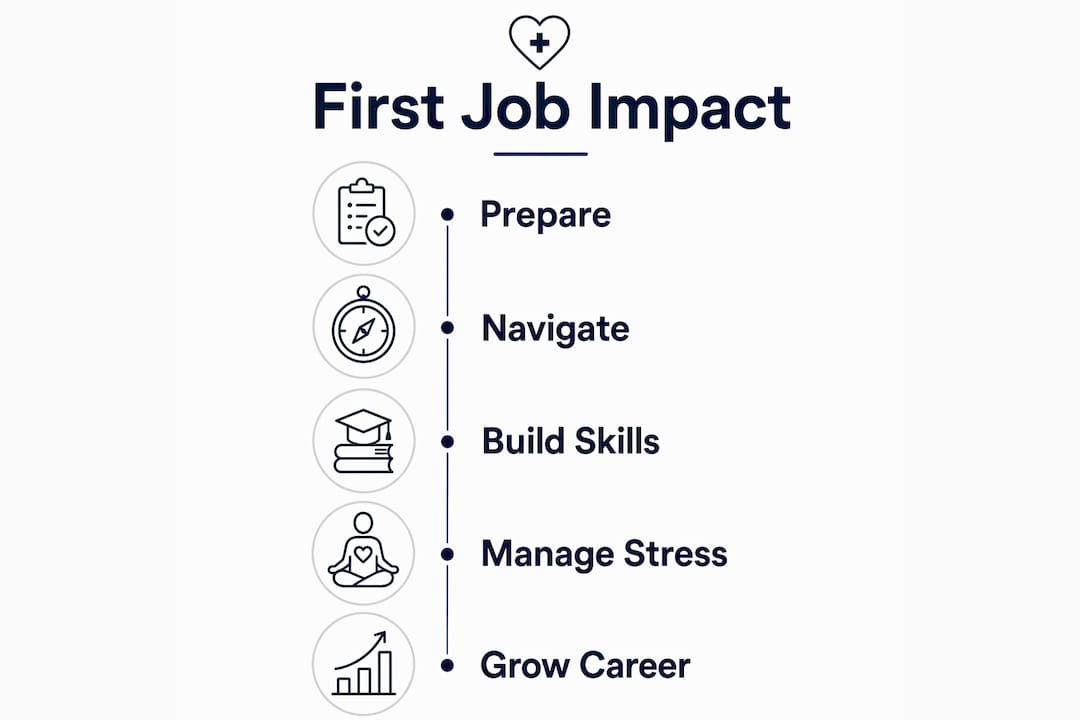
How to prepare effectively for your first nursing job
The shift from student to working nurse requires more than passing the NCLEX. You need to approach your job search like a professional evaluating an investment, because that is exactly what it is.
- Adopt a strategic mindset. Nursing professionals advise shifting from a "student mindset" to a "strategic asset" mindset. Do not passively accept the first offer you receive.
- Research residency programs. Organizations with formal new graduate residency programs signal a real commitment to your transition. Ask specifically about preceptor ratios and the length of the orientation period.
- Time your applications carefully. Residency cohort windows can close in as little as two weeks. Missing one can delay your supported entry point by months, regardless of your qualifications. Track opening dates and apply early.
- Ask the right interview questions. Find out the unit's retention rate for new graduates, what support services exist for nurse well-being, and whether frontline staff participate in the hiring process.
- Set realistic expectations. Hiring managers do not expect you to function like a five-year veteran. They want to see safe beginner traits: consistent attendance, clear communication, and a genuine willingness to ask for help.
- Prepare for day one practically. Know your unit's layout, review common medications and protocols for your specialty, and identify your preceptor before your first shift.
Pro Tip: Use the ANCC Pathway to Excellence Interview Tool to build your list of employer questions before any interview. It covers well-being, shared governance, and professional development in one organized framework.
How to navigate the nursing workplace in your first role

Walking into a clinical unit as a new graduate feels different from any clinical rotation you completed in school. The culture, the pace, and the unwritten rules are all new.
Build relationships early and deliberately. Introduce yourself to charge nurses, unit secretaries, and experienced staff in your first week. These are the people who will help you find supplies at 2 AM and cover you when your patient load spikes unexpectedly.
- Learn the unit culture quickly. Every unit has its own norms around communication, escalation, and peer support. Observe before you assert.
- Understand shared decision-making. Organizations that practice shared governance give nurses a voice in policy and practice decisions. If your unit has a practice council, join it or at least attend a meeting.
- Seek feedback proactively. Do not wait for your 90-day review. Ask your preceptor for specific, weekly feedback on your clinical reasoning and time management.
- Recognize mentorship when it appears. A senior nurse who takes time to explain the "why" behind a clinical decision is offering you something valuable. Reciprocate with attention and follow-through.
- Address workload concerns through the right channels. Staffing challenges are common in American hospitals. Know your unit's escalation process and use it rather than absorbing unsafe assignments silently.
Understanding what a preceptor actually does and how to get the most from that relationship can make a measurable difference in how quickly you gain clinical confidence.
Building essential nursing skills in your first year

Your first year is not about mastery. It is about building a foundation that holds under pressure.
Patient safety comes first, always. Before you develop speed, develop accuracy. Double-check medications, verify patient identifiers, and speak up when something does not look right. These habits, formed early, become automatic.
- Prioritization and time management. Learn to triage your task list at the start of every shift. Which patient is most unstable? Which assessment cannot wait? This skill separates competent nurses from exceptional ones.
- Communication across disciplines. Practice your SBAR (Situation, Background, Assessment, Recommendation) format with physicians and advanced practice providers until it feels natural. Clear handoffs prevent errors.
- Documentation efficiency. Accurate, timely charting protects your patients and your license. Learn your electronic health record system thoroughly in the first month.
- Critical thinking over task completion. As weeks pass, shift your focus from "did I do the task?" to "why did I do it and what should I watch for next?" That transition is where real clinical competence begins.
- Self-assessment. Keep a brief journal of clinical situations that challenged you. Review it monthly. Patterns in what trips you up are your personal development roadmap.
Nursing career advancement pathways almost always trace back to skills and habits built in the first year. The nurses who advance fastest are the ones who treated year one as a deliberate learning period, not just a probationary hurdle.
How to handle stress and burnout in your first nursing job
Burnout among new nurses is not a character flaw. It is a predictable response to high-acuity work without adequate support.
The financial cost of a single RN turnover is estimated at over $61,000 in 2026. Healthcare organizations have a direct financial reason to support you. If yours is not doing so, that tells you something important.
Recognize the warning signs early. Emotional exhaustion, cynicism toward patients, and a sense that nothing you do makes a difference are the classic markers of burnout. They tend to appear gradually, which makes them easy to dismiss until they become serious.
- Use structured debriefing. After a difficult shift or a patient death, talk it through with a colleague or your preceptor. Silence compounds trauma.
- Build a peer support network. Other new graduates on your unit or in your residency cohort are going through the same experience. Regular check-ins with them normalize the struggle and reduce isolation.
- Practice basic self-care without apology. Sleep, nutrition, and time away from clinical settings are not luxuries. They are the minimum requirements for sustained performance.
- Know what your employer owes you. The ANCC framework specifies that a positive practice environment includes structured well-being support. If your organization offers an employee assistance program, use it.
- Seek mentorship outside your unit. A nurse in a different specialty or a more senior colleague in another department can offer perspective that your immediate team cannot.
Clinical transition studies are clear: the first year should be treated as a supported developmental period, not a trial by fire. When that support is absent, professional isolation becomes the primary driver of nurses leaving the profession entirely.
Career growth opportunities that start with your first nursing job
Your first role is a starting point, not a ceiling. The nurses who advance most deliberately use their early experience to build professional capital, not just clinical hours.
Look for employers who offer clinical ladders, tuition reimbursement, and structured mentorship. These are not perks. They are signals that an organization views you as a long-term investment rather than a temporary staffing solution. A clinical ladder gives you a defined path from novice to expert with tangible recognition at each stage.
- Identify your specialty interest early. Your first unit will expose you to patient populations and clinical problems you may not have encountered in school. Pay attention to what energizes you.
- Network across your organization. Attend nursing grand rounds, join a shared governance committee, and introduce yourself to nursing leadership. Visibility matters when advancement opportunities arise.
- Set goals beyond your current role. Whether your target is a certification, a charge nurse position, or an advanced practice degree, name it in your first year and work backward to identify the steps.
- Use your first job to build references. Strong professional references from your preceptor and nurse manager are among the most valuable assets you will carry to your next role.
Networking in nursing builds the professional relationships that open doors to specialization, leadership, and advanced practice over time.
Research-backed insights on choosing your first nursing job wisely
The evidence on why early nursing job decisions matter is direct and consistent.
Approximately one-third of new nurses leave their organization within the first two years, driven primarily by burnout and inadequate transition support. The cost to healthcare systems exceeds $61,000 per RN turnover.
Unresolved professional difficulties in the first year can cause long-term trauma and reduced confidence that persist into the second and third years of practice, affecting delegation and critical decision-making. Your first job is not just a role. It acts as a permanent formative experience for your clinical muscle memory, either propelling you toward specialization or reinforcing habits that create lasting stress.
The ANCC Pathway to Excellence framework gives you a concrete checklist for evaluating any employer. Ask these questions before you accept an offer:
- What is the organization's retention rate for new graduate nurses in the past year?
- Does the hospital have a formal RN residency or fellowship program?
- What is the preceptor-to-new-graduate ratio on this unit?
- How are nurses involved in shared decision-making and policy changes?
- What well-being and mental health support services are available to staff?
- What are the most common reasons nurses have left this unit recently?
Use the nursing job offer evaluation guide at Flexiblenursingcareers to score your options before you sign anything. Also check residency program openings in 2026 to identify supported entry points that align with your specialty goals.
Ready to find a role that actually supports your growth? Flexiblenursingcareers matches new graduate nurses with flexible positions at organizations that invest in transition support, mentorship, and career development. Browse open nursing jobs and filter by the criteria that matter most to your first-year success.

Key Takeaways
Your first nursing job shapes your clinical habits, professional confidence, and long-term career trajectory more than any role that follows it.
| Point | Details |
|---|---|
| Turnover risk is high | Approximately one-third of new nurses leave within two years, mostly due to burnout and inadequate transition support. |
| Financial stakes are real | Healthcare organizations face high costs when an RN leaves, motivating retention efforts and making your retention a priority for employers. |
| First-year trauma persists | Unresolved difficulties in year one can reduce confidence and affect clinical decision-making into years two and three. |
| ANCC framework guides your choice | Shared decision-making, supportive leadership, and professional development are the markers of a positive practice environment. |
| Residency timing is critical | Cohort application windows can close in as little as two weeks; missing one delays your supported entry point significantly. |