
References in nursing hiring are formal endorsements that verify a nurse's clinical competence, work ethic, and patient safety record. They are not optional formalities. Most healthcare organizations require 2–3 professional references covering the most recent 3–7 years of employment before extending any job offer. That requirement exists because automated background checks cannot tell a hiring manager how a nurse performs under pressure, communicates with patients, or responds to a difficult shift. References fill that gap. They are the human layer of credential verification, and in 2026, their weight in healthcare recruitment is only growing.
What is the role of references in nursing hiring?
References serve as direct evidence of a nurse's real-world performance. A resume lists credentials and job titles. A reference confirms whether those credentials translated into safe, effective patient care. Employers will not issue unconditional job offers until professional references and employment history verifications are complete. That policy reflects a straightforward reality: healthcare hiring carries patient safety stakes that most other industries do not.
Nursing references also work alongside background checks, not instead of them. A Disclosure and Barring Service (DBS) check or criminal background screen reveals documented incidents. References reveal character, growth, and context. References function as a risk mitigation tool by providing nuanced context that background checks alone cannot capture. A nurse who had a documented workplace incident five years ago but has three strong supervisor references describing consistent improvement is a very different candidate from one with no context at all.
The standard industry term for this process is "employment reference verification," and it sits alongside credential verification and license checks as a core component of healthcare onboarding. Nurses who understand this process can prepare for it deliberately rather than scrambling at the last minute.

What types of references are required in nursing?
Not all references carry equal weight. Healthcare hiring managers rank them clearly, and knowing that hierarchy helps you build a stronger application.
Supervisor references are the gold standard. Hiring managers prioritize supervisor references over peer references because supervisors can verify clinical performance under pressure and adherence to patient safety standards. A charge nurse, unit manager, or clinical director who directly observed your work carries far more credibility than a colleague at the same level.
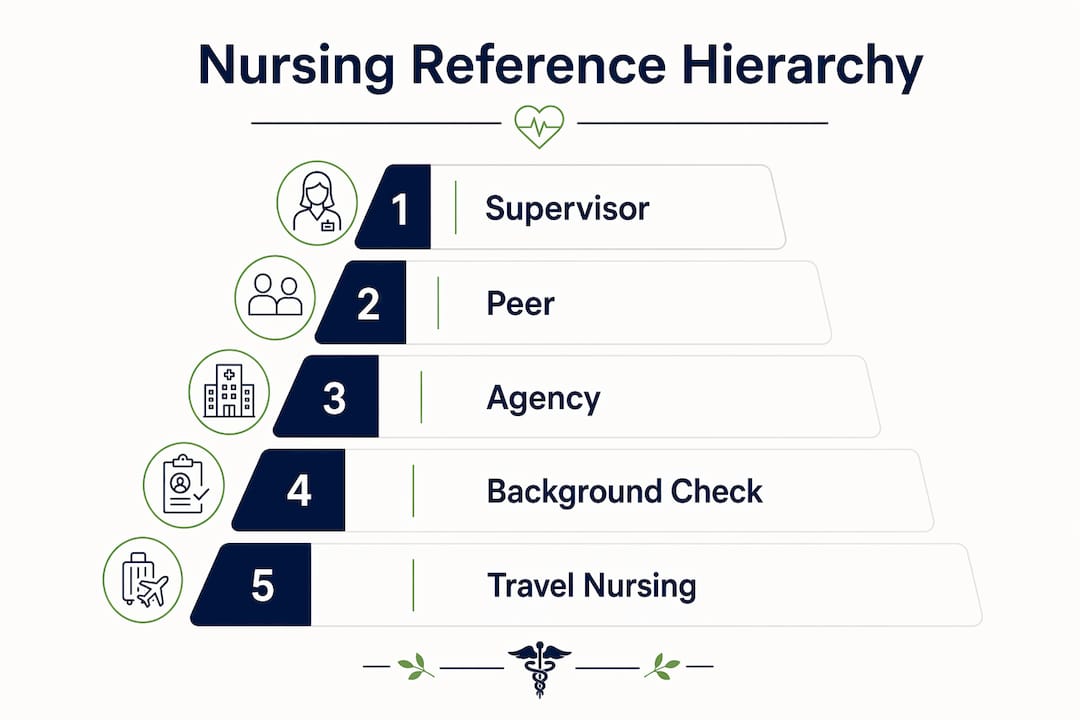
Peer references have a more limited role. They may supplement supervisor references in team-based or telehealth settings, but hiring managers view peer-only reference lists as a potential red flag. The concern is straightforward: peers rarely observe the full scope of a nurse's clinical decision-making or accountability.
Character references carry the least weight in nursing recruitment. They may be requested in specific circumstances, such as for a new graduate with limited work history, but they do not substitute for professional references in most healthcare settings.
Here is a quick breakdown of reference types and their typical use cases:
- Supervisor or manager references: Required for most hospital and clinical roles; must cover the most recent 3–7 years of employment
- Charge nurse references: Accepted as supervisor-level references in many acute care settings
- Peer references: Acceptable as a supplement in telehealth or community nursing; rarely sufficient alone
- Character references: Limited to new graduates or roles with minimal clinical requirements
- Academic references: Used for new graduates when no clinical supervisor is available
Pro Tip: Travel nursing agencies often treat references older than 2 years as invalid. If you are applying to agency or contract roles, prioritize recent supervisors from the past 18–24 months.
How do references affect nursing hires?
The impact of a reference on a hiring decision is direct and measurable. A strong supervisor reference can confirm clinical competency, punctuality, and patient interaction skills in a single conversation. A weak or refused reference can stop an application entirely.
"Nursing references serve as a window into real workplace performance and character, often valued more than automated background checks alone. They provide the human context that no database can replicate."
References often clarify ambiguous background check results, supporting hiring decisions by giving context to past incidents. A nurse who left a position under difficult circumstances but can provide a reference that explains the situation honestly is far better positioned than one who cannot. Positive references can be critical to overcoming minor past issues.
The table below shows how different reference outcomes typically influence hiring decisions:
| Reference outcome | Likely hiring impact |
|---|---|
| Strong supervisor reference with specific clinical examples | Accelerates offer and increases starting pay negotiation leverage |
| Positive peer reference with no supervisor reference | Raises questions; may delay offer pending additional verification |
| Refused or unavailable reference | Can block the offer entirely without documented explanation |
| Reference with minor concerns but context provided | Manageable if nurse addresses it proactively with the recruiter |
| Dishonest or inflated reference | Risks formal investigation by regulatory bodies |
Dishonest references risk investigations by regulatory bodies and can result in formal disciplinary actions. That applies to both the person providing the reference and the nurse who solicited it. Honesty is not just ethical. It is a professional requirement with real consequences.
How can nurses prepare strong references for job applications?
Preparation is the single biggest factor separating nurses who move through hiring quickly from those who stall. Remote nursing employers may request reference lists during initial applications, not just at the offer stage. Having your references ready before you apply eliminates one of the most common hiring delays for healthcare professionals.
Follow these steps to build a reference list that works:
- Choose supervisors who observed your clinical work directly. A manager who saw you handle a code blue or manage a complex patient load will give a far more credible reference than one who only reviewed your paperwork.
- Ask permission before listing anyone. Contact each reference by phone or email, explain the role you are applying for, and confirm they are willing and available to respond promptly.
- Brief your references on the job requirements. Share the job description so they can tailor their comments to the specific skills the employer values.
- Compile a standardized reference document. Include each referee's full name, current job title, organization, phone number, email address, and your relationship to them. Employers typically require this level of detail alongside work dates.
- Save it as a PDF. Standardized formats reduce friction during fast-moving hiring processes, especially for telehealth and agency roles.
- Update your list every 6–12 months. Contact information changes. A reference who has moved organizations or retired without updating you can cause unnecessary delays.
Pro Tip: If a former supervisor has left the organization, track them down through LinkedIn or a mutual colleague. A supervisor reference at a new employer is still a supervisor reference. Hiring managers care about the relationship, not the current employer.
Addressing a refused reference takes more effort but is manageable. The Royal College of Nursing recommends resolving reference disputes promptly to avoid career barriers. If a former employer refuses to provide a reference, document the refusal and offer the recruiter an alternative reference with an explanation. Transparency here protects you far more than silence.
What are common misconceptions about nursing references?
Several persistent myths about nursing references cause nurses to mismanage this part of their application. Clearing them up saves time and avoids avoidable setbacks.
- "References go on the resume." They do not. References are a separate document provided upon request or at the application stage for specific roles. Writing "references available upon request" on a resume is outdated and unnecessary.
- "Peer references are just as good as supervisor references." They are not, in most clinical settings. Hiring managers view peer-only references as a potential red flag because peers cannot verify clinical accountability the way a supervisor can.
- "A refused reference won't affect my application if I have others." A missing or refused reference can halt a nurse's career progression. Recruiters notice gaps, and unexplained refusals raise immediate questions about conduct.
- "I can use the same references for every job." You can reuse the same people, but you should brief them differently for each role. A reference for a pediatric ICU position needs to speak to different competencies than one for a telehealth triage role.
- "Inflating a reference slightly is harmless." Dishonest references risk formal investigations by regulatory bodies. No career benefit is worth that exposure.
Nurses who treat references as a living, managed part of their professional profile, rather than a last-minute checkbox, consistently move through hiring faster and with fewer complications. Reviewing common job search mistakes can help you spot other gaps in your application strategy before they cost you an offer.
Key Takeaways
Strong, well-managed references are the most direct way nurses can accelerate hiring decisions and reduce the risk of an offer falling through.
| Point | Details |
|---|---|
| Supervisor references are essential | Hiring managers prioritize direct supervisors who can verify clinical performance and patient safety standards. |
| Have references ready before applying | Remote and agency employers often request references at the application stage, not just at the offer stage. |
| Refused references block offers | A missing or refused reference can halt hiring entirely; resolve disputes and document refusals proactively. |
| Honesty is non-negotiable | Dishonest references risk regulatory investigations and formal disciplinary actions for all parties involved. |
| Keep your reference list current | Update contact details every 6–12 months and brief referees on each specific role you apply for. |
References matter more than most nurses realize
Here is what I have observed working in healthcare staffing: nurses consistently underestimate how much a reference shapes a recruiter's final decision. The clinical interview and the skills checklist get all the attention. The reference call happens quietly, often after the candidate thinks the job is already theirs. That is exactly when it can unravel.
The shift I am watching in 2026 is that telehealth and remote nursing roles are raising the stakes further. When a hiring manager cannot observe a nurse in person during an interview, the reference becomes the closest thing to a direct observation. Telehealth nursing roles are growing fast, and employers in that space are asking for references earlier in the process and asking more specific questions about independent decision-making and communication skills.
My honest recommendation: treat your reference list like a credential. Maintain it, update it, and invest time in the relationships that produce it. A supervisor who remembers you well and speaks specifically about your clinical judgment is worth more than a polished cover letter. The nurses who move fastest through hiring are not always the most credentialed. They are the most prepared.
— Flexible
Your next nursing role starts with the right preparation
Flexiblenursingcareers connects nurses with flexible, real-time matched job opportunities across clinical, telehealth, and agency settings. The platform is built for nurses who want to move quickly through hiring without the friction of outdated application processes.

Browse current nursing job openings across specialties and locations, with clear guidance on credentialing and reference requirements for each role. Flexiblenursingcareers also supports nurses with credential uploading tools that keep your verification documents organized and ready to submit. When your references and credentials are in order, hiring moves faster. Flexiblenursingcareers is designed to help you get there.
FAQ
What is the minimum number of references required for nursing jobs?
Most healthcare organizations require 2–3 professional references covering the most recent 3–7 years of employment. Travel nursing agencies often treat references older than 2 years as invalid.
Should references be included on a nursing resume?
No. References are a separate document provided upon request or at the application stage for specific roles. Listing "references available upon request" on a resume is considered outdated practice.
What happens if a former employer refuses to provide a reference?
A refused reference can block a job offer. The Royal College of Nursing recommends resolving reference disputes promptly. Document the refusal and offer the recruiter an alternative reference with a clear explanation.
Are peer references acceptable in nursing hiring?
Peer references are acceptable as a supplement in telehealth or team-based roles but are not sufficient on their own. Hiring managers view peer-only reference lists as a potential red flag for clinical verification purposes.
When should nurses have their references ready?
Nurses should have a complete, updated reference list ready before submitting any application. Remote and agency employers frequently request references at the initial application stage, not after an interview.