
Apply to nursing residency programs now, while you are still in your final semester, and register for flexible per-diem shifts to stay clinically active while you complete licensure. That single combination, residency applications plus bridging shifts, gives you the highest odds of a smooth transition from graduation to your first paid nursing role.
Your top first-job targets:
- Med-surg or telemetry units (commonly available with strong mentorship infrastructure)
- Home health or ambulatory care (offering lower patient ratios and increasing demand)
- Long-term care or rehab (often allowing faster hiring and steady skill-building)
Your 3-step action plan, starting today:
- Request official transcripts and apply for your ATT immediately. Your Authorization to Test is typically valid for 90 days, so schedule your NCLEX as soon as it arrives. Do not wait.
- Apply to a substantial number of targeted residency cohorts and entry-level postings. High-success new grads submit this volume and keep per-diem or specialty-adjacent shifts running simultaneously.
- Contact two clinical rotation preceptors this week. Ask for a brief informational conversation and a manager introduction. This outperforms mass cold applications.
Timing callout: Many residency programs open applications 3–6 months before cohort start dates. Applying during your final semester, when programs allow it, gives you the best shot at a conditional offer. Some months typically see heavier new-grad application volumes, while off-peak months can mean less competition.
Table of Contents
- What are the best entry-level nursing roles for new grads?
- How do you organize your search and when should you apply?
- How do you write a nursing resume that passes ATS filters?
- How do you prepare for a nursing job interview as a new grad?
- How do you evaluate a nursing job offer and choose wisely?
- What can you do to bridge the gap before your first permanent role?
- What does orientation and onboarding look like for new grad nurses?
- Key Takeaways
- The first nursing job matters more than most new grads realize
- How Flexiblenursingcareers helps new grads get to their first shift faster
- Useful sources and further reading
What are the best entry-level nursing roles for new grads?
Choosing your first nursing position is less about prestige and more about where you will learn the most with the support you actually need. Here is a practical breakdown.
| Role | Learning Curve | Patient Ratios | Mentorship | Transferability | Best Fit For |
|---|---|---|---|---|---|
| Med-Surg | Moderate | 4–6 patients | Strong (most hospitals have formal programs) | Excellent | New grads who want broad clinical exposure |
| Telemetry/Progressive Care | Moderate-High | 3–5 patients | Good | High (cardiac skills transfer widely) | Grads with cardiac rotation experience |
| Emergency Department | High | Variable | Varies by facility | High | High-energy, adaptable personalities |
| Labor & Delivery | High | 1–2 patients | Moderate | Specialty-specific | Grads with OB rotation and strong interest |
| ICU | Very High | 1–2 patients | Strong in academic centers | Very High | Grads with critical care rotations; competitive |
| OR/Perioperative | High | Procedural | Structured (scrub training provided) | Moderate | Detail-oriented, procedure-focused grads |
| Home Health | Low-Moderate | 1 patient at a time | Limited (independent work) | Moderate | Self-directed grads; growing entry point |
| Long-Term Care/Rehab | Low-Moderate | Higher (8–15) | Varies | Moderate | Grads who want faster hiring and steady reps |
A few things worth knowing before you pick:
- Med-surg remains the most common first role because it builds the widest clinical foundation. Hospitals also invest more in formal orientation there than in most other units.
- ICU and ED roles at large academic medical centers do hire new grads, but competition is steep. If that is your goal, apply broadly and have a backup plan.
- Home health and ambulatory care are accelerating as entry points for new grads, with one-on-one patient contact and lower chaos levels.
Pro Tip: Pick your first role based on mentorship quality and manageable patient ratios, not unit prestige. A well-supported med-surg year builds more transferable skills than an unsupported ICU placement.
How do you organize your search and when should you apply?
A scattered application process is one of the most common reasons new grads wait longer than necessary. Build a simple tracking system before you send a single application.
Your target facility list should include:
- Large hospital systems with formal new-grad residency programs
- Community hospitals (often less competitive, still strong mentorship)
- Outpatient clinics and ambulatory surgery centers
- Long-term care and rehab facilities
- Home health agencies
Rank each facility by: residency program availability, orientation length, commute, and whether they hire new grads without prior RN experience.
Spreadsheet fields to track per application:
- Facility name and unit
- Posting type (residency cohort, per-diem, staff RN)
- Cohort start date and application deadline
- Hiring manager or recruiter contact
- Application status and follow-up date
Timeline checklist:
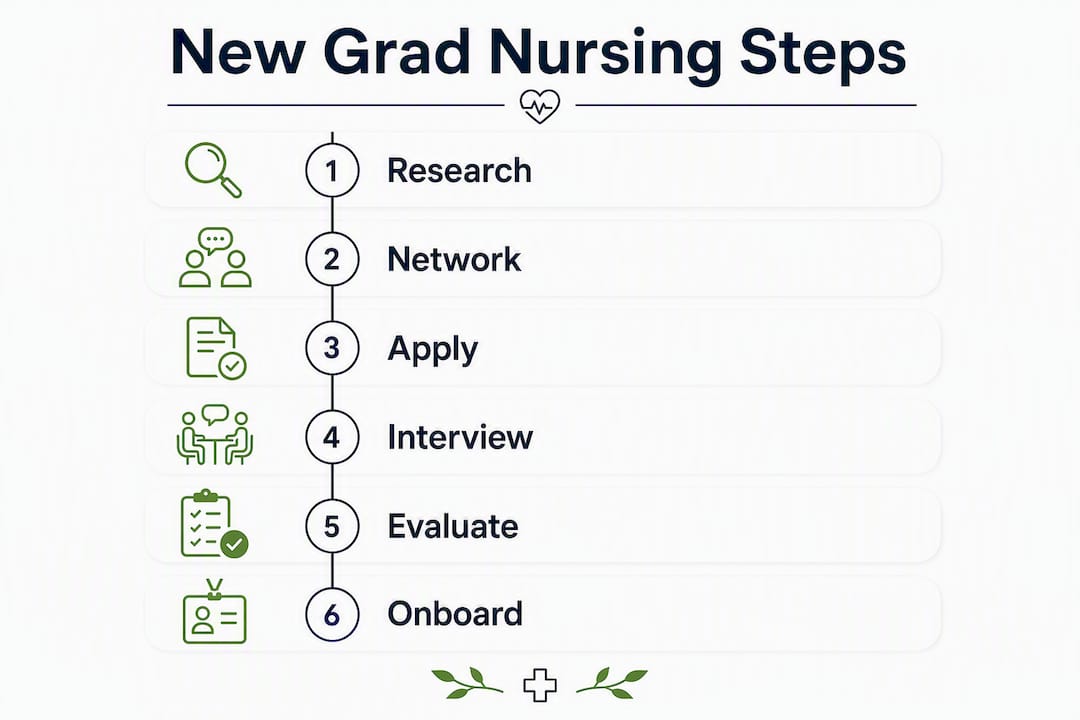
- Final semester: Apply to residency programs that accept conditional applicants. Programs open 3–6 months before start dates, so this is your highest-leverage window.
- Graduation month: Submit license application, update resume, and send 10–15 applications per week.
- Off-peak months (January–February, July–August): Push volume. Fewer competing applicants means your application gets more attention.
- 30–60 days post-NCLEX: Schedule informational interviews with nurses hired 6–12 months ago at your target facilities.
The networking piece is where most new grads underinvest. A 20-minute informational interview with a recently hired nurse at your target facility consistently outperforms 50 cold applications. Ask your clinical rotation preceptors directly: "Would you be willing to introduce me to the hiring manager?" Most will say yes.
Pro Tip: Email your two strongest preceptors within 48 hours of graduation. Ask for a brief call and a manager introduction. That warm referral can move your application to the top of the review pile.

How do you write a nursing resume that passes ATS filters?
Your resume has one job before a human reads it: pass the applicant tracking system. ATS software scans for exact phrasing from the job description, so mirroring the employer's own language is the single highest-return tactic you can apply in 10–20 minutes per submission.
What to include on a one-page new-grad nursing resume:
- NCLEX pass date and license number (or "pending" with expected date)
- Clinical rotation highlights with hours, unit type, and patient population
- Certifications: BLS, ACLS if applicable, any specialty certs
- Relevant work or volunteer experience (CNA, patient care tech, medical scribe)
- Named preceptors or facilities (with permission) to add credibility
Sample resume bullets:
- Completed 120-hour med-surg rotation at [Hospital Name], managing 4–5 patients per shift with direct supervision; performed medication administration, IV starts, wound care, and telemetry monitoring.
- Assisted RN preceptor with patient-centered care planning for post-surgical patients; documented assessments in Epic EHR and communicated changes in condition to charge nurse.
- Maintained 100% compliance with hand hygiene and infection-control protocols during 80-hour ICU clinical rotation.
ATS keyword priorities (use these phrases when the job posting uses them):
- Patient-centered care
- Medication administration
- IV access / IV starts
- Telemetry monitoring
- Wound care and dressing changes
- Electronic health records (EHR) / Epic / Cerner
- SBAR communication
Cover letter structure: Open with your graduation date and NCLEX status, name the specific unit and why it fits your clinical background, and close with one concrete clinical achievement. Keep it to three short paragraphs.
Document checklist before submitting:
- One-page resume (tailored per posting)
- Cover letter (unit-specific)
- Unofficial transcripts (official copies ready on request)
- BLS/ACLS certification copies
- Two to three professional references with contact info
Pro Tip: Customize the skills section of your resume for each posting. Copy the exact phrase from the job description, not a synonym. "Patient-centered care" and "patient-focused care" are not the same to an ATS.
How do you prepare for a nursing job interview as a new grad?
Your clinical rotations are already interviews. Nurse managers talk to preceptors. The way you show up on the floor, your questions, your reliability, and your attitude toward feedback, all feed into hiring decisions before you ever sit in a formal interview chair.
During rotations, demonstrate:
- Proactive communication with the care team
- Comfort asking clarifying questions (not guessing)
- Attention to safety protocols without being prompted
- Genuine curiosity about unit workflows and patient outcomes
Common new-grad interview questions and STAR frameworks:
- "Tell me about a time you caught a potential error." Use a rotation example: Situation (patient receiving wrong dose), Task (verify order), Action (checked MAR, flagged discrepancy to preceptor), Result (order corrected before administration).
- "How do you prioritize when multiple patients need attention?" Describe your triage logic from a busy rotation shift.
- "Describe a time you worked through a conflict with a team member." Keep it clinical and professional; focus on communication and resolution.
Interview logistics checklist:
- Bring printed copies of your resume and certifications
- Dress in business professional attire (not scrubs, unless told otherwise)
- Arrive 10 minutes early; know the unit floor and parking in advance
- Ask about orientation length, preceptor assignment, and unit culture
- Ask: "What does a successful first 90 days look like on this unit?"
Follow-up: Send a thank-you email within 24 hours. Reference one specific topic from the interview, the unit's approach to orientation or a challenge the manager mentioned. Two sentences is enough.
Pro Tip: The new grads who stand out in interviews bring a specific patient-care story and ask a thoughtful question about the unit's orientation structure. Curiosity about mentorship signals maturity, not weakness.
How do you evaluate a nursing job offer and choose wisely?
The American Nurses Association's guidance on choosing your first job is direct: align the organization's culture and values with your own before you sign. Compensation matters, but a high-paying role with no formal orientation can set your career back by a year.
Decision checklist:
- Orientation length (12 weeks minimum is a reasonable baseline for med-surg; ICU often runs 16–24 weeks)
- Preceptor assignment: is it formal and consistent, or informal and variable?
- Patient ratios on the unit
- Shift options and schedule flexibility
- Opportunities for certification support and skills advancement
Questions to ask before accepting:
- What is the exact orientation schedule, and who will be my preceptor?
- Is there a sign-on bonus, and what are the repayment terms if I leave early?
- What shift differentials apply to nights, weekends, and holidays?
- Does the facility offer tuition reimbursement or certification reimbursement?
- What is the first-year turnover rate on this unit?
Red flags:
- No formal orientation or vague answers about preceptor assignment
- High first-year turnover (ask directly; a deflected answer is itself a signal)
- Pressure to sign quickly with no time to review the contract
On negotiation: New-grad applicants commonly leave $3,000–$8,000 on the table by not asking about sign-on bonuses, shift differentials, or certification reimbursements. You do not need leverage to ask. A simple "Is there flexibility on the sign-on bonus or shift differential?" is enough. Get every negotiated item in writing before your start date.
Scenario tradeoff: A hospital offering $5,000 more per year with no formal orientation versus a system offering a structured 16-week residency with a dedicated preceptor. For a new grad, the residency is almost always the better financial decision over a three-year horizon, because the skills and confidence you build there determine your next role's salary.
Pro Tip: Ask about the sign-on repayment clause before you celebrate the bonus. Some require you to stay 18–24 months or repay the full amount. Know the terms.
What can you do to bridge the gap before your first permanent role?
If residency cohort windows are closed or your NCLEX results are pending, you are not stuck. Several bridging options keep your clinical record active and your resume current.
| Option | Time to First Shift | Resume Value | Notes |
|---|---|---|---|
| Per-diem shifts (hospital or clinic) | 2–4 weeks after licensure | High | Keeps skills sharp; flexible scheduling |
| Nurse technician / CNA role | Immediate (pre-licensure) | Moderate | Shows continuous patient care |
| Home health agency | 2–6 weeks | Moderate-High | Independent work; growing demand |
| Agency / temp staffing | 2–4 weeks after licensure | High | Broad facility exposure |
| Travel nursing | 6–12 months experience typically required | Very High | Usually not a first-job option |
| Nurse residency program | 3–6 months wait for cohort | Very High | Best long-term investment |
Flexible, per-diem, and real-time shift platforms help new grads bridge the gap between graduation and cohort start dates while keeping clinical skills sharp. This is not just a gap-filler. Hiring managers notice continuous patient-care work on a resume; a gap reads as inactivity.
The informational interview is the most underused bridging tactic. A 20-minute conversation with a nurse hired 6–12 months ago at your target facility yields better results than dozens of cold applications, because that nurse can tell you exactly what the hiring manager wants to hear and can pass your name along internally.
Pro Tip: Use Flexiblenursingcareers to find per-diem and flexible nursing shifts that fit around your NCLEX prep and residency application timeline. Staying clinically active while you wait for a cohort is one of the clearest signals you can send a hiring manager.
What does orientation and onboarding look like for new grad nurses?
Orientation for new graduate nurses is structured differently than it is for experienced RNs. Most hospitals and health systems run a formal new-grad residency or extended orientation program that lasts anywhere from 12 to 24 weeks, depending on the unit and the facility's resources.

The first two to four weeks typically cover hospital-wide policies, electronic health record training (Epic or Cerner are the most common), medication administration protocols, and safety procedures. After that, you move to unit-specific orientation with a dedicated preceptor, where you gradually take on a full patient assignment under supervision.
What separates a strong onboarding experience from a weak one is the preceptor relationship. A consistent, assigned preceptor who gives structured feedback is worth more than any sign-on bonus. If your preceptor rotates every week or is pulled to cover other assignments regularly, raise that concern with your nurse manager early.
The first 90 days are about building confidence through repetition, not proving you already know everything. Adopt what experienced nurses call a "sponge" mentality: observe carefully, ask clarifying questions before acting, and identify a calm, reliable colleague on the unit who can be an informal support person alongside your preceptor. That second relationship often matters as much as the formal one.
Most new grads reach independent practice somewhere between weeks 12 and 20. If you feel unsupported or rushed toward independence before you are ready, that is a legitimate concern to raise with your manager. Advocating for yourself during orientation is not a weakness; it is exactly what good nurses do.
Key Takeaways
Landing your first nursing job after graduation requires applying to residency cohorts during your final semester, submitting 25–40 targeted applications, and staying clinically active with per-diem or bridging shifts while your licensure is pending.
| Point | Details |
|---|---|
| Apply early and in volume | Submit 25–40 targeted applications; residency windows open 3–6 months before cohort start dates. |
| ATT and NCLEX timing | Your ATT is typically valid for 90 days — schedule your NCLEX as soon as it arrives. |
| Negotiate every offer | New grads commonly leave $3,000–$8,000 unclaimed by not asking about sign-on, differentials, or cert reimbursement. |
| Informational interviews work | A 20-minute conversation with a recently hired nurse at your target facility outperforms 50 cold applications. |
| Flexiblenursingcareers for bridging | Use Flexiblenursingcareers to find per-diem and flexible shifts that keep your clinical record active while you wait for a residency cohort. |
Your one-week action plan:
- Request official transcripts
- Apply for your ATT (or schedule NCLEX if ATT is in hand)
- Update your resume with clinical rotation hours and certifications
- Email two preceptors asking for a brief call and a manager introduction
- Submit at least five applications to residency programs or entry-level postings
One-month goal: 20+ applications submitted, two informational interviews completed, at least one per-diem or bridging shift scheduled.
Three-month goal: NCLEX passed, 30–40 total applications submitted, at least two interviews scheduled, one offer in hand or actively negotiating.
The first nursing job matters more than most new grads realize
The conventional advice is to "just get your foot in the door anywhere." That framing undersells what your first role actually does to your career trajectory. The unit you start on, the preceptor you work with, and the orientation structure you receive shape your clinical instincts for years. A well-supported first year builds the kind of confidence that makes every subsequent role easier. A chaotic one, where you are expected to function independently before you are ready, can create anxiety patterns that take years to undo.
New grads often feel pressure to appear competent immediately. Resist that. The nurses who develop fastest are the ones who ask the most questions in their first 90 days, not the fewest. Asking "can you walk me through your reasoning on that?" is not a sign of weakness. It is how you build clinical judgment.
On the job search itself: the process takes longer than most programs prepare you for, and that is normal. If you are three months post-graduation and still searching, you are not behind. You are in the middle of a process that, for many new grads, takes four to six months from graduation to first shift. Keep your application volume up, stay clinically active with per-diem work, and protect your mental health by setting a daily limit on how much time you spend on applications. Two focused hours beats six anxious ones.
How Flexiblenursingcareers helps new grads get to their first shift faster
New grads who are waiting on a residency cohort or NCLEX results have a real problem: every week without patient-care work is a week your resume sits still. Flexiblenursingcareers solves that specific gap. The platform matches you to per-diem and flexible nursing shifts in real time, based on your credentials, availability, and the type of clinical environment you want to work in. No lengthy application process. No waiting for a recruiter to call back.

Getting started takes three steps: create your profile, verify your credentials, and start browsing available shifts. Once your license is active, you can book shifts that fit around your residency applications and interview schedule. Facilities on the platform range from hospitals to home health agencies, so you can build a clinical record across settings while you wait for your permanent role to come through.
Individual outcomes vary, and using the platform does not guarantee a hire. What it does give you is continuous patient-care work on your resume and the flexibility to keep applying without financial pressure. Browse available nursing positions and sign up today.
Useful sources and further reading
These sources were used in this article and are worth bookmarking for your job search.
- New Nurse Graduate Checklist 2026 | TSHC — Primary source for ATT/NCLEX timing, first-90-days structure, and home health growth data. Use this as your licensure timeline reference.
- How to Land Your First Nursing Job | Baylor University Online — Credential requirements and entry-level role overview from an accredited nursing program.
- How to Choose Your First Nursing Job Wisely | ANA — American Nurses Association guidance on evaluating culture, values, and practice environment before accepting an offer.
- Top 5 Jobs for New Nursing Grads | Sumner College — Role-by-role breakdown of common first positions and what each offers new graduates.
- Getting Your First Job Out of Nursing School | EduMed — Practical job-search tactics and credential checklist for new nursing graduates.
- Find Nursing Residency Program Openings | Flexiblenursingcareers — Guide to locating and applying to residency cohorts with application window timelines.
- Flexible Healthcare Roles Checklist for Nurses | Flexiblenursingcareers — Checklist of per-diem, home health, and ambulatory roles for bridging the gap before a permanent hire.