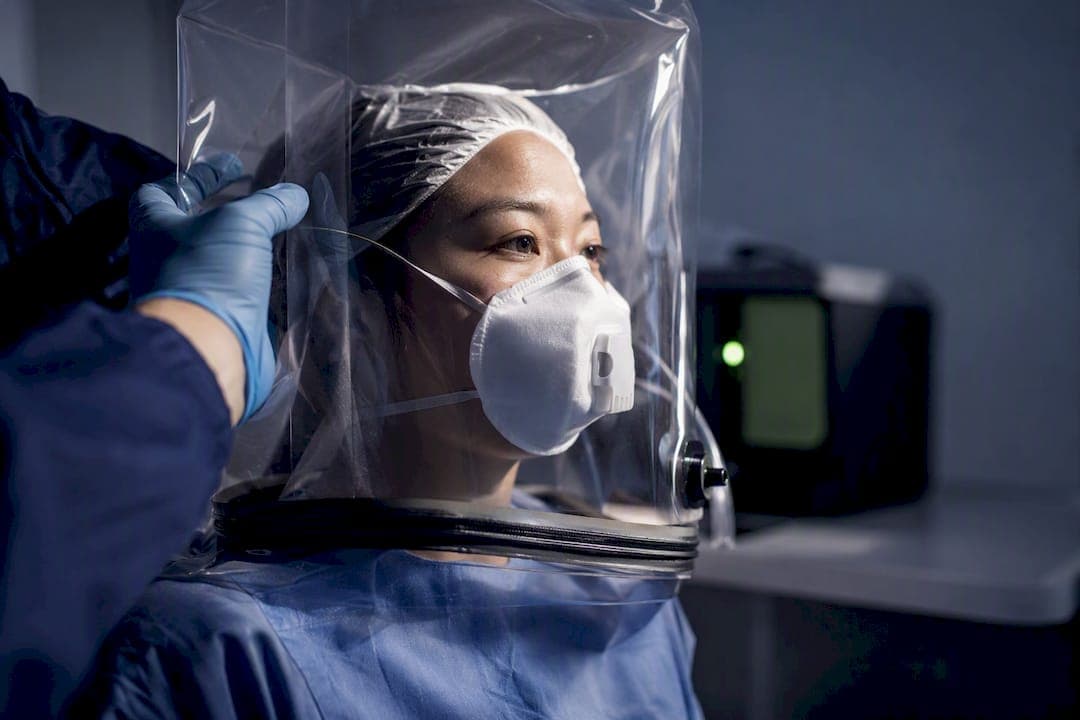
OSHA requires fit testing for every tight-fitting respirator before an employee's first workplace use, then at least once every twelve months thereafter, under 29 CFR 1910.134. You must confirm a qualified tester can run either a qualitative or quantitative test, hit the required pass level (100 for half-face, 500 for full-face), and document the result. Start now: list every worker in a tight-fitting respirator, schedule the initial and annual tests, and lock in a competent tester before anyone straps one on.
TL;DR:
- Employers must conduct an initial fit test for every worker using a tight-fitting respirator before first use, then at least once every 12 months, and after any respirator or facial change.
- Quantitative fit testing with a fit factor of at least 100 for half-face and 500 for full-face respirators is required, with proper probe placement and equipment calibration critical to accurate results.
- Proper protocol involves pre-test preparation, a wear-in period, a user seal check, facial hair removal, movement exercises, and strict monitoring to avoid invalidation.
- Records must include employee details, respirator specifications, test method, date, and results, retained for as long as the employee uses the respirator.
- Competent fit testers are those trained with documented proficiency in setup, calibration, troubleshooting, and adherence to OSHA procedures, not necessarily holding a formal certification.
Table of Contents
- What Are the OSHA Fit Testing Requirements for Employers?
- Qualitative vs. Quantitative Fit Testing: Which One Applies?
- Who Needs Fit Testing and How Often?
- Who Can Legally Conduct a Fit Test?
- How Do You Run an OSHA-Compliant Fit Test Session?
- What Records Must Employers Keep for Fit Testing?
- What Mistakes Cause Fit Tests to Fail or Get Invalidated?
- Why Fit Testing Compliance Is a Staffing Problem, Not Just a Safety One
- How NurseFlex Helps Employers Staff Fit-Tested Clinicians
- Where to Find the Official Fit Testing Rules
- Sources
What Are the OSHA Fit Testing Requirements for Employers?
The legal foundation sits in 29 CFR 1910.134, with Appendix A spelling out the exact protocols testers must follow. Any employee assigned a tight-fitting respirator, whether an N95 filtering facepiece, a half-mask elastomeric, or a full-face unit, needs a passing fit test before wearing it on the job. Loose-fitting respirators, including powered air-purifying respirators (PAPRs) with hoods, are exempt from fit testing because they don't rely on a seal against the face.
That distinction trips up a lot of safety programs. A facility might assume its PAPR-equipped staff are covered under the same testing schedule as N95 wearers, then discover during an audit that half its "compliant" workers were never actually required to test in the first place, while the ones who genuinely needed testing slipped through. Getting this sorted early saves confusion later.
Fit testing isn't a standalone task. It's one piece of a written respiratory protection program (RPP) that OSHA expects every employer with respirator use to maintain. A compliant RPP folds fit testing into a larger structure:
- Medical evaluation: workers must be medically cleared to wear a respirator before any fit test happens, typically through a questionnaire reviewed by a physician or other licensed health care professional.
- Training: employees need instruction on donning, doffing, seal checks, and the limitations of their specific respirator model.
- Program administration: someone at the organization owns the RPP, tracks who needs testing and when, and keeps records current.
- Respirator selection: employers must offer enough models and sizes that a genuine fit is achievable for different face shapes.
- Maintenance and storage: cleaning, inspection, and storage procedures that keep the respirator's sealing surface intact between uses.
NIOSH/CDC guidance makes an important point that gets lost in a lot of compliance checklists: fit testing isn't about the respirator's quality, it's about the seal on that specific person's face. A NIOSH-approved N95 that performs beautifully in a lab can still leak badly on an individual with a narrow bridge or a beard, which is exactly why the fit test exists as a separate, mandatory step even after the respirator itself has cleared federal approval.
For healthcare employers specifically, fit testing intersects directly with staffing logistics. A nurse pulled into a new unit for an airborne isolation shift needs a current fit test on file for the specific respirator model that unit stocks, not just any N95. Facilities that treat fit testing as an afterthought during rapid staffing changes tend to discover the gap during an actual exposure event, which is the worst possible time to find out.
Qualitative vs. Quantitative Fit Testing: Which One Applies?
OSHA accepts two categories of fit test, and the one you use depends on the respirator type and how much numerical precision your program needs.
Qualitative fit testing (QLFT) relies on the wearer's own sensory response. The tester introduces a test agent, saccharin, Bitrex, or isoamyl acetate are the most common, into a hood or enclosure around the wearer's head while they perform a series of exercises. If the wearer can taste or smell the agent through the respirator, the test fails. It's a pass/fail method with no numerical output, and OSHA's Appendix A restricts QLFT to filtering facepieces and other negative-pressure half-mask respirators. You cannot use QLFT for a respirator that requires a fit factor above 100, which rules it out for full-face units entirely.
Quantitative fit testing (QNFT) uses an instrument to generate an actual numerical fit factor. The most common tool in U.S. workplaces is a condensation nuclei counter (CNC), commercially known as a PortaCount, which measures the ratio of particle concentration outside the mask to the concentration inside it. Other accepted QNFT methods include controlled negative pressure (CNP) testing and generated aerosol protocols. The math is straightforward: a fit factor of 500 means the concentration inside the respirator is 500 times lower than outside it.
Pro Tip: If your program tests a mix of half-face and full-face respirators, run QNFT for everything rather than switching methods by mask type. It's more setup work upfront, but you avoid the confusion of two separate protocols and you get a defensible number on file for every worker, not just a pass/fail note.
The pass levels themselves are non-negotiable under federal rule:
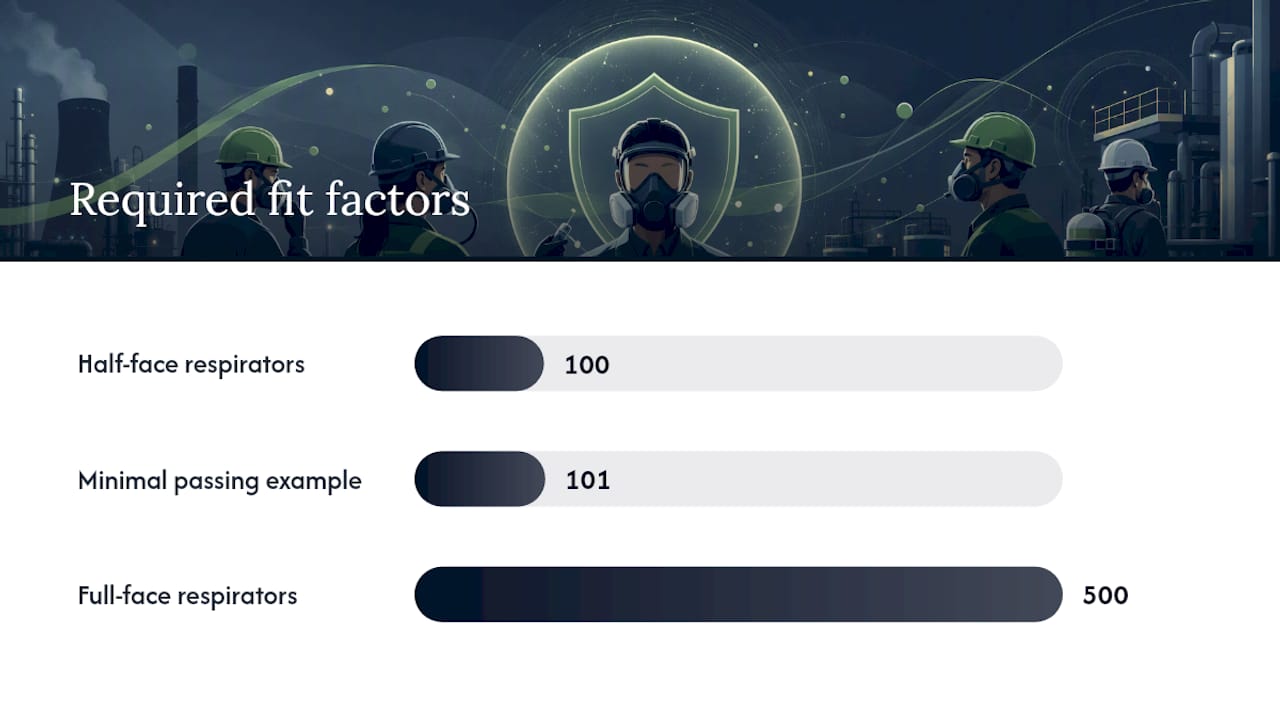
- Half-face respirators: minimum fit factor of 100 under quantitative testing.
- Full-face respirators: minimum fit factor of 500 under quantitative testing.
- Qualitative testing: pass/fail only, no numerical output, valid solely for exempted half-mask models.
A fit factor of 100 sounds abstract until you translate it: it means the wearer is breathing air that has been filtered roughly 100 times more effectively than unprotected air at the leak point. OSHA's protocol treats this threshold as the floor, not a target, so a result of 101 technically passes but leaves almost no margin if the respirator shifts slightly during a shift.
Quantitative testing on a probed respirator introduces its own mechanical wrinkles. The facepiece needs either a permanent sampling probe or a temporary probe adapter, and the tubing connecting that probe to the CNC has to be secured with proper strain relief. Skip the strain relief and the weight of the tubing can tug on the mask during exercises, distorting the seal and producing an artificially low fit factor that has nothing to do with how the respirator actually performs in daily use. NIOSH's guidance on filtration and fit testing flags this exact failure mode as a common source of false negatives in QNFT sessions, and it's worth checking every single time a probe is set up, not just occasionally.
Who Needs Fit Testing and How Often?
Every employee assigned a tight-fitting respirator for occupational use needs a fit test. That's the baseline. The frequency and retest triggers are where employers get tripped up, so here's the full sequence.
- Initial fit test before first use. No employee wears a tight-fitting respirator on the job until they've passed a fit test on that specific make, model, and size.
- Annual retest at minimum. OSHA and NIOSH both confirm the standing requirement of at least once every 12 months, regardless of whether anything about the employee or respirator has changed.
- Retest when switching respirator facepiece. A different make, model, or size triggers a new fit test immediately, even if the annual window hasn't closed. An employee who passed on a small half-face elastomeric doesn't automatically pass on a medium.
- Retest after facial or dental changes. Significant weight change, dental work, facial surgery, or new scarring near the sealing surface can all alter fit enough to require retesting.
- Retest when the employee reports a fit problem. If a worker tells you the respirator feels loose, uncomfortable, or is leaking during use, that report itself triggers a new test. Employers can't wait for the annual cycle to address it.
Prior fit test results from a previous employer can sometimes carry over, but only under specific conditions: the test must have used the identical respirator make, model, and size the new employer is issuing, it has to fall within the 12-month validity window, and the employer accepting the record needs documentation detailed enough to confirm all of that. In practice, most employers find it faster and less risky to just run a fresh test rather than chase down and verify someone else's paperwork, especially for healthcare staffing situations where a clinician might be moving between facilities on short notice.
Who Can Legally Conduct a Fit Test?
There's no single federal certification card that makes someone an OSHA-approved fit tester. That surprises a lot of safety officers who assume there's a national credential to check for, similar to a CPR certification. Instead, OSHA places the burden on the employer to verify that whoever runs the test is actually competent to do it.
Competency, in OSHA's framing, means the tester can prepare test solutions correctly, calibrate and operate the testing equipment, administer the full exercise protocol without shortcuts, and recognize when a result is invalid rather than just recording whatever number the machine spits out. A tester who doesn't understand that a slipping strap mid-exercise voids the test isn't competent, regardless of how many tests they've technically administered.
Most employers lean on the ANSI/AIHA/ASSE Z88.10 practice standard for respirator fit testing as their benchmark, and many use formal training programs from equipment manufacturers or occupational health vendors to get testers up to speed. For organizations without in-house capacity, contracting with an occupational health provider that specializes in respirator programs is often more practical than building the expertise internally.
A quick checklist for evaluating whether your fit tester is actually ready:
- Can they demonstrate correct calibration of the QNFT instrument before each testing session?
- Do they know the difference between a voided test and a passed test, and can they explain why an adjustment mid-exercise invalidates results?
- Have they completed a formal training program, and is that training documented?
- Can they correctly prepare QLFT sensitivity and fit-test solutions without guidance?
Pro Tip: Ask your fit tester to walk you through what they'd do if a PortaCount showed a fit factor of 40 on someone who passed easily last year. A competent tester immediately checks the probe connection and strain relief before assuming the employee's face changed. If they jump straight to "they must have lost weight," that's a red flag on their troubleshooting depth.
How Do You Run an OSHA-Compliant Fit Test Session?
Appendix A lays out a specific sequence, and skipping steps is the fastest way to end up with a test that won't hold up under audit. Here's the walkthrough.
1. Selection and demonstration. Before any testing begins, employees should be shown how to properly don the respirator, check the seal, and adjust straps, ideally in front of a mirror so they can see what a correct fit looks like. OSHA's Appendix A expects employees to have access to multiple models and sizes during this phase, not just whatever the facility happens to have in bulk.
2. Wear-in period. The employee wears the selected respirator for at least five minutes before testing starts. This isn't a formality. It gives the mask time to settle into its actual working position on the face, rather than testing the seal it has the moment it's first put on.
3. User seal check. Immediately before the formal test, the employee performs a positive or negative pressure seal check on their own. This is a quick self-assessment, not a substitute for the fit test itself, but it catches obvious problems before you burn time on a full session that's doomed to fail.
4. Facial hair check. Any facial hair that crosses the sealing surface, stubble included, invalidates the test before it starts. This is one of the most common reasons a scheduled fit test gets cancelled on the spot, and it's worth communicating the rule to employees well before their appointment so they're not showing up unshaven for nothing.
5. Exercise regimen. The employee performs a defined sequence of movements designed to simulate real workplace motion, since leaks tend to show up during movement rather than while standing still. Each exercise runs for one minute, except the grimace exercise, which runs 15 seconds. The exact list under Appendix A includes normal breathing, deep breathing, turning the head side to side, moving the head up and down, talking, the grimace test (for QNFT only), bending over, and a final round of normal breathing.
6. Monitoring for adjustments. If the employee touches, adjusts, or repositions the respirator at any point during the exercise sequence, the test is void. There's no partial credit. The whole sequence restarts from the beginning once the fit is reestablished.
7. Recording the result. For QNFT, the fit factor for each exercise (or the overall calculated result depending on the protocol variant used) gets logged, along with pass/fail status against the 100 or 500 threshold. For QLFT, it's a straightforward pass or fail based on whether the employee detected the test agent.
For quantitative sessions specifically, probe placement matters as much as the exercise sequence itself. The probe needs a secure connection with strain relief on the tubing, and NIOSH's technical guidance recommends checking that the filter cartridge used during CNC testing doesn't inadvertently strip out the ambient particles the counter needs to measure. Using an incompatible cartridge, one that filters too efficiently for the counting method, can produce a fit factor reading that looks like a failure when the actual seal is fine.
Pro Tip: Keep a printed copy of Appendix A at the testing station, not just saved on a laptop somewhere. When a result looks off, testers who can flip straight to the exercise list and cross-check timing tend to catch their own procedural mistakes faster than the ones relying on memory.
What Records Must Employers Keep for Fit Testing?
A fit test that isn't documented might as well not have happened, at least from an OSHA inspector's perspective. The minimum fields your recordkeeping needs to capture, consistent with practices reflected in state-level guidance like Washington's WAC 296-842-15005, include:
- Employee name
- Respirator make, model, and size
- Fit test method used (QLFT or QNFT, and which specific protocol)
- Test date
- Pass/fail result, and the numerical fit factor for QNFT sessions
Retain these records for as long as the employee is using that respirator, and keep them accessible for OSHA review during an inspection. Most compliant programs fold fit-test records directly into the employee's broader respiratory protection file alongside medical clearance and training documentation, rather than storing them in a separate system that someone has to remember to cross-reference.
If you're accepting a fit test result from a prior employer, the documentation burden gets heavier, not lighter. You need written confirmation of the exact make, model, and size tested, the test date (to confirm it's within the 12-month window), and the method used. Without all three, treat it as if no test exists and run a new one. This is also where credential checklists for healthcare placement become relevant, since fit-test records often travel alongside licensure and immunization documents when a clinician moves between facilities.
What Mistakes Cause Fit Tests to Fail or Get Invalidated?
A surprising number of failed fit tests have nothing to do with the respirator's actual seal quality. They're procedural errors that produce a bad number on a mask that would otherwise pass.
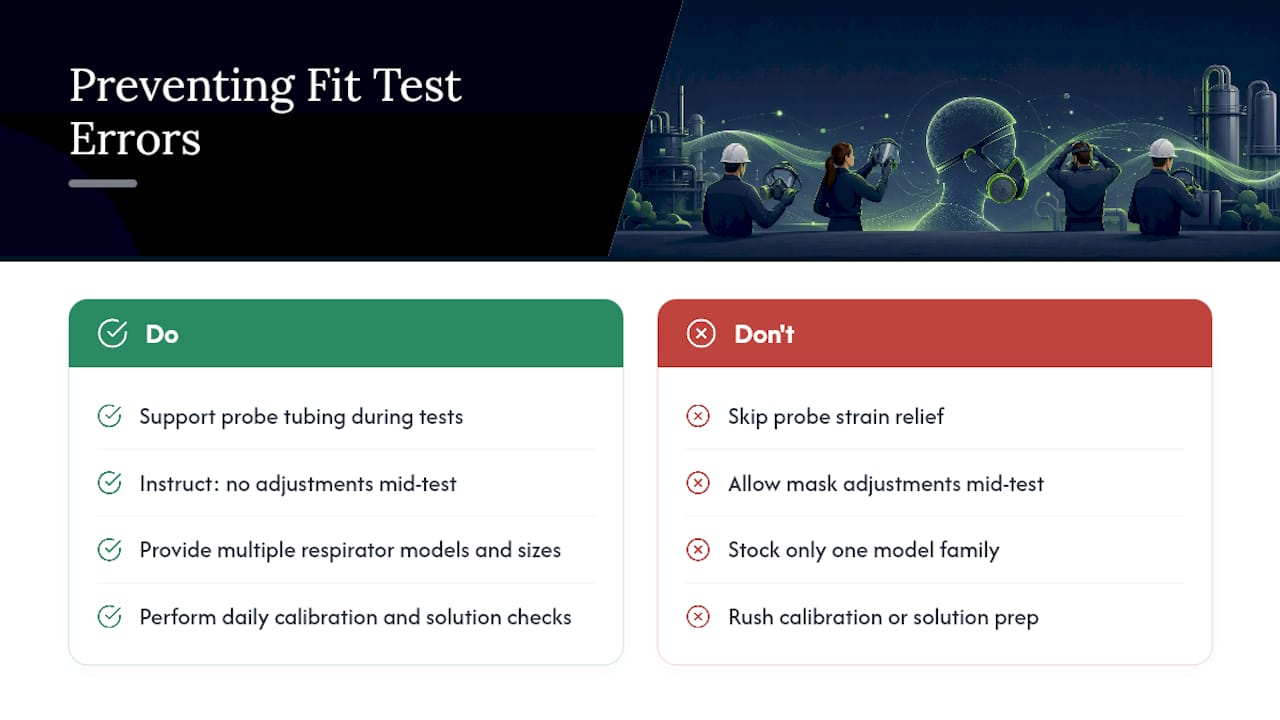
Probe strain relief gets skipped. The tubing connecting a probed respirator to a CNC instrument needs to be supported so its weight doesn't pull on the mask during exercises. Without it, movement during the test drags the facepiece slightly out of position, and the resulting fit factor reads lower than the true seal quality.
Adjustments during exercises void the whole session. Employees instinctively reach up to fix a slipping mask mid-test. Once they touch it, the test has to restart. Testers should brief employees on this rule before starting, not after the first violation.
Limited model selection forces a bad fit. If your facility stocks only one respirator model in two sizes, some employees are never going to pass, no matter how many times they test. Appendix A expects a genuine range of options, and broader model selection correlates with better pass rates and stronger on-shift compliance, since workers who chose a mask that actually fits their face are more likely to wear it correctly all shift long.
Calibration and solution prep get rushed. A CNC instrument that hasn't been calibrated that day, or QLFT sensitivity solution that's past its useful concentration, produces results nobody should trust. Build calibration checks into the start of every testing session rather than treating them as a weekly task.
Ambient particle levels skew CNC readings. Testing in a room with unusually high or low background particle counts can throw off the ratio calculation. A stable, moderately particle-rich environment (not a freshly HEPA-filtered clean room) gives the counter something consistent to measure.
Pro Tip: If a worker who's passed fit tests for years suddenly fails, don't assume their face changed. Check the equipment first, calibration, probe connection, cartridge compatibility, before you put them through a stressful conversation about facial hair or weight change that might not even be the real issue.
Why Fit Testing Compliance Is a Staffing Problem, Not Just a Safety One
Most safety officers treat fit testing as a box to check before a shift starts. That framing misses the staffing cost of getting it wrong. Every clinician who shows up to an airborne isolation unit without a current, matching fit test on file is a shift that gets disrupted, a reassignment scramble, or worse, a compliance gap that only surfaces during an incident review.
The employers who handle this well tend to do one thing differently: they give clinicians a real choice of respirator models rather than issuing whatever's in the supply closet. Comfort drives compliance, and a worker who chose their own fit is far less likely to fudge a seal check just to get through a busy shift. That's not a minor operational detail. It's the difference between a program that looks compliant on paper and one that actually holds up when someone's exposed.
Onboarding speed matters here too. Facilities that treat fit-test documentation as an afterthought during rapid hiring routinely discover the gap only after a staffing delay forces someone to scramble for a same-day retest. Building fit-test verification into the credentialing step from day one, rather than bolting it on later, saves everyone the last-minute panic.
— Flexible
How NurseFlex Helps Employers Staff Fit-Tested Clinicians
Fit testing itself stays entirely on the employer's plate; that responsibility never transfers. What Flexiblenursingcareers does is remove the friction around finding clinicians who are ready to meet those requirements the moment they walk in. Instead of sorting through stacks of applications hoping someone's paperwork lines up, employers get matched in real time with credentialed nurses and healthcare professionals whose documentation, including respiratory protection records, is already organized and ready for review.

That matters most when a unit needs coverage fast and can't afford a candidate who shows up without a current fit test on file for the correct respirator model. The service doesn't administer fit tests or replace your occupational health provider. It helps connect you with qualified candidates, so your compliance team can focus more on verifying paperwork. If your facility is trying to fill respirator-required shifts without the usual hiring lag, visit the employer page to see how the matching process works, or browse current nursing job listings to start building your candidate pool today.
Where to Find the Official Fit Testing Rules
For the exact legal text, go straight to OSHA's Appendix A, the mandatory fit-test protocol document, and keep a copy on hand for your testers. NIOSH/CDC's fit-testing overview offers plain-language guidance, and TSI's protocol comparison is useful if you're weighing OSHA's rules against international standards.
Sources
- 1910.134 App A - Fit Testing Procedures (Mandatory) | OSHA
- Fit Testing | Personal Protective Equipment | NIOSH/CDC
- Respirator Fit Test Protocol Comparison: OSHA, HSE & ISO | TSI