
Joint Commission National Performance Goal 12 requires hospitals to be staffed to meet patient needs and for a licensed registered nurse to direct nurse staffing operations, effective January 2026. It replaces informal staffing guidance with a defined standard: adequate numbers, the right skill mix, verified competency, and a nurse executive who owns the decisions. Hospitals that treat this as a documentation exercise, rather than an operational one, will struggle at survey.
TL;DR:
- Hospitals must maintain a written, up-to-date staffing plan that accounts for patient acuity and service volume at least annually.
- The nurse executive responsible for staffing must hold an active RN license and have documented authority over staffing decisions, reporting regularly to governance bodies.
- Documentation should include primary-source verification of credentials, competency assessments, and performance improvement analyses linked to staffing levels and patient outcomes.
- Regular self-audits, mock tracer exercises, and real-time staffing platforms like NurseFlex Jobs help hospitals prepare for surveyor reviews and demonstrate compliance.
- Outcome-focused staffing, supported by competency systems and technology, is more effective than fixed nurse-to-patient ratios in meeting accreditation standards.
Table of Contents
- What Joint Commission Staffing Standards Actually Require
- What Surveyors Look For During Accreditation Reviews
- How to Prepare Now for Joint Commission Staffing Requirements
- Linking Staffing to Outcomes: Performance Improvement and Competency
- Survey-Ready Checklist: Evidence to Have on Hand
- Technology's Role in Meeting Joint Commission Competency Requirements
- Why Outcome-Linked Staffing Beats Fixed Ratios
- How NurseFlex Jobs Supports Staffing Agility and Documentation
- Sources
What Joint Commission Staffing Standards Actually Require
NPG 12 sets a plain expectation: hospitals must staff units to meet patient needs, and every staff member assigned to patient care must be competent to do that work. The Joint Commission's national performance goals tie this to specific Elements of Performance, not a general aspiration. Hospitals need a written staffing plan, a documented process for determining the right number and mix of staff for each unit, and a nurse executive accountable for both.
That nurse executive requirement is not a formality. Under the NPG 12 language for hospitals, the executive directing staffing operations must hold an active RN license. This person sets staffing policies, decides staff types and numbers by unit or service line, and answers for those decisions when outcomes trend the wrong way. A chief operating officer or non-nurse administrator can support staffing operations, but cannot be the accountable authority under this goal.
Primary-source verification and a maintained Staffing List sit underneath the standard's Elements of Performance. The Joint Commission's Hospital Program materials effective January 2026 spell out documentation windows for verifying credentials, including expedited timelines for emergency or disaster staffing. NPG 12 does not replace the CMS Conditions for Participation; it layers accreditation-specific proof requirements on top of the federal floor CMS already sets for adequate nursing services.

What Surveyors Look For During Accreditation Reviews
Surveyors build their staffing assessment from documents first, then confirm what they see through interviews and tracer activity. Expect them to request:
- The hospital's written staffing plan, including how acuity and service volume factor into unit assignments.
- The current Staffing List, showing job categories, unit placement, and competency status for each role.
- Personnel files with primary-source verification records and completion dates.
- Performance improvement (PI) analyses that connect staffing levels to safety or quality trends.
- Competency assessment records tied to defined intervals, not just hire-date orientation.
Tracer methodology means a surveyor will follow a single patient's care path and ask staff, on the spot, how their assignment was determined and whether they felt equipped for it. A charge nurse who cannot explain how the day's staffing matched patient acuity is a bigger red flag than a missing form. Surveyors also look at timing: competency reassessments on a defined cycle (often annual, sometimes tied to specific high-risk procedures) and verification completed before, not after, a clinician starts patient care.
How to Prepare Now for Joint Commission Staffing Requirements
Preparation starts with governance, not paperwork. Confirm the nurse executive's authority is documented in bylaws or an organizational chart, and that staffing decisions are reported to the board or a quality committee on a regular cycle, not just when something goes wrong.
- Write and maintain a formal staffing plan tied to each unit's typical acuity and service volume, updated at least annually or after a major service change.
- Build a current Staffing List that maps every clinical role to its unit, shift pattern, and competency status, and review it on a set schedule.
- Standardize primary-source verification workflows so license, certification, and background checks happen before a clinician's first patient assignment, with a documented exception process for emergency credentialing.
- Fold emergency and disaster staffing into the plan, referencing the hospital's hazard vulnerability analysis so surge staffing has a documented basis rather than an improvised one.
Pro Tip: Run a mock tracer once a quarter. Pick one unit, pull one patient chart, and have your charge nurse walk a colleague through how that day's staffing was decided. If they can't answer in under two minutes, your documentation trail has a gap a real surveyor will find.
Linking Staffing to Outcomes: Performance Improvement and Competency
NPG 12 requires staffing adequacy to enter the hospital's performance improvement analysis whenever there is an undesirable pattern, trend, or single serious event tied to patient safety or quality, according to AIHC's summary of the goal. That means a spike in falls, missed medication administrations, or a sentinel event on a specific unit should trigger a documented look at whether staffing levels or skill mix played a role, not just a clinical root-cause review.
Useful metrics to track alongside staffing data include:
- Skill mix ratios by unit and shift.
- Staff turnover and vacancy rates, which often precede quality declines.
- Missed or delayed care events.
- Acuity-adjusted patient outcomes, since a PMC review of staffing and outcomes literature links skill mix and staffing levels directly to measurable patient results.
Competency assessments need their own documented cadence. Orientation checks alone are not enough. Organizations should define assessment methods (direct observation, simulation, written testing, or peer feedback), set reassessment intervals, and name who is responsible for signing off, with records kept in each employee's personnel file.
Survey-Ready Checklist: Evidence to Have on Hand
Assemble a single packet before survey season rather than scrambling unit by unit. Include:
- Current written staffing plan with acuity and volume assumptions spelled out.
- Staffing List showing job types, units, and competency status.
- Personnel files with primary-source verification dates clearly documented.
- PI analyses that show staffing was evaluated after any relevant safety or quality trend.
- Emergency and disaster staffing plan referencing the hazard vulnerability analysis.
- Competency assessment policy naming methods, intervals, and responsible assessors.
Frame every staffing decision as a three-part story: what the patient need was, who was assigned and why they were qualified, and what outcome followed. The most common gap hospitals find, once they audit themselves, is a competency record that lapsed past its stated interval. Close that gap by auditing personnel files against your own policy's reassessment schedule before a surveyor does it for you.
Technology's Role in Meeting Joint Commission Competency Requirements
Real-time, competency-tagged staffing platforms make the documentation trail easier to produce on demand. When an assignment tool matches a nurse to a shift based on verified skills and current acuity, that match itself becomes evidence that staffing decisions were competency-driven rather than convenience-driven.
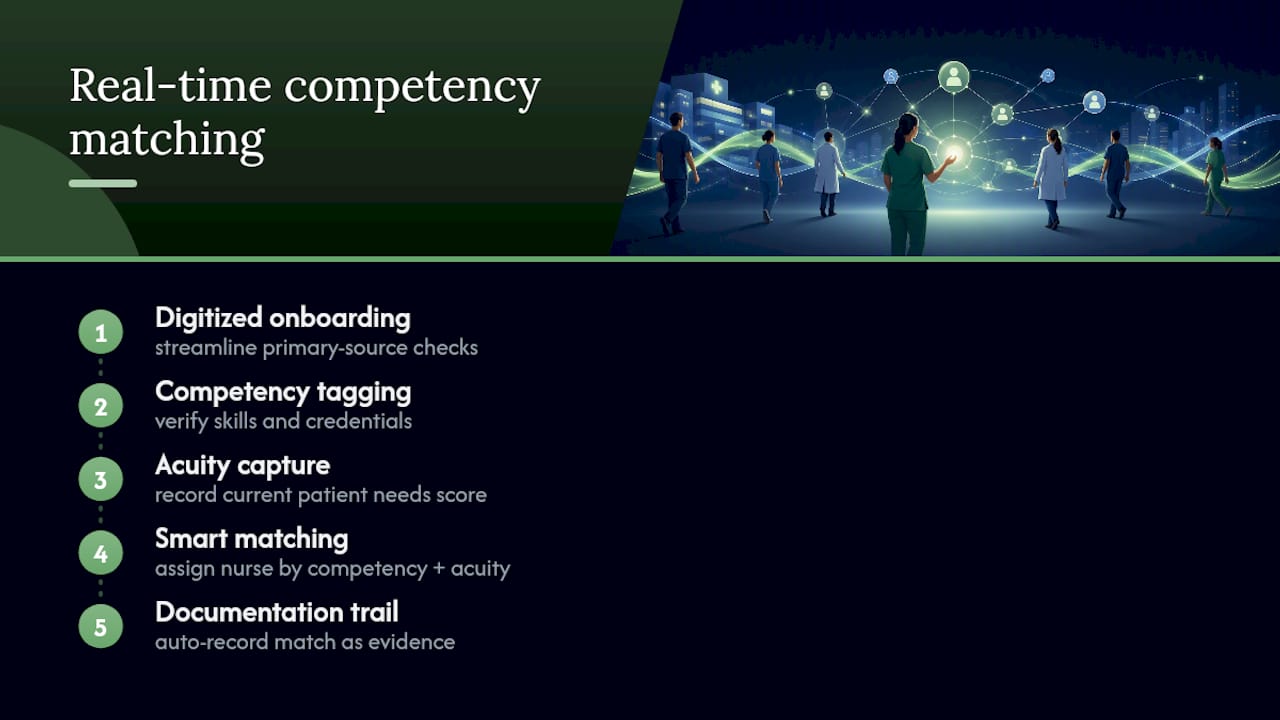
Faster, digitized onboarding also closes the verification gaps surveyors flag most often. A streamlined credential-checking process reduces the odds a clinician starts a shift before primary-source verification is complete, which is exactly the kind of timing lapse tracer methodology exposes.
Why Outcome-Linked Staffing Beats Fixed Ratios
NPG 12 does not mandate a nurse-to-patient ratio, and that is deliberate. Hospitals that chase a fixed number miss the point. The smarter investment is in competency systems, PI integration, and documentation that ties every staffing call to a patient outcome. Executive reporting should follow that same logic.
— Flexible
How NurseFlex Jobs Supports Staffing Agility and Documentation
Meeting NPG 12 takes more than policy language. It takes staffing operations that can actually produce verified, competency-matched coverage on short notice, and prove it. NurseFlex Jobs was built for exactly that gap: real-time matching connects open shifts to nurses whose skills and availability fit the assignment, competency tags travel with each candidate's profile, and rapid onboarding shortens the window between hire and first shift, where verification lapses tend to happen.

For hospitals building a stronger evidence trail around staffing decisions, a platform like NurseFlex Jobs can support the record-keeping without replacing internal governance. Your nurse executive still owns the staffing plan and the PI process; the platform simply reduces the manual effort of matching qualified staff to units under pressure. Explore how the employer-facing tools work for flexible staffing, or browse current nursing job listings to see the matching process firsthand. For scheduling workflows and documentation templates, hospitals often pair this approach with resources like MyLTC Apps' compliance-first scheduling guide. Start by requesting a demo to see how real-time matching fits your unit's staffing plan.
Sources
- National Performance Goals | Joint Commission
- National Performance Goals™ Effective January 2026 for the Hospital Program (Joint Commission PDF)
- Nurse staffing as national performance goal 12 | AIHC
- PMC article on staffing and outcomes