
Nurses must either document immunity or receive specific vaccines commonly required by employers, most often hepatitis B, annual influenza, MMR, varicella, and Tdap. State or facility rules can add layers on top of that baseline. The CDC's recommended vaccines for healthcare personnel list forms the clinical backbone, while state health departments and individual hospital occupational health policies decide how those recommendations get enforced. The American Nurses Association treats immunization as a professional obligation, not a preference.
Here's what to do in the next 24 to 72 hours if you're job hunting or starting orientation soon:
- Pull your records now. Track down vaccination cards, prior employer occupational health files, or school health records before you need them.
- Request your employer's actual vaccine policy in writing. Don't rely on a recruiter's summary. Ask HR or occupational health for the document itself.
- Book titer testing or catch-up doses immediately if you can't find documentation. Waiting until orientation week creates avoidable delays.
Pro Tip: If you're between jobs right now, get your titers drawn today. Lab turnaround alone can eat a week, and most facilities won't schedule you for orientation without results in hand.
Key Takeaways
Nurses who document immunity or complete required vaccines, most often hepatitis B, annual influenza, MMR, varicella, and Tdap, avoid onboarding delays and unit reassignment.
| Point | Details |
|---|---|
| Core vaccine list | Hepatitis B, annual influenza, MMR, varicella, and Tdap are the vaccines most commonly required across U.S. healthcare employers. |
| Serology often required | Titers or anti-HBs testing frequently replace informal history, especially when documentation can't be located. |
| Rules stack in layers | Employer policy is enforced daily; state statutes add mandates on top; ACIP and CDC set the clinical baseline underneath both. |
| Exemptions carry conditions | Medical, religious, or philosophical exemptions rarely mean no employer response, masking, reassignment, or limited privileges often follow. |
| Portfolio prevents delays | Keeping scanned records, lab reports, and dates in one place avoids redundant titers when changing employers. |
Table of Contents
- Immunization Requirements for Nurses: What's Required vs. Recommended
- Vaccine-by-Vaccine Briefings Every Nurse Should Know
- How to Prove Immunity: The Records and Lab Tests Employers Accept
- Medical, Religious, and Philosophical Exemptions: What Employers Can Actually Require
- Who Sets These Rules, and Where to Check for Updates
- A Step-by-Step Checklist for Job Searches and Employer Changes
- Why the Immunization Push Isn't Just Bureaucracy
- Why Flexiblenursingcareers Pays Close Attention to Your Immunization Records
- The Gap Between What Nurses Assume and What Actually Gets Enforced
- Frequently Asked Questions About Nurse Immunization Requirements
- Sources
Immunization Requirements for Nurses: What's Required vs. Recommended
Not every vaccine on a hospital's list carries the same weight. Some are non-negotiable conditions of employment. Others are strongly recommended by ACIP but left to facility discretion. Knowing the difference keeps you from scrambling over a shot nobody actually mandated, or worse, missing one that does show up as a hard stop at credentialing.
Commonly required or treated as a condition of employment:
- Hepatitis B — Documented series completion or immunity is expected almost universally for anyone with patient contact, verified through vaccination dates or anti-HBs serology.
- Influenza (annual) — Most hospitals require a fresh dose every flu season, verified through occupational health records.
- MMR (measles, mumps, rubella) — Two documented doses or positive IgG titers for all three components.
- Varicella (chickenpox) — Two documented doses, a positive titer, or in some cases a clinician-confirmed history of disease.
- Tdap — At least one adult dose is standard, verified through documentation of the specific Tdap formulation, not just any tetanus shot.
Routinely recommended or situational:
- Meningococcal vaccine — Recommended for microbiologists and some lab personnel handling isolates, not typically required for bedside nurses.
- Pneumococcal vaccine — Recommended for HCP with certain underlying conditions, not a blanket workforce requirement.
- COVID-19 vaccination or boosters — Facility policies vary widely and continue to shift; check current employer policy rather than assuming a fixed rule.
- Travel-related vaccines — Relevant mainly for travel nurses heading to assignments with specific regional disease exposure.
The distinction matters because ACIP and the CDC issue clinical recommendations, but those recommendations only become binding when a state statute or an employer's occupational health policy adopts them as a condition of employment. A recommendation tells you what's medically sound. A mandate tells you what happens if you show up without it.
Vaccine-by-Vaccine Briefings Every Nurse Should Know
Hepatitis B: series options and when serology matters
If you've never been vaccinated against hepatitis B, you have two legitimate paths. The two-dose Heplisav-B series is given at day 0 and one month later. The three-dose route, using Engerix-B or Recombivax HB, follows a 0, 1, and 6-month schedule. Both are considered complete series under CDC recommendations.
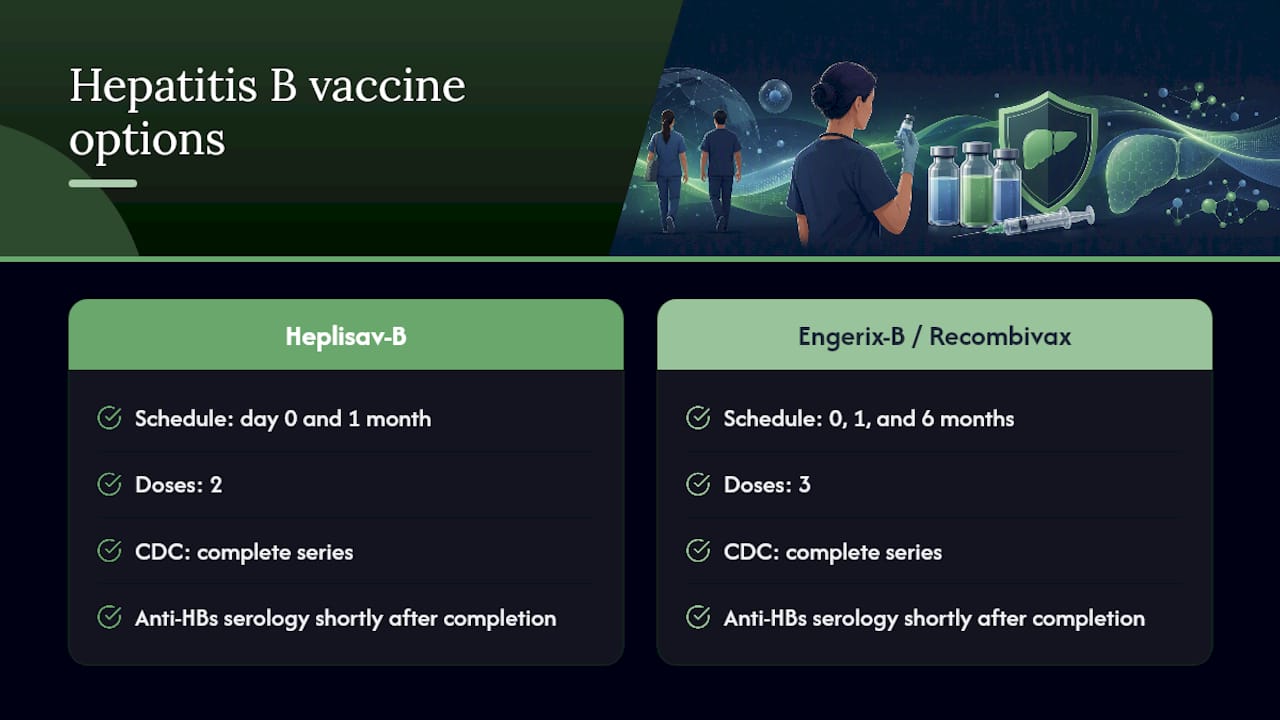
For nurses with occupational blood exposure risk, which covers nearly all bedside and procedural roles, anti-HBs serologic testing is advised shortly after finishing whichever series you chose. A reactive result confirms immunity. A non-reactive result usually triggers a second full series followed by repeat testing, since a meaningful percentage of adults don't seroconvert after the first attempt.
Under OSHA's Bloodborne Pathogens standard, your employer must offer the hepatitis B vaccine at no cost if your job carries occupational exposure risk, and must provide you with information about it before you decide. If you decline, OSHA requires you to sign a formal declination form, which stays in your employee health file and can be revisited if your role or exposure risk changes.
Influenza: annual, and the declination conversation isn't going away
Annual influenza vaccination is recommended for all healthcare personnel, full stop. What varies is enforcement. Some systems mandate the vaccine outright as a condition of continued employment. Others allow declination but attach consequences, most commonly mandatory surgical masking in patient care areas throughout flu season for anyone who opts out.
One detail nurses in oncology, transplant, NICU, or bone marrow units should know: inactivated injectable influenza vaccine (IIV) is preferred over live attenuated formulations for staff who work with severely immunosuppressed patients, according to CDC's Pink Book guidance. If your unit rotates you through high-risk transplant floors, don't assume any flu shot satisfies the requirement, ask occupational health which formulation your facility stocks.
MMR and varicella: documentation or titers, no shortcuts
Facilities generally accept two documented doses of MMR or laboratory evidence of immunity (positive IgG) for measles, mumps, and rubella individually. The same two-track logic applies to varicella: two documented doses, a positive titer, or in some states a clinician's documented diagnosis of prior chickenpox.
Here's where a lot of nurses get tripped up. Verbal recollection of "I had chickenpox as a kid" or a faded pediatrician's card from 1998 frequently isn't enough for credentialing at larger health systems, which often insist on formal lab serology regardless of self-reported history. If you can't produce solid documentation, plan on a blood draw, not a conversation with HR.
If titers come back negative or equivocal, catch-up vaccination is the standard path, and most occupational health departments can get you started the same day you test.
Tdap and Td: one adult dose, then boosters on schedule
Nurses need documentation of at least one Tdap dose as an adult, distinct from a generic tetanus booster. After that initial Tdap, routine Td or Tdap boosters follow the standard ten-year interval unless a specific exposure (like a dirty wound) calls for an earlier one. Some facilities in maternal-child health or pediatrics push harder on Tdap timing given pertussis exposure risk to newborns.
Meningococcal and pneumococcal: mostly situational
These rarely show up as blanket nursing requirements. Meningococcal vaccination matters more for clinical laboratory staff handling Neisseria meningitidis isolates. Pneumococcal vaccination is recommended for HCP with specific underlying health conditions rather than the general nursing workforce. If your role doesn't fall into either category, don't expect these to appear on your onboarding checklist, though it's worth confirming with occupational health if you work in a specialty lab or research setting.
COVID-19: policy in flux, check before you assume
COVID-19 vaccination policy for healthcare personnel remains one of the more unsettled areas. Some facilities still document vaccination status as part of onboarding; others have scaled back formal requirements entirely. Because this is an area where employer policy can shift faster than most other vaccines on this list, verify current facility and state guidance directly rather than assuming last year's rule still applies. ACIP and CDC recommendations continue to evolve here, so a quick check before your start date beats relying on outdated information from a previous job.
Pro Tip: Keep a running log with exact dates, lot numbers, and administering clinic for every vaccine you receive from now on. When you switch jobs, ask the new occupational health department to enter your records into the state immunization information system (IIS) if one exists. It turns a folder of paper into something searchable across employers.
How to Prove Immunity: The Records and Lab Tests Employers Accept
Employers generally accept three categories of proof: an official immunization record with specific dates, laboratory serology showing numeric antibody levels against a reference range, or in limited cases, documented clinical disease from a treating clinician. What they don't reliably accept is your memory of what you think you had as a kid.
Serology becomes necessary, not just preferred, in a few specific situations. Anti-HBs testing for hepatitis B typically happens one to two months after completing the vaccine series for anyone with blood exposure risk. MMR and varicella titers step in whenever documented doses can't be located, which is common for nurses who trained or worked across several states and lost track of paperwork along the way.
Getting your records together doesn't have to be complicated:
- Contact prior employers' occupational health departments directly. Most retain employee health files for years and can fax or email a copy.
- Request transcripts from nursing school health services. Many programs required immunization documentation for clinical rotations, and that file often still exists.
- Order titers through your primary care provider, a retail pharmacy clinic, or an urgent care center if documentation genuinely can't be found.
- Ask your current or prospective employer's occupational health team whether they can administer catch-up vaccines onsite during onboarding, which often saves a separate appointment.
Build a simple immunization portfolio and keep it current: scanned copies of your vaccination card, PDF lab reports with reference ranges visible, any signed declination forms, and a one-page summary listing every dose with dates. Store it both physically and digitally. A consolidated portfolio prevents redundant titers and speeds up every future credentialing cycle you go through.
Medical, Religious, and Philosophical Exemptions: What Employers Can Actually Require
Exemption categories exist, but acceptance varies sharply by state and by facility, and none of them make you exempt from all employer response. Medical exemptions require documentation from a physician of a genuine contraindication, such as a severe allergic reaction to a vaccine component. Religious exemptions depend on state law and facility policy, and some states have narrowed or eliminated nonmedical exemptions for healthcare workers entirely. Philosophical exemptions are recognized in only a handful of states and almost never for HCP specifically.
Even where an exemption is granted, employers commonly attach conditions. It's rarely a free pass. Expect one or more of the following:
- Annual declination paperwork that must be re-signed and reviewed each year, not filed once and forgotten.
- Mandatory masking in patient care areas, particularly during declared flu season.
- Reassignment away from high-risk units, such as transplant, oncology, or neonatal intensive care.
- Limits on clinical privileges in some hospital systems, especially for procedural or surgical roles.
- Termination, in facilities with strict mandate policies and no accommodation pathway.
New York offers a concrete example of how this plays out in statute: when the state health commissioner declares influenza season underway, unvaccinated personnel must wear surgical masks in patient and resident care areas, regardless of why they're unvaccinated. That's not a hospital's internal preference. It's a state requirement with teeth.
The ANA's official position doesn't support exemptions beyond medical contraindication, framing immunization as an ethical professional obligation rather than a personal choice comparable to other workplace preferences.
Pro Tip: If you're pursuing a medical exemption, get the contraindication documented in writing by the physician who diagnosed it, not a general practitioner filling out a form secondhand. Bring that documentation to occupational health early and ask directly what accommodation options exist for your specific unit before assuming reassignment or termination are the only outcomes.
Who Sets These Rules, and Where to Check for Updates
Three layers govern what you're actually required to do, and they don't always agree with each other. Your employer's occupational health policy is what gets enforced day to day, it's the document that decides whether you clock in or get sent home. State statutes and regulations sit above that, sometimes mandating specific vaccines or specific consequences (like New York's masking rule) that employers must follow regardless of their own preference. Federal guidance from ACIP and the CDC shapes the clinical recommendations underneath both layers, while OSHA and CMS influence exposure-related obligations and reporting.
When you need to check current rules, work through them in this order:
- Start with your facility's occupational health policy. It's the most immediately enforceable document and usually the fastest to obtain.
- Check your state health department's HCP vaccine page. The CDC's State Immunization Laws for Healthcare Workers tool lets you look up state-specific rules and exemption recognition directly.
- Consult ACIP and CDC clinical guidance for dosing schedules, serology timing, and series options once you know what's mandated.
- Ask about your state's immunization information system (IIS) if you want your records centralized and accessible to future employers without repeat paperwork.
A Step-by-Step Checklist for Job Searches and Employer Changes
Before you start applying:
- Assemble your immunization portfolio: scanned vaccination cards, lab reports, and any signed declination forms.
- Request official copies from prior employers' occupational health departments and your nursing school's health services office.
- Schedule titer testing now for anything you can't document, rather than waiting until an offer is on the table.
During onboarding:
- Submit your full portfolio to the new employer's occupational health department as early as they'll accept it.
- Complete any mandated series or sign required declination forms, understanding what each one commits you to.
- Schedule follow-up serology (like anti-HBs testing) if your role requires it, and calendar the appointment before you forget.
When you switch facilities or take a travel assignment:
- Confirm unit-specific requirements. Transplant, oncology, and NICU units often carry additional expectations beyond baseline hospital policy.
- Update your records in your state's IIS if one exists, so the next facility can pull your history instead of starting from zero.
- Ask about employer-provided vaccines and realistic timelines for catch-up doses before your start date, especially for multi-dose series that need weeks to complete.
Most catch-up vaccination happens fastest through employer occupational health during onboarding, since it's typically provided at no cost to you. Community health clinics, retail pharmacy clinics, and public health departments are solid backups when you need something before a job even starts.
Pro Tip: If you're job hunting across multiple facilities at once, upload your immunization documentation to your professional profile as soon as it's assembled. Employers with strict vaccine requirements often prioritize candidates who've already cleared this hurdle over ones who haven't started the paperwork.
Why the Immunization Push Isn't Just Bureaucracy
Mandatory immunization policies work. Comprehensive workplace programs that follow ACIP recommendations and provide employer-supported vaccination access measurably increase coverage rates and reduce workplace disruptions, including fewer staff furloughs after exposure incidents and lower post-exposure management costs for the facility. That's not an abstract policy win. Every nurse pulled off the floor for a two-week furlough after an exposure is a nurse who isn't covering your unit that week either.
The American Nurses Association frames this in ethical terms rather than purely operational ones: nurses carry a professional obligation to protect the patients they treat, and immunization is one of the more direct ways that obligation gets fulfilled. The ANA's position also pushes back on the idea that employers should tolerate broad nonmedical exemptions, arguing instead for employer-provided, cost-free vaccination access as the mechanism that actually gets coverage rates up.
Pro Tip: If a coworker pushes back on a mandate, the strongest argument usually isn't "it's the rule." It's the operational one: unvaccinated exposures mean furloughs, furloughs mean short staffing, and short staffing means everyone left on the floor absorbs the difference. That's the version that tends to land.
Why Flexiblenursingcareers Pays Close Attention to Your Immunization Records
Placement speed usually comes down to paperwork, not clinical skill. When a nurse's immunization portfolio is complete and current, occupational health can clear them faster, and that's the difference between starting a shift this week or waiting three weeks for a repeat titer that should never have been necessary.
At Flexiblenursingcareers, we've built the platform around exactly that friction point. Nurses who upload credentials early, including immunization dates, lab results, and prior employer documentation, surface faster to facilities with strict vaccine requirements because there's nothing left for occupational health to chase down.
If you're building out your profile, fill in every immunization field completely rather than leaving gaps for "will provide later." Facilities searching for fast-start candidates filter on exactly that completeness. Browse current nursing jobs on Flexiblenursingcareers and get your documentation uploaded before you start applying, not after an offer lands.
The Gap Between What Nurses Assume and What Actually Gets Enforced
Most nurses treat immunization requirements as a single, uniform checklist. That's the wrong mental model. What actually determines your obligations is a three-layer stack, employer policy, state statute, and federal guidance, and each layer can override or add to the one below it without much warning.
The bigger blind spot is documentation, not vaccination itself. Plenty of nurses assume they're covered because they got the shots years ago. What trips people up during credentialing isn't a missing vaccine. It's a missing piece of paper proving the vaccine happened, with the right dates and the right formulation named. A verbal history of childhood chickenpox means nothing to an occupational health coordinator running through a compliance checklist. A titer result with a reference range printed on it means everything.
The other underestimated factor is how fast COVID-19 policy keeps shifting relative to the rest of this list. Hepatitis B and MMR requirements have been stable for decades. COVID-19 policy has changed multiple times across multiple years, and nurses who assume last year's rule still applies are the ones who get caught flat-footed at orientation. Treat that one category differently: verify it fresh every time you change jobs, rather than assuming continuity with your last position.
Frequently Asked Questions About Nurse Immunization Requirements
Do nurses need vaccinations to work in a hospital? Yes. Nearly every U.S. hospital requires documented immunity or completed vaccination for hepatitis B, MMR, varicella, and Tdap, plus annual influenza vaccination, as a condition of employment or clinical placement.
What happens if a nurse can't find their old vaccination records? Occupational health departments typically order titer testing to confirm immunity when documentation can't be located, which is common practice rather than a red flag.
Can a nurse refuse the flu vaccine? Some facilities allow declination with conditions, most commonly mandatory masking in patient care areas throughout flu season. Other facilities treat annual influenza vaccination as a strict condition of employment with no declination option.
Are religious exemptions from vaccination guaranteed for nurses? No. Recognition of religious exemptions varies by state, and some states have removed nonmedical exemptions for healthcare personnel entirely. Even where recognized, exemptions often come with employer-imposed conditions like reassignment or masking.
How long does hepatitis B immunity testing take after finishing the vaccine series? Anti-HBs serologic testing is typically done one to two months after completing either the two-dose Heplisav-B or three-dose Engerix-B/Recombivax HB series.
Where can nurses check state-specific immunization requirements? The CDC's State Immunization Laws for Healthcare Workers tool and individual state health department HCP vaccine pages are the most reliable sources for state-specific rules and exemption recognition.
This article is general information, not a substitute for advice from a qualified doctor. Consult a qualified healthcare professional about your own circumstances before acting on anything here.
Sources
- Recommended Vaccines for Healthcare Personnel
- Health Care Personnel - New York State Department of Health
- Immunizations | ANA Position Statement | ANA Enterprise